Field Guide
Snow Goose
You hear them before you see them. A rising roar, somewhere between a sustained cheer and the sound of a storm front, fills the cold air. Then the sky changes. A field that was white with geese a moment ago erupts upward in a mass of wings, tens of thousands of birds banking in the low winter light. White morphs catch the sun and flash like broken mirror. Dark-bodied blue morphs thread through the crowd like smoke. The noise is total. It presses on your ears. Then the flock rolls south, and the sky empties, and the field below is stripped to bare stubble.
Snow Geese do nothing quietly. When they arrive, you know. When they leave, you feel the absence.
What It Looks Like
The Snow Goose comes in two distinct colour forms - not subspecies, not separate species, but two morphs of the same bird, sometimes breeding with each other in the same colony.
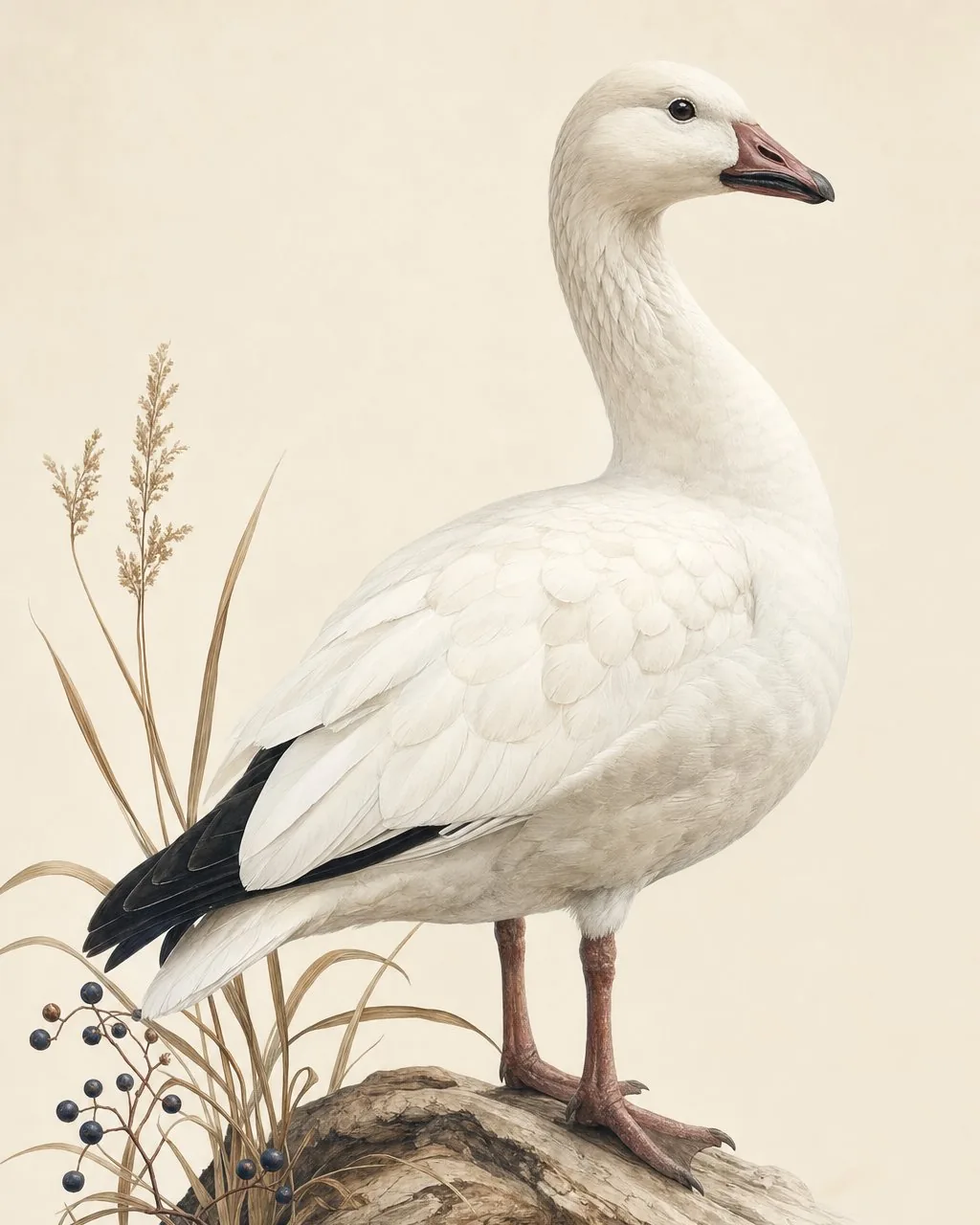
The white morph is what most people picture: a stocky, medium-sized goose, all white except for jet black wingtips that flash cleanly in flight. The bill is pink, thick, and distinctive at close range because of the dark “grinning patch” - a black line along the cutting edge of both mandibles that gives the face a slightly fixed expression. The legs are pink. The eye is dark. In bright sun on snow, a flock of white-morph Snow Geese is almost difficult to look at directly.
The blue morph was once considered a separate species entirely. It appeared in field guides as the Blue Goose and was treated as its own bird until the 1960s, when ornithologists confirmed it was a colour variant of the same species. The blue morph has a white head and upper neck, but the body is dark brownish gray - not actually blue, despite the name, though the feathers can carry a cold blue-gray tint in certain light. The wings are dark above. The bill and legs are the same pink as the white morph. A blue-morph adult standing next to a white-morph adult looks like a different species. They are not.
Both morphs interbreed freely. Mixed pairs produce offspring that can be either morph or intermediate in pattern. The ratio of white to blue morphs varies across the range: in eastern Arctic colonies, blue morphs are common and may outnumber whites. In western Arctic colonies, white morphs dominate overwhelmingly.
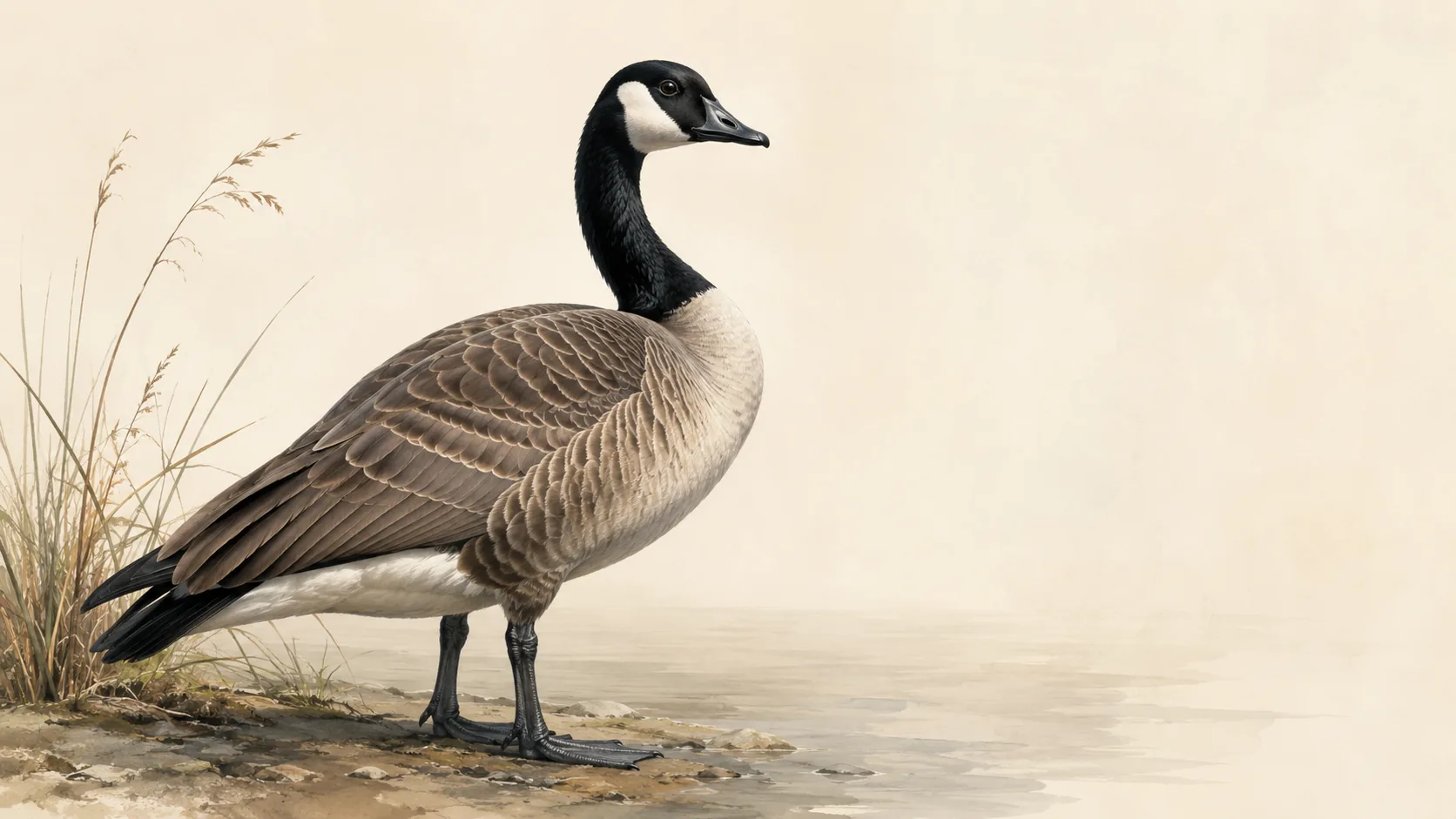
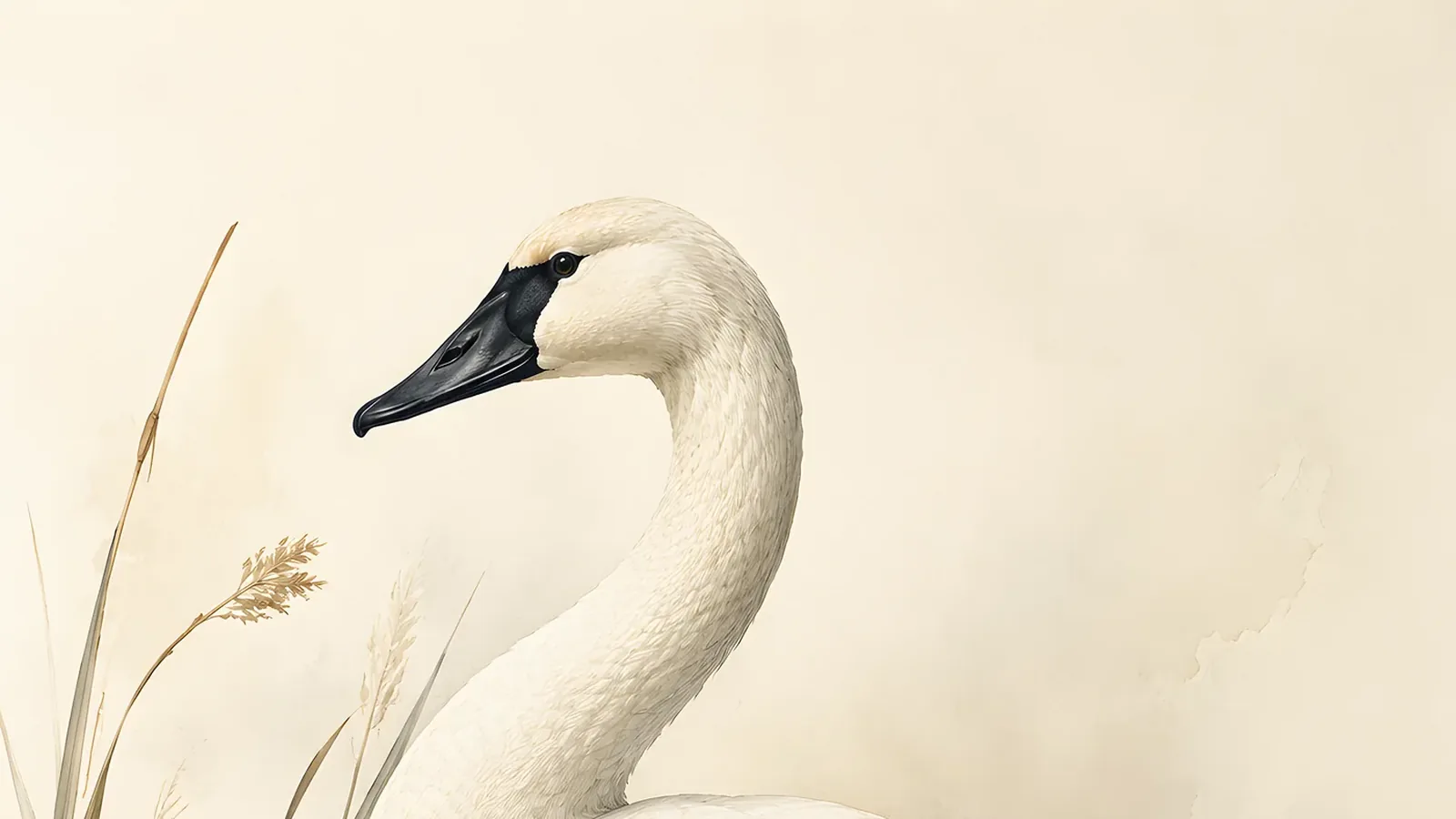
Compared to a Canada Goose, the Snow Goose is noticeably smaller with a more compact build and a bill that lacks the Canada Goose’s long, elegant profile. In flight, the white morph might briefly suggest a trumpeter swan to a new observer, but the swan is far larger and holds its neck straight rather than angled.
Measurements
| Measurement | Range |
|---|---|
| Length | 64 - 79 cm |
| Weight | 2,200 - 3,300 g |
| Wingspan | 132 - 165 cm |
| Lifespan (wild) | 8 - 20 years |
“There are now so many Snow Geese that their collective weight in some Arctic colonies exceeds the total biomass of all other nesting waterfowl in North America combined. That statistic, from U.S. wildlife managers in the early 2000s, was the point at which the conversation shifted from protection to management.”
Voice
The Snow Goose call is a high, nasal bark: honk or kow, repeated rapidly and without any of the resonance of a Canada Goose’s double-noted call. Individual birds are loud enough. A roosting flock of ten thousand is something else - a continuous layered roar, each bird contributing its single note to a collective sound that does not resolve into anything but noise. The calls carry for miles over flat marshland. You can locate a flock before it comes into view by sound alone, a rising white noise that sharpens into individual voices only when the birds are overhead.
In flight, a moving flock keeps calling constantly. The sound rises and falls as the flock banks and shifts formation. It is not pleasant, exactly, but it is one of those sounds that means something specific about a season and a place - late autumn, a marsh or a harvested field, cold air coming off the water.
Range and Habitat
Snow Geese breed on the Arctic tundra of northern Canada, from the coasts of Hudson Bay west to Banks Island and Victoria Island, and in smaller numbers in Greenland and far northeastern Russia. Breeding colonies can be enormous - some contain hundreds of thousands of birds nesting within a few square kilometers. They arrive on the tundra in May or June, as snow is still melting, and depart south by September.
Migration routes are traditional and consistent. The Central Flyway carries the bulk of the population through the Great Plains - through the Dakotas, Nebraska, Kansas - to wintering grounds along the Gulf Coast of Texas and Louisiana and into New Mexico. The Mississippi Flyway handles a large portion of the blue-morph population, with major concentrations in Missouri, Arkansas, and the Mississippi Delta. The Atlantic Flyway carries birds to the Mid-Atlantic coast, particularly the Delaware Bay region and the Chesapeake.
Winter habitat is varied and tells you something about how adaptable the species has become: coastal salt marshes, freshwater impoundments, harvested cornfields, rice paddies, and open pasture all host wintering flocks. The birds move constantly between roosting sites on water and feeding sites on surrounding agricultural land.
Diet and the Agricultural Connection
Snow Geese are grazers and grubbers. On the Arctic breeding grounds, they eat sedges, grasses, and the roots and rhizomes of marsh plants, pulling vegetation out of saturated soil with their bills. On migration and in winter, they shift readily to agricultural crops - waste corn left after harvest, winter wheat, rice stubble, and green sprouts in early-planted fields. This agricultural food source is not incidental to their population growth. It is central to it.
For much of the 20th century, market hunting had reduced Snow Goose numbers to a fraction of historic levels. When the Migratory Bird Treaty Act and subsequent protections took hold, the population began recovering. Recovery coincided with the expansion of intensive grain agriculture across the North American interior. Hundreds of millions of acres of harvested corn and wheat fields, littered with high-calorie grain, became an effectively unlimited winter food source for a goose species already well-adapted to exploiting temporary food bonanzas.
The birds arrived in winter heavier, departed in spring in better condition, raised more young, and survived migration at higher rates. The feedback loop compounded across decades.
Breeding
Snow Geese nest colonially, often in colonies of extraordinary density. Pairs nest within a meter or two of each other in the most crowded parts of large colonies. The nest is a shallow scrape or mound of plant material lined with down. Clutch size is typically three to five eggs. Both parents tend the nest, though the female does most of the incubation.
Goslings hatch after roughly three weeks and are mobile almost immediately, following parents to feeding areas around the colony. Families remain together through the first migration south. Young birds from the same colony tend to follow the same migration corridor as their parents, which is how flyway traditions persist across generations.
Blue-morph and white-morph individuals pair freely across morph boundaries. The genetic basis of the colour difference is relatively simple, which explains how the two forms remain distinct rather than blending into a single intermediate type across generations.
The Overabundance Problem
The Snow Goose story is one the conservation world returns to when discussions turn complicated. It is a story of genuine success - a species hunted nearly to collapse, then brought back under legal protection - that became, in time, an ecological crisis.
By the 1990s, Snow Goose populations in eastern and central North America had grown past 5 million birds. By the early 2000s, estimates ranged above 15 million. The numbers are contested, but the direction is not. The birds were abundant beyond any historic baseline, and the consequences were becoming visible on the Arctic tundra.
The mechanism is called “eat-out.” Snow Geese grub for roots and rhizomes in the soft tundra soil, pulling out vegetation wholesale rather than simply grazing the surface. At the densities achieved by modern colonies - tens of thousands of birds nesting per square kilometer, arriving year after year - the vegetation does not recover between seasons. The grubbing strips the organic layer from the soil. What was sedge meadow becomes bare mud flat. Shorebirds lose nesting habitat. The mudflats, once formed, can persist for decades.
Wildlife managers documented hundreds of thousands of hectares of degraded or destroyed habitat in Hudson Bay lowlands, James Bay, and the St. Lawrence estuary. The affected areas continued to expand. The birds were, in effect, destroying the ecosystem that sustained them, slowly enough that the damage accumulated across decades before it became undeniable.
The response was a management policy reversal. In 1999, the U.S. Fish and Wildlife Service issued a Conservation Order allowing hunters to take Snow Geese by methods not permitted for other waterfowl - electronic calls, unplugged shotguns, longer shooting hours, hunting in spring before the birds had reached the breeding grounds. Similar measures followed in Canada. The intent was to reduce the population by several million birds.
Hunting pressure increased substantially. It has not reduced the population. The birds are wary, the flyways are wide, and hunter access to remote staging areas is limited. Snow Goose numbers have plateaued in some surveys but not declined to management targets. The tundra damage continues.
This is the inheritance of a conservation success pursued without a ceiling: a bird saved from market hunters now exists at numbers that overrun the capacity of its habitat. The protection worked. The population grew. The tundra paid.
Standing at the edge of a winter marsh as thousands of Snow Geese lift from the water, the spectacle is real. The noise, the scale, the movement - these are not diminished by knowing the numbers behind them. But the sky full of geese carries a different weight once you know where they have been and what they have left behind.