
Field Guide
Little Blue Heron
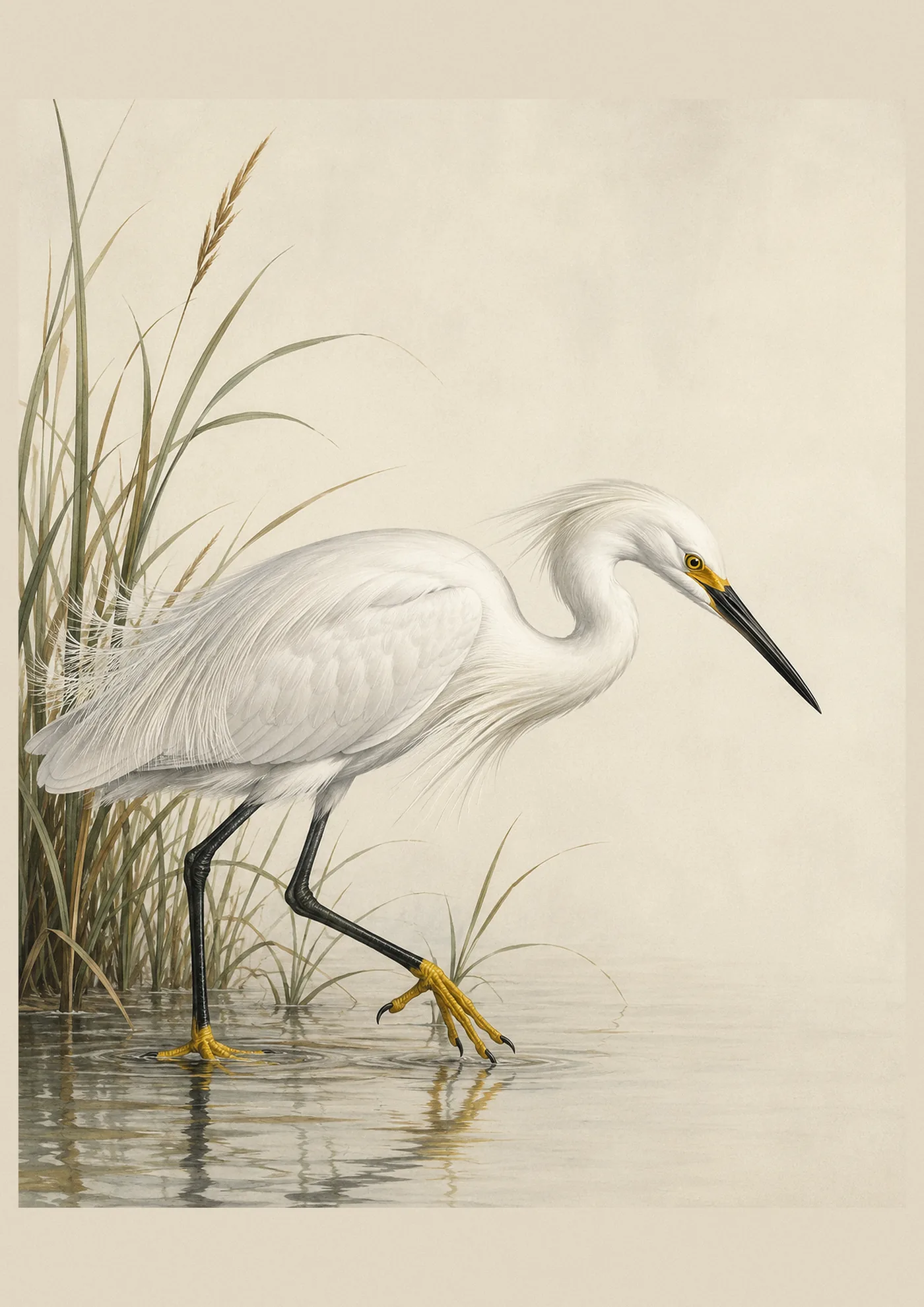
A white bird stands in a shallow pond in Louisiana among a loose flock of Snowy Egrets. It carries itself the same way they do, reads the same, holds the same still pose at the water’s edge. Look at the bill, though. It is two-toned, pale gray near the base, dark at the tip, not the solid black of a snowy egret. Look at the legs. Dull greenish-gray, not black with gold feet. The bird is not a Snowy Egret. It is a young Egretta caerulea - a Little Blue Heron in the first year of its life, white from crown to toe, living inside a borrowed identity it has not yet earned.
By the time this bird is two years old, it will be unmistakably itself: dark slate-blue, neck and head flushed with purple-maroon, moving through the shallows with a deliberate unhurried patience that sets it apart from the frenetic energy of the egrets it once shadowed. The transformation is one of the most ecologically freighted color changes in North American ornithology.
What it looks like
The adult Little Blue Heron is a small, dark wading bird, 56 to 74 centimetres long and weighing 296 to 412 grams. The wingspan runs 100 to 105 centimetres - compact for a heron, closer in mass and silhouette to the Snowy Egret than to the towering Great Blue Heron.
The body is deep slate-blue, approaching gray in flat light but revealing blue-green sheens in direct sun. The head and neck are a distinct purple-maroon, rich in breeding season, sometimes fading toward dull chestnut in winter. That two-tone contrast - blue body, purple neck - is the field mark that settles the identification at a distance for an adult bird. At close range the bill is also distinctive: pale gray or blue-gray at the base, sharply black at the tip, giving a two-toned look that differs from the solid dark bills of related species. The lores are greenish-blue. The eyes are yellow. The legs and feet are dull greenish-gray.
The first-year bird is a different matter entirely: pure white, with those slightly duller legs and the same two-toned bill being the only clue to its true lineage. Between the first and second year, as the bird begins its molt into adult plumage, it passes through a piebald “calico” phase - patches of white and blue appearing simultaneously across the body - that is its own distinctive field mark.
| Measurement | Range |
|---|---|
| Length | 56 - 74 cm |
| Weight | 296 - 412 g |
| Wingspan | 100 - 105 cm |
| Lifespan (recorded) | up to 14 years |
| Clutch size | 3 - 5 eggs |
| Incubation | 20 - 24 days |
Born white
No other North American heron does what the Little Blue Heron does: spend an entire year - through its first autumn, first winter, and first spring - completely and uniformly white, then molt through calico into the dark plumage it will carry for the rest of its life.
The white phase is not partial. It is not a pale variant. The juvenile bird is as white as a great egret, with none of the dark tipping or gray shadows that mark other young herons. It is, for twelve months, indistinguishable from a small egret at almost any field range.
This is not accidental, and the evidence that it serves a function is strong. G. S. Caldwell published two studies that together make the clearest case. In Behavioral Ecology and Sociobiology in 1981, Caldwell documented that juvenile Little Blue Herons foraging inside Snowy Egret flocks in Panama achieved a substantially higher catch rate than juveniles foraging alone - the flocks flushed more prey, and the white birds were tolerated within them in ways that dark adults were not. Where Snowy Egrets actively displaced or attacked adult Little Blues that attempted to join the group, they left white juveniles essentially alone. The juvenile’s white plumage was, in effect, a social credential. Then in 1986, in The Auk (103: 494-505), Caldwell added the predation dimension: white birds attracted more raptor attacks than dark ones - the white plumage is more visible from above - but the risk was offset by the many-eyes effect of the flock, and the net foraging advantage for a white juvenile inside an egret group remained positive.
The picture Caldwell’s work assembles is of a bird that has solved the problem of being young and inexperienced in a competitive feeding landscape by wearing a temporary membership badge. It cannot yet compete on equal terms with experienced adults. It cannot force its way into productive feeding zones. But in white, it can slip into groups that tolerate it, catch more fish than it would alone, and survive long enough to learn.
The egret disguise
The hypothesis is sometimes called aggressive mimicry - a term usually applied to predators that mimic something harmless to get close to prey. The Little Blue Heron case is better described as social mimicry, or simply protective resemblance in a foraging context. The young bird resembles the species it is most profitable to be near.
What makes it compelling is the specificity. The snowy egret is the species in question - not the Great Egret, not the Tricolored Heron, not the Cattle Egret. The Snowy Egret is an active, stirring hunter, kicking and shuffling the bottom to flush prey. It forages in loose groups. It inhabits the same shallow freshwater and coastal margins that the Little Blue Heron prefers. A white juvenile Little Blue Heron can slot directly into a feeding Snowy Egret flock and benefit from everything the egrets disturb, without the egrets treating it as a competitor.
The transition happens on schedule. As the juvenile begins to acquire adult feathering in its first spring, it is also becoming capable enough to hold its own - it can compete, defend a feeding position, and make use of the quieter, more solitary stalking strategy that defines adult Little Blue Heron behavior. The disguise expires when it is no longer needed.
Whether this sequence evolved specifically as a response to Snowy Egrets, or whether white juveniles simply benefited opportunistically from a foraging association that already existed, the correlation between plumage timing and behavioral capability is too neat to ignore.
What it sounds like
The Little Blue Heron is not, under most circumstances, a bird you hear.
Foraging adults are almost entirely silent, moving through shallow water without announcement. When flushed, a bird may emit a low, nasal croak or a single sharp call, and birds quarreling over feeding territory will produce guttural croaks and a sound described variously as raspy or parrot-like. At the breeding colony, the volume is higher and less dignified: a range of harsh croaks, bill-snapping, and screaming between birds in dispute, though the Little Blue Heron remains one of the quieter species in a mixed heronry.
The silence is in keeping with its hunting style. This is a patient bird, not an active one. The sound draws attention. Silence does not.
Range and habitat
Egretta caerulea is a bird of the Americas, resident across the Gulf Coast and southern Atlantic seaboard, and extending through the Caribbean, Central America, and down the coasts of South America to Peru and Brazil.
In the United States the core range runs from the Carolinas to Texas along the coast, through the Mississippi Valley, and down into Florida - where the species is state-listed as Threatened due to wetland losses, despite holding Least Concern status on the IUCN Red List. Partners in Flight estimates a global breeding population of approximately 1.1 million birds, but North American Breeding Bird Survey data show a cumulative decline of roughly 49 percent between 1966 and 2019, which places the species well into the “High Concern” category for North American waterbirds despite the global Least Concern rating.
In summer, post-breeding birds wander widely, including well north of the breeding range. Young birds in white plumage turning up in New England or the Great Lakes in late summer are a regular occurrence. Winter finds most birds concentrated in the Gulf states, Florida, the Caribbean, and Central America.
Habitat preference centers on shallow water with some vegetative cover. The Little Blue Heron tends toward vegetated pond margins, slow ditches, crayfish ponds, swamps, and flooded fields rather than the wide open mudflats that attract larger herons. Prey access depth is typically five to 15 centimetres - ankle-deep water where small fish and crustaceans cannot easily escape into a current. The combination of patience and shallowness gives the bird a very different hunting character from the opportunistic, active Snowy Egret it once mimicked.
Diet and breeding
The diet is dominated by small fish - killifish, mosquitofish, mollies - and crustaceans, particularly crayfish and grass shrimp. Fiddler crabs feature in coastal habitats. Frogs, aquatic insects, tadpoles, and occasionally small lizards and snakes round out the diet. In habitats where wetlands dry seasonally, the bird will move into grasslands and pastures for grasshoppers and other terrestrial insects.
Hunting technique is deliberate and slow. The Little Blue Heron walks with the neck extended forward at a slight downward angle, watching the water ahead, then pauses and waits. The strike, when it comes, is fast. Cornell’s All About Birds records a prey capture success rate of around 60 percent, which is high for a wading bird. The patience earns the result.
Breeding is colonial. Little Blue Herons nest in mixed rookeries alongside Great Egrets, Tricolored Herons, and Snowy Egrets, typically in the lower strata of the colony in shrubs or small trees over water, three to twelve feet up. The nest is a loose stick platform built mainly by the female from material gathered by the male. Three to five pale blue-green eggs are laid in early spring, incubated by both parents for 20 to 24 days. The young fledge in 42 to 49 days and are capable of breeding by the end of their first year - though in their first breeding season they are still in transition plumage, leaving their identity at least partially ambiguous.
The Little Blue Heron is born white to pass as something it is not, then turns blue when it no longer needs the pretence. The molt is not just a color change - it is a graduation, the moment a bird that survived by resemblance acquires the confidence to be itself.
The calico bird - neither white nor blue, spotted and piebald - is a brief intermediate state, weeks wide. It fits nowhere in either world. It is the heron in the act of becoming.