Field Guide
Connecticut Warbler
The tamarack bog is not a welcoming place at any hour. Boot-swallowing sphagnum, standing black water, the spring cold that lingers weeks past what feels reasonable. You have walked forty minutes from the nearest track, following a rough heading toward the sound of a distant song - a loud, carrying beecher-beecher-beecher punching out of the low spruce. The bird is somewhere in there. It is not going to come out. You are looking for Oporornis agilis, the Connecticut Warbler, and this is what looking for it always means.
Of the 36 wood-warblers that breed in the northern United States, this is arguably the one least often seen by the people who most want to see it. Not because it is particularly rare, though populations have fallen sharply, but because it has mastered the art of being present and invisible at the same time. The bog holds it. The bog is the point.
What it looks like
The Connecticut Warbler is a large warbler by family standards. Measured at 13 to 15 centimetres, and weighing between 11 and 25 grams depending on season and fat deposits before long-haul flight, it sits noticeably heavier and more rounded than most of its relatives. Wingspan runs 22 to 25 centimetres.
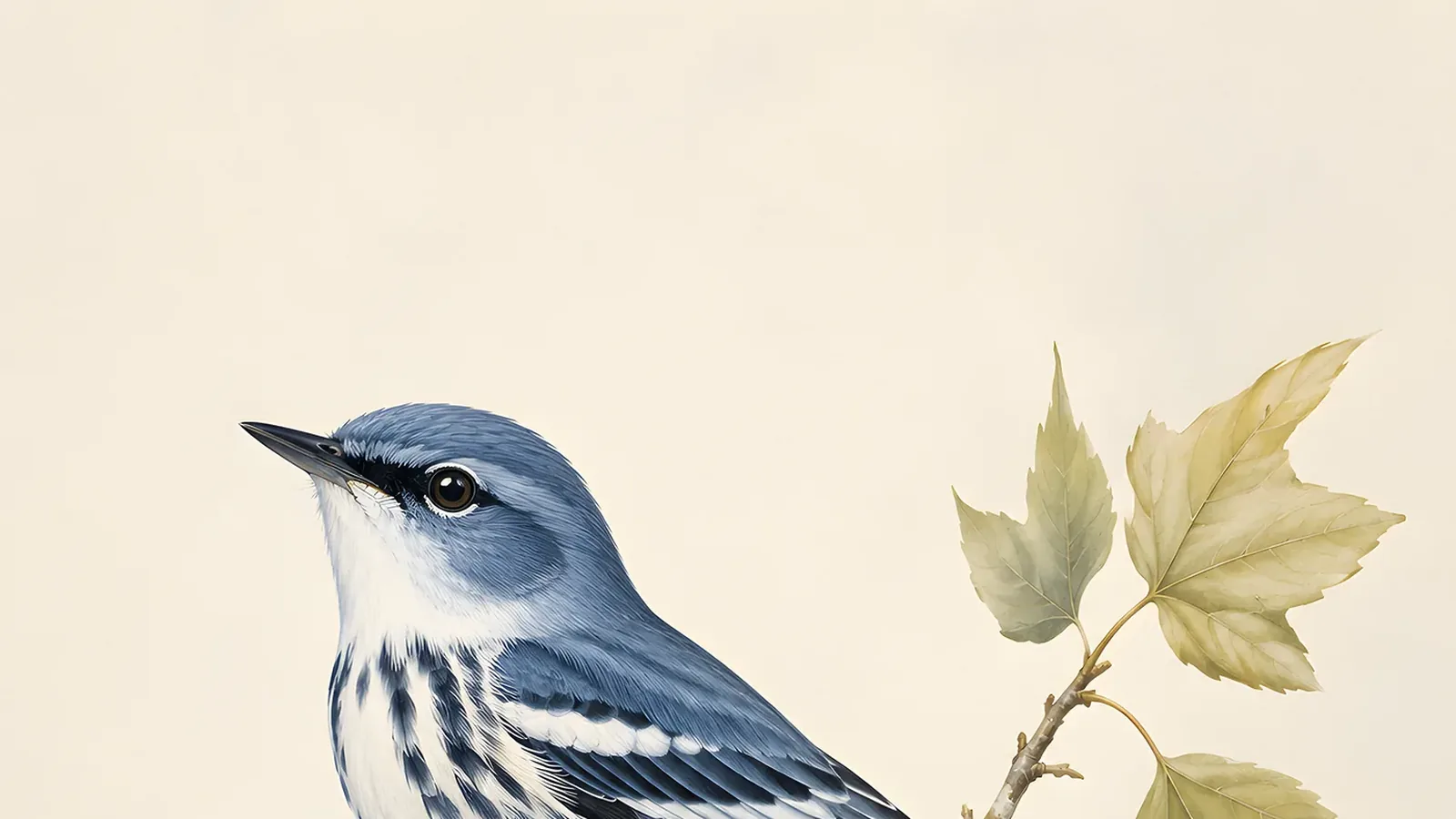
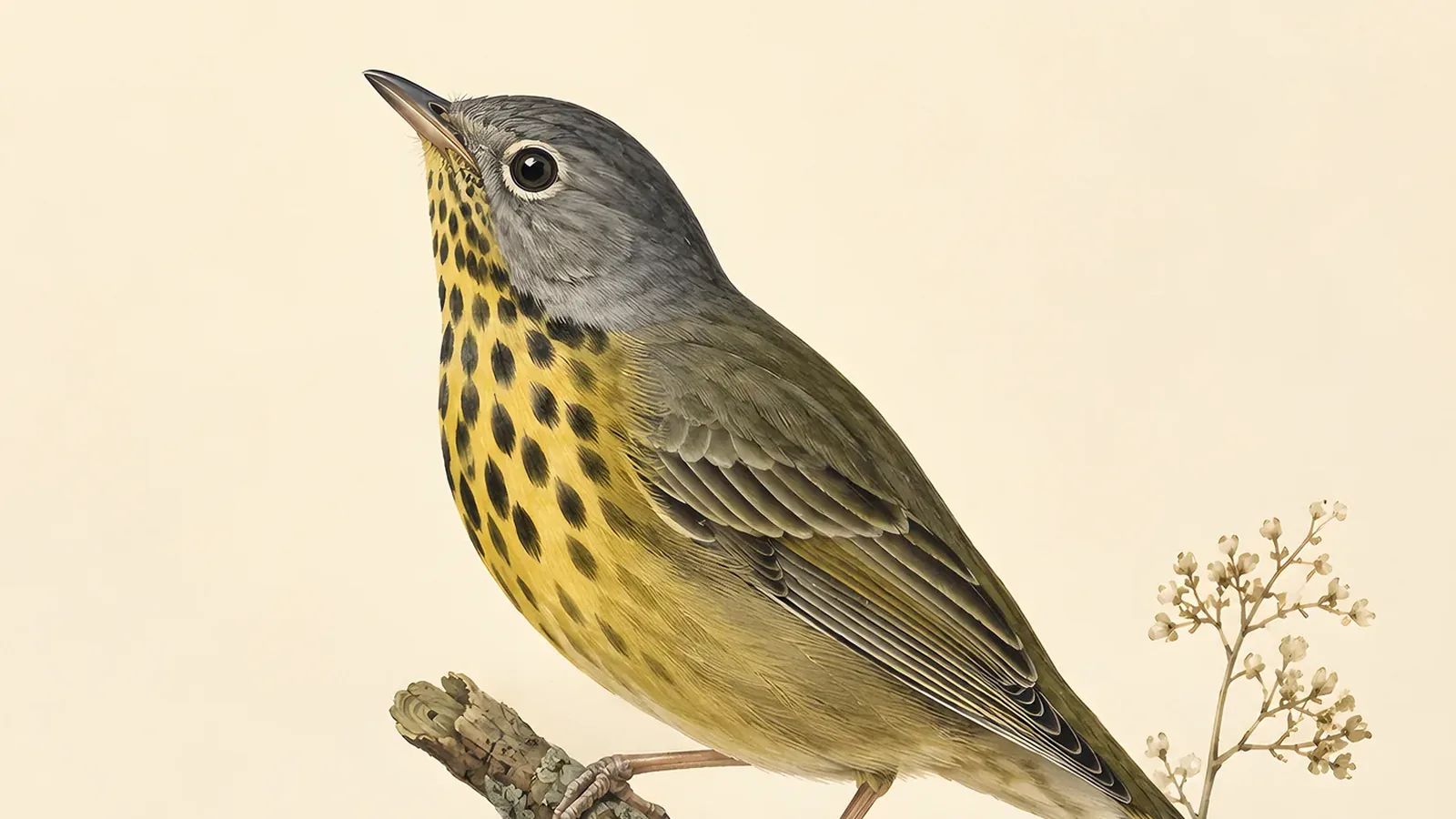
The adult male in breeding plumage wears a solid slate-grey hood that covers the head, throat, and upper breast. Below the grey the body transitions cleanly to bright yellow. The back and wings are olive-green, plain in patterning, and a useful contrast to the clean visual division between hood and underparts.
The face is where the identification locks. A bold, unbroken white eye-ring encircles the eye completely. Not a half-ring, not a pair of crescents, not an arc that fades. Complete. That completeness is the field mark you build everything else around. The similar Mourning Warbler (a species that does hop) has a broken or absent eye-ring in the male. MacGillivray’s Warbler has bold white arcs above and below but a gap at the sides. The Connecticut’s ring is a full, clean circle, and in the right light it reads at surprising distance.
The female is duller throughout - brownish olive above, paler grey-brown on the hood, yellower below - but she carries the same complete eye-ring. Immatures and autumn birds show a buffy wash across the breast but retain the ring. Even on a skulking, half-seen bird in dim understory, that white circle identifies the species.
| Measurement | Range |
|---|---|
| Length | 13-15 cm |
| Weight | 11-25 g |
| Wingspan | 22-25 cm |
| Oldest banded record | 4 years, 3 months (Pennsylvania, 1964) |
| Population decline since 1966 | over 60% rangewide |
The bird that walks
Most warblers hop. On the ground, on branches, between perches - the standard wood-warbler locomotion is a two-footed spring, both feet leaving and landing together. The Connecticut Warbler walks. Deliberately, one foot in front of the other, head bobbing slightly, moving along the sphagnum or across a low branch the way a thrush or an Ovenbird moves. It is immediately noticeable when you are watching one, which is rare enough to still feel like a surprise even when you have read about it in advance.
This walking habit, combined with its preference for dense understory vegetation within which it spends most of its time, means the bird is simply less visible than its voice suggests. It arrives at a location, announces itself loudly for extended periods, and then moves through the tangled base layer of a bog or poplar stand in a way that keeps it below sight lines. Audubon’s own field guide notes that it “walks deliberately” rather than hops, and that it is “sluggish and secretive” for a bird that sings with real force. This is not contradiction. The two are consistent: a bird that has evolved to work the forest floor and low scrub has no need to expose itself to do so.
The legs are noticeably long and pale pink. Long legs are a structural companion to the walking habit - warblers built for canopy gleaning tend toward shorter tarsi and the hopping locomotion that goes with them. The Connecticut’s proportions reflect its more terrestrial orientation.
The name is wrong
Alexander Wilson collected the first known specimen of this species in autumn 1811 in Stratford, Connecticut. He described the bird in 1812 and named it for the state where he found it. That is the whole story, and it is entirely misleading.
The Connecticut Warbler does not breed in Connecticut. It is not a common migrant there. Wilson happened to net a bird that was passing through on its way south, and the name stuck to a species that breeds hundreds of kilometres to the north-west and passes through New England only thinly and briefly. More than 70 years elapsed between Wilson’s specimen and 1883, when the first nest was found in Manitoba - long enough for the bird to remain something of a mystery even after it had a name. The name Connecticut Warbler tells you where one bird was once caught, not where this bird lives.
The common name records a collecting accident. The scientific name says what actually matters: agilis, quick and ready for movement - a bird built for long journeys through difficult terrain.
Where it does breed, and where it actually lives, is far to the north-west of Connecticut: the boreal forest and its southern outliers.
Range and the boreal bog
The breeding range runs in a band from western Quebec through Ontario, Manitoba, Saskatchewan, and into Alberta and eastern British Columbia. South of Canada, it is limited to the northern Great Lakes states: the northern counties of Minnesota, northern Wisconsin, and the Upper Peninsula of Michigan. This is not a bird of the lower 48 in any broad sense - it is a specialist of the Canadian boreal zone that clips the US border in a few northern jurisdictions.
Within that range, habitat preference divides by region. In the east and around the Great Lakes, the Connecticut Warbler breeds in lowland bogs dominated by black spruce (Picea mariana) and tamarack (Larix laricina), with sphagnum moss understory and semi-open canopy. Grinde and colleagues (2023, Journal of Field Ornithology) documented breeding habitat in Minnesota as mature lowland coniferous stands with approximately 55 per cent canopy cover and dense ground-level vegetation - enough shade for moisture, enough gap for song to carry. In western Canada, the habitat shifts: drier ridges, open poplar stands, and mixed aspen-jack pine woodland support breeding pairs in Manitoba and Saskatchewan.
On migration in autumn, the species uses the undergrowth of lowland deciduous woods and dense thickets. It is one of the later migrants, arriving on breeding grounds in late May and departing early. During spring migration it moves north-west through the interior, along the Mississippi flyway, reaching the Great Lakes region after peak warbler-watching has passed for most birders.
In winter the species occupies lowland tropical forest in South America. Hallworth and colleagues traced a substantial portion of the tracked population to the Gran Chaco of Bolivia and neighbouring countries - a region currently under significant deforestation pressure.
Diet
The Connecticut Warbler feeds primarily on insects throughout the breeding season. The documented diet includes caterpillars, spiders, snails, beetles, and other invertebrates found on and near the forest floor. Audubon’s field guide records occasional consumption of seeds and berries outside the breeding season. The foraging method is slow and deliberate: the bird walks along the sphagnum surface and low branches, picking prey from moss, bark, and decaying wood. This ground-level foraging strategy - one shared with the cerulean warbler in a different habitat context - is a departure from the high-canopy gleaning that characterises many of its relatives.
Nests documented by Grinde and colleagues (2023) averaged clutch sizes of four eggs with 97 per cent survival from hatching to fledging in the study sample. Fledglings remain within roughly 35 metres of the nest for the first week, concealed in dense vegetation while they develop flight capability.
Migration and breeding
The Connecticut Warbler takes a different route south than it does north. In spring, birds push north-west from their South American wintering grounds, crossing the Caribbean to Florida and then angling north-west through the interior to reach the Great Lakes and boreal breeding grounds. In autumn, they push east to the Atlantic seaboard, then launch over open ocean in a transoceanic flight of 48 hours or more. McKinnon, Artuso and Love (2017, Ecology) tracked 29 male Connecticut Warblers fitted with geolocators at their Manitoba breeding sites and recovered data from four returning birds, documenting nonstop flights of 1,050 to 1,490 miles from the US Atlantic coast to the Greater Antilles - primarily Haiti - before continuing south to the Amazon basin. The bird is completing what amounts to a loop, using the prevailing wind patterns in each direction rather than retracing the same corridor twice.
This elliptical migration has a conservation consequence. The stopover in Haiti comes at a point when the birds are depleted and dependent on specific coastal scrub and lowland forest - habitat in a country with its own severe land-pressure problems and where ornithological survey data is scarce. McKinnon noted that the stopover sites are “essential for protecting this species from disappearing entirely.” A bird that survives a boreal winter, a boreal summer, and the fall Atlantic crossing still has to find food in Haiti.
The species has declined by over 60 per cent rangewide since 1966, with declines of nearly 70 per cent in Bird Conservation Region 12. Grinde and colleagues (2023) recorded an annual decline of approximately 8.65 per cent in Minnesota since 1995. The primary drivers are understood to be loss and fragmentation of boreal breeding habitat and pressure on wintering and stopover habitats in South America and the Caribbean. The IUCN currently lists the species as Least Concern, but that category reflects population size rather than trajectory. The trajectory is steep.
The bird named for a state it only passes through is heading in one direction, and the direction is down. The bog where you are standing, forty minutes from the road, straining to locate the source of beecher-beecher-beecher in the black spruce - that bog is less common than it was. There are fewer breeding pairs in it than there were in 1966. The song, when you hear it, is real. The bird, if you catch a glimpse of it walking across the sphagnum in a pale shaft of morning light, is a sighting to keep. Not because it is the rarest bird in the bog. Because this degree of difficulty is getting harder, and the bird is getting fewer.