Field Guide
Mountain Plover
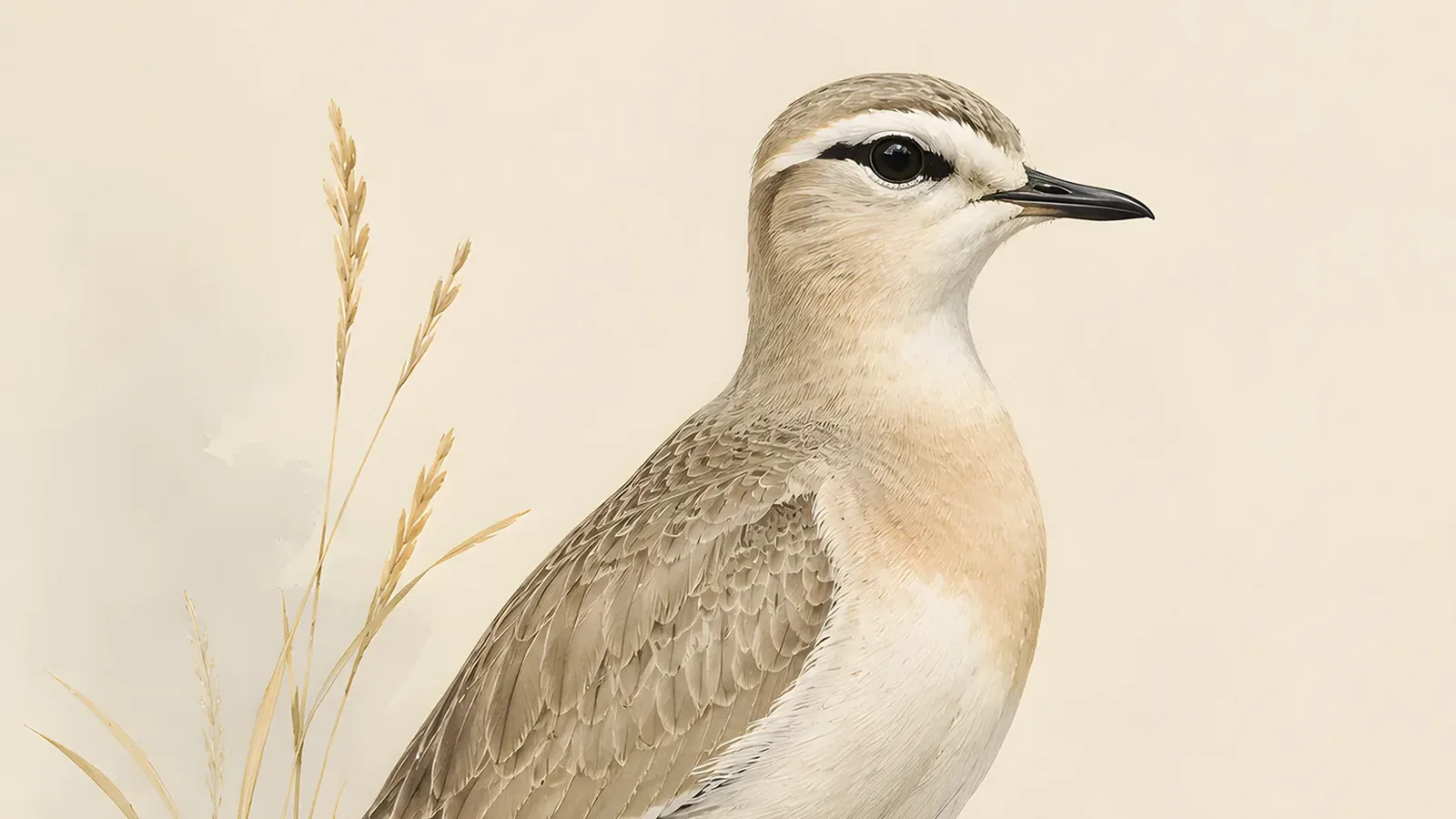
In a prairie-dog town in eastern Colorado, a stretch of bare earth opens where the colony’s constant digging and grazing have reduced the grass to a stubble of stems. Look long enough across that ground and you will notice something move - a pale, roundish bird, sandy-brown above and whitish below, with dark legs and a short black bill. It stops. It runs a few steps. It stops again. Charadrius montanus, the Mountain Plover, has no marsh, no mud flat, no tideline to frame it. It stands in the open dirt as if the bare earth is exactly what it requires. Which it is.
The name is wrong twice over. This bird lives on neither mountains nor water. John Kirk Townsend collected the type specimen in 1837 along the Platte River in Nebraska - flat, arid, far from any peak - and the name “montanus” followed from a taxonomic confusion that was never corrected. What the bird actually occupies is the driest, most heavily disturbed shortgrass prairie on the continent: the places where bison rolled and wallowed, where prairie dogs clip every stem to ankle height, where the soil surface stays as bare and hard as packed clay. It is a bird of radical openness, and a landscape that looks ruined to most eyes is, for this plover, home.
What it looks like
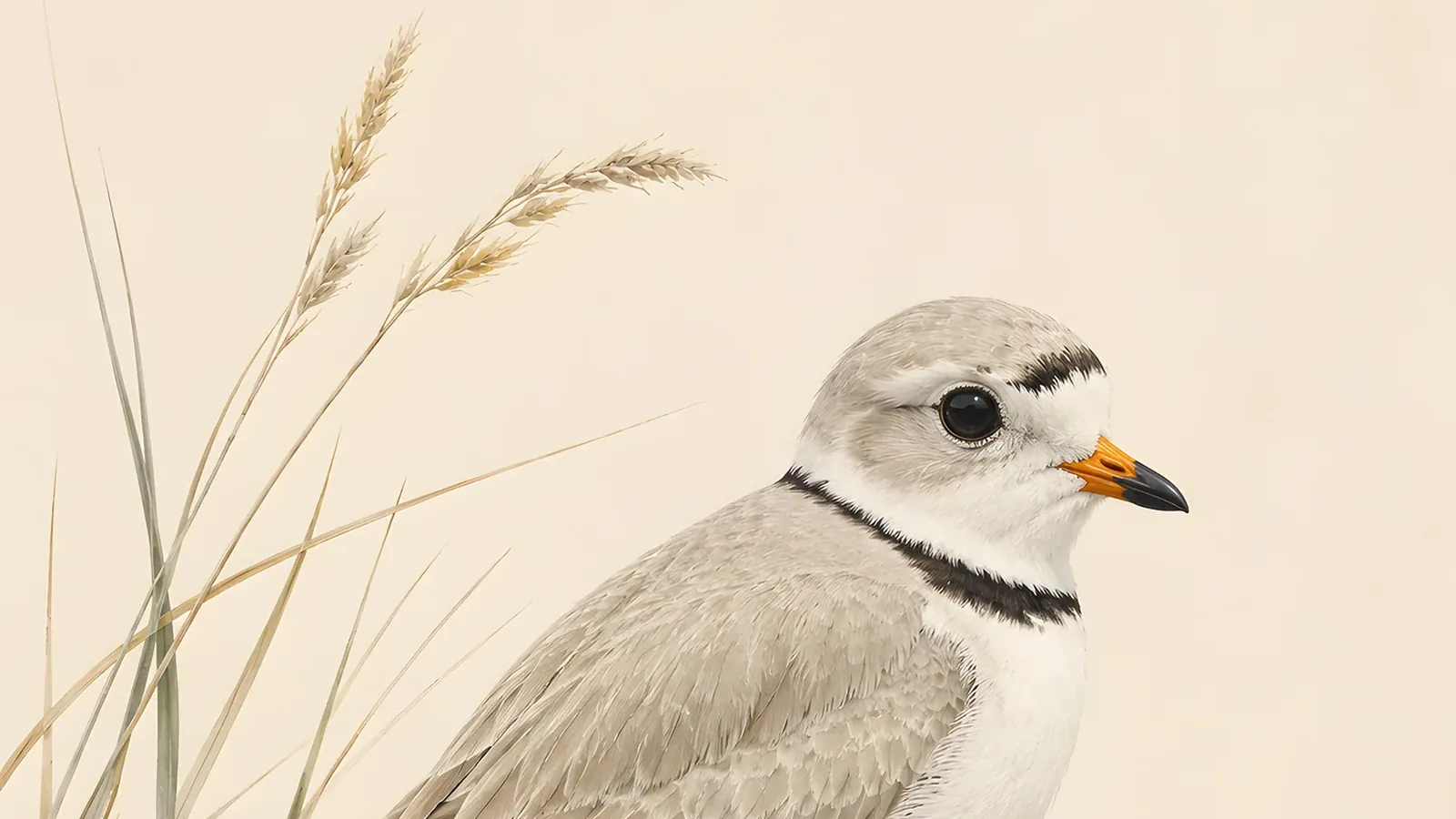
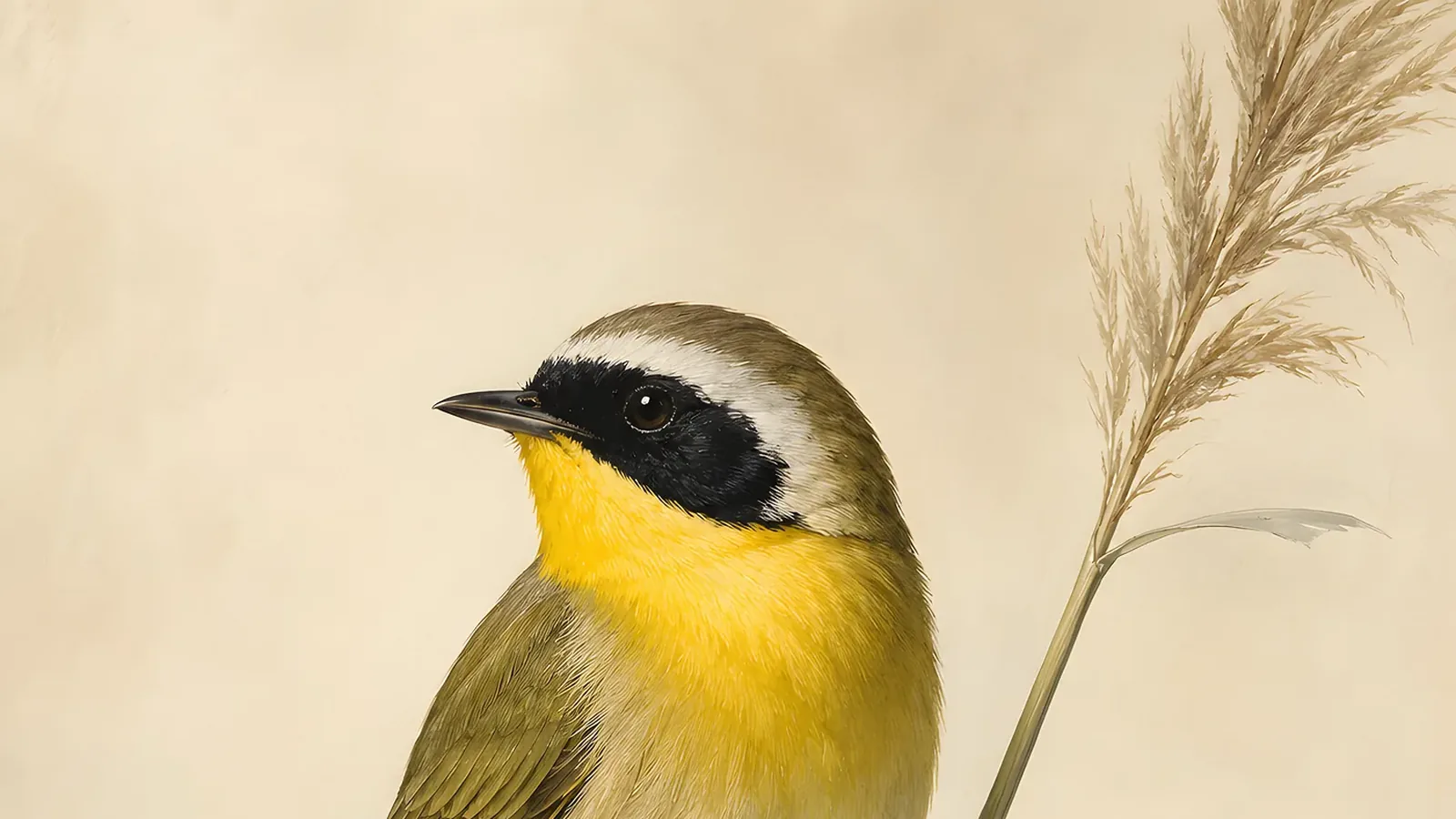
The Mountain Plover is a compact, upright shorebird, 20 to 23 centimetres long, weighing 90 to 140 grams, with a wingspan of 45 to 48 centimetres - roughly the size of a large robin. The Audubon Society field guide describes the plumage simply: pale above, whiter below, with a white eyebrow and a black forehead stripe and black lore in breeding plumage. There is no breast band. Every other North American plover carries a dark chest mark. The Mountain Plover does not, which means a standing bird on bare ground is essentially a ghost - the same sandy colour as the soil, the pale underside catching no shadow.
In non-breeding plumage, the black head markings fade to brown, and the bird becomes even harder to resolve from its background. This camouflage is not incidental. The mountain plover does not flush readily. It runs, stops, tilts its head, and relies on its own invisibility. Against bare shortgrass earth or fallow cropland - another surface it uses - the bird can be five metres away and require deliberate effort to find.
| Measurement | Range |
|---|---|
| Length | 20 - 23 cm |
| Weight | 90 - 140 g |
| Wingspan | 45 - 48 cm |
| Mean lifespan (from chick) | approx. 1.9 years |
| Maximum recorded longevity | 10+ years |
The legs are pale, another distinguishing mark from related plovers, and the bill is short and straight. In flight, the wings show faint wingstrips - white patches on the flight feathers - and the tail has a narrow white terminal band with dark subterminal bar.
“The Mountain Plover is a bird of barren places: overgrazed rangeland, prairie-dog colonies, fallow fields, and burned grasslands, almost always far from water.” - Audubon Field Guide
A plover of the dry plains
The habit of calling this a shorebird is the second confusion embedded in the species. Most Charadriidae are water-adjacent birds - they stand in surf, wade in mud, forage tidal flats. The Mountain Plover breeds and forages far inland, almost always far from water. Cornell’s All About Birds places its habitat as “semi-arid plains, grasslands, plateaus with very short grass, even bare soil.”
What the bird wants is not water but openness and low structure. It needs ground-level visibility - the ability to see approaching predators from a distance and to run rather than fly as a first response. Dense, tall grass blocks sight lines and provides cover for foxes, coyotes, and raptors that hunt by ambush. Bare earth or cropped grass of three centimetres or less is the structural requirement.
The piping plover and its close relatives hunt the margins of water, scurrying along wet sand for invertebrates exposed by wave action. The Mountain Plover hunts dry ground for grasshoppers, beetles, flies, and crickets - the Audubon field guide notes the diet is “almost entirely insects” - and it pursues them by sight across open terrain, running rapidly and stopping to snatch prey from the surface. It does not probe. It watches and chases.
The animals that make its habitat
The Mountain Plover cannot make its own habitat. It depends on animals large enough to alter the landscape - historically the American bison, and today the black-tailed prairie dog.
Bison herds of millions once moved across the shortgrass plains of the Great Plains, cropping grass down to the sheath, rolling in wallows, and then moving on. That disturbance created the patchwork of bare and very short grass that the Mountain Plover needed. Bison were removed from the plains. Prairie dogs - colonial ground squirrels that clip vegetation within their towns to three centimetres or lower - took over much of that ecological function.
The relationship between Mountain Plovers and prairie-dog towns has been documented with unusual precision. Biologist Stephen J. Dinsmore (Mississippi State University) monitored 641 Mountain Plover nests in Montana between 1995 and 2000 and found that only seven occurred outside prairie-dog colonies. Craig Knowles of FaunaWest Wildlife Consultants, over a two-year study, observed 162 plovers in the field and found all but one on prairie-dog colonies (National Wildlife Federation, 2004).
Research by David J. Augustine and colleagues, published in The Journal of Wildlife Management (Augustine and Derner, 2012, Vol. 76:721-728), found that intensive cattle grazing at twice the recommended stocking rate could not replicate the bare-ground conditions created by prairie dogs or fire. The vegetation structure that cattle produce even under heavy pressure differs from what prairie dogs create through constant clipping and burrowing. The implication is direct: a landscape managed only for cattle, without prairie dogs, does not consistently produce Mountain Plover habitat.
A study by Duchardt, Beck, and Augustine published in The Condor: Ornithological Applications (2020, Vol. 122, Issue 1) refined this picture further. Plover densities on prairie-dog colonies in northeastern Wyoming peaked at 5.8 birds per square kilometre on medium-sized colonies (100 to 500 hectares), but dropped to 2.1 birds per square kilometre on colonies exceeding 2,000 hectares. The bird prefers colonies with high bare-ground coverage and annual forbs, and nest survival across 136 nests averaged 34 percent over a 30-day monitoring period.
The double clutch
The Mountain Plover breeds between April and June, and its reproductive strategy is the most unusual fact in its natural history. W.D. Graul, whose 1975 paper in the Wilson Bulletin (Vol. 87:6-31) remains foundational, described and documented what is now called simultaneous double-clutching: the female lays a clutch of three eggs in one nest, leaves the male to incubate it, and then lays a second clutch of three eggs in a second nest that she incubates herself. Both nests are active at the same time. The female manages one. The male manages the other.
This arrangement roughly doubles the breeding output of a single pair per season, and it is rare enough among shorebirds to have drawn decades of subsequent study. Incubation for each clutch runs 28 to 31 days. The nests are scrapes - small depressions in bare or sparsely vegetated ground, often lined with debris including, on prairie-dog towns, prairie-dog dung. The chicks are precocial, walking and foraging within hours of hatching.
On the wintering grounds, from October through March, Mountain Plovers move to California (particularly the San Joaquin Valley) and to bare agricultural fields and overgrazed pastures across Texas, New Mexico, and Mexico. They often form flocks in winter, behaviour completely unlike the solitary or paired birds of the breeding season.
Range and decline
The breeding range centres on the shortgrass plains of eastern Colorado and the eastern Montana and Wyoming grasslands, with smaller populations in Nebraska, Kansas, New Mexico, Oklahoma, and Texas. Population estimates have been revised upward in recent years - Partners in Flight (2019) estimated approximately 20,000 mature individuals, considerably more than the 10,000 to 14,000 that earlier surveys suggested - but the species remains classified as Near Threatened by the IUCN, with a continuing decline in mature individuals.
The population fell an estimated 63 percent between 1966 and 1991, according to data cited by the National Wildlife Federation, a loss driven primarily by two overlapping threats: the poisoning and shooting of prairie dogs across the Great Plains (an estimated 98 percent decline from five billion to a remnant population on less than one percent of former range), and the conversion of shortgrass prairie to cropland. The Mountain Plover’s tolerance for fallow fields and plowed land has provided a partial buffer - it is one of the few grassland birds that uses agricultural land - but that buffer is not a substitute for intact shortgrass prairie with functioning prairie-dog colonies.
Breeding
The nest is placed in the open, often near a cow pat or clod of dirt that provides the sitting bird a low sightline. Dinsmore, White, and Knopf, writing in Ecological Applications (2003), documented that bodies mass in chicks significantly influenced juvenile survival - heavier chicks at hatching had measurably better survival prospects through their first weeks. Estimated annual survival rates for adults were 0.68, while juvenile survival was substantially lower at 0.46 to 0.49. The mean lifespan from hatching was approximately 1.92 years, though the oldest banded individual - a female banded in Montana in 1995 and recaptured on the same breeding grounds in 2004 - reached at least 10 years of age.
The Mountain Plover’s call is a harsh single note - krrrp - flat or slightly falling. During courtship, the male makes low-altitude display flights over territory with slow, exaggerated wingbeats while calling. The calls carry well across open ground, which is the whole point.
The plover’s survival depends on animals and on processes - grazing, burrowing, disturbance - that most management traditions work against. Prairie dogs were poisoned at industrial scale for most of the 20th century because ranchers believed they competed with cattle for grass. That belief has been significantly revised, but the poisoning programmes continued long enough to reduce prairie-dog populations to a fragment of their former extent, and with them, the Mountain Plover. What you are watching, when you find a pale bird standing in the bare dirt of a prairie-dog town, is a species holding on in the aftermath of a continental-scale simplification. The animals that used to make this habitat across a hundred million acres now make it on scraps. The bird makes the best of the scraps it finds.