Field Guide
Purple Sandpiper
A wave breaks over the mussel bed and the rock disappears under white water. When it clears, three small brown birds are still there, standing in the wash, picking at the exposed surface as if the Atlantic had not just passed through them. Purple Sandpipers. They have been on this rock through December and January, and they will be here in February too. They are the last shorebirds to leave the northern coast, and the most indifferent to weather this side of a seabird.
This is a bird defined by its willingness to stand where nothing else does. Cold, exposed, wave-battered rock is its element in winter, and it works that element with a calm thoroughness that looks, from a distance, like stubbornness.
What it looks like
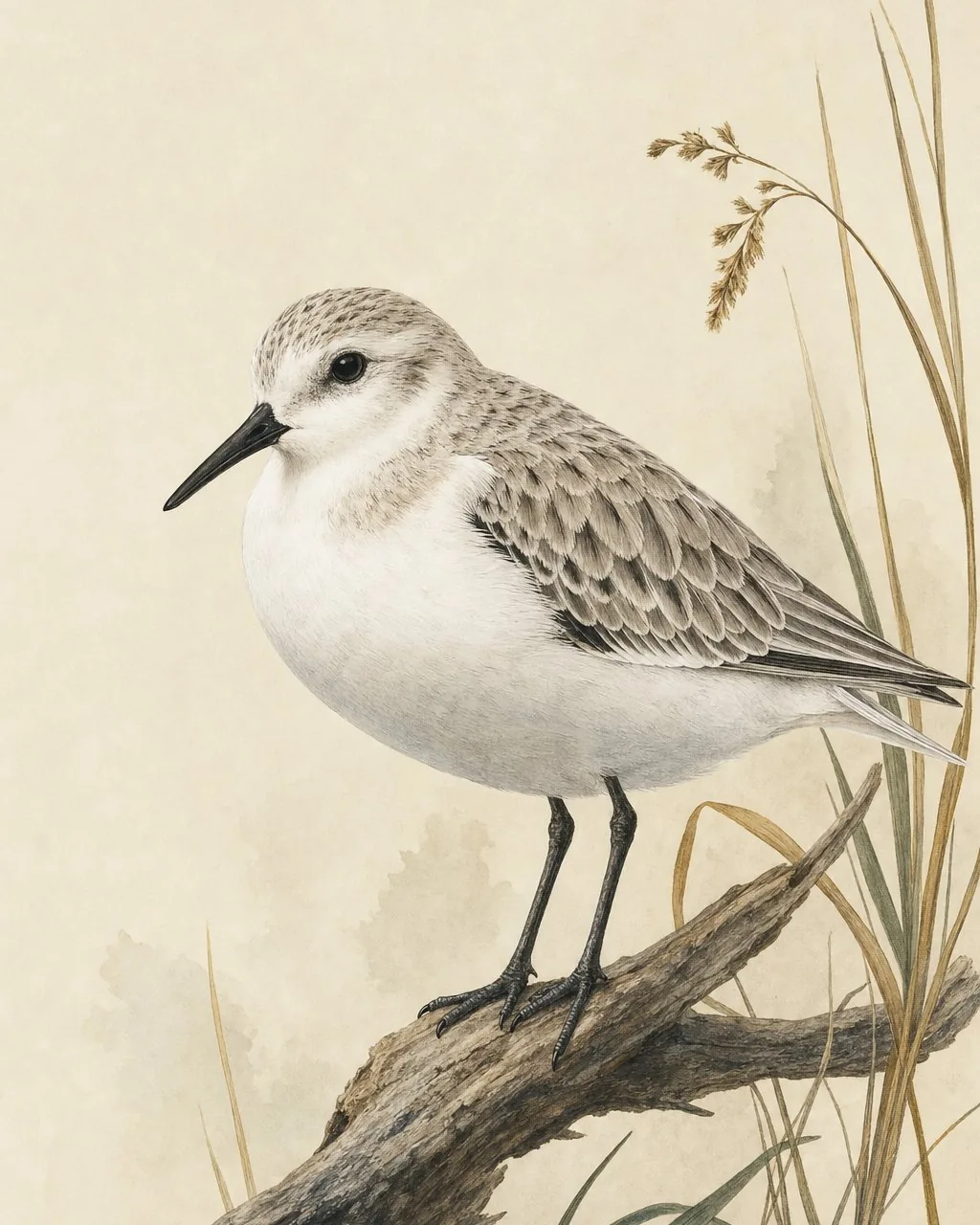
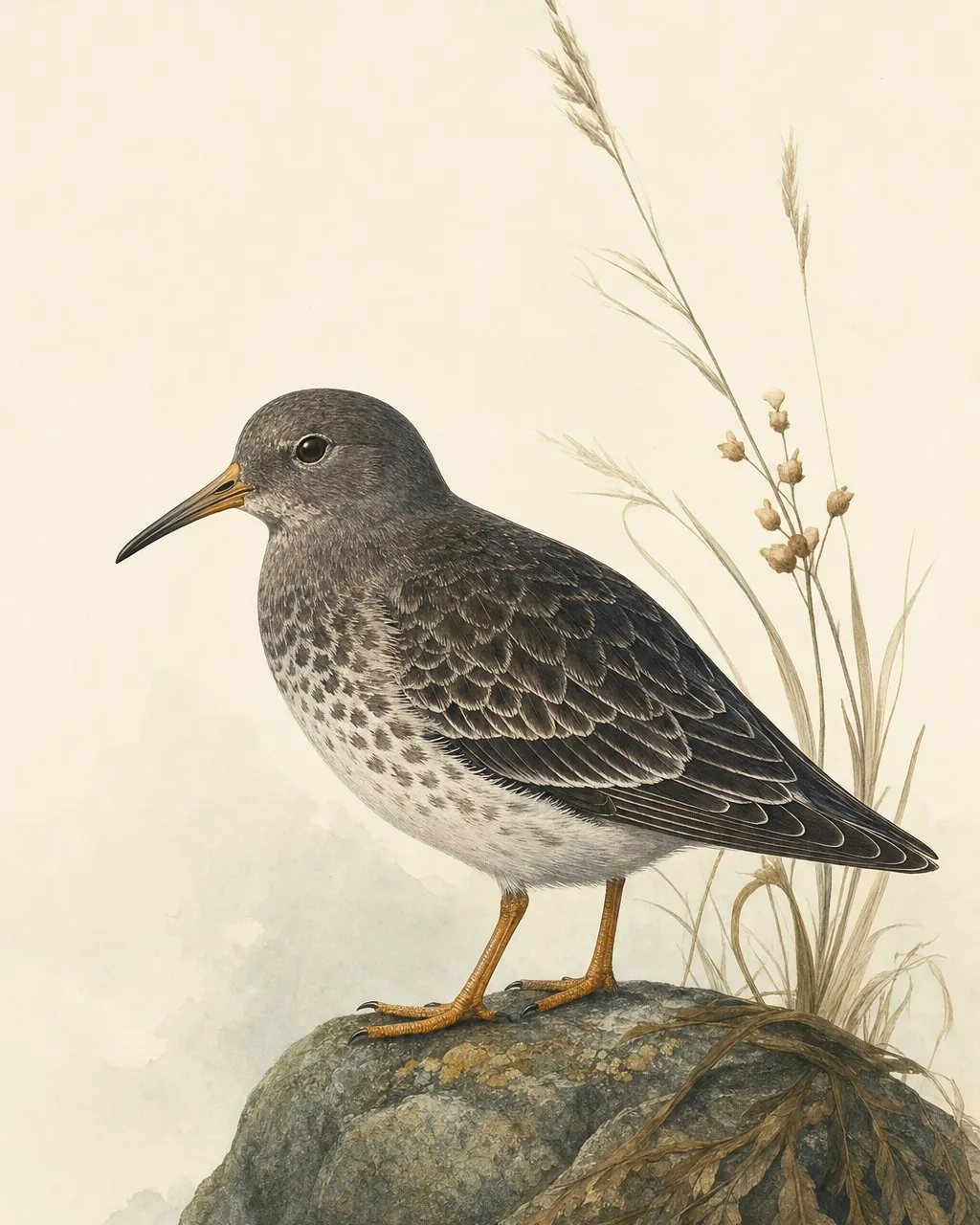
Dark and compact. In winter plumage - which is how most birders in the United States see it - the Purple Sandpiper is grey-brown above with a slightly paler head and neck, and white below with some grey-brown smudging across the breast and flanks. The bill is drooped slightly at the tip, pale orange at the base with a darker distal portion. The legs are short and orangey-yellow. The overall impression is of a small, dark, rounded shorebird that sits low and moves with purpose.
The purple in the name is not a field mark you will often notice. In certain lights, the feathers of the upperparts have a slight gloss or sheen that tends toward violet - a trick of light on the feather microstructure. The name is old and the mark is subtle.
In breeding plumage, achieved before the birds depart north in spring, the upperparts become warmer and more rufous-brown, and the bill base is more obviously orange. This is the plumage of the high Arctic breeding grounds, which almost no visiting birder ever sees.
| Measurement | Range |
|---|---|
| Length | 20-22 cm |
| Weight | 60-110 g |
| Wingspan | 37-44 cm |
| Lifespan | 5-13 years |
Voice
A low, soft weet or weet-it - quieter than most shorebirds in similar situations. On the rocks they are generally silent, communicating with each other at close range in brief, soft calls. A flushed bird will give a short, sharp call as it departs. On the breeding grounds, males give a prolonged musical trill from a high point as part of display.
“Of all the shorebirds I have watched in winter, none walks into the breaking wave with such complete disregard. The Purple Sandpiper does not retreat. It bends its head into the water and keeps working.” - field notes, Maine coast, January
Range and habitat
The Purple Sandpiper breeds in the high Arctic - northern Canada, Greenland, Iceland, Spitsbergen, Norway and the Russian Arctic coast. It nests on rocky tundra with open vegetation, often near running water. The breeding range is remote and the nesting habitat inhospitable to observers, which is why the species is much better known as a winter bird than as a breeder.
Winter range along the eastern North American coast extends from Labrador and Newfoundland south to North Carolina and occasionally Virginia. The heart of the US winter range is New England - Maine in particular, where rocky headlands and jetties hold good numbers from October through April. South of Cape Cod, birds are less predictable, found mainly on jetties and rock groins.
Rocky intertidal habitat is the key variable. Sandy beaches and mudflats are ignored. The bird needs exposed rock, and specifically rock that is regularly washed by waves - this is where the invertebrate prey is most accessible.
Diet
The Purple Sandpiper works methodically through the mussel beds, barnacle crusts, and wrack lines that wave action exposes on rocky shores. Mussels, periwinkles, amphipods, small crabs, marine worms, and isopods all appear in the diet. The slightly drooped bill tip is useful for prying into crevices and under mussels, and the bird has been observed flipping small stones in the manner of a Ruddy Turnstone.
The dependence on rocky intertidal habitat means the bird’s food supply is renewed by every tide. This is why it can occupy the same jetty or headland all winter - the wave action that makes the habitat uncomfortable also makes it productive.
Breeding
On the breeding grounds, the Purple Sandpiper engages in a role reversal that is unusual even among shorebirds. The female, after laying the clutch, departs to begin her southward migration, leaving the male to incubate the eggs and raise the chicks. Males incubate for about three weeks and then brood and guard the chicks for another week or two before the young become independent.
This strategy means females are free to begin the energetically expensive migration earlier, while males carry the full cost of parental care. Among waders, female-absent incubation has evolved independently in several lineages, always in species where the breeding season is extremely short.
The rock-bird winter
Purple Sandpipers are notably tame. Not habituated-to-humans tame, but genuinely calm in the presence of approaching people. This is a feature of their habitat, not a defect in their threat-assessment. A bird that retreats from every approaching wave would not survive winter on a rocky Maine headland. The willingness to hold position in the face of disturbance is a life skill here, and it extends to humans approaching too close.
Experienced birders on the Maine coast will approach to within two or three metres of birds on a jetty. The sandpipers continue feeding, glancing up occasionally, then returning to the mussel bed. This is the bird’s judgment: this large creature is not a hawk. It will not crouch and accelerate.
Populations are declining, slowly but measurably, and the cause is not fully understood. Climate change is altering the sea-ice dynamics that structure their Arctic breeding habitat. Winter jetty maintenance and coastal construction disturb the limited rocky habitat available along the US coast. The species is not yet of high conservation concern, but the trajectory is the wrong direction.
Closing
Go to any good jetty on the Maine coast in February. Look at the seaward end, at the rocks below the spray zone, where the water is still breaking. The Purple Sandpiper will be there, dark and compact and unbothered, working the mussels the tide just exposed. Around it, the other shorebirds are gone - south months ago, waiting for spring. The sandpiper stayed. It is doing what it does.