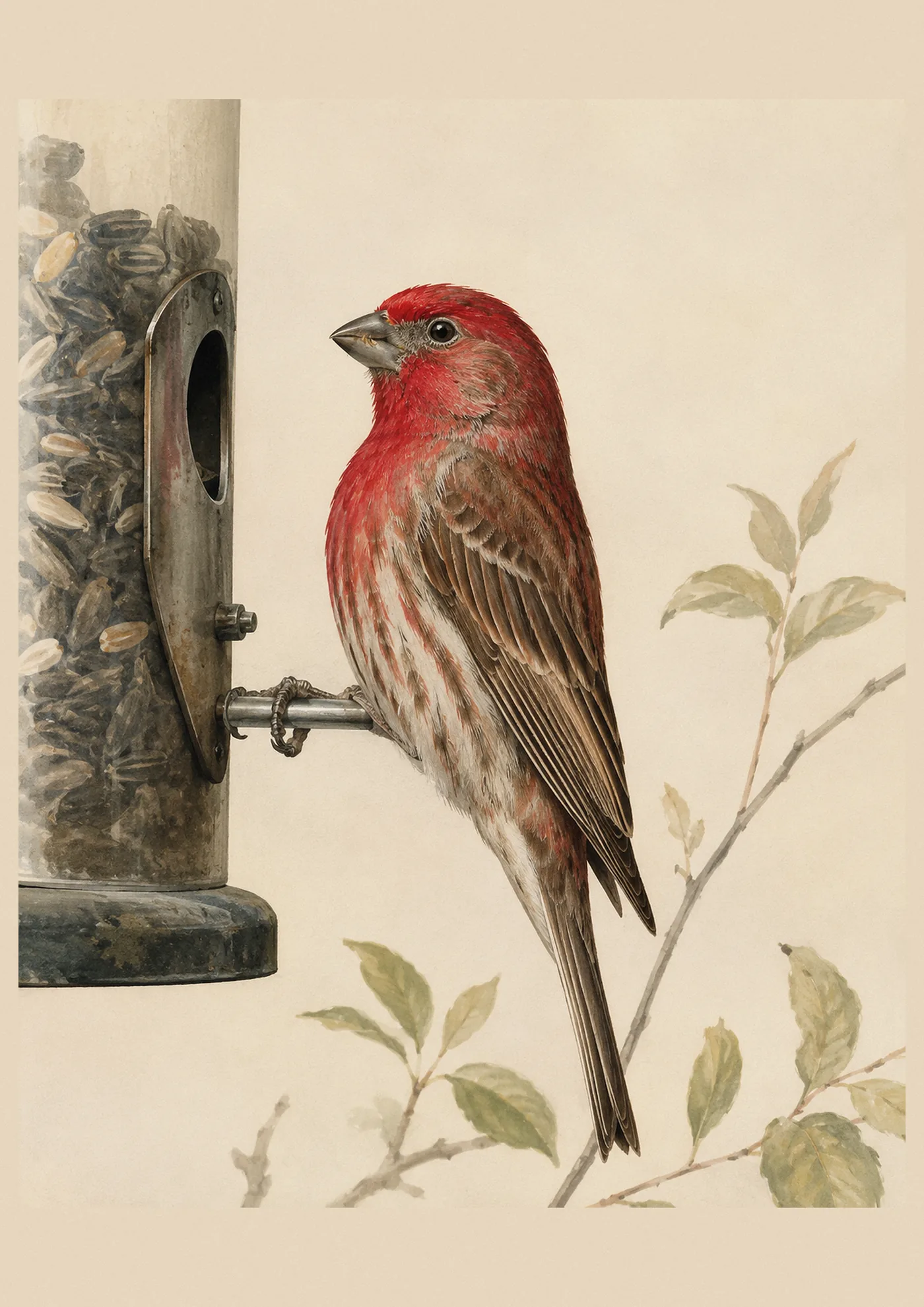


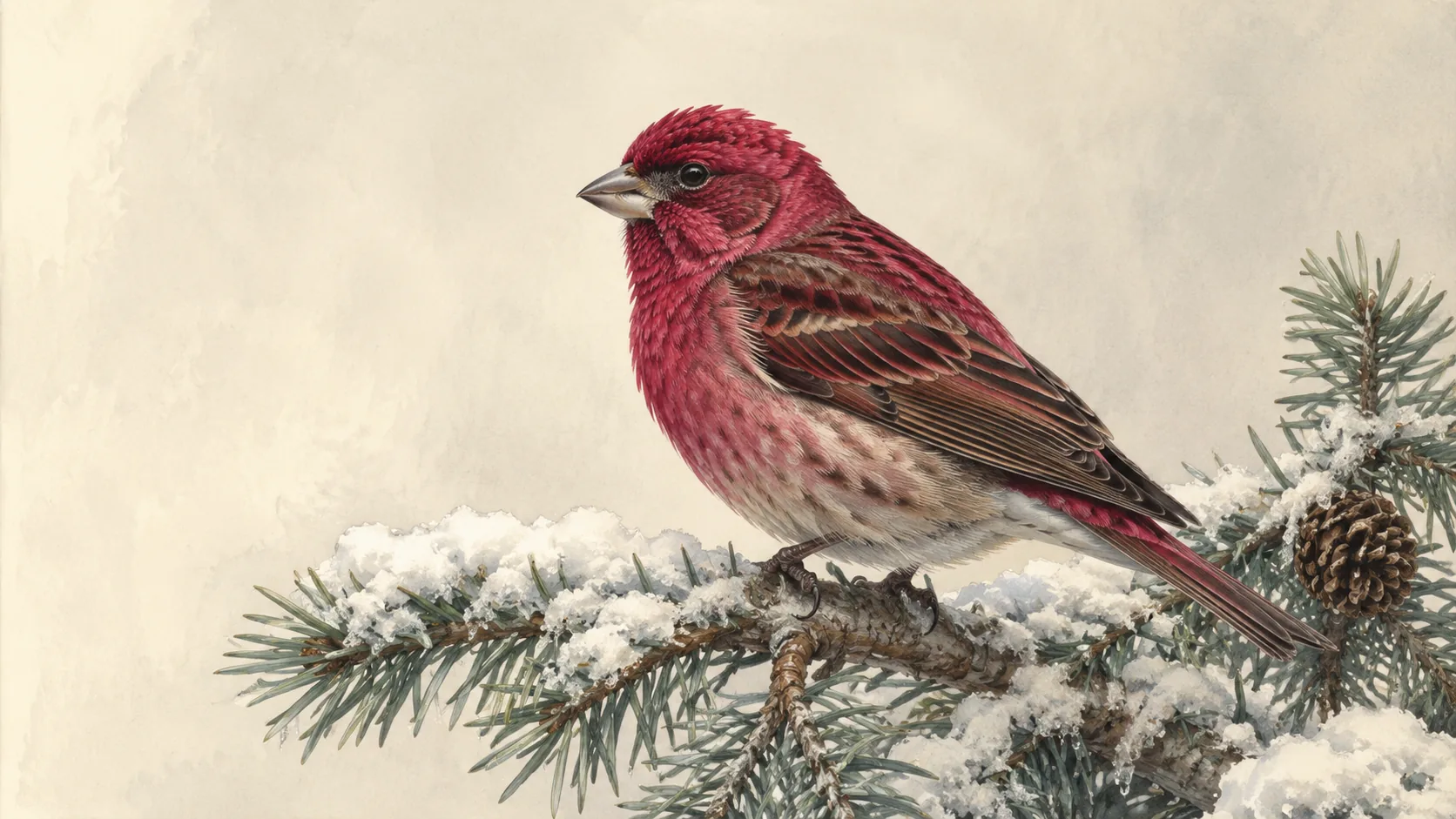

Picture a January morning in a spruce grove along the Maine coast. The feeders are quiet. Then a small flock drops in from nowhere - 20, perhaps 30 birds, travelling together in a loose cloud - and one male lands on the platform feeder closest to the window. He is the colour of a crushed raspberry. He cracks a sunflower seed with one deliberate bite and is gone again before you have reached for your binoculars.
This is how most people first meet Haemorhous purpureus: briefly, unexpectedly, in winter, at a feeder he has decided to visit that year rather than the next. The Purple Finch is not a reliable presence. He comes and goes according to a rhythm the ornithologist and the backyard birder alike have found difficult to predict.
What he actually looks like
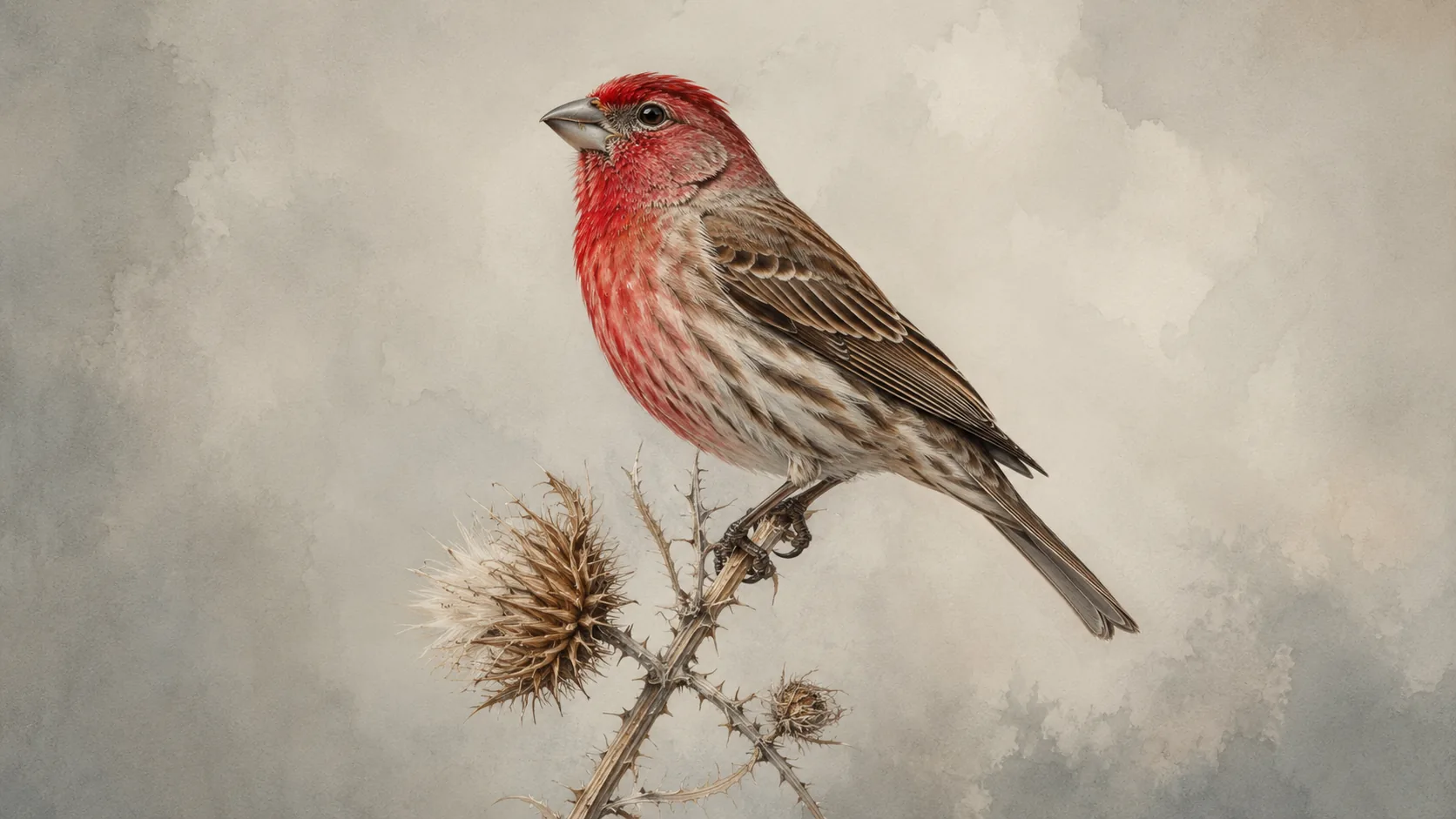
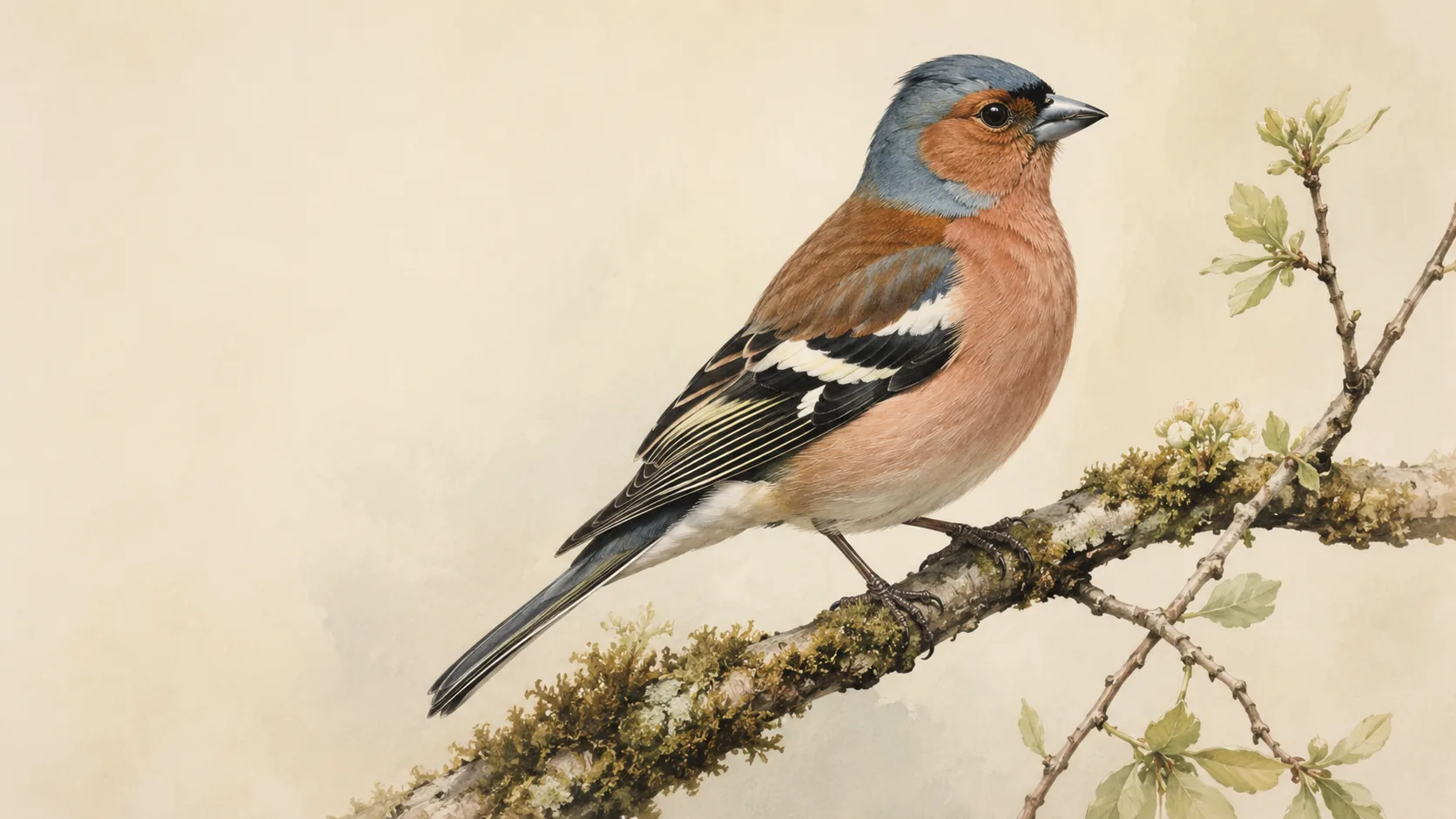
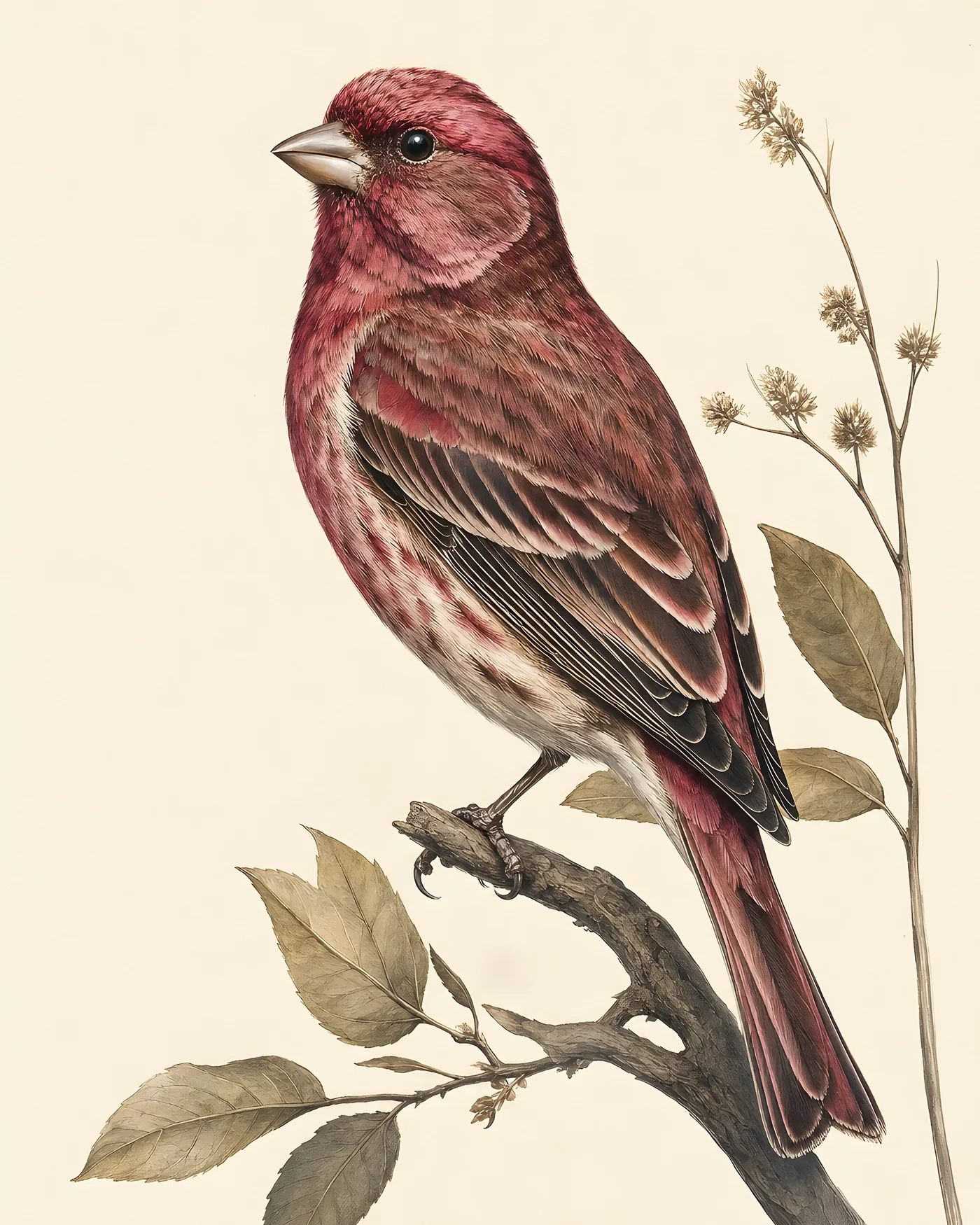
The name is a problem. “Purple” has never accurately described this bird. The adult male is coloured a deep, warm rose-red - Cornell Lab’s All About Birds describes it as “dipped in raspberry juice” - concentrated on his head, throat, and breast, then washing paler down his flanks and fading to white on his belly. His back carries red-brown streaks on a darker ground. He has a stout, conical bill designed for cracking open seeds. He is 14 to 17 centimetres long, weighs 18 to 32 grams, and carries a wingspan of 22 to 26 centimetres.
The female is a different bird entirely. She is brown and crisply streaked, with a bold pale supercilium above a dark cheek patch and a clean white malar stripe - a face pattern so distinct that it is one of the best ways to separate her from the female House Finch, which lacks the sharp contrast. She could pass for a sparrow. She is frequently overlooked. This is unfortunate, because her field marks are actually more diagnostic than his.
The bird most likely to be confused with the Purple Finch is the House Finch, which occupies much of the same winter range and visits the same feeders. The male House Finch is redder at the crown and breast but that red is restricted and often blotchy; the Purple Finch’s raspberry wash is more diffuse and extends further down the back. The House Finch also shows stronger flank streaking. The easiest rule: if he looks neatly dressed, he is probably a Purple Finch. If he looks as though the red was applied unevenly by someone in a hurry, he is probably a House Finch.
What he sounds like
The Purple Finch sings a fast, liquid warble - cheerful, tumbling, with a quality that ornithologists often describe as “musical” in a way that distinguishes it from the more clipped phrases of the House Finch. Cornell’s All About Birds and Birds of the World both document the warbling song as a fast, rising-and-falling string of 6 to 23 rapid, connected notes, with no two sequential notes at the same pitch. The song carries well in still coniferous woodland. It is easy to hear and difficult to locate, which is true of most singing birds in a dense spruce canopy.
In flight, the Purple Finch gives a sharp, distinctive “tick” or “pit” call - a single note repeated at intervals that is one of the more reliable sounds for identifying a passing flock overhead during migration. It reads as abrupt and dry against the background of a spring morning.
Where he lives across the year
The Purple Finch breeds across southern Canada and the Pacific seaboard, favouring moist coniferous forests, mixed boreal woodlands, and the edges of bogs. In the East, breeding populations occupy a broad band from Nova Scotia west through Quebec and Ontario. On the West Coast, a separate population nests in the coniferous forests of British Columbia, Oregon, and northern California.
In winter, the species moves south and east across much of the United States, though the extent of movement varies considerably from year to year. This is the key ecological fact about this bird. Cornell’s Birds of the World describes “quasicyclical irruptions” across the winter range, driven by annual variation in conifer cone crops in the boreal zone. In a year when spruce and fir cones are abundant at high latitudes, Purple Finches may remain largely in Canada. In a poor cone year, they push south in numbers, appearing at feeders from New England to the Carolinas, and arriving at feeder stations that saw none the previous winter.
During these irruption years, flocks of two to more than 200 birds travel together. Outside them, the Purple Finch can feel almost absent from its former winter range.
Diet and the feeder question
The Purple Finch is primarily a seed-eater, with a diet that shifts by season. In winter the staples are tree seeds - ash, elm, and conifer - supplemented by weed seeds and whatever feeders offer. Spring brings a shift toward buds: tree buds, flower buds, and the soft growing parts of herbaceous plants. Summer adds insects, particularly caterpillars and beetles, which become important for feeding nestlings. The Audubon Society’s field guide notes that berries also figure prominently in late summer.
At feeders, sunflower seeds and nyjer are the reliable draws. When a flock arrives, they work the platform feeders systematically - each bird cracking and discarding the hull in one motion - and they typically stay for a few minutes before lifting as a unit and moving on.
Breeding and nesting
Breeding begins in April and runs through August. The female builds a compact open cup from twigs, weeds, bark strips, and rootlets, lined with fine grass and moss. Nests are placed high in conifers - Audubon’s field guide puts the typical height at 15 to 20 feet above the ground - on horizontal branches away from the trunk. The clutch runs to four or five eggs, greenish-blue with dark spotting. Incubation takes around 13 days. Fledging follows 13 to 16 days after hatching.
The male does not incubate. He feeds the female during incubation and both adults bring food to the nestlings. One brood per season is typical in the East, with a second possible on the Pacific Coast.
The House Finch question
Here is the behavioural fact about this species that matters most for anyone trying to understand where the Purple Finch has gone in the Northeast: the House Finch is winning. The House Finch was introduced to the eastern United States in the 1940s and has since expanded to cover essentially the same range as the native Purple Finch. Where they overlap, the House Finch is the more aggressive competitor. It wins at feeders, takes preferred nest sites, and has contributed to a significant population decline in the Purple Finch. Breeding Bird Survey data, cited by Partners in Flight, documents a long-term survey-wide decline and steeper regional losses across parts of the Northeast.
The Audubon field guide says, plainly, that Purple Finches have “become less numerous as feeder visitors in the Northeast” and may have been “driven back into the woods” by the combined pressure of House Finches and House Sparrows.
This is not a minor adjustment to a stable population. It is a species losing ground in its own native territory to a competitor that arrived there by accident, imported as a cage bird and released by pet shop owners in New York in 1940.
The IUCN lists the Purple Finch as Least Concern globally. That designation reflects a still-large population and a wide range. It does not capture what has been happening at the local scale across the northeastern United States for the past 80 years.