Field Guide
Cooper's Hawk
A backyard bird feeder in a Pennsylvania suburb in late October. The feeder is busy - mourning doves on the platform, house finches on the ports, a nuthatch working the wooden post. Then, nothing. Every bird vanishes in under a second. Half a second later, a Cooper’s Hawk arrives.
Astur cooperii is the raptor your feeders were designed, without knowing it, to attract. The birds you feed are the birds it eats. The woodland edge your garden creates is exactly the habitat it hunts. Cornell’s Birds of the World notes that since the 1970s, the Cooper’s Hawk has colonized suburban and urban landscapes so thoroughly that it is now likely the most common backyard breeding raptor across North America. This is not a woodland specialist retreating to wild country. It is an apex predator that moved in when we planted gardens and felt at home.
Identification
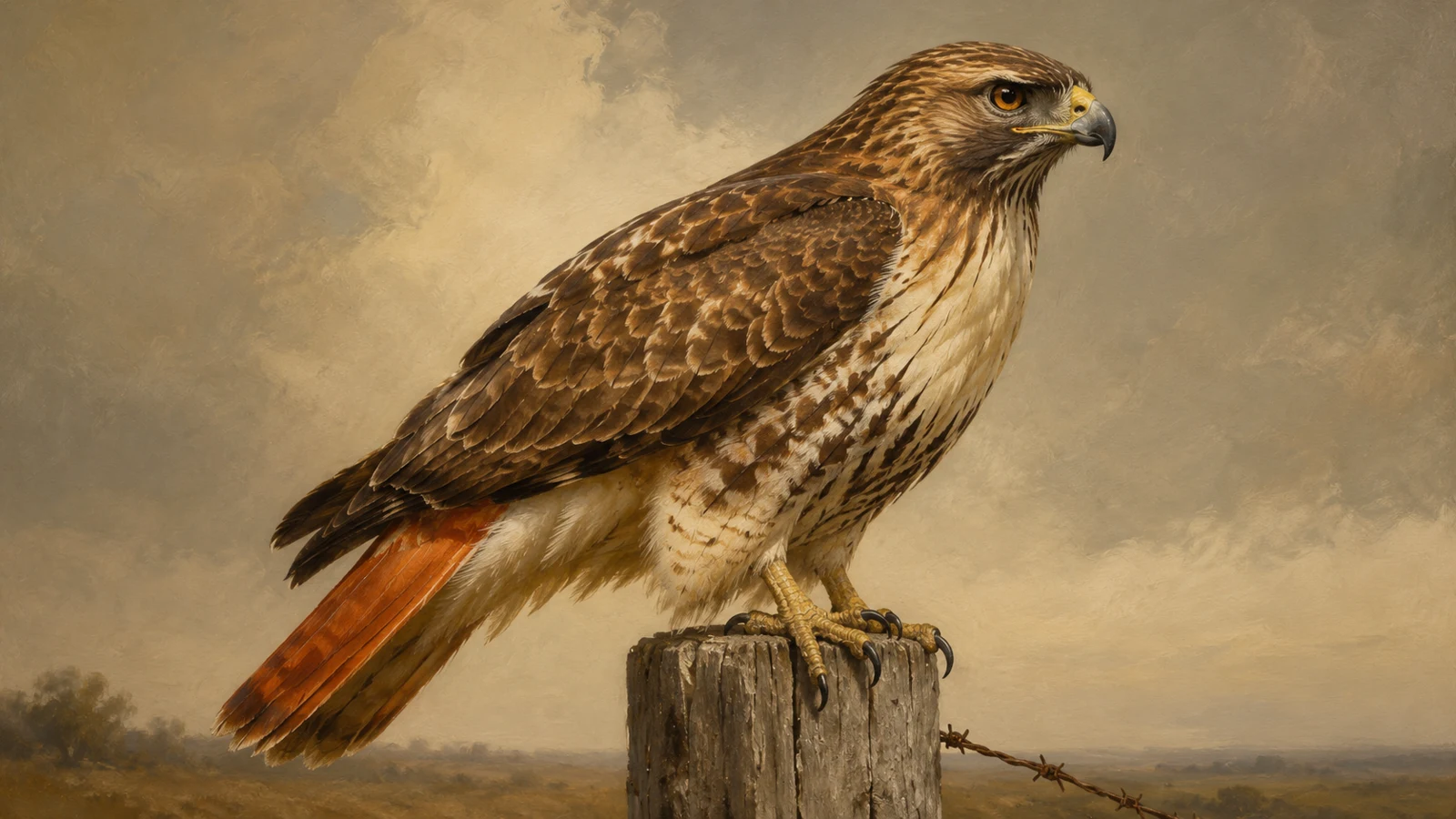
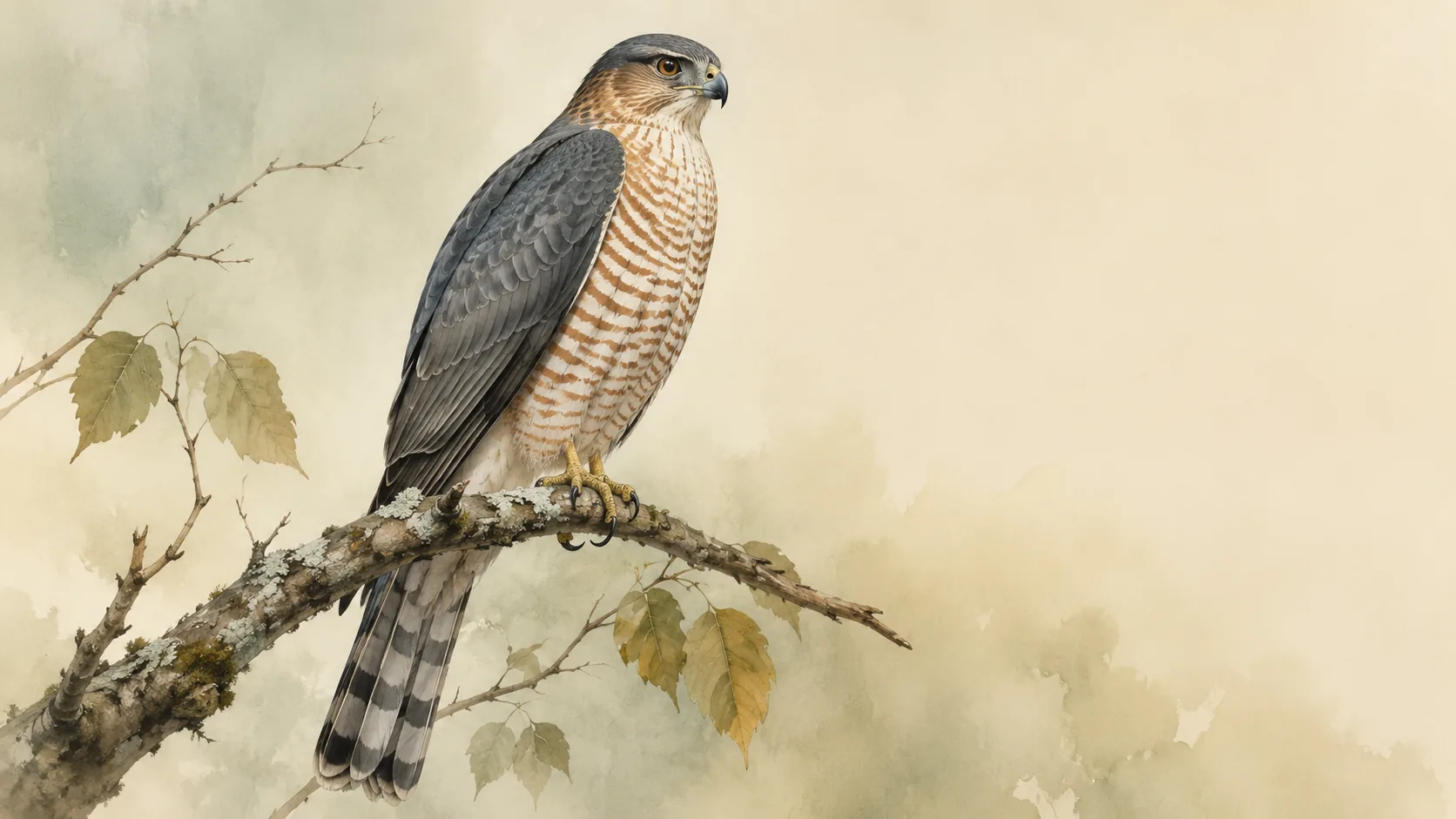
The Cooper’s Hawk is a medium-sized accipiter - crow-sized, long-tailed, short-winged, built for threading timber rather than soaring above it. Adults are blue-gray above with a blackish-brown cap that contrasts sharply with a paler nape, giving the head a capped, hooded look. The underparts are white at the base, crossed by coarse rufous or cinnamon barring. The long tail is banded gray and dark, and in flight shows a rounded tip - a detail that separates it from the Sharp-shinned Hawk, whose tail tip is square or even notched.
Females are substantially larger than males. The species shows among the greatest reversed sexual size dimorphism in the Accipitridae family, according to Cornell’s Birds of the World. A small male Cooper’s Hawks runs 35 to 42 centimetres long and weighs around 215 to 390 grams. A large female reaches 46 to 50 centimetres and may weigh 600 grams or more. The same genus, the same nest, a very different body.
Juveniles are brown above with whitish, dark-streaked underparts. The juvenile plumage creates confusion with Sharp-shinned Hawks throughout autumn migration, and correctly separating the two at a hawk watch is considered one of the more demanding field problems in North American birding. Study the head projection in flight: a Cooper’s Hawk shows more of its head ahead of the wings, giving it a flying-cross silhouette. The Sharp-shinned looks small-headed by comparison.
Voice
The Cooper’s Hawk is not a quiet bird near the nest. The most common call is a rapid, nasal cak-cak-cak-cak, similar to several other accipiters but deeper and slower-paced than the Sharp-shinned Hawk’s version. Both sexes call during courtship and when the nest is approached. Away from the nest site, and particularly when hunting, the bird is typically silent. The sudden stillness at a feeder is not accompanied by any sound. There is no warning.
Range and habitat across the year
The species breeds from southern Canada - British Columbia east to Nova Scotia - through the entire contiguous United States and into northern Mexico. The Audubon Society’s field guide records year-round residency across most of the mid-latitude US, with northern-most populations moving south in autumn. Wintering birds reach as far as Costa Rica.
Breeding habitat is deciduous and mixed deciduous-coniferous forest, typically with a dense closed canopy. The suburban expansion documented since the 1970s has added parks, college campuses, and leafy residential neighbourhoods to that list. In the Southwest, riparian woodlands along desert waterways hold breeding pairs in otherwise arid country.
Migration is diurnal and often concentrated at geographical bottlenecks - ridgelines, lake shores, peninsulas. The hawk counts at Cape May in New Jersey and Hawk Mountain in Pennsylvania document thousands of Cooper’s Hawks moving through each autumn. Many, however, do not migrate at all. The decision appears to depend partly on prey availability through winter. A suburb with well-stocked feeders is a reliable food source year-round, and Cooper’s Hawks have learned to read that.
Diet
Birds make up the majority of the diet - Audubon records 50 to 85 per cent of prey items as avian, with over 300 prey species documented across the range. Robins, jays, flickers, starlings, and mourning doves are regular targets. Chipmunks, squirrels, mice, and bats fill the rest of the diet, along with occasional reptiles.
The hunting method is pursuit through cover rather than the open-sky stoop of a falcon. A Cooper’s Hawk launches from a concealed perch, accelerates through undergrowth, and uses its long tail as a rudder to navigate gaps between branches. It occasionally hunts on foot, pursuing prey into dense brush after a flush. Cornell’s Birds of the World documents tandem hunting between mated pairs, with one bird flushing prey toward the other. The cooperative behaviour is unusual for a raptor thought of as solitary.
Breeding and nesting
Pairs form in late winter and are, by most accounts, monogamous within a season - there is less evidence of the long-term pair fidelity seen in some other raptors. Males return to the same territory year after year. The female chooses the nest site and does most of the construction.
Nests are bulky stick platforms placed 25 to 50 feet up in deciduous or coniferous trees, typically with dense canopy cover overhead. The female lays three to five bluish-green eggs. Incubation runs 34 to 36 days, carried out mainly by the female while the male delivers food to her. The young fledge after 27 to 34 days and remain dependent on their parents for approximately eight weeks. Two to four fledglings per season is the typical outcome.
One documented nesting behaviour worth noting: males arrive at the nest site early and begin construction or refurbishment before the female has arrived. He builds alone, or begins to, which is uncommon in hawks. The behaviour may be a form of territory advertisement, signalling occupancy and quality to prospective mates.
A behaviour worth watching for
A Cooper’s Hawk hunting a suburban feeder does not always approach from above. It often uses the house itself - flying close to a wall or fence line, turning sharply at the corner, arriving at the feeder from below the sightline of the birds feeding there. It exploits geometry the way a chess player exploits the board. Observers near urban hawk counts have noted that birds wintering in city environments show measurably different hunt approaches than birds in forest habitat - more use of structure, more patience between attempts.
The species is also notable for surviving prey strikes that would kill smaller raptors. Cooper’s Hawks take birds close to their own body weight - pigeons and doves that can resist hard - and collisions during a chase sometimes injure the hawk. A skeleton study at a raptor rehabilitation centre found healed fractures in the coracoid bones (the shoulder-strut bones that brace the wing against the sternum) in a significant proportion of Cooper’s Hawks examined. These injuries are consistent with impact during prey capture. The bird absorbs the cost of its own hunting method.
The Cooper’s Hawk is the argument that a predator does not need open sky to be formidable - it needs only to be faster, at the right moment, than whatever it is chasing.