Field Guide
Superb Lyrebird
In June, when the wet sclerophyll forests of Victoria go quiet with cold, a male Menura novaehollandiae climbs onto one of his small cleared dirt mounds and begins to sing. He will do this for up to four hours. By midwinter he has filled the forest with the calls of kookaburras, whipbirds, and a dozen other species, none of which are present. The Superb Lyrebird is not singing to you. He is rebroadcasting the entire neighbourhood back at itself, and the neighbourhood is fooled.
That is the thesis here: the lyrebird is not merely a mimic. He is the acoustic memory of the southeastern Australian forest, storing and replaying a record of the soundscape around him. A recording made on 28 June 1931 in Sherbrooke Forest, Victoria - among the earliest captured of a lyrebird in the wild - proved that the mimicry was not selective or approximate. It was precise. And field ornithologists have confirmed that the skill is culturally transmitted across generations, which means individual dialects of borrowed sound pass from bird to bird across time, like oral tradition.
What he looks like
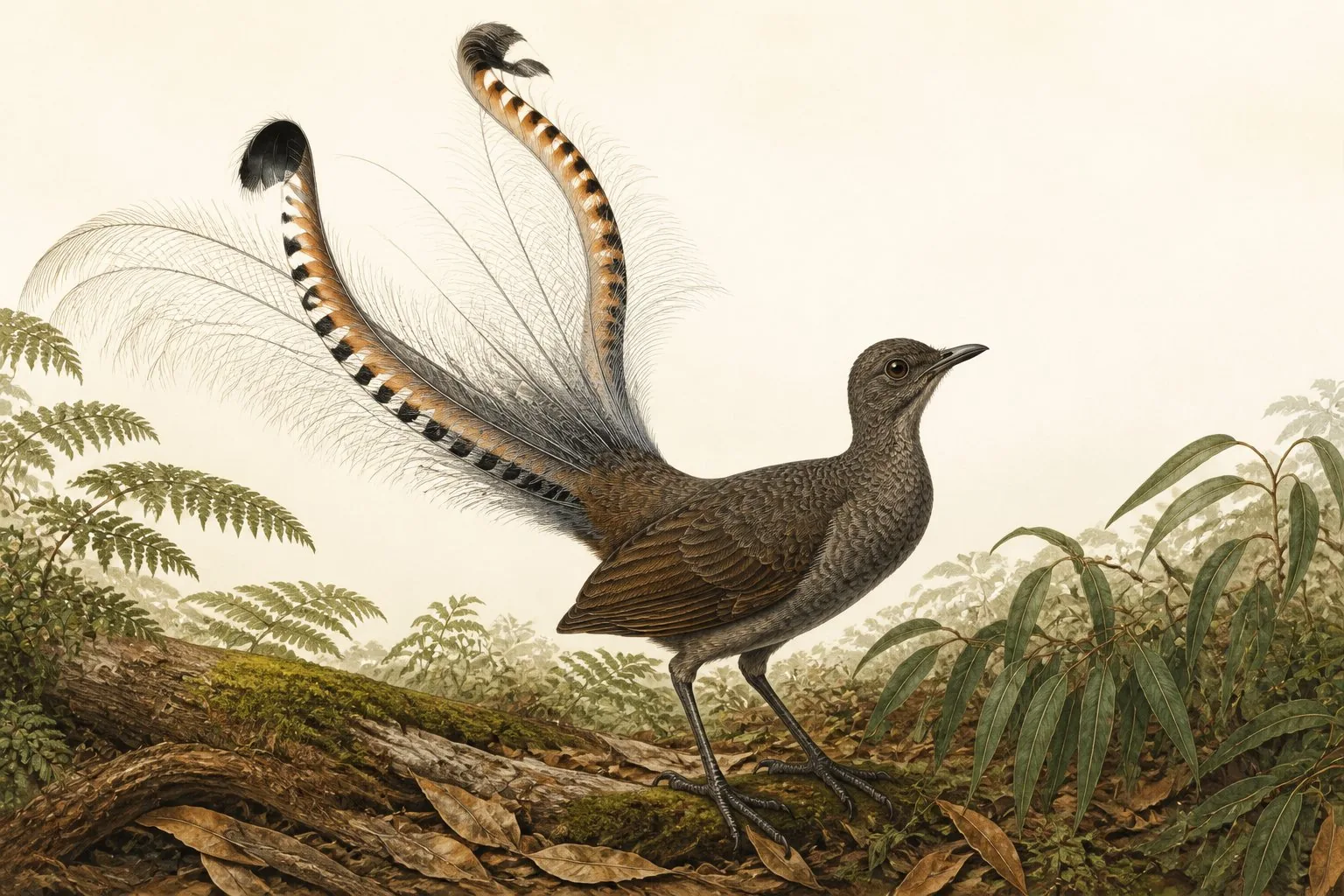
The Superb Lyrebird is one of the largest passerines on earth, a category to which he belongs technically but not intuitively. He is 79 to 99 centimetres long and weighs roughly 900 to 1,100 grams, with the male significantly larger than the female. He is built like a game bird - heavy, ground-hugging, capable of running fast through dense understorey but not built for sustained flight.
His body plumage is predominantly brown on the back and wings, with rufous wash across the chest and throat, and lighter underparts. The legs are powerful and grey. The bill is strong and dark. Nothing about any of this is arresting. Then the tail emerges.
The male’s tail consists of 16 feathers. The two outermost are broad, curved, and lyre-shaped - the feathers that named him. Inside these sit the filamentaries: long, fine, gossamer silver-white plumes that spread into a fan during display. During courtship he fans the full tail forward over his head, creating a translucent white canopy above his own body, and begins to sing.
Females are plainly brown with some rufous on the throat. They carry a shorter tail and, until recently, were thought to be the quiet half of the species.
What he sounds like, and what she sounds like too
The male produces perhaps the widest vocal range of any terrestrial bird. Around 70 to 80 per cent of his song, according to multiple field studies, consists of direct imitations of other species. In Victoria’s Central Highlands he reliably copies kookaburras, yellow-tailed black cockatoos, eastern yellow robins, pilotbirds, and the eastern whipbird, among others. He has been documented incorporating chainsaws, car engines, and camera shutters when those sounds fall within his territory. The imitations are good enough to deceive the species being copied.
Research by Anastasia Dalziell of Cornell Lab of Ornithology and Justin Welbergen of Western Sydney University has shown that female Superb Lyrebirds also mimic - extensively, and for different reasons. Where males use mimicry to attract and retain mates, females appear to use it defensively. Dalziell and Welbergen found that females reproduce predator and flock-alarm calls to deter interference during the nesting period, producing more mimetic vocalisations during nest defence than while foraging. The female lyrebird, once thought to be a passive observer, is also a practitioner.
Range and habitat across the year
The Superb Lyrebird is a resident of southeastern Australia. Its range runs from the extreme southeastern corner of Queensland down through the coastal ranges of New South Wales, through the Australian Capital Territory, and into Victoria, east of the Great Dividing Range. It was introduced to Tasmania in the 1930s and has established a self-sustaining population there.
It is not migratory. Its territory is its year-round world. Birds hold individual home ranges within moist eucalyptus forest, wet sclerophyll forest, and rainforest, wherever the understorey is dense and the soil soft. The male maintains multiple display mounds within his territory. He defends the mounds against rival males but not the full range, which can overlap with others.
The breeding season runs from June to October, peaking in the cool of July. Outside the breeding season, males continue to sing and maintain their mounds, but with less urgency.
Diet and a consequence most people do not know about
The Superb Lyrebird eats invertebrates - insects, spiders, worms, small crustaceans - gathered from the leaf litter and topsoil by raking with the feet. The raking is relentless. Both sexes do it through every non-breeding hour.
A 2019 study by Alex Maisey of La Trobe University, working in Victoria’s Central Highlands, measured what that raking actually does to the forest floor. The results were startling: lyrebirds displaced an average of at least 155 tons of soil and leaf litter per hectare per year, rising to around 352 tons per hectare in the most intensively foraged areas. For comparison, earthworms - the standard benchmark for soil bioturbation - move around 100 tons per hectare. The lyrebird exceeds them.
The consequence is ecological. The constant turning of litter buries organic matter, accelerates decomposition, aerates the soil, creates microhabitat for invertebrates, assists seed germination, and - critically - reduces the depth of dry fuel accumulation on the forest floor. Where lyrebirds were experimentally excluded from a study area, dry litter built up to three times the normal depth. The Superb Lyrebird is a keystone species in the same fire-affected forests where it lives, and the connection between it and the vegetation is mechanical as well as ecological.
Breeding and nesting
The female lyrebird builds the nest and incubates the egg alone. She lays a single egg per season - brown to purple-grey, heavily speckled - and incubates it for around 50 days, one of the longest incubation periods of any passerine. She broods the chick for approximately six weeks after hatching.
The nest is substantial: a dome structure built on the ground, on a rock shelf, in a tree hollow, or on a low stump, using sticks and rootlets and lined with the female’s own feathers. She selects the site. The male plays no part in nest building, incubation, or chick-rearing.
Males reach sexual maturity and begin growing the ornate lyre tail at three to four years old. The full tail, at its most developed, is not complete until around year six or seven. Females are thought to assess tail quality and song complexity when choosing a mate. The male’s only reproductive investment is the quality of the display on the mound.
Superb Lyrebirds live up to 20 years, which means a successful male might spend 15 or more winters on his mound, refining his repertoire, accumulating new material, and passing it - through cultural transmission of song - to younger males who learn from him.
The acoustic archive
The lyrebird’s mimicry has an implication that ornithologists have only recently begun to take seriously. If song is culturally transmitted across generations, then a lyrebird population carries a living archive of the soundscape as it existed across decades. Older birds may reproduce calls of species that have locally declined or vanished. In areas where the soundscape has been radically altered - by chainsaw, by land clearing, by a collapsing bird community - the lyrebird may be singing a world that is no longer there.
That is not sentimentality. It is a data point. The acoustic record carried in a lyrebird’s throat is a document of what the forest once sounded like. The IUCN lists Menura novaehollandiae as Least Concern, though its 2019-2020 fire season burned approximately 40 per cent of its native range. Populations have recovered before. Whether the cultural record - the songs inside individual birds - survives intact when communities are fragmented by fire is a different question, and one that has not yet been fully answered.
The lyrebird is not performing. He is recording. The difference matters.