Symbolism
The American Robin Is Not a Robin
The Name Is a Lie
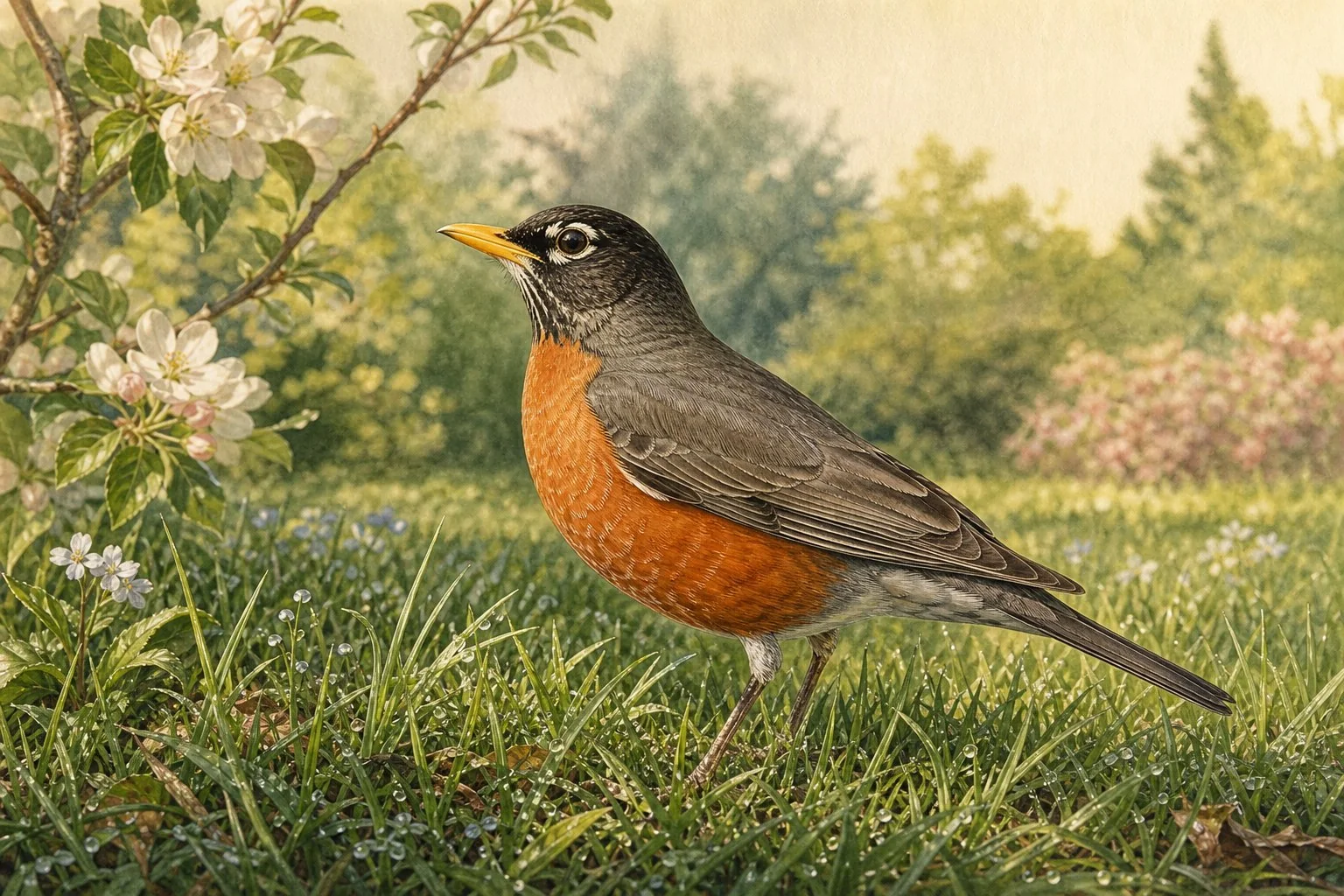
The American robin is a thrush. Its closest relatives are blackbirds and nightingales. The European robin - the compact, round-bellied bird on British Christmas cards - belongs to the family Muscicapidae. The American bird belongs to Turdidae. Their shared ancestor lived roughly 17 million years ago.
The American robin is twice the wingspan and four times the body weight of the European bird. They are not cousins. They are not even distantly cousins by any useful standard.
The name came from English settlers who looked at the orange breast and felt homesick. That is the whole story. It is an act of colonial nostalgia wearing the clothes of taxonomy. Mark Catesby, who traveled the American colonies during 1712 to 1726 to document wildlife for European audiences, found the name already in use. Alexander Wilson’s American Ornithology (1808 to 1814) locked it into scientific literature. By then the error was unfixable.
Understanding this matters for the symbolism. The American robin carried imported meaning from a bird it is not related to. It was given an identity before anyone properly looked at it.
The Spring Bird That Never Left
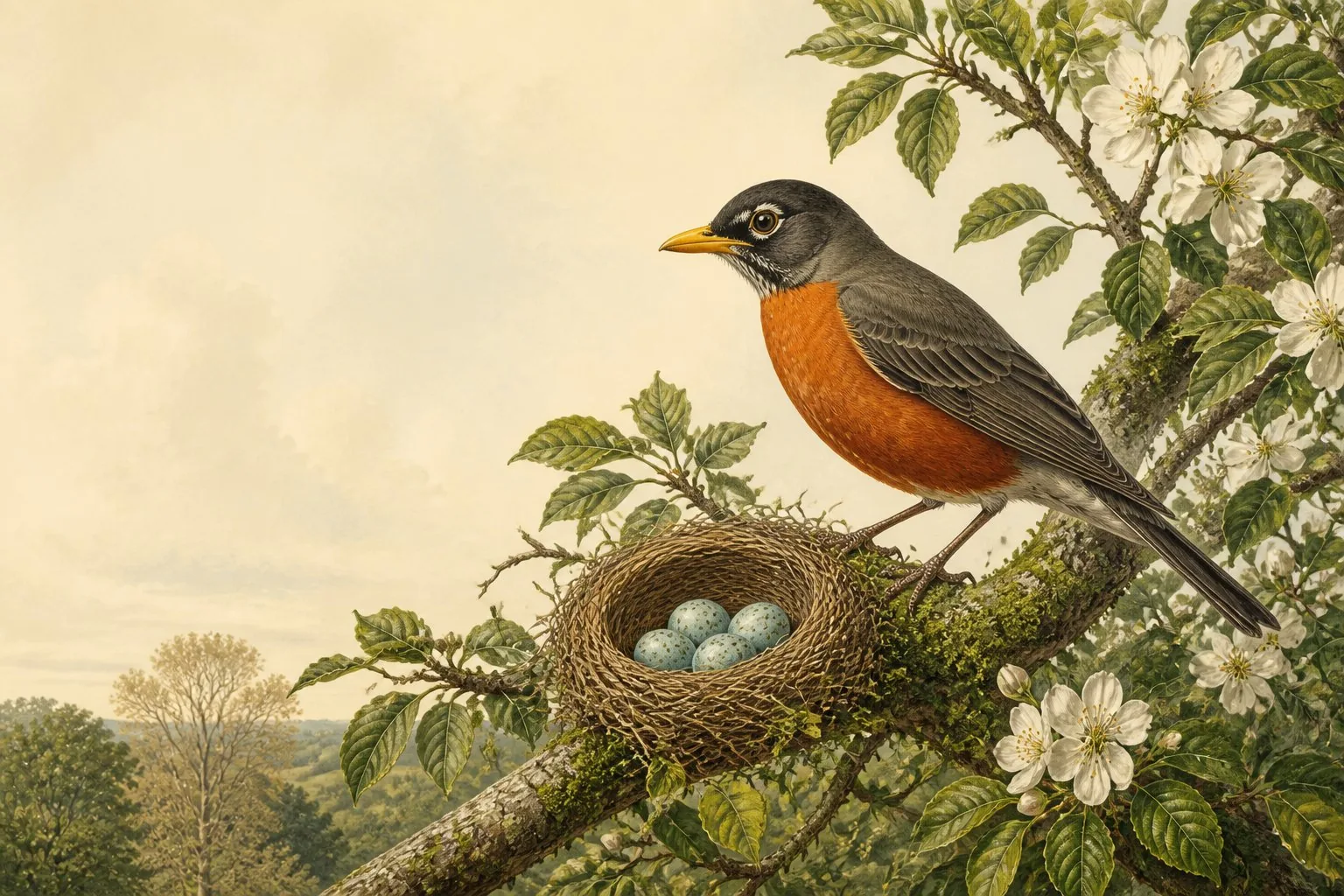
The robin became the symbol of spring’s return. It is on greeting cards, children’s books, and three state flags of cultural memory. The image is of a bird reappearing after winter - a messenger of warmth arriving from somewhere south.
Many American robins never leave.
They overwinter in large communal roosts, sometimes containing a quarter of a million birds, moving nomadically through the landscape. In winter, fruit makes up more than 90 percent of their diet - juniper berries, holly, crabapples, hawthorns. They are in the woodlands, stripping fruit trees. They are three miles from your house. When they appear on your lawn in March, they have not just returned from Florida. They have simply switched from woodland fruit to lawn worms, becoming visible again as they do.
The myth was more accurate historically. Audubon Christmas Bird Count records from the Midwest show very few wintering robins in Illinois before 1951. In earlier centuries, when winters were harsher, the birds did move south more consistently. The cultural memory calcified around a behavior that was already fading.
There is also an irony specific to British settlers. In Britain, the European robin is the winter bird, the Christmas bird - appearing on Victorian Christmas cards, associated with the Nativity legend. When settlers crossed the Atlantic and applied the name to the orange-breasted thrush they found, they detached it from winter symbolism entirely and attached it to spring. Same color, same name, same genre of feeling. Inverted by 180 degrees.
What the Head Tilt Actually Means
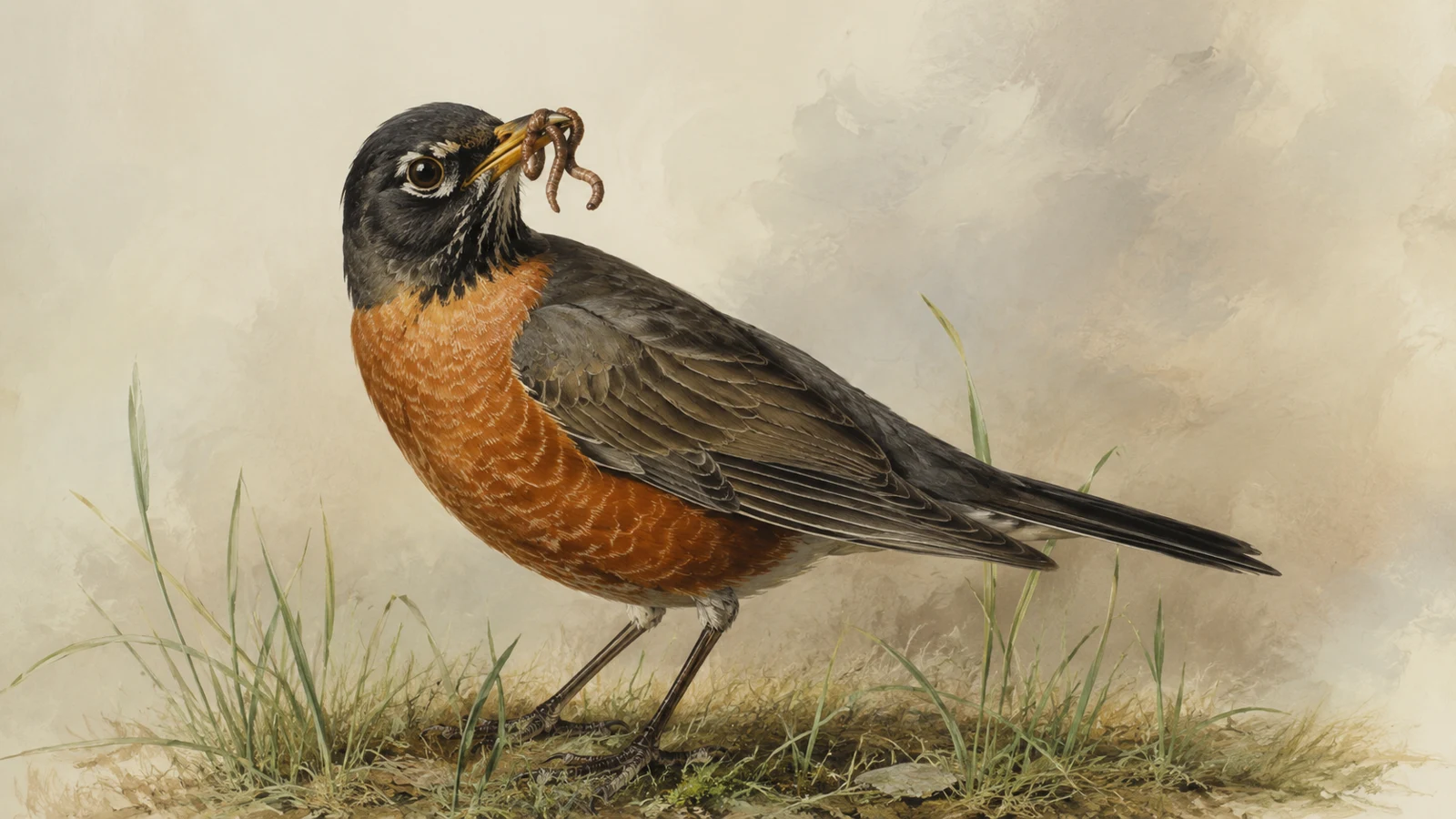
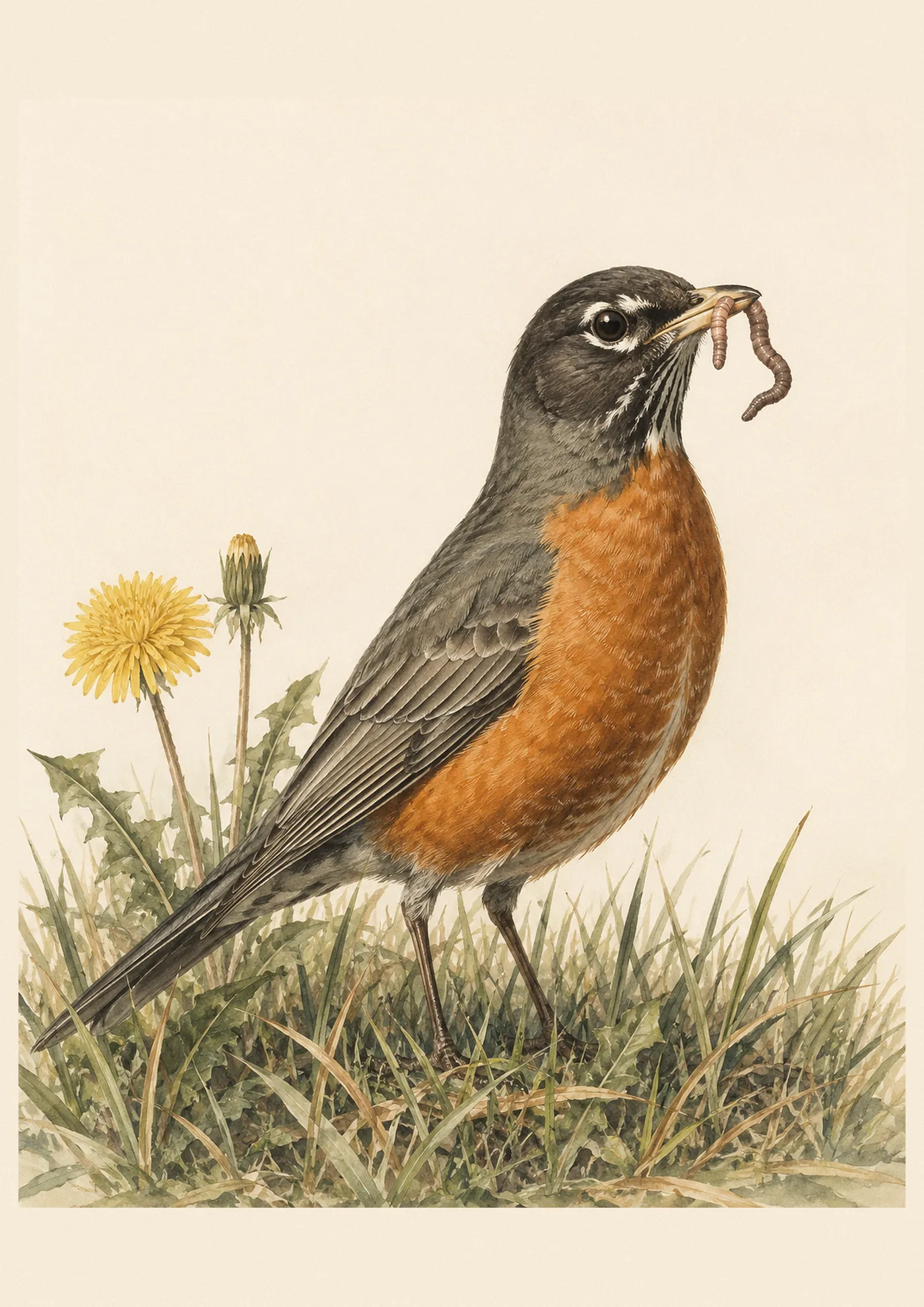
The American robin tilts its head over a patch of ground, utterly still, then stabs. It looks exactly like a person pressing their ear to a wall. Centuries of observers concluded: it is listening for worms.
This is not wrong. It is also not the whole picture.
The dominant scientific view from Frank Heppner’s 1965 experiments was that the head tilt is optical, not auditory. A robin’s eye has a zone of sharpest focus - the lateral fovea - positioned to the side, not the front. To focus on the ground directly below the bill, the bird must rotate its head so the sharp-focus zone points downward. In other words, robins look sideways at the ground because that is where their clearest vision points.
Then in 1997, Robert Montgomerie and Patrick Weatherhead published “How robins find worms” in Animal Behaviour (vol. 54, pp. 143 to 151). They ran controlled aviary experiments with four robins. When they blocked vision, smell, and vibrotactile cues but left hearing intact, the robins still found buried mealworms. When they added white noise to mask auditory cues, foraging success dropped significantly.
The current scientific position is that both vision and hearing contribute - probably vision for surface detection and localization, possibly hearing for sub-surface sensing. Smell is definitely not involved. Robins cannot smell earthworms.
The folk observation - “that bird is listening” - accidentally gestures at a real mechanism even though the visual explanation for the head tilt is purely optical. It is wrong for the right reasons.
Ojibwe: The Boy Who Became Opichi
In Ojibwe, the robin is opichi - a noun animate. The animacy classification is not decoration. In Anishinaabe grammatical tradition, animate nouns are living persons, not objects. The robin is grammatically a person.
The central Ojibwe narrative is the story of Opichi: the boy who became a robin.
A boy undergoes the traditional fasting vigil - the vision quest in which a young man receives a guardian spirit. Night after night, powerful spirits come to him: beaver, hawk, wolf, bear, eagle. Each time, his father refuses to accept the vision as sufficient. He wants his son to receive greater power than any other boy in the community. His ambition has no natural limit.
The father’s overreach is the story’s engine. He keeps sending the boy back out. He demands the boy wait longer. The threshold that should end the fast is crossed, then crossed again.
When the parents finally come to the shelter, it is empty. A bird with a gray-black body and a red chest flies out. It is their son.
The bird speaks: “You see me as I am now. The one who was your son is gone. You sent him out too early and asked him to wait for power too long.”
The robin promises to return every spring when the gentle breath of the Fawn returns to the land. His song, every spring, is a reminder: do not push sons beyond endurance. The red breast is the mark of a transformed life.
A 2014 academic paper, “Opichi: A Transformation Story, an Invitation to Anishinaabe (Ojibwe) Legal Order,” treats this legend as an articulation of Anishinaabe legal principles. The robin’s story encodes rules about when and how a community may impose demands on individuals. The spring song is not decoration. It is a legal reminder.
Haudenosaunee: The Robin Who Woke the Leaves
A closely parallel story exists among the Haudenosaunee. A boy is transformed into Jis-go-ga - the robin - not as punishment but as rescue, to spare him from the disgrace of a failed fasting vigil. The transformation is mercy rather than consequence.
He promises to return to the village each spring, singing to the trees to wake the leaves. Among Haudenosaunee traditions, the Iroquois reportedly planted wild cherry trees near their longhouses specifically to attract robins. The white eye-ring of the robin was interpreted as an emblem of prophetic or visionary ability.
Both the Ojibwe and Haudenosaunee traditions connect the robin’s spring song directly to the social calendar. The robin’s return signals the appropriate season for boys to undertake the fasting vision quest. The bird is not a symbol layered onto spring. It is part of the social architecture that organizes spring.
Miwok and Mi’kmaq: Fire and Red
Two other documented traditions explain the robin’s red breast through fire.
In the Miwok legend “How Tol-le-loo Stole Fire,” Robin (Wit-tah-bah) is the guardian of fire. He spreads himself over the embers to protect them. A mouse (Tol-le-loo) steals the fire from beneath him while he sleeps. The scorching from the coals turns his breast red. It is explicitly a fire-origin myth, parallel to the global structure in which an animal guards fire, loses it, and is physically marked by the encounter.
The Mi’kmaq have a similar explanatory legend for the red breast, documented separately from a narrative called “Nukumi and Fire” in which the robin brings fire to the culture hero Kluskap.
Both stories belong to a category of mythological explanation: the bird’s distinctive color is the permanent record of a mythological event. The robin carries the mark of fire on its chest.
Note what the Cherokee fire myth does NOT contain: a robin. The definitive Cherokee First Fire story, extensively documented, features Raven, the Screech Owl, the Hooting Owl, and the Horned Owl as failed fire-bringers, each marked by the ordeal - Raven turns black, owls get smoke-rings around their eyes. The successful agent is the Water Spider, who weaves a silk bowl and carries a live coal home safely. Any internet source citing a Cherokee robin-fire story has either confused tribes or invented the connection.
Blackfoot and Hopi: Sentinel and Direction
Among the Blackfoot, robins functioned as peace symbols and sentinels. Robins near a camp signaled that the village would be safe from attack. This is grounded in observable behavior: robins feed on the ground in open areas and flush early. They are reliable early-warning animals. The symbolic weight tracks directly from the biological fact.
The Hopi assigned the robin to the south as a directional guardian. In Hopi ceremonial tradition, birds are keepers of the cardinal and intercardinal directions. The robin’s position in this system reflects its place in a comprehensive cosmological map, not a free-floating spiritual association.
How a Song Built the Modern Symbol
In 1926, Harry Woods wrote “When the Red, Red Robin (Comes Bob, Bob, Bobbin’ Along).” It was recorded by at least four artists that year alone - Jack Smith, Cliff Edwards, Paul Whiteman, the Ipana Troubadors. Al Jolson covered it. Bing Crosby covered it. It became one of the most covered American standards of the 20th century.
The lyrics are simple: the robin arrives, and sorrow ends. “There’ll be no more sobbing when he starts throbbing / His old sweet song.” The song did not invent the spring association, but it distributed it nationally at scale, at the moment when radio was reaching every household. It crystallized the symbolism and made it a shared cultural property.
Around the same time, three states selected the robin as their state bird: Michigan (1931), Connecticut (1943), and Wisconsin (1949). In each case, children’s votes or mass popular surveys drove the result. Michigan’s own Audubon Society president, Edith Munger, told the Detroit Free Press in 1929 that she believed the result “would have been different if voters, particularly the children, had received proper nature education about birds.” More than 190,000 votes had been cast. The robin beat the Black-capped Chickadee. She found it embarrassing.
In 2022, Michigan state legislator Markkanen introduced a bill to replace the robin with the Kirtland’s Warbler. He made the logic explicit: “The robin is a state bird for many states, and it’s nowhere close to extinction and never has been. Michigan deserves a bird that uniquely represents the State of Michigan.” The Kirtland’s Warbler breeds only in Michigan’s jack pine forests and was nearly extinct before recovery efforts. The bill did not pass. Michigan kept its common lawn bird.
Dawn
The American robin is reliably the first bird to sing in the morning chorus. In areas with high artificial light, it begins during true night. A 2006 study in The Condor (Ornithological Applications) recorded urban robins in Pennsylvania beginning to sing at 1:11 AM. In Virginia, 3:43 AM. In natural light conditions, song onset tracks civil twilight - the moment just before sunrise when the sky begins to lighten.
Each male has a personal repertoire of 10 to 20 caroling phrases. He also maintains a bank of 75 to 100 quieter whispered notes, added to the carol at dusk. The classic phrase, as transcribed by the Cornell Lab: “cheerily, cheer up, cheer up, cheerily, cheer up.” Each male’s repertoire is individually unique. Males improvise and add new elements throughout their lives.
A bird that sings in darkness, that sings first, that announces the day before the day technically begins - this is the behavior that made every dawn-and-renewal association biologically plausible. The robin’s symbolism as a herald of spring, as a voice preceding change, is grounded in what the bird actually does. It sings in the dark. It has always sung in the dark.
What Is Documented and What Is Not
The Ojibwe, Haudenosaunee, Mi’kmaq, Miwok, Blackfoot, and Hopi connections to the robin are documented in oral tradition archives, academic papers, and indigenous language databases. These are real cultural traditions.
Much of what circulates online as “robin symbolism” - including the idea that a robin visit is a message from a deceased loved one - is predominantly a contemporary internet folk belief. In the US, this territory is dominated by the cardinal, not the robin. The cardinal is red against snow all winter, impossible to miss, and has been actively promoted by the funeral industry since at least the 1990s. The American robin’s grief symbolism appears to borrow from British traditions about the European robin - a bird with centuries of crucifixion legend and Christmas card iconography. The American bird sits awkwardly in this borrowed role.
The honest answer about “visiting from heaven” symbolism for the American robin: it is thin, it is recent, and it is not where this bird’s actual cultural weight lives.
The actual weight lives in Ojibwe legal tradition - in the story of a father who pushed too hard and lost his son. It lives in Miwok fire myth - in the bird who guarded the coals and was burned for it. It lives in a 1926 pop standard that gave a generation a way to feel about spring. It lives in a 1997 lab study that reopened a question everyone thought was settled.
The robin tilts its head. It is trying to see. It may also be trying to hear. We are still not entirely sure. That uncertainty is more interesting than the greeting card.