Field Guide
Eastern Towhee
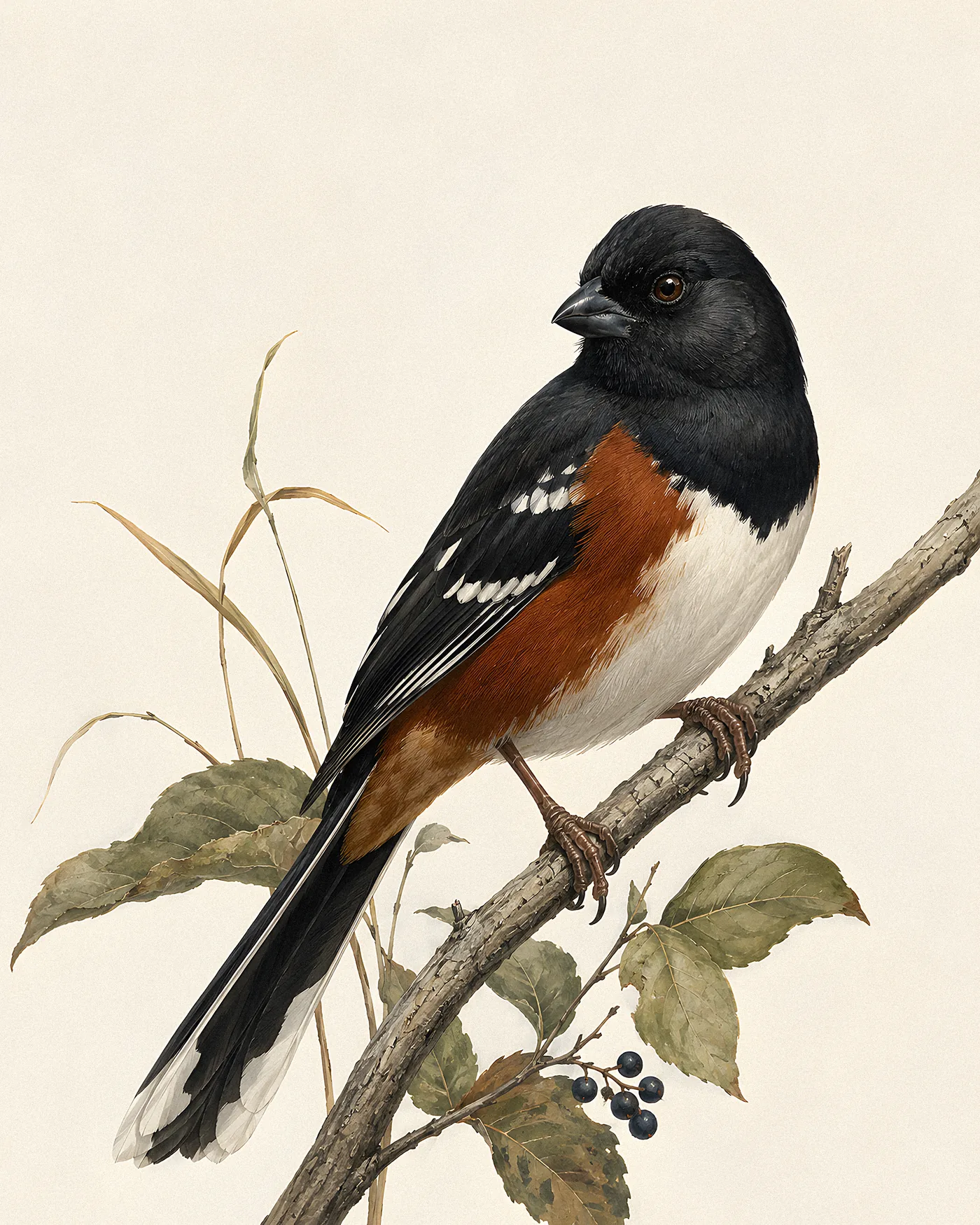
A brushy fence line in the Carolina Piedmont, late April, and something is working the leaf litter under a tangle of greenbrier. You cannot see it, but you can hear it: a loud, deliberate scuffle, two feet kicking back at once, then a pause, then the scuffle again. The sound is too big for the bird. When it finally hops up onto an open twig it is a large, bold sparrow in a black hood, rufous along the sides, white down the belly, and it fixes you with a hard red eye before announcing itself in three notes.
The Eastern Towhee is a bird you hear before you see, and once you learn its two signatures - the double-footed scratch in the leaves and the ringing drink-your-tea - it stops being a mystery skulker and becomes one of the most knowable birds of the eastern brush.
What it looks like
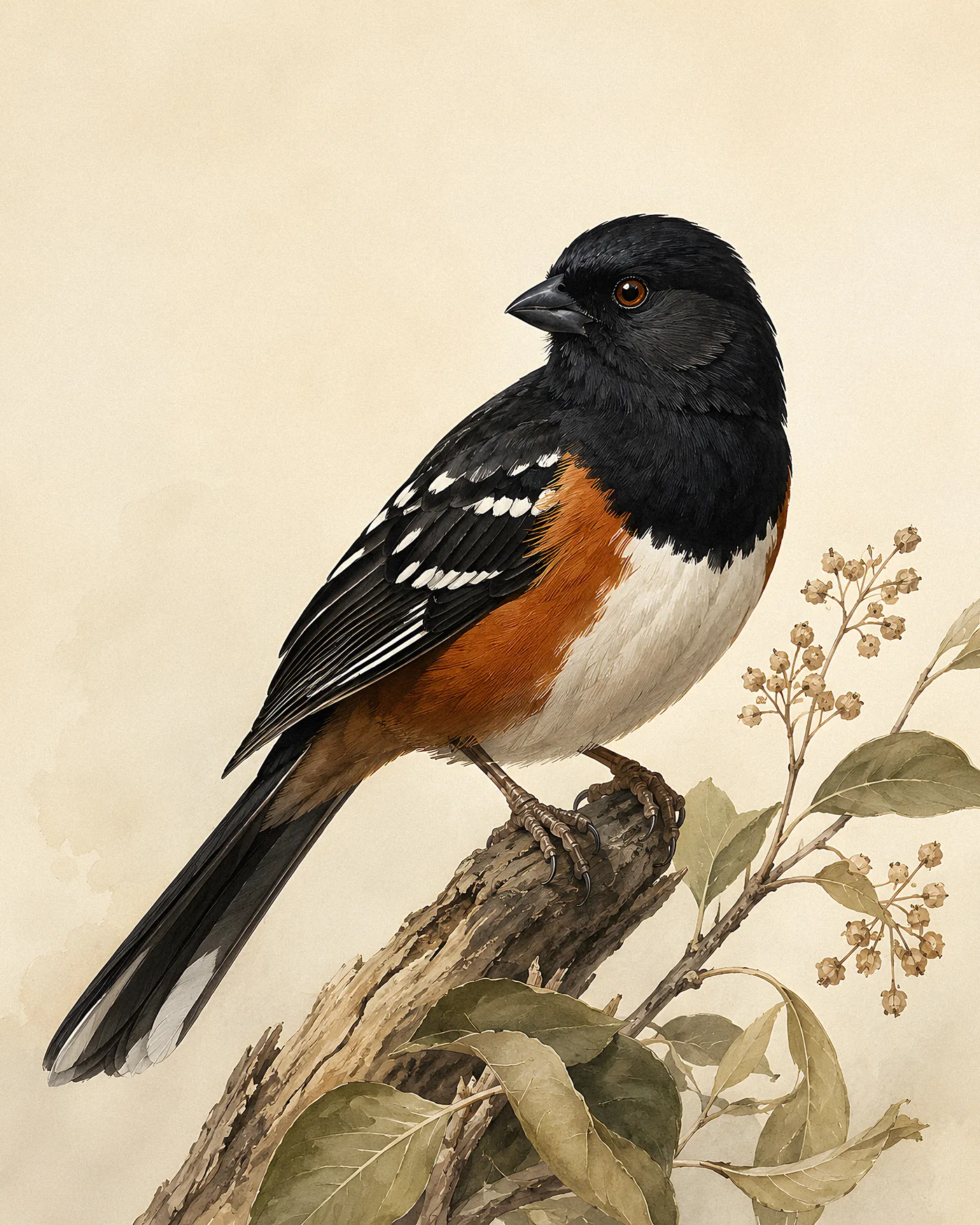
The male is built on a clean three-colour plan. The whole head, throat, back, wings and tail are sooty black. The sides and flanks are a warm rufous, the colour of dead oak leaves, and the belly between them is clean white. White corners flash in the long tail when the bird flies low across a gap. Cornell Lab puts the species at 17 to 23 centimetres long, a third again the size of a Song Sparrow and twice the weight, with a heavy, conical seed-cracking bill.
The female wears exactly the same pattern in a softer key. Where the male is black she is a rich warm brown, so a pair side by side reads as the same bird painted twice, once in ink and once in coffee. Both sexes carry the rufous sides and the white belly.
The eye is its own field mark. Across most of the range it is a deep red, almost garnet. But Cornell Lab notes that birds of the southern Atlantic coast and Florida have a pale, white or straw-coloured eye instead, a regional form once treated as a separate “white-eyed” race. It is a small thing that changes the whole face of the bird.
What it sounds like
The song is the easiest part of the bird to learn, because it tells you what it is. Cornell Lab describes it as a clear drink-your-tea, lasting about a second: a sharp, metallic opening note, a second note, and then a musical trill on the end. Generations of birders have heard exactly those words in it. The male sings it from an open perch at the top of the thicket, the one moment he stops skulking.
The call is the other giveaway and the source of an old country name. It is a rising, slurred tow-hee, or chewink, or jo-ree, depending on the bird and the ear, and it is where the species got its name. In the brush the bird will keep up a steady chewink contact note long after it has stopped singing for the season.
Range and habitat
Pipilo erythrophthalmus is a bird of edges and thickets across the eastern United States and the southern fringe of Canada. It wants dense, scrubby cover with a deep layer of dead leaves underneath: forest edges, overgrown fields going back to brush, power-line cuts, the shrubby margins of gardens, coastal scrub and young second growth. It avoids both open lawn and closed, shady forest interior. The structure matters more than the tree species - what it needs is a tangle with a litter floor.
Northern birds are migratory, pulling south in winter into the southeastern states where southern birds stay put year-round. Cornell Lab records the species as still common but in slow long-term decline across much of its range, tied to the loss of the early-successional brushy habitat it depends on as old fields are either developed or grow into mature woodland.
Diet
The towhee feeds mostly on the ground, and the way it feeds is the thing to watch. It uses a vigorous double-scratch, jumping forward and kicking both feet backward at once to rake the leaf litter aside, then snatching whatever the rake exposes. The noise of one towhee foraging can sound like a much larger animal moving through the brush.
The menu is broad and shifts with the seasons. Cornell Lab lists seeds and fruits - ragweed, smartweed, grasses, acorns, blackberries, blueberries - alongside a heavy animal component of beetles, caterpillars, true bugs, spiders, millipedes, centipedes and snails. In spring the bird adds soft leaf buds and flower buds. Insects rise in the diet through the breeding season; seeds and fruit carry it through autumn and winter.
Breeding and nesting
The nest is set on or very near the ground, which fits a bird that lives in the litter. The male delivers material and the female does the building, weaving a cup of bark strips, leaves, grasses and twigs lined with finer material, tucked into the base of a shrub, a clump of grass or a tangle of vines. Set that low, the nest leans hard on concealment.
Cornell Lab records a clutch of three to five eggs, incubated by the female for about 12 to 13 days. The young leave the nest quickly, in around 10 to 12 days, often before they can fly well, scrambling out into the cover their parents chose for exactly that reason. Towhees are also among the regular hosts of the Brown-headed Cowbird, which lays its eggs in towhee nests for the towhees to raise.
The towhee is the bird you hear scratching like a far heavier animal, then see resolve into a hooded sparrow with a hard red eye.
What to listen for
This is a bird that rewards the ear more than the eye. Most of the year the Eastern Towhee stays buried in cover, and most of your encounters will be sound: the unmistakable two-footed rummage in the dead leaves, the rising chewink contact note, and in spring the ringing drink-your-tea from the top of a thicket. Learn those three, and a bird that seemed to be all glimpses and rustles becomes one you can place with your eyes shut.
When it does step into the open, take the moment. The black hood, the rufous flank, the white belly and that garnet eye make the male one of the handsomest of all the large sparrows - a bird the tradition of Audubon would have set, exactly as you find it, at the edge of the brush.