Field Guide
American Pipit
November in a plowed Montana field. The soil is bare, the corn stubble chest-high to a boot, and the light is flat and grey. Nothing seems to be moving - until it does. A small brown bird advances across the furrows with a deliberate, head-nodding walk, pausing every few seconds to pump its tail up and down in a rhythmic, mechanical bob. Then another. Then a dozen. Then, as the eye adjusts, fifty or a hundred - a loose assembly of Anthus rubescens, the American Pipit, walking the field as purposefully as fieldworkers, tails going like small metronomes.
This is where most people meet the species. Not singing. Not perched. Just walking, tail pumping, across the blankest landscape available.
What it looks like
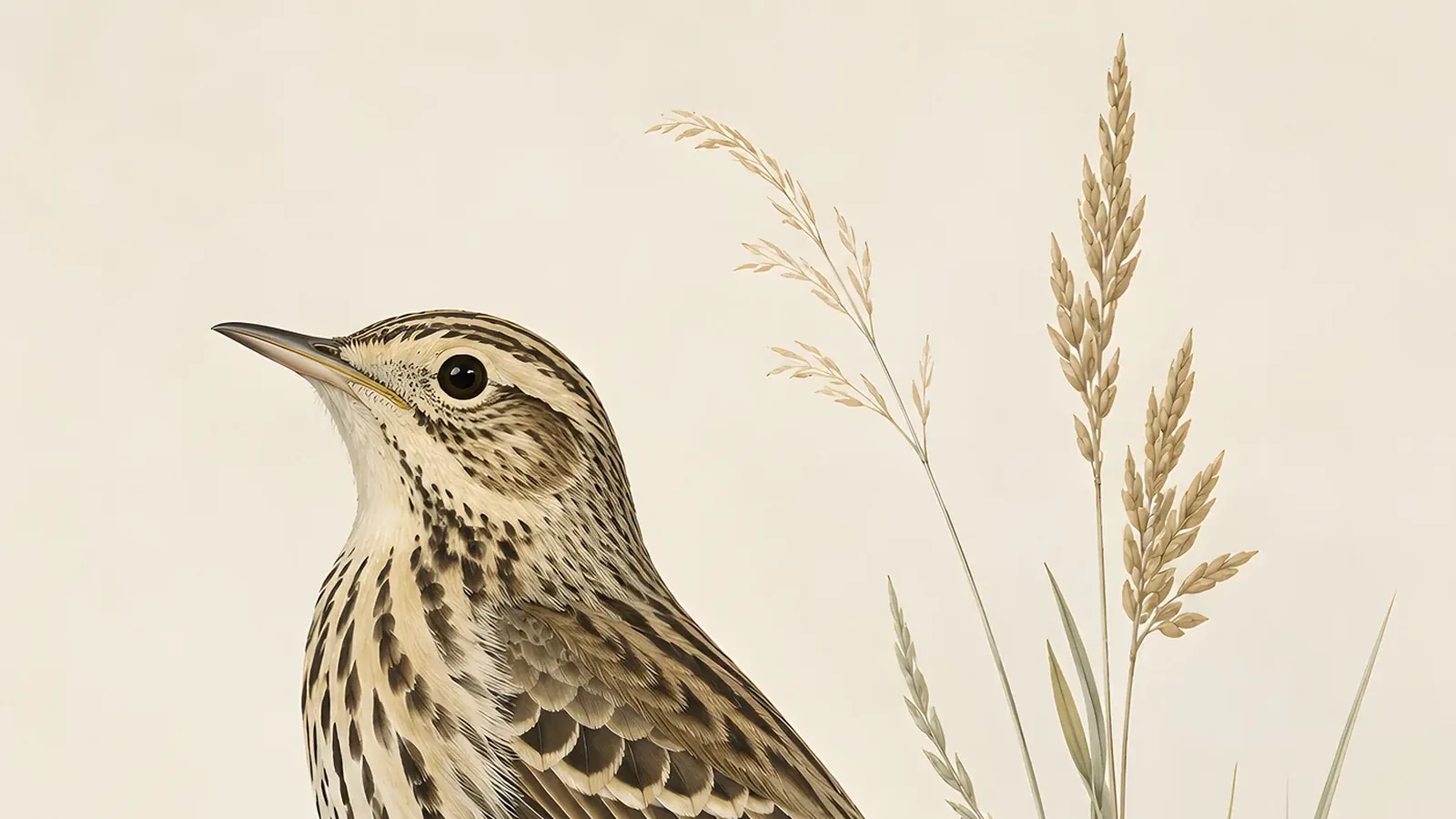
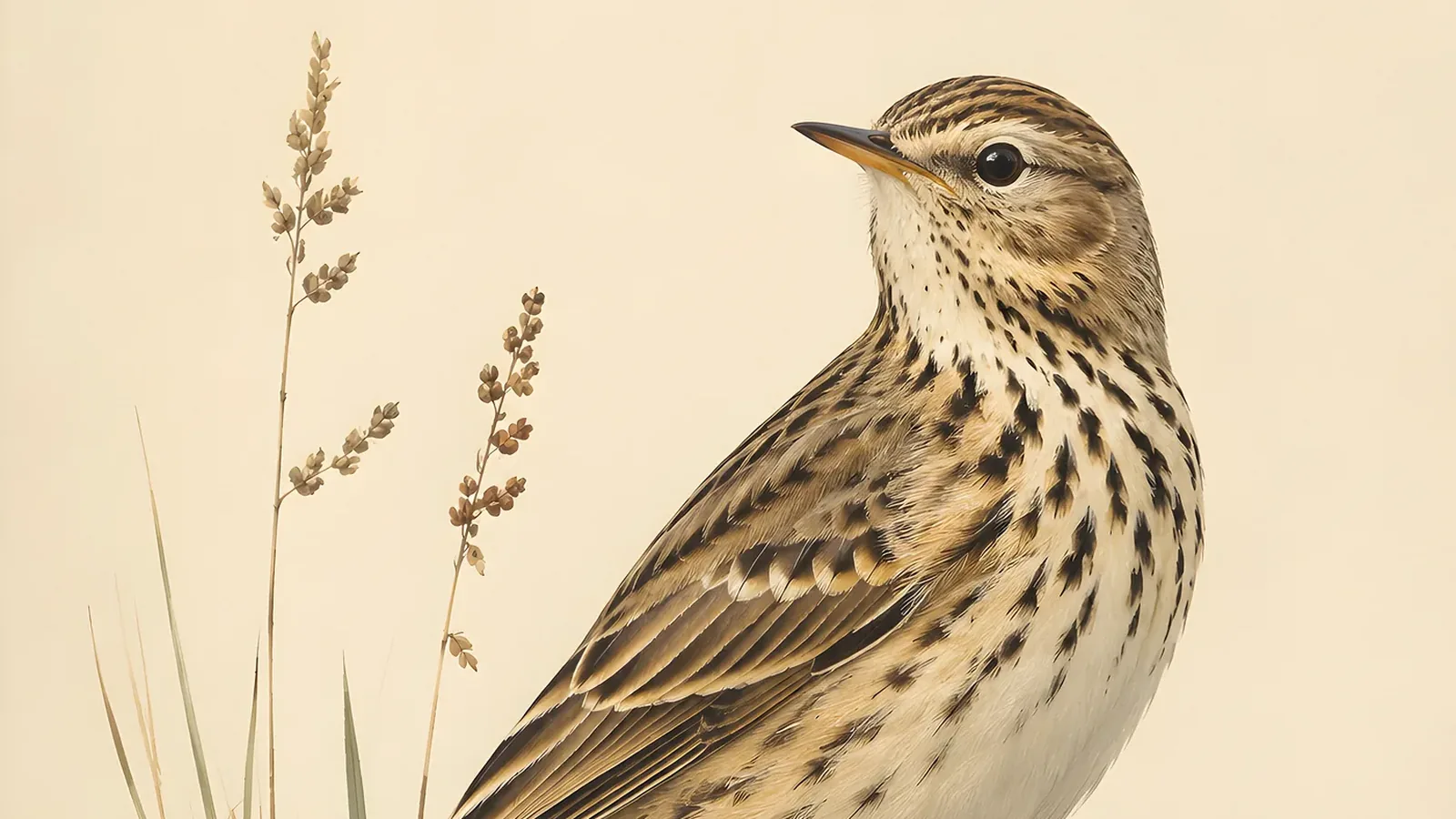
The American Pipit is a slender sparrow-sized bird, 15 to 17 centimetres in length and weighing as little as 20 grams. The build is trim and elongated, with a fairly long tail, thin bill, and erect posture when alert. Nothing about it shouts. The back is warm gray-brown, the underparts are pale buff to whitish, and the chest carries a band of fine dark streaks. The legs are blackish - a useful field mark against the similar Sprague’s Pipit, whose legs are pale pink.
The face carries a thin pale supercilium and a faint dark malar stripe. The outer tail feathers flash white in flight - the easiest thing to see when the bird lifts off in a loose, bounding arc. The bill is thin and pointed, suited to picking small invertebrates from bare ground rather than cracking seeds.
Breeding plumage adds warmth. The underparts become richer pinkish-buff and the chest streaks fade to something finer and less insistent. The back stays gray-brown. Even in breeding dress the bird is subdued - which suits it. The tundra is a place where a flashy bird advertises itself to predators.
| Measurement | Range |
|---|---|
| Length | 15 - 17 cm |
| Weight | 20 - 32 g |
| Wingspan | 25 - 27 cm |
| Oldest recorded | 4 years, 1 month (banding, New Hampshire, 1943) |
The walk and the tail
Almost every field guide note on A. rubescens mentions the tail-bobbing, but what deserves equal emphasis is the walking. The American Pipit does not hop. It walks - a ground-hugging, deliberate stride that carries it forward without apparent urgency across bare earth, mudflat, or tundra. This walking gait is the single most reliable identification point in the field and distinguishes it at a glance from sparrows, which hop, and from most warblers, which do both.
The tail pump is continuous. While standing and while walking, the tail goes up and down in a steady beat. The function is debated among ornithologists. In the closely related wagtails (also Motacillidae), the tail-wag is thought to signal alertness to potential predators - a visible declaration that the bird has spotted the threat and flight is ready. Cornell Lab of Ornithology’s All About Birds notes the same behaviour in pipits without resolving the question definitively. What the pump does accomplish, without ambiguity, is identity: a brown bird walking a bare field with a pumping tail is an American Pipit until proven otherwise.
A bird that bobs its tail while walking a November field has been doing the same thing on an arctic snowfield six months before. The tail does not lie about where it has been.
The voice reinforces the name. The contact call is a thin, doubled pip-pip or spit-spit, given in flight and lending the bird its common name. The Audubon Field Guide describes the flight song as a weak, tinkling trill delivered during the male’s aerial display on the breeding grounds - a looping, ascending flight that can carry him more than 30 metres above the tundra before he descends again on stiff wings.
Range and two worlds
The American Pipit lives between two landscapes that could not be less alike. In summer it breeds on arctic and high-alpine tundra - the open, windswept ground above or north of the treeline, where vegetation is low, the growing season measures in weeks, and frost can come in any month. Breeding range spans northern Alaska through the Canadian Arctic south through the Rocky Mountains, with isolated alpine populations reaching as far south as the high peaks of New Mexico.
The Boreal Songbird Initiative estimates that roughly 35 percent of the North American breeding population nests within the boreal zone - a reminder of how far north the centre of gravity for this species actually sits.
In winter the bird descends to open lowland habitats: plowed fields, short-grass prairies, mudflats, river sandbars, coastal beaches, and agricultural stubble. The range in winter includes the southern United States from California east to the Atlantic coast, and extends into Mexico. Partners in Flight placed the global breeding population at approximately 20 million birds, though following the 2024 split of the Siberian Pipit (Anthus japonicus) as a separate species, that figure requires revision downward. The IUCN lists A. rubescens as Least Concern.
The transit between these two worlds happens by day, in loose flocks, in a pattern of bounding flight that looks casual but covers ground efficiently. In migration, pipits associate with Horned Larks and Snow Buntings - other open-country birds that share the same preference for bare, exposed ground where food is visible from a walking pace.
Diet
The diet shifts with the season and the landscape. On the breeding grounds, the American Pipit eats almost entirely insects - flies, beetles, true bugs, caterpillars, moths, and spiders, with ticks and millipedes taken when encountered. The Audubon Field Guide notes that birds nesting in alpine meadows will visit unmelted snowbanks where dead insects accumulate, carried upslope by rising warm air from valleys below. This is the food supply arriving pre-sorted by thermodynamics.
Coastal migrants take small crustaceans and marine worms from mudflats and shorelines. Inland birds in fall and winter shift substantially toward grass seeds and weed seeds, which can comprise close to half the diet in some estimates. The thin bill handles both jobs without difficulty - a generalist tool in a generalist bird.
Foraging is almost entirely terrestrial. The pipit walks forward, picking from the ground surface or from the bases of low plants, occasionally wading into shallow water along shoreline margins. It does not scratch or dig. It looks.
Breeding on the tundra
Nest sites are chosen once snow melt has exposed suitable ground - a constraint that compresses the breeding season into a narrow window. The female builds a cup nest of grass, sedge, and other plant material, placed at ground level where it is hidden by a rock, a tussock, or an overhang of sod. Clutch size runs from four to six eggs, pale whitish to buff and heavily spotted with brown and gray. Larger clutches are more common in northern populations.
The female incubates alone for 13 to 16 days. Both parents feed the nestlings, which fledge at around 14 days and receive care for a further two weeks. The pair bond is seasonal - socially monogamous for one breeding season, not beyond. Males are territorial early in the season, and rival males confront each other with wings drooped and tail bobbing, the same motion that identifies the species to birders all winter, here repurposed as threat display.
The pair bond does not survive the season. The birds that meet on a Montana stubble field in November almost certainly never encountered each other on the tundra. They are connected by landscape alone - by the fact that bare open ground is what A. rubescens requires, from the High Arctic to the Gulf Coast and back again each year.
The species is closely related to - and until recently was thought by some taxonomists to belong to the same superspecies as - the Sprague’s Pipit, which is paler, streaked above rather than plain, and restricted to native grassland. Sprague’s Pipit does not bob its tail. This is not a trivial difference. It is the clearest visible evidence that two birds that look nearly alike have been solving the problem of identity - who to approach, when to display, whether to flee - in quite different ways for a very long time.
The American Pipit walks. It walks the tundra in June, the mountain meadow in July, the California mudflat in October, the Iowa field in January. The tail goes up and down. It has been doing this since before the field was a field.