Field Guide
Sprague's Pipit
You hear it before you can find it. Somewhere very high, above the open grassland of North Dakota or southern Alberta, a thin descending phrase falls through the air - a glassy tinkle, repeated, falling, repeated again. You scan upward and find nothing. The sky is empty. The song keeps coming down, patient and persistent, from a height at which a bird the size of a sparrow is simply invisible.
Anthus spragueii - Sprague’s Pipit - is performing its display flight. It may have been up there for an hour. It may stay up for another two. No other bird in North America holds the sky for as long.
What it looks like
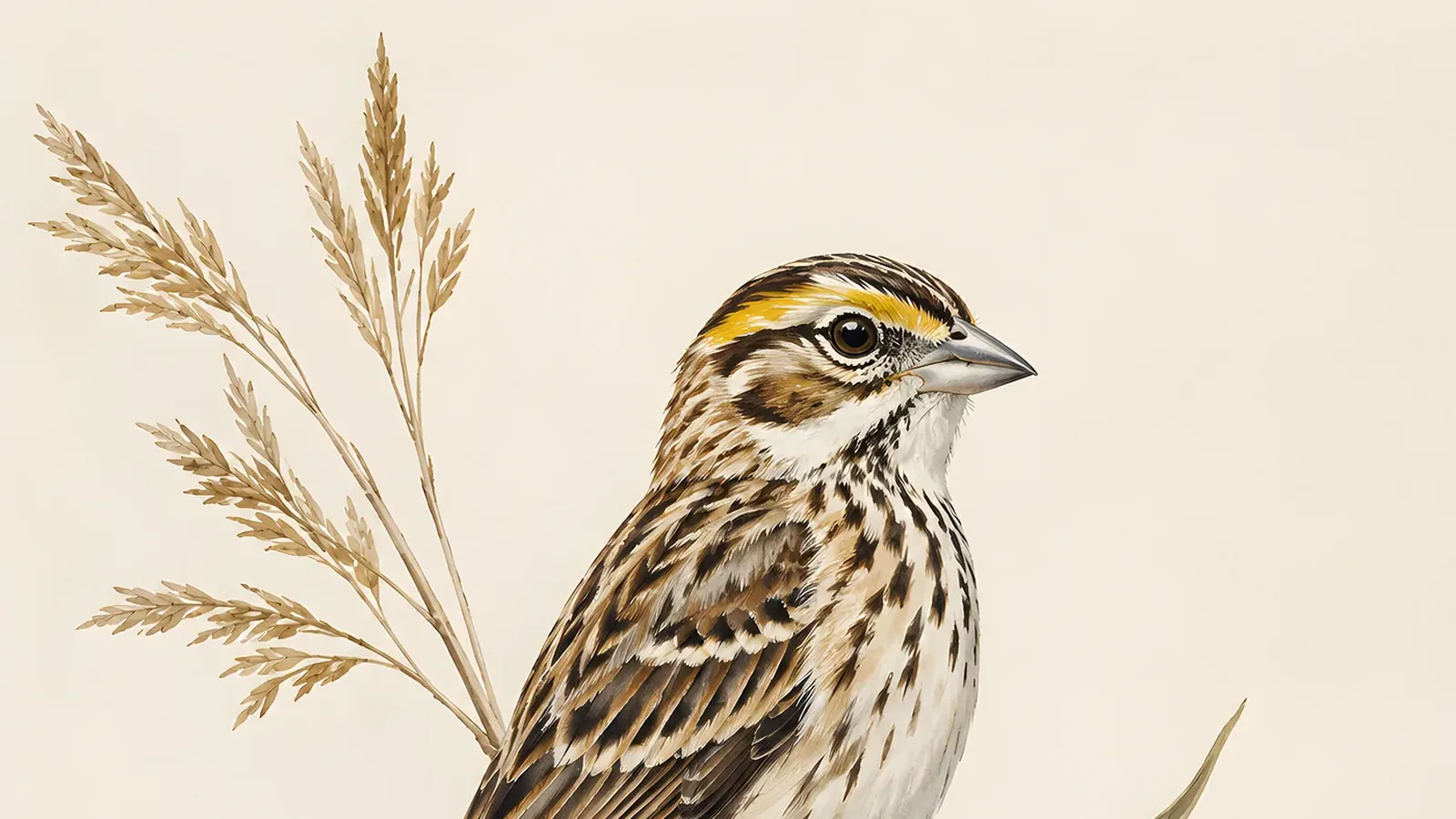
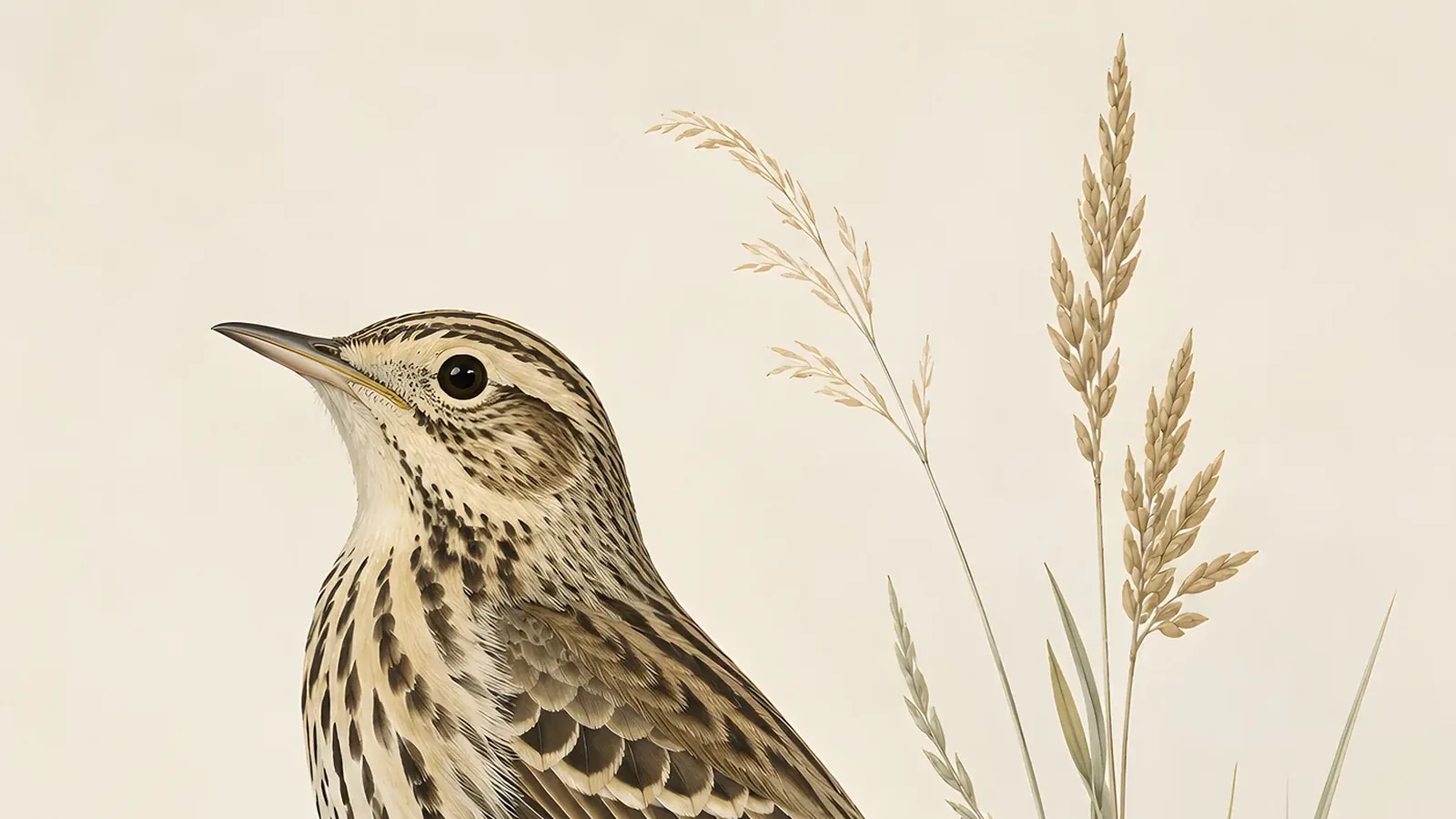
Sprague’s Pipit is, by design, a bird you are not supposed to see. At 16 to 18 cm long and 22 to 26 grams - a compact, sparrow-sized animal - it sits at the scale where the grassland swallows things whole. The back is warm buff streaked heavily with dark brown, a pattern that dissolves instantly into dead native grass and sun-bleached stem. The face is notably plain: a pale buff wash, a faint eye-ring, almost no supercilium to speak of. It has the wide-eyed, slightly startled expression of a bird with nothing to hide behind but its own blandness.
The bill is thin - not the seed-cracker bill of a sparrow but the fine probe of an insect hunter. The legs are pinkish-pale. The outer tail feathers flash white when the bird flushes, which it does rarely and reluctantly, preferring to walk through the grass on those long thin legs rather than fly. It does not pump its tail the way American Pipits do. It walks with a deliberate, head-bobbing stride, picking through the stems.
Sexes are identical in plumage. The male’s only advertisement to the world is what he does with the sky.
| Measurement | Range |
|---|---|
| Length | 16 - 18 cm |
| Weight | 22 - 26 g |
| Wingspan | 24 - 27 cm |
| Clutch size | 4 - 5 eggs |
| Incubation | 13 - 14 days |
| Fledging | 10 - 11 days |
The longest song-flight
In 1843, John James Audubon traveled up the Missouri River with Isaac Sprague, a botanical illustrator from Hingham, Massachusetts, whom Audubon had recruited for his skills with a pencil. Somewhere in the unbroken grasslands of present-day Montana or the Dakotas, Sprague first observed the bird that would carry his name skyward. He reportedly watched one male for nearly an hour as it circled and hovered far overhead, delivering its song at intervals of roughly ten seconds, each burst lasting about five seconds before a brief silent glide. The following year, in 1844, Audubon formally described the species as Alauda spragueii - a tribute to his companion.
It was an apt naming. The display flight of the male Sprague’s Pipit is, by any honest accounting, one of the most extreme behaviors in North American ornithology.
The male launches from the ground and spirals upward, typically reaching 90 meters or more - 300 feet - before leveling off into a circling, hovering flight. He holds that altitude and sings. He beats his wings in rapid bursts like a small hawk hanging in a thermal, then sweeps in undulating arcs before recovering and hovering again. According to the account by Davis, Robbins, and Dale in Birds of the World (2014, Cornell Lab of Ornithology), display flights routinely exceed 30 minutes. Durations of three hours or more have been observed. At that height, in the flat light of a prairie morning, the bird becomes a speck, then nothing. The song continues to descend long after the singer is gone from sight.
This is not mere skylarking. The sustained flight has a structural logic: a female on the ground can assess a male’s endurance over many minutes, even hours, with no clear deception possible. You cannot fake three hours aloft. The length of the flight is the signal.
What it sounds like
The song is a descending series of thin, liquid whistles - a tinkling cascade, each note slightly lower than the last, like water falling over small stones. Observers have described it as crystalline, as glassy, as oddly delicate for a grassland bird. It carries well across flat country. It does not carry the urgency of a wood-warbler’s song or the territorial intensity of a sparrow’s outburst. It is patient. It falls.
On the ground, the pipit is mostly silent. The call, when given, is a short, sharp squeet. There is nothing in the call that prepares you for the sustained aerial performance.
Range and the native-prairie rule
Sprague’s Pipit breeds across the short- and mixed-grass prairies of the Northern Great Plains, from central Alberta and Saskatchewan south through eastern Montana, North Dakota, and South Dakota into northern Minnesota. About 80% of the global breeding population nests in Canada. The species winters in the Chihuahuan grasslands of northern Mexico, western Texas, New Mexico, and Arizona - again in open short-grass country, never in cultivated fields, rarely in tame pasture.
The critical fact about this bird’s ecology is its absolute dependence on native grass. It will not use improved pasture seeded with introduced species. It avoids cropland entirely. It shuns shrubby or brushy areas and will not breed in grasslands fragmented below roughly 65 hectares. Saskatchewan research suggests a minimum functional patch size closer to 190 hectares for stable breeding populations (Alberta Piped Conservation Foundation, 2025).
This is the definition of a grassland obligate. Unlike Henslow’s Sparrow, which tolerates some wet-meadow and reclaimed-field habitat, Sprague’s Pipit requires large, intact, native sod - the kind of prairie that existed across the Northern Great Plains before systematic agricultural conversion began in the late nineteenth century.
That conversion has not stopped. Partners in Flight estimates the species has lost 73% of its global population since 1970 (Partners in Flight, 2019). Privately-owned lands support roughly 70% of the remaining breeding habitat. A 2015 study in Biological Conservation by Thompson, Lipsey, and Pipher used cropland conversion risk modeling across the Northern Great Plains and found that future agricultural expansion threatens the most intact blocks of remaining pipit habitat - the exact patches the birds most depend on.
The IUCN currently lists Anthus spragueii as Vulnerable (VU).
Diet
Sprague’s Pipit is primarily an insect hunter. A study by Gabrielson (1924) examining stomach contents from 11 birds found grasshoppers or crickets comprising 75% of contents in six specimens. Work by Harris (1933) in Manitoba found that females delivered grasshoppers (84.3%), crickets (10%), and moths (5.7%) to nestlings. Adults also take beetles, weevils, ants, stink bugs, caterpillars, and various small invertebrates gleaned by walking slowly through the grass, bill low, scanning ahead. In winter, the diet shifts partially toward seeds - grasses and forbs - though insect prey remains important wherever available.
The bird does not probe. It picks. It has the patience of a bird that spends its life walking through grass looking at things other birds fly over.
Breeding
Males arrive on the breeding grounds in late April or early May, ahead of females, and immediately begin their aerial displays. The nest is built entirely by the female, from dry grass stems bent and woven into a cup set on the ground, often with a canopy of grass arched over the entrance - a dome, essentially, with a side door. The construction keeps the eggs and nestlings out of direct sun and partly concealed from above.
Clutch size is typically four or five eggs, sometimes as many as seven. Incubation lasts 13 to 14 days. Chicks fledge at 10 to 11 days - unusually early, driven by the open-ground vulnerability of the nest site. Some pairs raise two broods in a season, though one appears more common at northern latitudes.
The male’s display flights continue through incubation and into the early nestling period, an investment of energy that, given the flight durations recorded, is genuinely extraordinary. The female watches from the grass below, choosing, waiting, measuring one male’s endurance against another’s.
The argument this bird makes is simple and unanswerable: that spectacle does not require visibility. The most sustained aerial display of any bird in North America belongs to an animal you cannot see when it is performing. The song falls out of an empty sky. The prairie it lives on - the native mixed-grass sod of Saskatchewan, of North Dakota, of southeastern Montana - is disappearing under the plow at a rate the bird cannot outrun.
What we are losing when we lose Sprague’s Pipit is not a glamorous species. It is a small streaked thing that walks through grass and then climbs out of sight and sings for three hours to no one you can see. It is the proof that the Northern Great Plains, when they were whole, held performances that happened whether or not anyone was watching. The prairie kept its own records. We are only now learning what was in them.