Biology
What makes a falcon a falcon
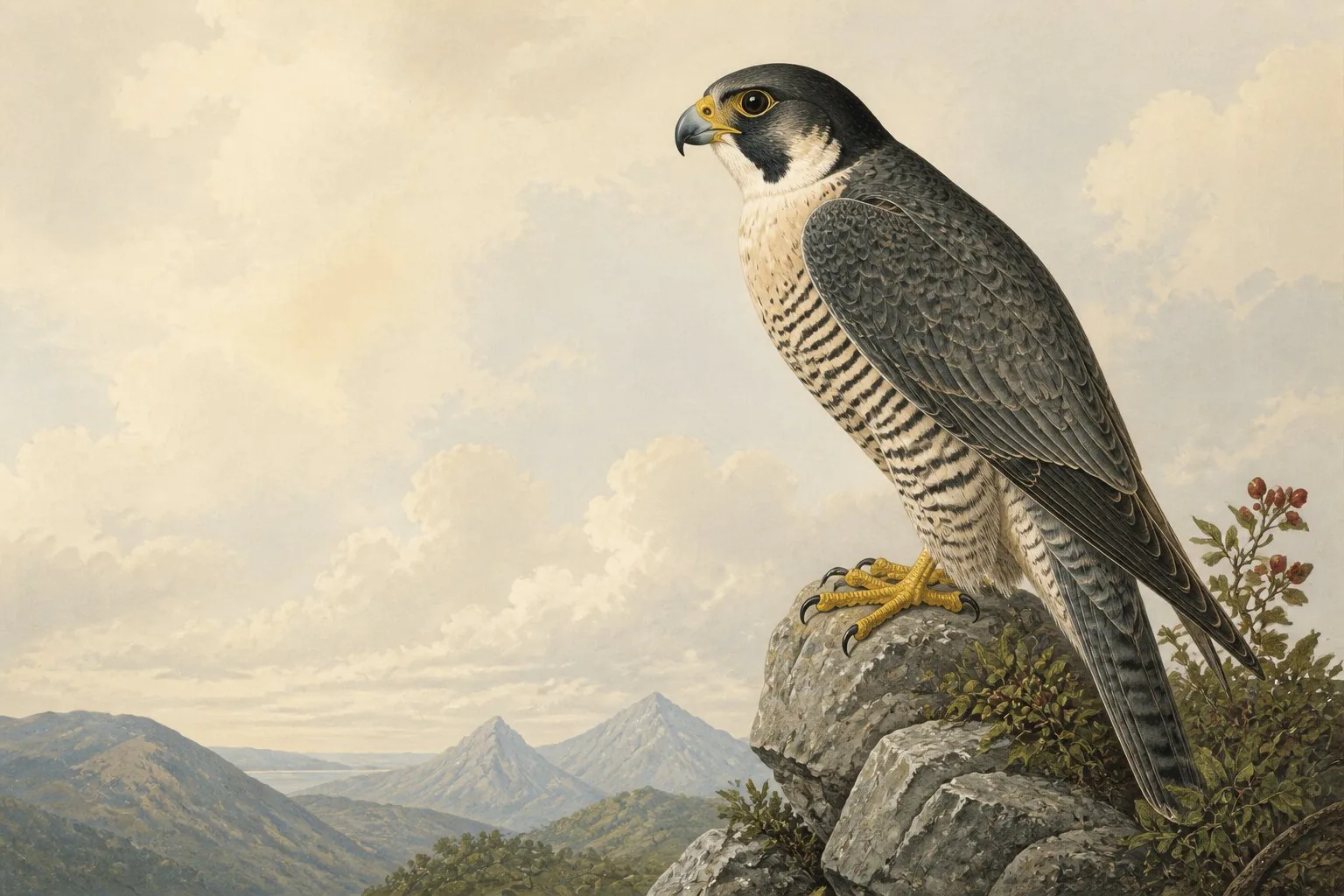
On August 20, 1999, the U.S. Department of the Interior removed the Peregrine Falcon from the federal Endangered Species List. The number of breeding pairs in the lower 48 states had reached a low of 39 in 1970. By delisting, The Peregrine Fund reported at least 1,650 pairs across the United States and Canada - more than twice the recovery target of 631. The organisation had bred and released more than 4,000 captive-raised birds since 1974. It is one of the most complete reversals in conservation history, and it happened to a specific kind of bird that was worth that effort.
The kind is worth understanding.
Not a hawk
Falcons belong to the family Falconidae - 64 species across every continent except Antarctica, in two subfamilies: the Polyborinae (caracaras and forest falcons) and the Falconinae (true falcons and falconets). What makes this taxonomy important is what it implies about ancestry. Molecular studies have shown that Falconidae sits closer to parrots and passerines than to Accipitridae, the hawk and eagle family. The shared silhouette - hooked bill, swept wings, predatory habit - is convergent evolution. Two separate experiments produced the same outline.
The structure that actually marks a true falcon, that no hawk possesses, is the tomial tooth: a notch in the upper mandible corresponding to a divot in the lower. It is not a tooth in any vertebrate sense. It is a ridge of keratin that presses against the back of a prey animal’s neck and severs the spinal cord. The falcon uses it when the prey is already in the talons. The kill is fast.
The stoop
The Peregrine Falcon (Falco peregrinus) reaches speeds of over 200 mph in its hunting dive, called the stoop. The Audubon Society and The Peregrine Fund both cite measured speeds above 200 mph, with some aerodynamic estimates running higher. It is the fastest recorded movement of any animal.
What science added to the speed record is an explanation of the guidance system. Research tracking Peregrines with GPS units and body cameras, hunting European Starlings, found they use proportional navigation - the same principle as heat-seeking missiles - to intercept moving prey. The falcon adjusts its angle of attack continuously rather than committing to a fixed point. As Audubon reported, the lead researcher concluded that “the stoop can therefore be considered a highly specialist attack strategy.” High speed is not incidental to accuracy: at 200 mph, the aerodynamic forces increase lift and allow finer corrections than slower flight permits.
The impact alone stuns or kills. The tomial tooth finishes the work.
The range of the family
The largest falcon is the Gyrfalcon (Falco rusticolus) - females up to 4 lb 10 oz, wingspan approaching five feet, hunting ptarmigan across Arctic tundra from Alaska to Greenland. Audubon estimates 83,000 individuals globally. The smallest in North America is the American Kestrel (Falco sparverius), 9-12 inches, 2.8-5.8 oz, most often seen hovering over roadsides and dropping onto grasshoppers. The Merlin (Falco columbarius) hunts by direct pursuit - chasing small birds low through turns and reversals. Each strategy produced a different body.
The Audubon field guide lists the American Kestrel at 9.2 million birds, Least Concern, declining since 1966 from habitat loss and fewer nesting cavities. Nine million birds losing ground quietly does not generate the same urgency as 39 pairs facing extinction. The lesson of the peregrine recovery - that a specific cause identified early can be reversed - has not transferred cleanly to a species whose problem is the gradual shape of a landscape.
The DDT collapse
DDT did not kill Peregrine Falcons directly. It accumulated - in insects, in the small birds that ate insects, in the falcons that ate small birds. At each step the concentration multiplied. By the time it reached a peregrine’s bloodstream, the levels disrupted calcium metabolism. The eggs she laid had shells too thin to survive incubation. Breeding failed across whole regions without a single bird being visibly harmed.
The peregrine did not need to be poisoned. She needed only to eat what she had always eaten, in a landscape where the food chain had been quietly altered.
Tom Cade, an ornithology professor at Cornell University, founded The Peregrine Fund in 1970. The organisation developed captive-breeding techniques and released more than 4,000 birds across 28 states between 1974 and 1997. The DDT ban followed in 1972. Urban nesting was not part of the plan - it was an outcome. Skyscrapers replicate cliff faces adequately for a falcon that cannot distinguish sandstone from glass. Peregrine pairs return to the same building ledges across years. The bird that came closest to disappearing from North America now breeds in every major U.S. city.
The speed record is the fact that travels. But speed is the mechanism, not the story. The same body that hunts at the physical limit of a bird’s nervous system is, by that precision, more sensitive to what accumulates in the food chain. A Northern Cardinal carrying on through a rough August moult - replacing feathers, preparing for March - is not under that kind of pressure. The peregrine is. Paying attention to common birds - knowing what a group of cardinals is called, noticing the bald head in August - is practice for the kind of observation that catches a food chain failing before 39 pairs become zero. The falcon’s architecture explains both outcomes: why the peregrine could recover when the chemical cause was removed, and why a species with a less legible kind of endangerment is harder to save. They just look, from a distance, like the same problem.