Biology
The Best Place to Hang a Hummingbird Nest (and Why That's the Wrong Question)
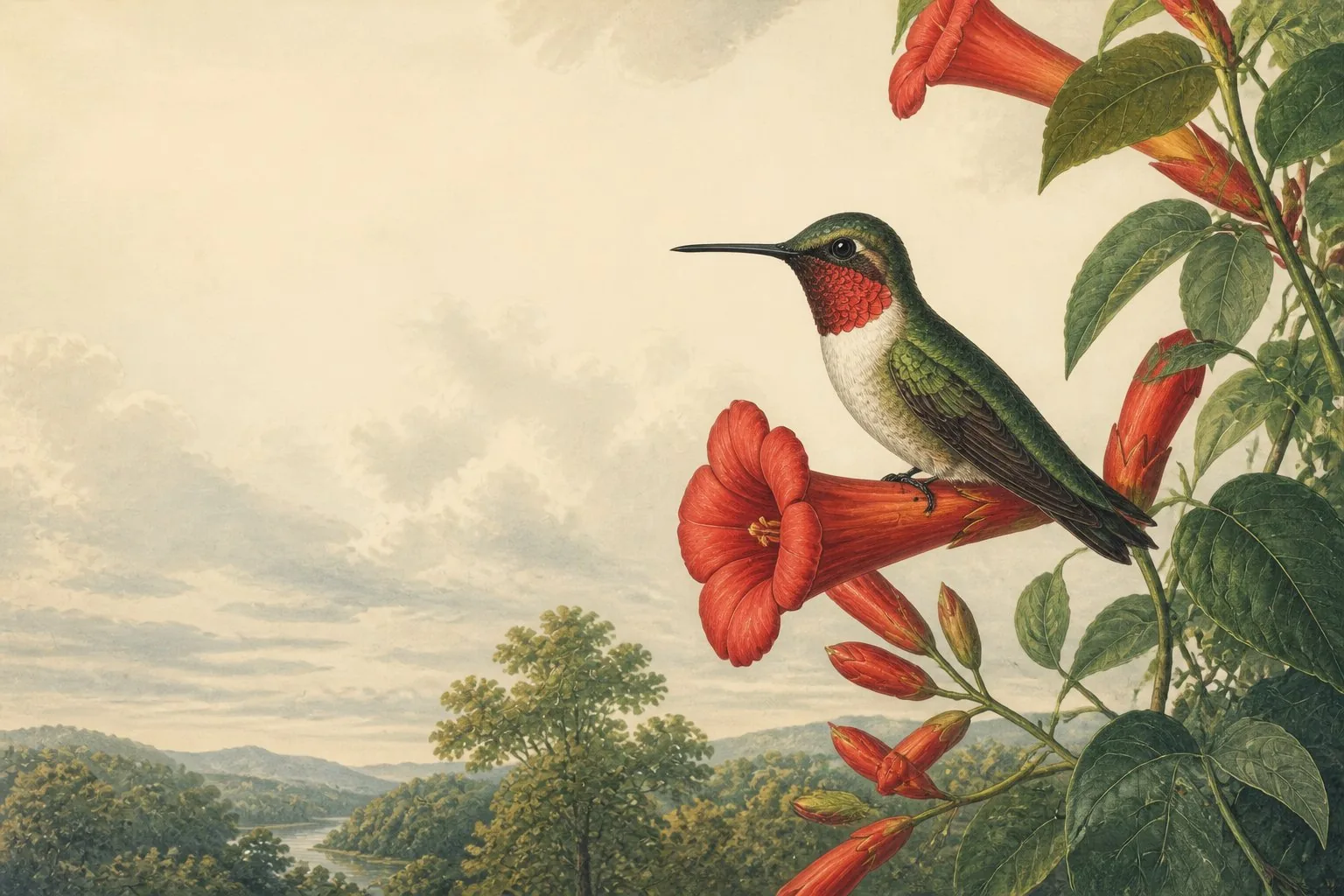
A female ruby-throated hummingbird, Archilochus colubris, spends six to ten days building her nest before she lays a single egg. She chooses the branch herself. She gathers the spider silk herself. Nobody hangs it for her. Nobody could.
The question of where to hang a hummingbird nest contains a premise the bird rejects. She is not a cavity nester looking for a box you have mounted on a post. Cornell Lab’s NestWatch states plainly: “Tiny nest boxes being sold as ‘hummingbird houses’ are decorative at best.” There are no documented cases of hummingbirds nesting in enclosed cavities. The commercially sold hummingbird house is a product that solves a problem the bird does not have.
What the female selects
Audubon’s field guide for the ruby-throated hummingbird describes the nest site as “a tree or large shrub, 5 to 50 feet above the ground, usually 10 to 20 feet, placed on a horizontal branch or one that slopes down from the tree, usually well surrounded by leafy cover.” That descending angle matters: a downward-sloping branch drains rain away from the eggs, and a thin limb sways in wind rather than snapping against the nest.
The Rutgers Cooperative Extension, in its guide to attracting ruby-throated hummingbirds, lists preferred nesting trees as oak, maple, beech, birch, hornbeam, poplar, and hackberry. Species in other parts of North America show different preferences. Anna’s hummingbird (Calypte anna) nests between four and 25 feet off the ground, per Audubon, on branches, vines, wires, or under eaves - and may begin nesting in December in California. Black-chinned hummingbirds (Archilochus alexandri) often choose limbs four to eight feet above a stream. Allen’s hummingbird (Selasphorus sasin) nests anywhere from two to 50 feet up.
The one constant across species: the female chooses alone. The male plays no role in nest construction or incubation.
Why the nest holds together
Spider silk is the structural key. The female collects it by pressing her bill and breast against webs near the site, then works it into plant down and moss to form the cup walls. Audubon reports it serves two functions: adhesive, binding the soft materials into a firm structure, and elastic, allowing the nest to expand as the chicks grow. A ruby-throated nest is roughly two inches across when first built and stretches across the 20 to 22 days between hatching and fledging. Lichen pressed into the outer surface provides camouflage so effective that most people walk directly beneath active nests without seeing them.
Hummingbirds do not use birdhouses because they are not cavity nesters. Any enclosed box marketed as a “hummingbird house” is a gimmick. What works is habitat: native flowers, undisturbed spider webs, sheltered branches, and no pesticides within foraging range.
What you can actually change
Leave the spider webs. If you clear them reflexively, you remove her primary building material. This single step is more consequential than any bracket or platform.
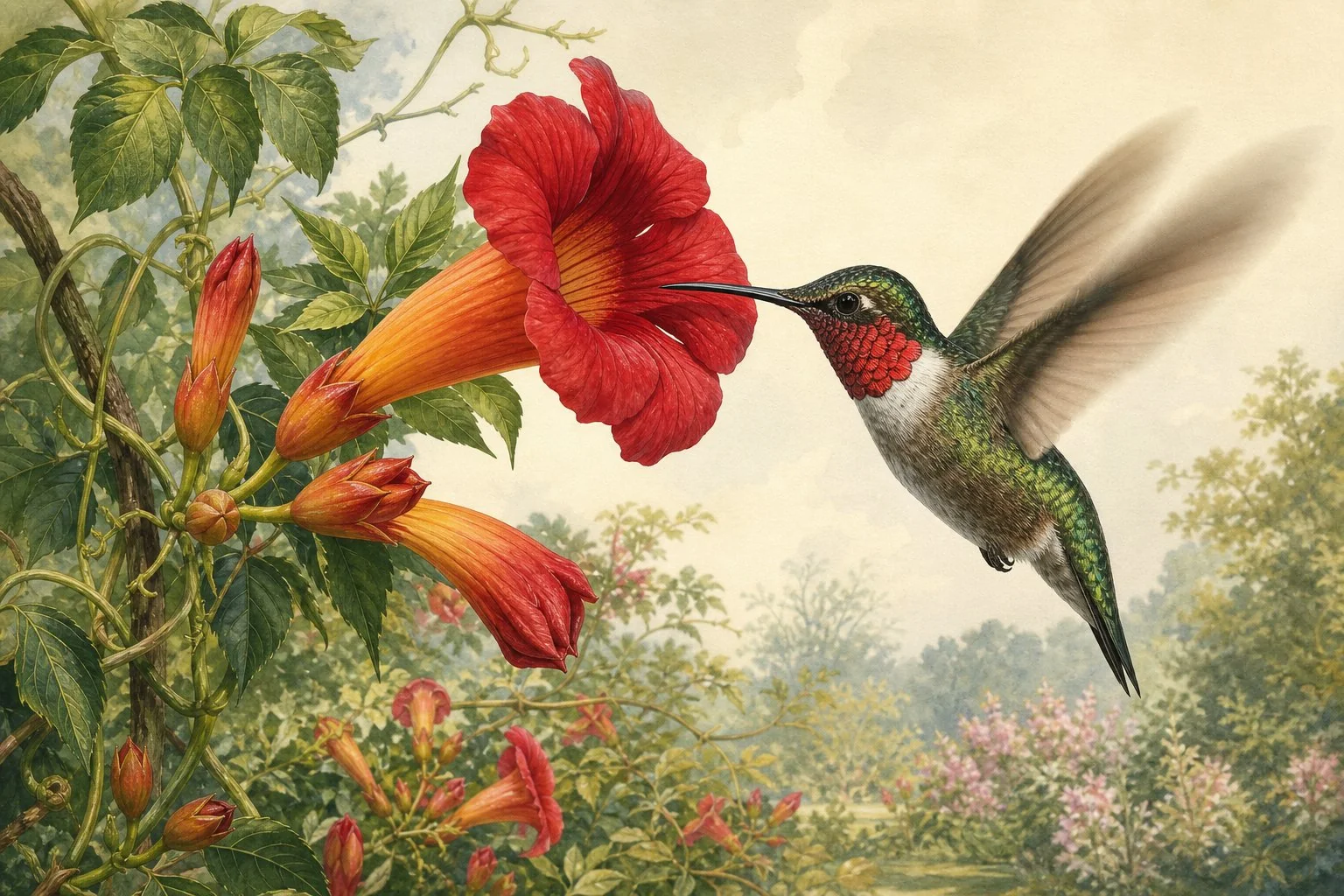
Plant native tubular flowers - cardinal flower, coral honeysuckle, trumpet creeper, bee balm - and protect the insects. Rutgers notes the female may catch up to 2,000 insects during the breeding season to feed her chicks. A yard with no insects is a yard she cannot raise chicks in, regardless of how often the feeders are cleaned. Keep feeders away from candidate nest sites: the territorial aggression around hummingbird feeders is constant, and she nests away from it.
A mature deciduous tree with thin outer branches, overhanging a path or open clearing, gives her the structural site she selects most consistently. A nesting platform - a Y-shaped bracket mimicking a branch fork, mounted at least two metres off the ground in partial shade - can add one more option, but only in a yard that already meets the conditions above.
You probably will not see the nest until it is empty. Unlike the white cardinal or the molting cardinal in August, whose unusual appearance draws your eye, the female hummingbird at her nest is nearly invisible. That is the point. She did not build something you could hang. She built something you can barely find - in the gap between the branch and the sky, on a Tuesday morning in May, with silk from a web you almost swept away.