Symbolism
The Bluebird of Happiness Is Younger Than Your Grandmother
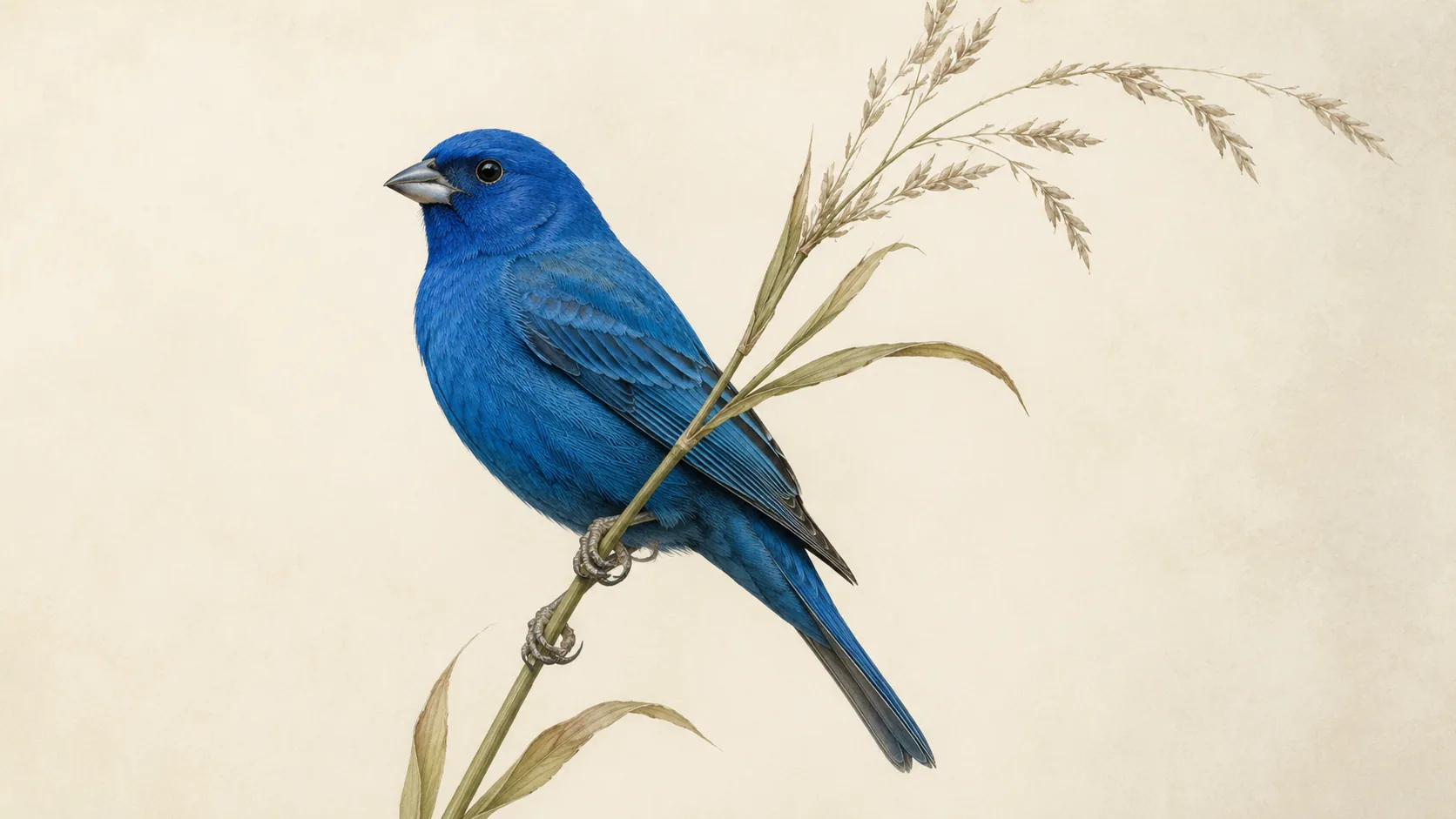
The bluebird of happiness was written by a Belgian playwright in 1908.
Not discovered. Not confirmed by indigenous tradition. Not named as a symbol in any religious text. Written, by Maurice Maeterlinck, in a play called L’Oiseau bleu, first performed at the Moscow Art Theatre in September 1908 under the direction of Konstantin Stanislavski. The play won Maeterlinck the Nobel Prize in Literature in 1911. The “happiness was here at home all along” moral, delivered at the end when the children return from their search to find their own bluebird recovered and waiting for them, entered the English language as a settled phrase within a generation. When someone says “bluebird of happiness” they are quoting the plot of a 1908 Belgian fantasy play, whether they know it or not.
Before 1908 the bluebird had associations. They were different ones.
What Maeterlinck Actually Wrote
L’Oiseau bleu is a fairy tale in six acts. Two children, Tyltyl and Mytyl, are sent by the fairy Bérylune to find the Blue Bird of Happiness, which she needs to cure her sick daughter. The children travel through the Land of Memory, the Palace of Night, a forest, a graveyard, and the Kingdom of the Future searching for the bird. Every bird they find looks blue in its native environment and turns another color when captured or brought out of context.
When they return home - after all of it, the encounters with the dead, the unborn, the spirits - their own turtledove, which has always lived in a cage in their cottage, has turned blue. The bird of happiness was at home the entire time.
Maeterlinck was writing in the Symbolist tradition, the Belgian branch of the French literary movement that included Mallarmé and Verlaine. The blue bird is explicitly a symbol throughout the play - no character in the story encounters it as an actual bird. The “bluebird” the English-speaking world took from the play is the symbolic residue of a theatrical metaphor, not a bird tradition.
The phrase migrated from the theatre into popular culture through the film adaptations (1918, 1940) and through the 1934 Jan Peerce song “Bluebird of Happiness,” which became an American standard and drove the phrase deep into the culture. By mid-century it was assumed to be ancient.
Before the Play: What the Bird Actually Meant
The traditions involving bluebirds before Maeterlinck are more various and more specific.
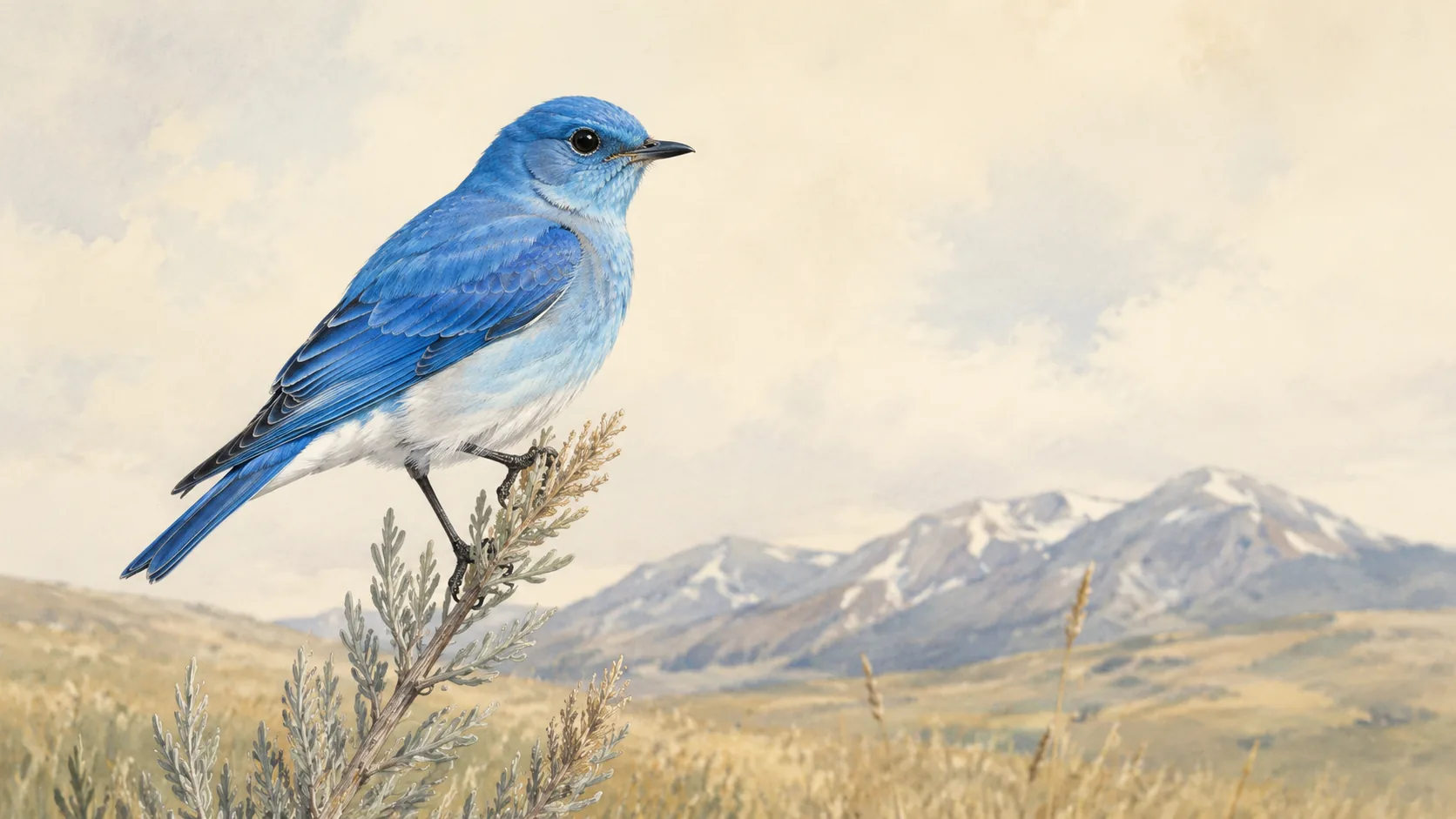
The Navajo associate the Mountain Bluebird - the species that ranges across the western mountains and high plains - with the dawn. In Navajo ceremonial structure, the dawn and the east are paired with specific birds. The Mountain Bluebird is among the dawn-song birds; its appearance at first light is integrated into a ceremonial framework about the relationship between morning, renewal, and the emergence of the day. This is not a happiness belief. It is a cosmological assignment: this bird belongs to this part of the day.
The Cochiti Pueblo have a Bluebird kachina. Kachinas in Pueblo ceremonial life are spirit beings that embody specific forces, qualities, or natural phenomena, and the bluebird’s inclusion in that system reflects its presence in the high-desert landscapes the Pueblo peoples have inhabited for centuries.
The Pima have a bluebird transformation story - a boy who bathed in a lake and emerged blue - structured around vanity, good fortune, and physical transformation. The bird appears at the end as what the boy becomes when his luck turns.
None of these traditions is about happiness in the Maeterlinck sense. They are about cosmological timing, ceremonial function, and narrative transformation. The European fairy-tale happiness reading is a separate structure that arrived a century ago and displaced most of what people know.
The State Bird Pattern
Six states have adopted a bluebird as their state bird: Missouri (Eastern Bluebird, 1927), Idaho (Mountain Bluebird, 1931), Tennessee (Eastern Bluebird, 1933), Nevada (Mountain Bluebird, 1967), New York (Eastern Bluebird, 1970), and Connecticut (Eastern Bluebird, 1984).
The early adoptions - Missouri in 1927, Idaho in 1931, Tennessee in 1933 - come in the two decades immediately following the Maeterlinck play’s peak cultural influence. The later adoptions came as state bird designations were being revisited and revised across many states in the mid-twentieth century. Whether the bluebird’s new symbolic weight as a happiness bird influenced these choices is not documented in the legislative records, but the timing is not accidental. A bird that means happiness is a good choice for a state bird.
The proliferation also reflects real concern. By the time New York adopted the Eastern Bluebird in 1970, the species was in serious population decline.
The Population Crash and Recovery
In the twentieth century, Eastern Bluebird numbers fell dramatically. The cause was direct and human: the House Sparrow (Passer domesticus), introduced to Brooklyn in 1851, and the European Starling (Sturnus vulgaris), introduced to Central Park in 1890, both cavity-nesting birds that compete aggressively for nest holes. Bluebirds cannot excavate their own cavities - they depend on natural holes in dead trees and on abandoned woodpecker holes. House Sparrows and starlings, both larger and more aggressive, took over those cavities faster than bluebirds could use them.
By the 1950s and 1960s, birders across the eastern United States were reporting significant drops in bluebird sightings. The North American Bluebird Society was founded in 1978 specifically to address the decline, primarily through nest box programs - putting up wooden boxes with entrance holes sized specifically to admit bluebirds and exclude starlings.
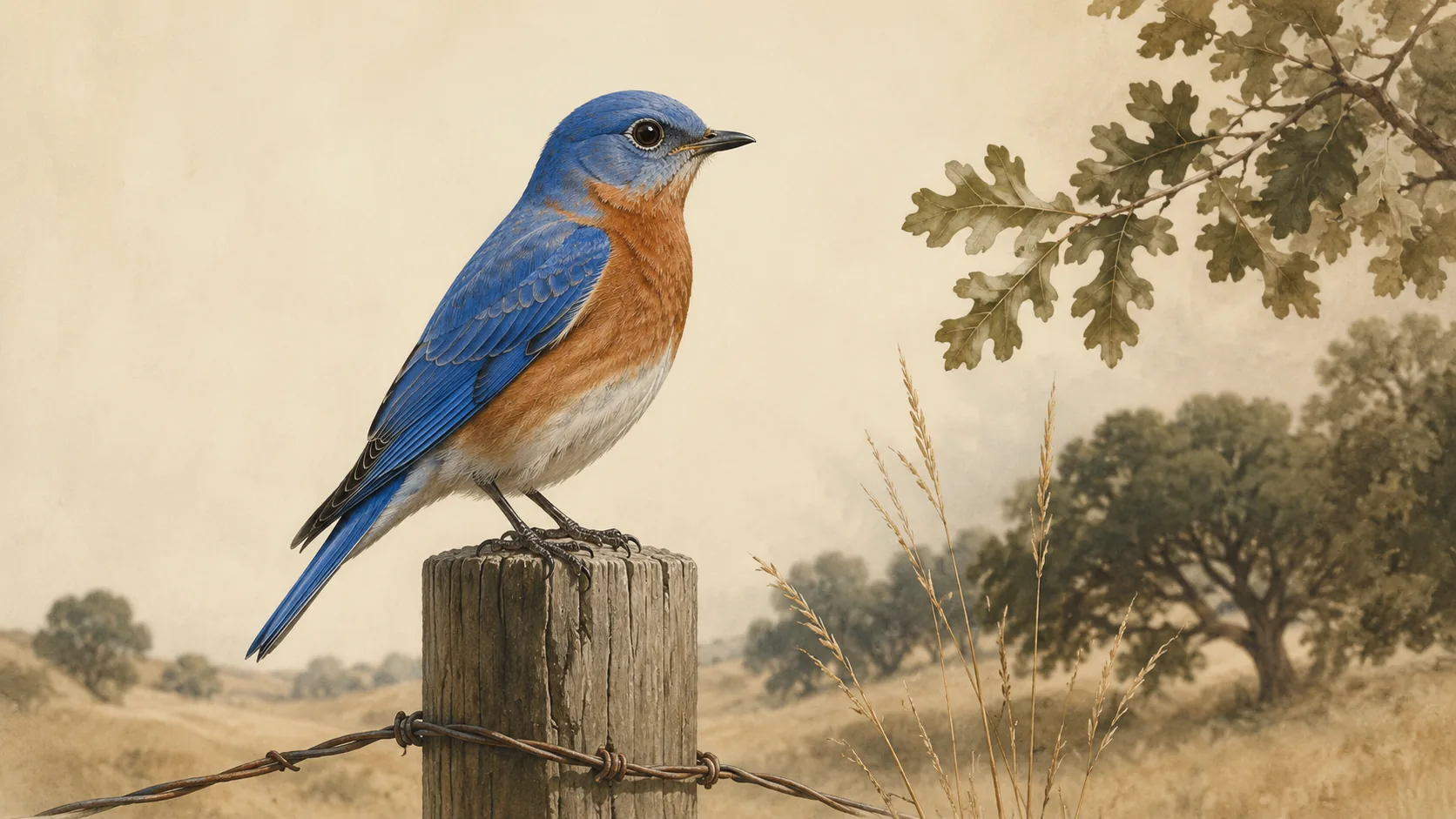
The programs worked. Bluebird populations across much of the east and midwest have substantially recovered. The bird at the fence post is there, in many places, because someone nailed a box to that fence post and defended it from sparrows for decades.
What the Bird Actually Is
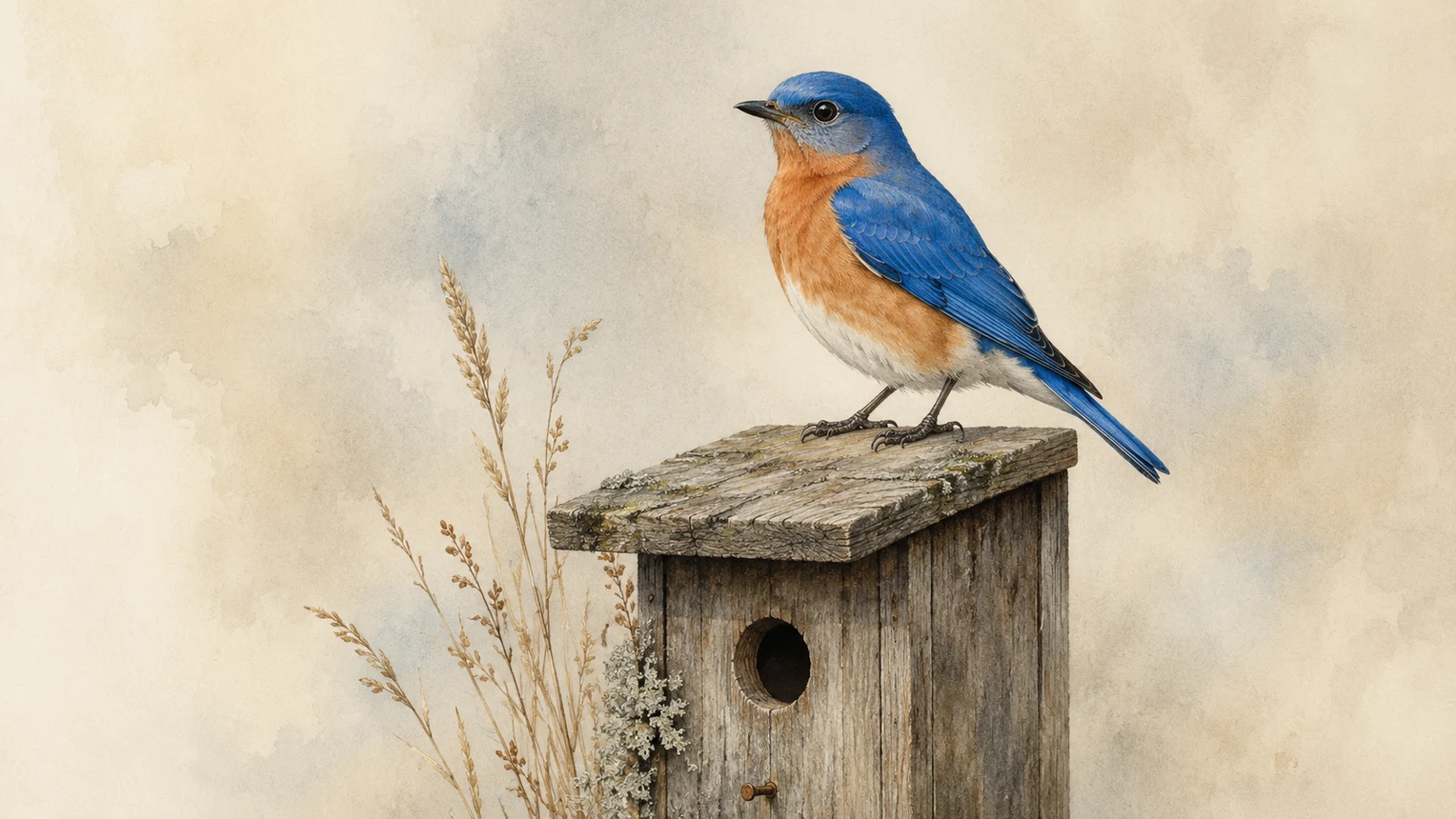
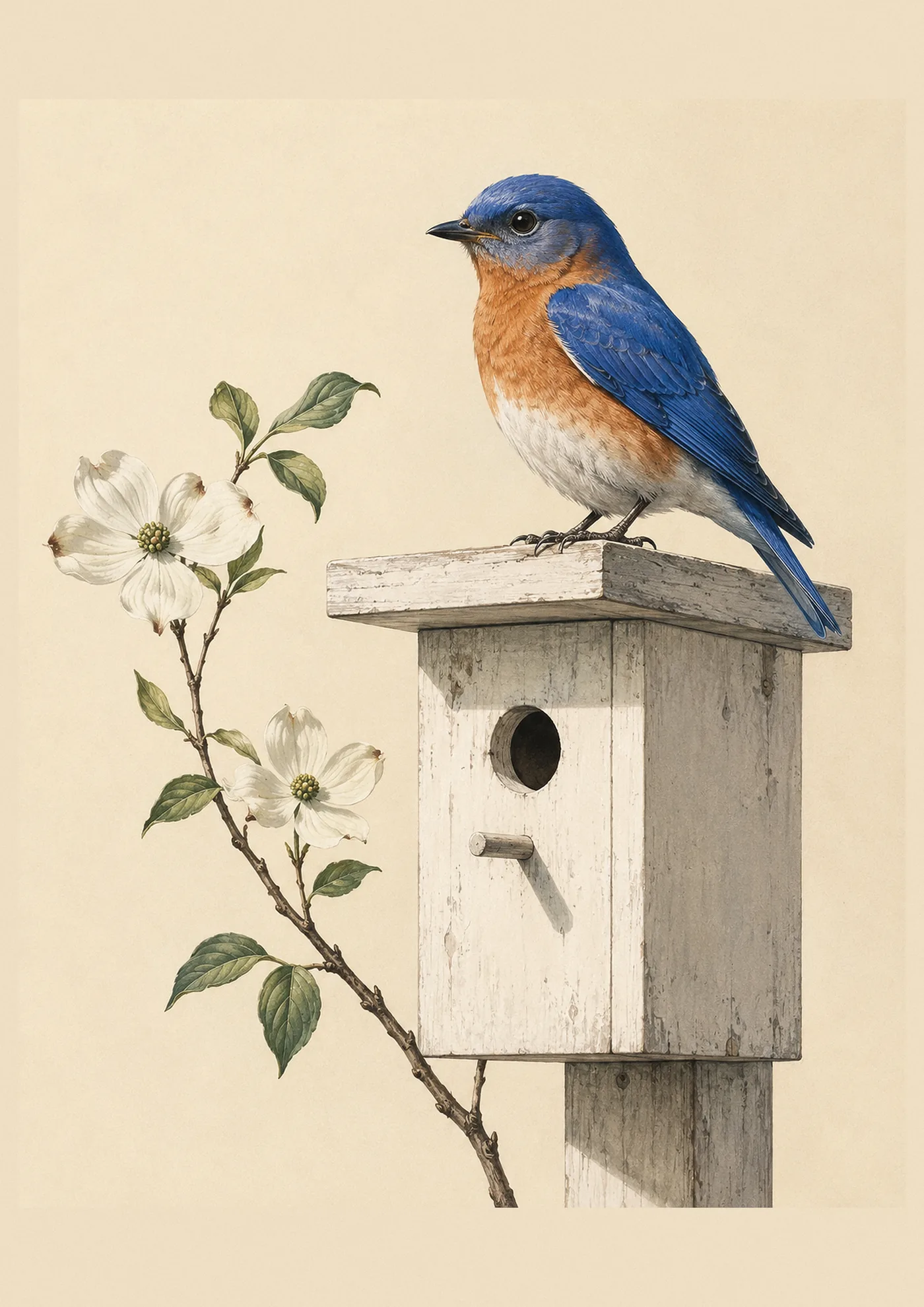
The Eastern Bluebird (Sialia sialis) is one of three North American bluebird species - the others being the Western Bluebird (Sialia mexicana) and the Mountain Bluebird (Sialia currucoides), the only one that is entirely blue rather than blue and orange-red.
The male Eastern Bluebird is the bird of popular imagery: cobalt-blue upperparts, rust-orange breast and flanks, white belly. The female is softer - blue-gray where the male is vivid, with just enough warm color on the breast to signal the same species without announcing it.
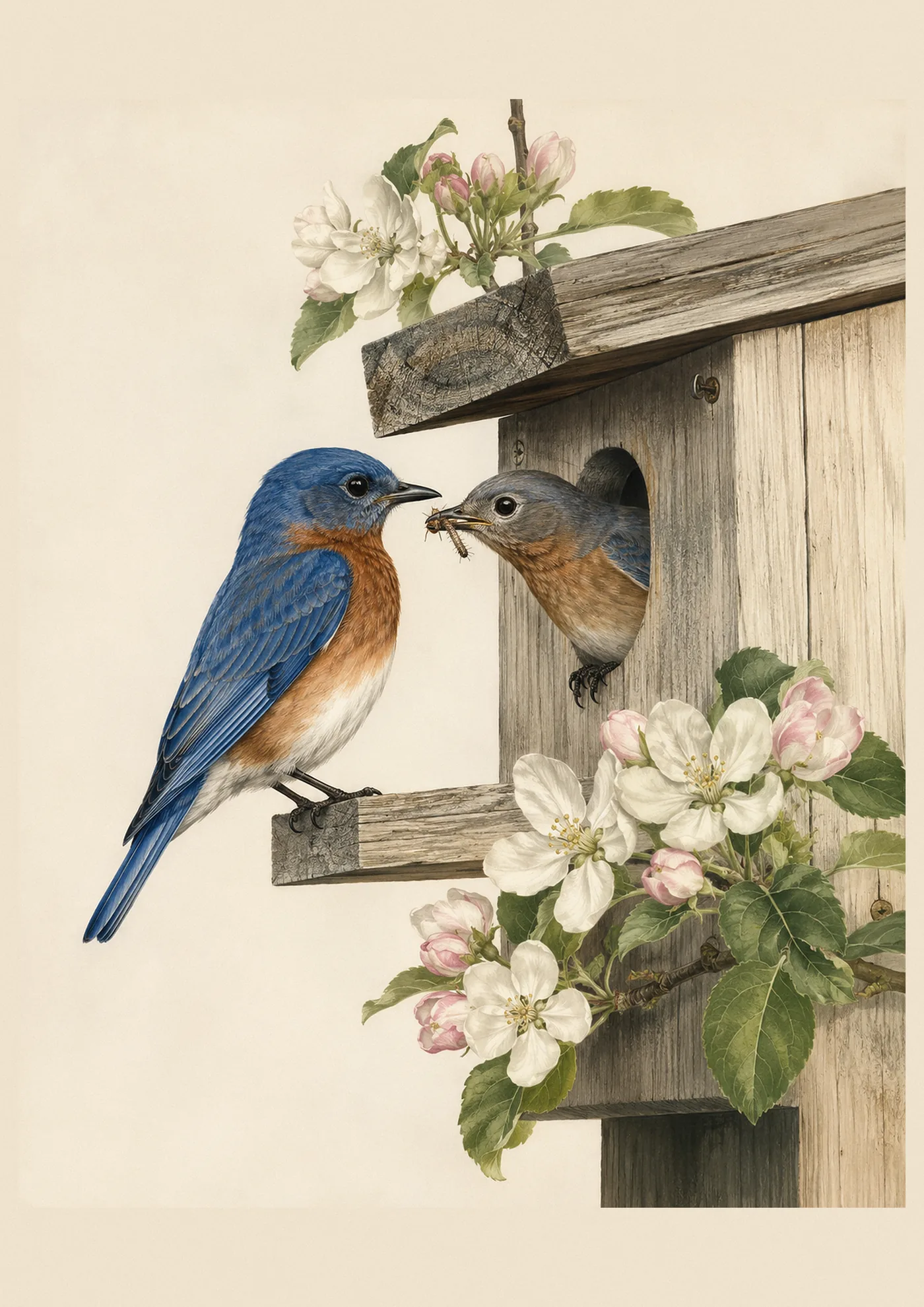
What early observers were watching at nest boxes - and what probably influenced the positive associations long before Maeterlinck - was real behavior. Eastern Bluebirds are cooperative breeders. Young from the first brood of a season regularly remain at the nest to help their parents raise second-brood siblings. A male bluebird brings food to an incubating female throughout the nesting period. A family of bluebirds at a nest box, if you watch long enough, is a functional small community.
The behavior that looks like happiness - the attentiveness, the provisioning, the young from the first brood arriving with food for their newly hatched siblings - is real. Observers were not projecting without cause. They were watching a bird whose social structure is genuinely more cooperative than most. The word “happiness” was Maeterlinck’s. The reason the word attached so easily was that something at the nest box seemed to justify it.
The Honest Accounting
The “bluebird of happiness” is a twentieth-century cultural artifact with a specific, traceable origin: a 1908 Belgian play, two major film adaptations, and a 1934 standard that drilled the phrase into the language.
The indigenous traditions involving bluebirds are older, more specific, and structurally different. The Navajo dawn-bird assignment has nothing to do with personal happiness. The Cochiti kachina tradition is ceremonial and cosmological. The Pima transformation story is about luck and vanity. None of them are the same as Maeterlinck’s metaphor.
What is consistent across traditions, documented and undocumented, is the bird’s behavior: it stays. It returns to the same nest box year after year. It calls in a falling, liquid tone that birders describe as a mournful beauty. The male in spring is visually startling - a blue that seems too vivid for a real bird. The family at the nest box is cooperative in a way that reads, to human observers, as intentional care.
Maeterlinck borrowed a real bird to carry a theatrical metaphor and the metaphor outlasted the play. The bird itself is older than the metaphor, more complicated, and, as of about 1970 in New York State, still worth protecting.
The happiness was not exactly here all along. The bird had to be brought back. But it came back, and the fence post is where it was always going to be.