Field Guide
Mountain Bluebird
On a June morning in a Wyoming sage flat, ten thousand feet up and still cold in the shadows, something hangs in the air above the grass. It is not a kestrel, though it holds the same trembling stall on beating wings. It is smaller, and it is blue. A male Mountain Bluebird, the colour of the sky directly overhead, suspended over a patch of bunchgrass while he watches for the movement of a grasshopper below.
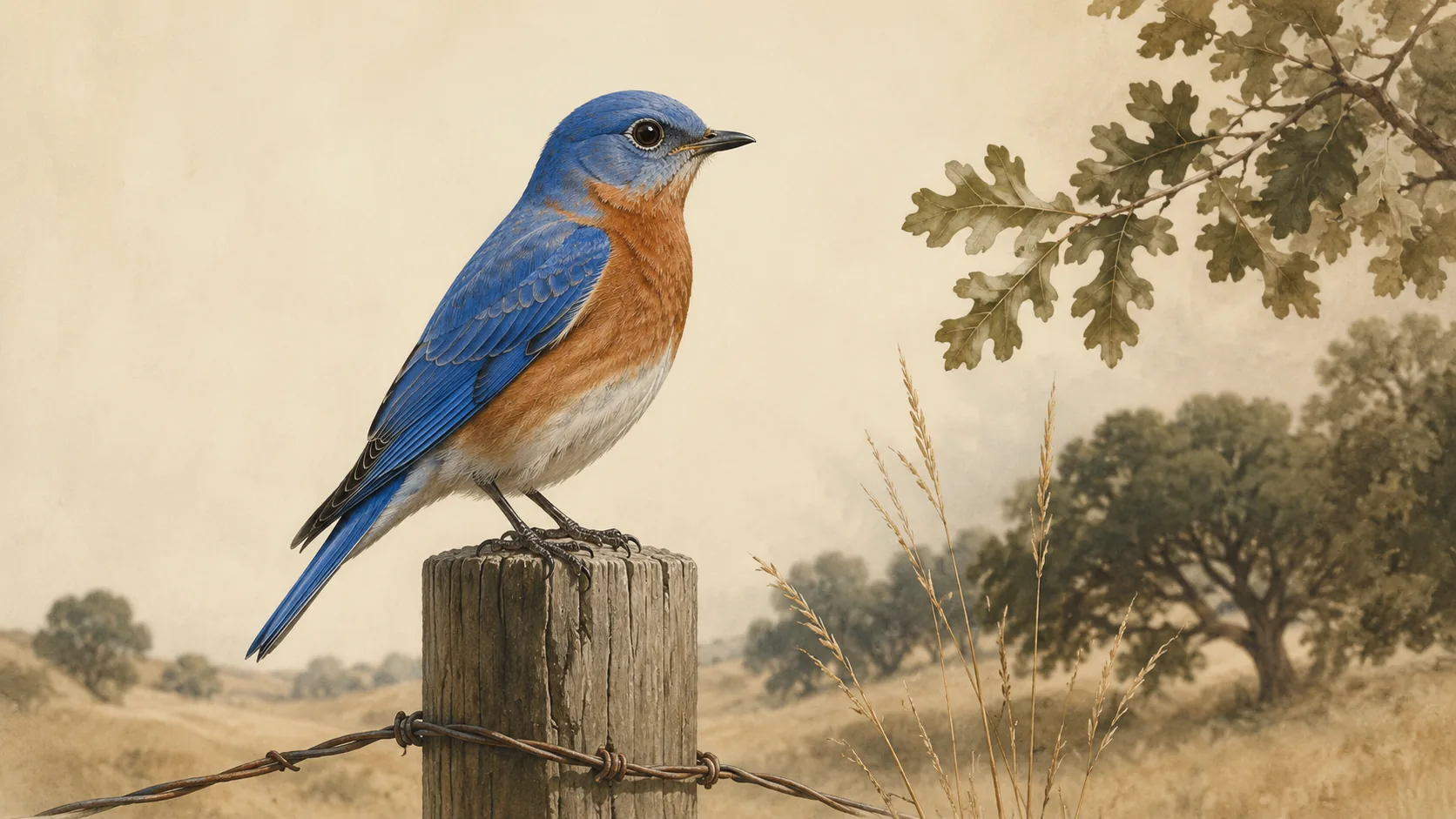
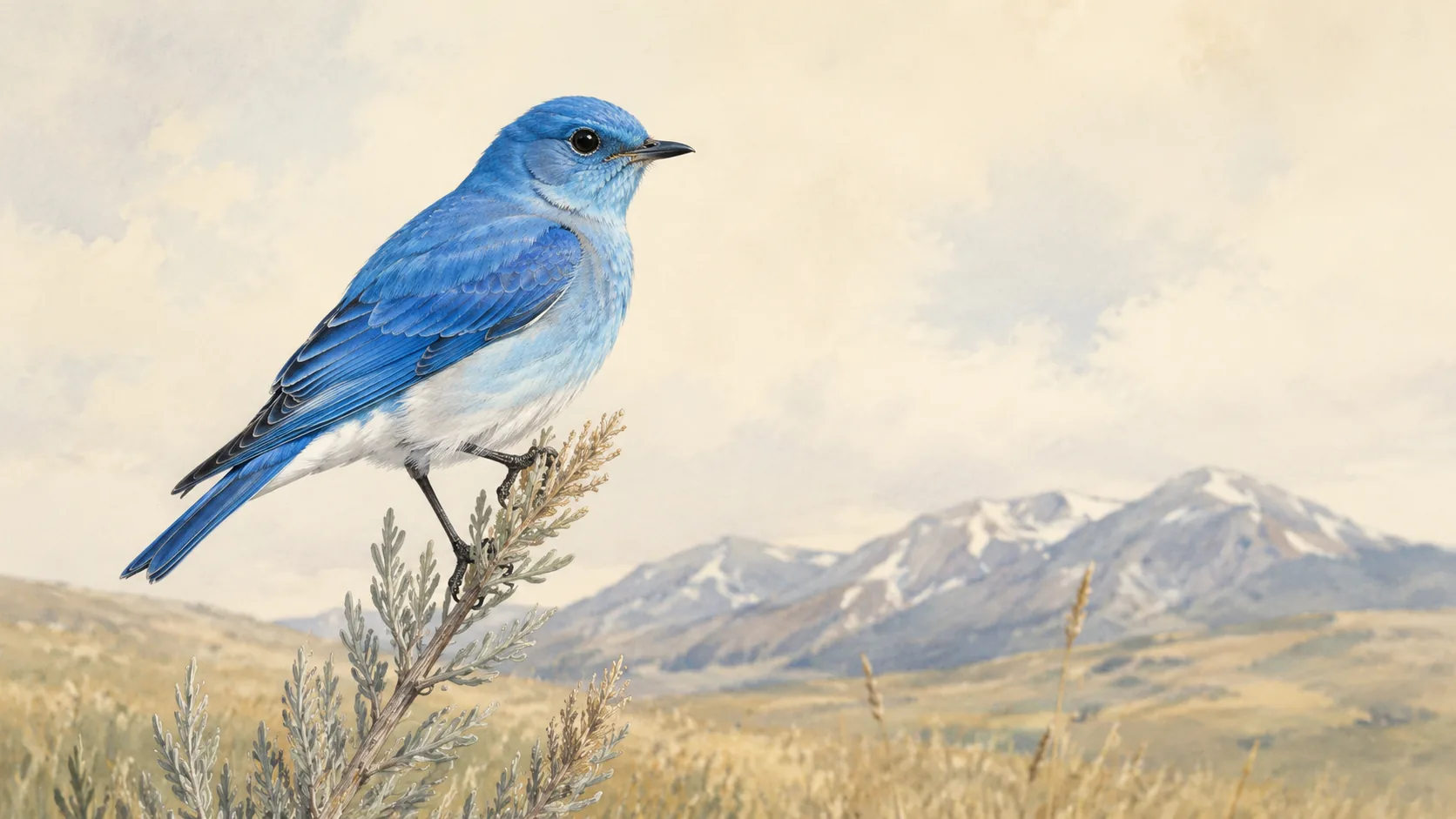
The other two North American bluebirds wear rust on the breast. This one does not. The male is sky-blue and nothing else, paler underneath, deepening to turquoise across the back and wings, with no red anywhere on him. Set him against the high western sky and he is hard to find. Set him against sage or snow and he is the brightest thing in the country.
What he looks like
The adult male is washed almost entirely in sky-blue, brightest and deepest on the upperparts and wings, fading to a paler blue-white on the belly and under the tail. There is no rufous breast band, no chestnut shoulder, none of the warm colour that marks his eastern and western relatives. The blue is structural, not pigment: the same trick of nanoscale feather architecture scattering light that makes a Blue Jay blue and the sky blue. A shed Mountain Bluebird feather held against the light looks grey-brown.
The female is a study in restraint. She is grey-brown overall, palest on the belly, with blue confined to soft washes in the wings and tail that catch the light when she flies. In poor light she can read as plain, but the moment she opens her wings the blue gives her away.
Both sexes are slim, long-winged, and upright, with a thin straight bill. Cornell Lab puts the species at 16 to 20 centimetres long, with a wingspan of roughly 30 to 36 centimetres and a weight between 24 and 37 grams. The overall impression is of a longer-winged, more aerial bird than the eastern or western bluebird, and that shape matches the way it lives.
What he sounds like
The Mountain Bluebird’s voice is quieter and less assertive than its plumage. The song is a low, soft warble of short clear notes, often delivered before dawn from a high perch or in flight, falling and undulating rather than ringing out. The common call is a thin few or a soft chattering tew, easy to miss against wind on an open flat.
Both sexes use the contact calls. The full dawn song belongs mainly to the male, given early in the breeding season as he advertises a territory and, crucially, a nest cavity. Where many songbirds sing to defend a patch of ground, the male bluebird is in large part advertising the hole he has found, because in his world a good cavity is the scarcest thing there is.
Range and habitat
The Mountain Bluebird is a bird of open high country across western North America. It breeds from Alaska and western Canada south through the Rocky Mountains and the Great Basin into the mountains of Mexico, and it nests at elevations the other bluebirds rarely reach. Cornell Lab records breeding territories up to 12,500 feet above sea level, at the edge of prairie and tundra, across sagebrush flats, alpine meadows, pastures, and recently burned or clear-cut ground.
What ties these habitats together is openness with scattered perches: short grass or sage to hunt over, and a tree, fencepost, or cliff with a cavity to nest in. The bird avoids closed forest. It wants sight lines and air.
Unlike the resident eastern bluebird of suburban gardens, this is a genuine migrant. Audubon notes that Mountain Bluebirds move relatively late in autumn and early in spring, and that their winter range shifts from year to year with the food supply, swinging across the open Southwest and into Mexico wherever berries are abundant. In winter they gather into loose flocks, sometimes hundreds strong, drifting over grassland and pinyon-juniper.
Diet
In the breeding season the diet is overwhelmingly insects: beetles, grasshoppers, crickets, caterpillars, ants, and bees, taken from the ground and the air. In autumn and winter the bird shifts heavily onto berries and small fruits, which carry it through the months when insects are gone. The seasonal swing from animal protein to fruit is what allows it to hold open country that freezes hard.
The foraging is the part worth watching. The Mountain Bluebird hunts by hovering, holding a trembling stall a few metres above the grass, scanning, then dropping onto prey, kestrel-like, before lifting back up to hover again. It will also sally out from a low perch to snatch insects in mid-air. Audubon describes this hovering as far more habitual in this species than in the eastern or western bluebird, which perch-and-pounce far more than they hang in the air. On a windy western flat the technique pays: the bird can hold station over good ground and let the grass reveal what moves in it.
Breeding and nesting
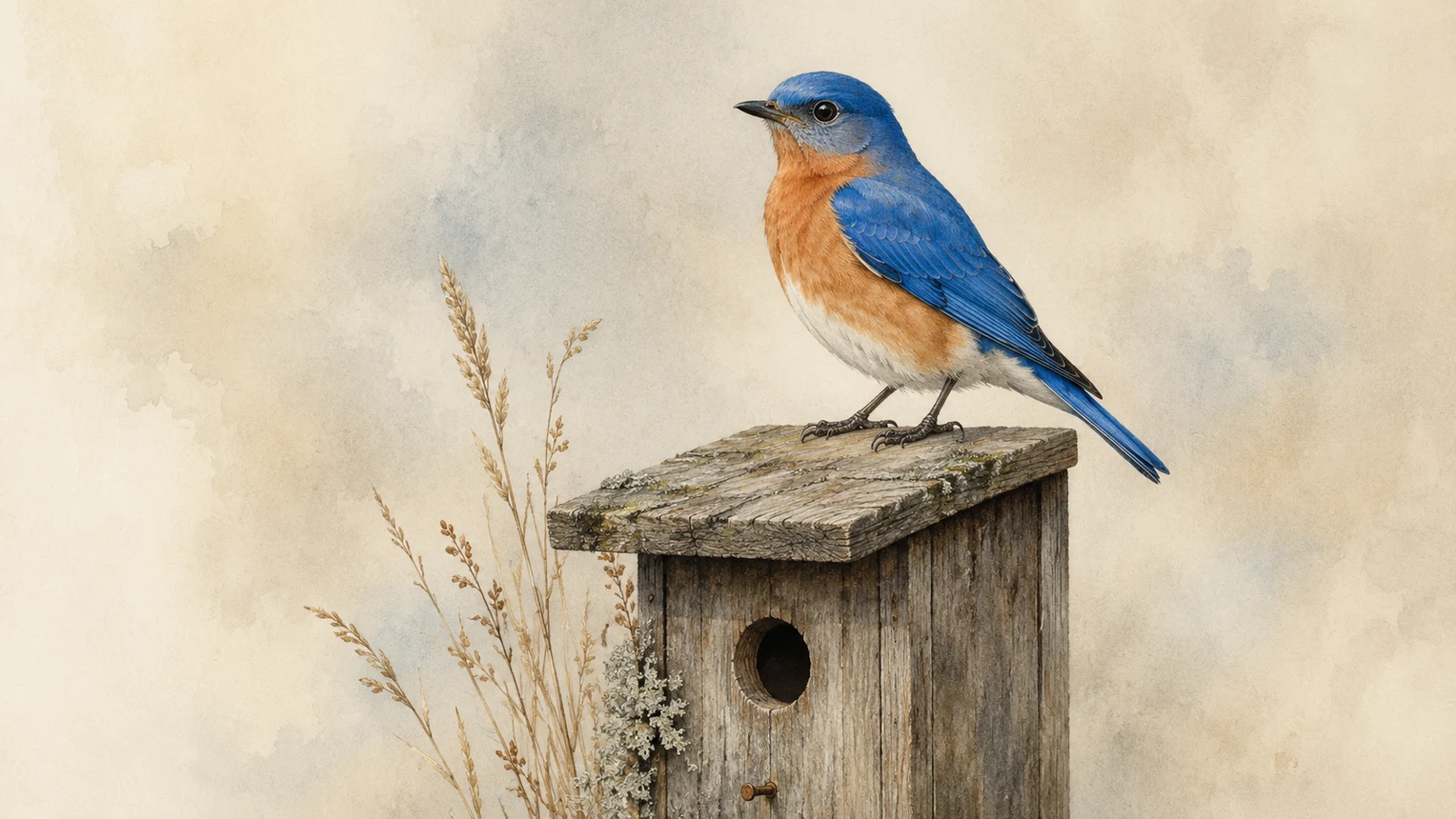
The Mountain Bluebird is a secondary cavity nester. It cannot excavate its own hole, so it depends on what woodpeckers leave behind, along with natural tree hollows, cliff crevices, and, increasingly, nest boxes. Cornell Lab notes that suitable old woodpecker holes are probably in limited supply across much of the range, which makes the cavity the limiting resource and the male’s nest-site advertising central to courtship.
Inside the cavity the female builds a loose cup of grasses, weed stems, twigs, rootlets, and pine needles, lined with finer material, hair, and sometimes feathers. She lays a clutch of usually five or six pale blue, unmarked eggs, occasionally as few as four or as many as eight. She alone incubates, for roughly thirteen to fifteen days. Both parents then feed the young, which leave the nest at around eighteen to twenty-one days and are tended for several weeks more. Pairs commonly raise two broods in a season.
That dependence on cavities is also the species’ vulnerability and its conservation story. As old snags were cleared and competition for holes rose, the bird leaned hard on human help. Bluebird-box trails strung along fence lines and back roads through the western states have given it nest sites where natural ones ran short, and they remain one of the clearest cases of a nest-box programme directly sustaining a wild bird. The IUCN lists the Mountain Bluebird as Least Concern, with a population estimated by Partners in Flight at around 5.6 million and broadly stable.
The behaviour worth watching
The thing to watch is the hover. Most birds that hover are doing something exotic: a hummingbird at a flower, a kestrel on a road verge. The Mountain Bluebird does it as ordinary daily work, and it is the only bluebird that does. A male holding station against a high blue sky, wings a blur, body still, the same colour as the air behind him, is one of the quiet marvels of the western summer.
There is something fitting in a bird this colour choosing to live in the air over the grass rather than in it. He is built to be seen against sage and snow and lost against the sky, and he spends his hunting life pressed up into the sky where he vanishes. The blue that makes the male so easy to admire on a fencepost is camouflage the moment he lifts off to hover.
No other bluebird wears no rust, breeds this high, or hangs in the air to hunt. The Mountain Bluebird does all three, and it is the same colour as the sky it does them against.
For a person, the reward is geographic. You do not get this bird at a suburban feeder. You get it by going up: into the sage, into the high pasture, onto the burned hillside where the dead trees still stand full of woodpecker holes. The Mountain Bluebird is a reason to gain elevation, and it pays the climb in colour.