Field Guide
Yellow-headed Blackbird
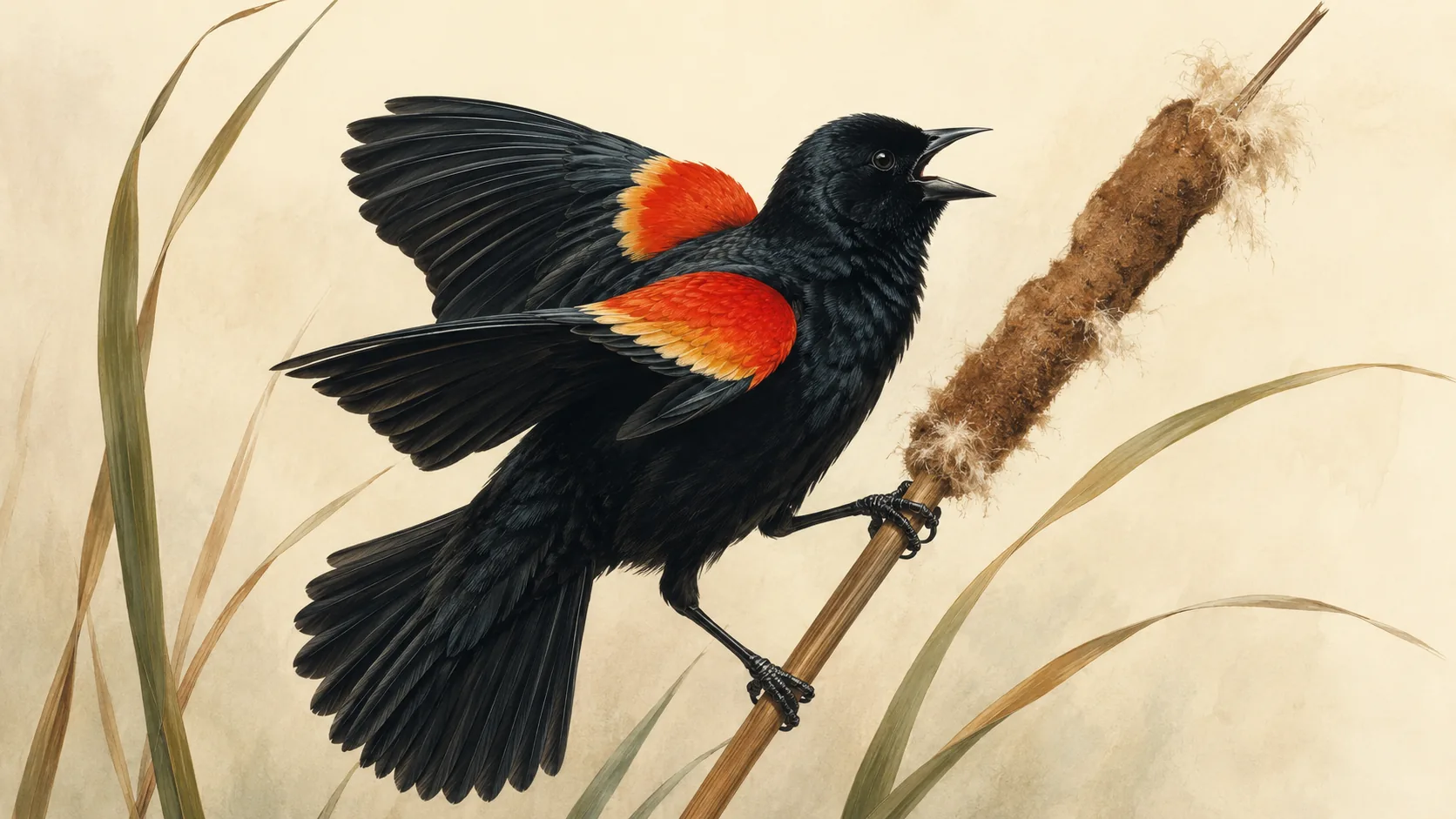
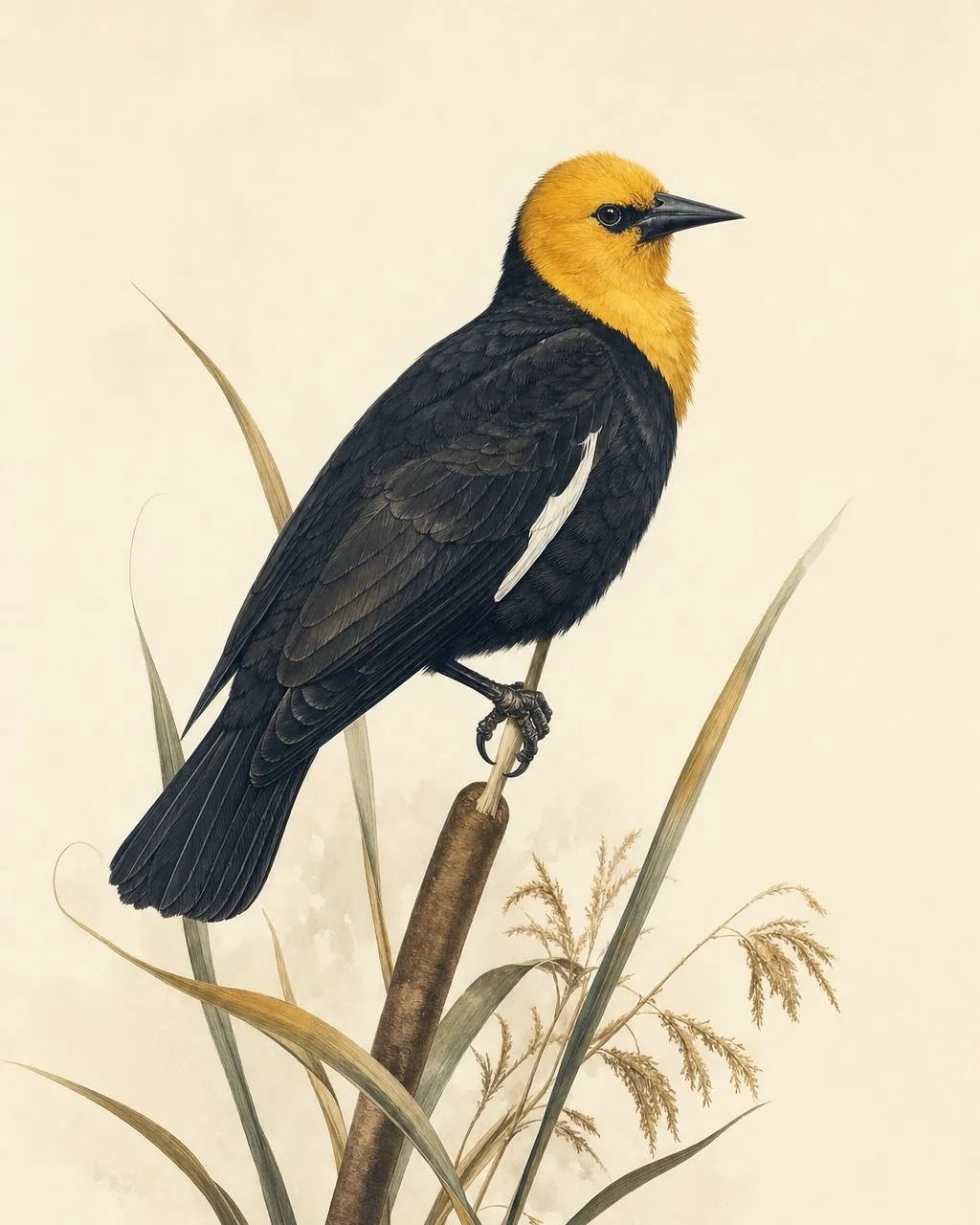
A western marsh in June, cattails and open water, a dozen Red-winged Blackbirds working the reed edges. Then a larger bird drops onto a cattail stem and grips it, the stem bending under the weight. The head is chrome yellow. The body is jet black. White wing patches catch the light. The bird opens its bill, strains forward like something being wrung out, and produces a sound that is best described as a gate being forced open underwater. It holds the note for an improbable duration and then stops.
This is the song. There is no other song in North American birds quite like it.
What It Looks Like
The male Yellow-headed Blackbird is among the most unmistakable birds in North America. The entire head and upper breast are brilliant golden-yellow - not a hint of streaking or graduation, just clean, burning yellow on a jet-black body. The white wing patches show clearly at rest on the shoulder and flash broadly in flight. The bill is heavy and conical. The eyes are dark.
Females are a brown bird with a pale yellow wash on the face and throat and yellow streaks on the breast - recognizable by pattern but much less dramatic. Immature males begin showing yellow on the head in their first fall but lack the clean adult plumage until their second year.
The species is noticeably larger than the Red-winged Blackbird it often accompanies. Size, yellow head, and white wing patches together constitute a field mark package that eliminates confusion in almost any light condition.
| Measurement | Range |
|---|---|
| Length | 21 - 26 cm |
| Weight | 44 - 100 g |
| Wingspan | 38 - 44 cm |
| Lifespan | 4 - 11 years |
Voice
The song has been variously described as a rusty hinge, a circular saw biting into green wood, a protesting mechanical screech. All of these are fair. The male strains visibly to produce it - head forward, bill wide open, body tensed - and the result is a series of harsh, buzzing, grinding phrases with very little tonal quality. It does not build to a climax. It simply grinds and stops.
This description understates the sheer enthusiasm with which male Yellow-headed Blackbirds produce the song. A colony in full display is a wall of grinding sound that carries across the marsh on still mornings.
Calls are more musical: a low, rolling krr-uk given frequently in flight and at colonies.
Range and Habitat
The breeding range covers the interior West from the prairie provinces of Canada south to California, Utah, and the Great Plains of the US. Key states include Utah, Idaho, Oregon, California, and the Dakotas, but the species breeds across the broad intermountain marsh country wherever suitable wetlands exist.
Breeding habitat is fresh and brackish marsh with emergent vegetation - cattails and bulrushes over standing water of moderate depth. The birds require open water for foraging and dense emergent vegetation for nest support. They are colonial and consistently associated with the largest, deepest marsh areas available.
In winter, the species forms large flocks and moves south into the southern US and Mexico, joining mixed blackbird roosts in agricultural areas. Spring migration brings dramatic north-bound flocks across the Great Plains and intermountain West in April and May.
Diet
Insects, seeds, and grain - with a seasonal shift between them. In the breeding season, adults and growing young are fed primarily on invertebrates: beetles, damselfly larvae, aquatic insects, caterpillars, and grasshoppers. Outside the breeding season, grain becomes the primary food source, and winter flocks can cause significant damage in agricultural areas.
The species forages on the ground, in shallow water, and in vegetation, probing and gleaning with the heavy bill. It follows agricultural equipment in plowed fields, taking exposed invertebrates and seeds.
Social Behavior and Nesting
Yellow-headed Blackbirds nest colonially in marsh vegetation, and the social dynamics within a colony are a study in the logic of competition. Males are larger than females and use that size to dominate the highest-quality territories at the center of the marsh - areas over deep water with thick cattail cover that provide the best protection from ground predators. Female Red-winged Blackbirds, which nest around the marsh periphery, are displaced to the edges by the arriving Yellow-headed males each spring.
A successful male holds a territory and attracts multiple females, forming a harem of 2 to 6 that nest within his defended area. The male defends the territory vigorously but provides relatively little parental care - females do most of the incubation and chick-rearing.
The nest is a deep cup woven from wet marsh grass, fixed to cattail stems over water. The female lays 3 to 5 gray-buff eggs with dark speckling. Incubation takes about 12 to 13 days. Young fledge at approximately 9 to 12 days old - an early departure compared to many songbirds.
The Logic of Yellow
The yellow head is a rank signal in the social vocabulary of a breeding marsh. Males arrive before females to establish territories, and early-arriving males with the brightest, most extensive yellow head coloration tend to claim the best territories and attract the most females. Studies of Yellow-headed Blackbirds have found correlations between head color, territory quality, and reproductive success - a classic example of honest signaling, where the trait being advertised is difficult to fake.
The white wing patches serve a similar function in flight display, where males spread their wings to show the patches while delivering the grinding song from a cattail perch. The full display - yellow head forward, wings spread, terrible sound emerging - is a performance structured for an audience of other males as much as potential mates.
The marsh quiets at midday, the males mostly perched and silent, the colony noise dropped to a background murmur. One male gives a single grinding phrase from a cattail twenty meters out, unprompted and unhurried. The yellow head catches the sun and stays lit for a moment after the bird moves back into shadow.