Field Guide
Brown Kiwi
A female Apteryx mantelli - the North Island Brown Kiwi - will spend roughly a month growing a single egg before she lays it. That egg weighs about 430 grams. She herself weighs around 2.6 kilograms. The arithmetic works out to roughly 20 percent of her body mass committed to a single offspring, which she will then hand entirely to her partner. He sits on it alone, in a burrow or a hollow log, for 75 to 90 days. No other bird on earth produces an egg so large in proportion to its body. The kiwi holds the Guinness world record, and the record is not close.
The kiwi is also the only bird known to have its nostrils at the tip of its bill rather than at the base. This is not an anatomical footnote. It defines how the bird experiences its world.
Identification and appearance
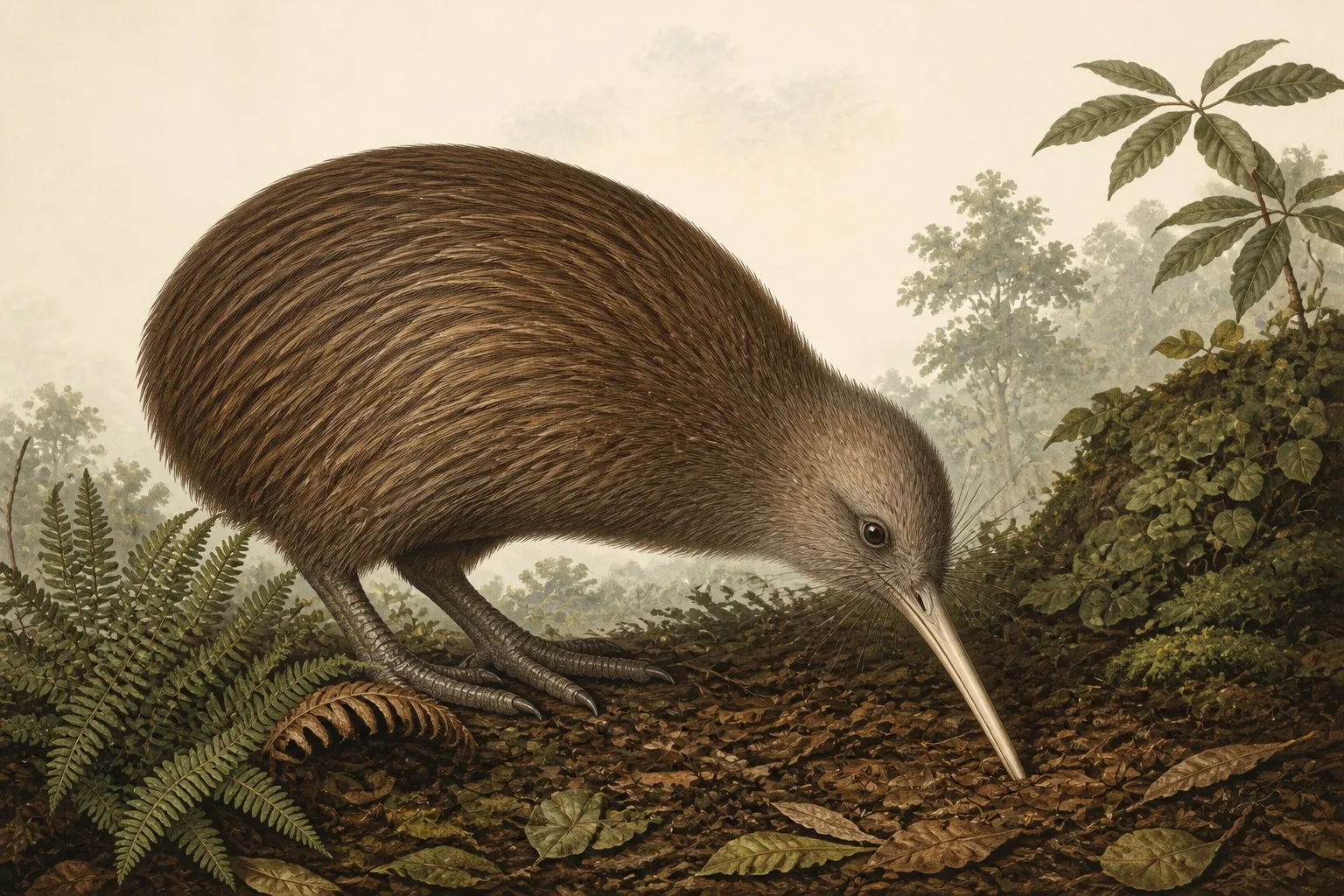
The Brown Kiwi stands roughly 40 to 55 centimetres tall and has no visible wings. The wings exist, vestigially, tucked beneath streaky reddish-brown feathers so dense and hair-like that the bird looks more mammal than bird from a distance. The plumage is a mix of dark brown, reddish-brown, and black, layered in a spiky texture that provides both camouflage in dense undergrowth and insulation through the cold New Zealand night. There is no tail worth mentioning. The legs are short and dark, set far back on the body like a diver’s. The bill is long, pale, and slightly decurved - and at its very tip, those nostrils sit in open air.
Females are consistently larger than males: females run from 2.3 to 2.7 kilograms, males from around 2 to 2.3 kilograms. Both sexes wear identical plumage. Modified facial feathers project around the base of the bill and function as whiskers, helping the bird navigate through vegetation in darkness.
The Brown Kiwi cannot be confused with anything else within its range. Outside captivity and sanctuaries, you will not see one by day. You might hear one.
Voice
The male gives a high-pitched ascending whistle, repeated 15 to 25 times in rapid succession - shrill, carrying, and unmistakable in a native forest at 2 a.m. New Zealand Birds Online describes it precisely this way. The female answers with a lower, hoarser call. Pairs use vocalisations to maintain contact across their territories, and the calls double as warnings to rivals. Brown Kiwi are highly territorial, marking the boundaries of their home range nightly with scent-marked droppings. The calls are the sound of that negotiation.
Because the species is nocturnal and cryptic, voice is usually the only evidence of presence. Experienced guides in Northland can locate a bird entirely by sound and bring a group to within a few metres without a torch.
Range and habitat
The North Island Brown Kiwi occupies the northern two-thirds of New Zealand’s North Island, with the main populations centred on Northland, Coromandel, the eastern North Island, and the western North Island. A population also survives on several offshore island sanctuaries where introduced predators have been eradicated.
The species is notably adaptable. New Zealand Birds Online notes that it inhabits native forest and scrub, pine plantations, rough farmland, and regenerating forest from sea level to 1,400 metres north of the Manawatu Gorge. This flexibility has kept it in the landscape despite dramatic habitat loss. But habitat flexibility does not mean predator tolerance - and that distinction is where the conservation story lives.
Diet
Foraging happens entirely at night and almost entirely by smell and touch. The nostrils at the bill tip allow the kiwi to detect prey beneath the soil surface while probing, without needing to see anything. The bill is inserted into the ground and worked along until a sensory hit registers. This is olfactory hunting - rare among birds, which overwhelmingly rely on vision.
The diet is dominated by small invertebrates: earthworms, the larvae of beetles, cicadas, and moths, centipedes, spiders, crickets, and weta. New Zealand Birds Online records that these make up the bulk of intake, supplemented by small amounts of fruit and leaves. The bird walks slowly along, tapping the ground before probing - a distinctive rhythmic gait that experienced observers recognise even in darkness.
Breeding and nesting
Breeding peaks between June and November. A pair will use the same burrow system over multiple seasons - burrows dug into earth banks or rootstocks, or natural hollow logs, often with multiple entrances. The female lays one to two eggs per clutch and may lay up to five eggs in a season if conditions allow.
Then the male takes over. He incubates alone for 75 to 90 days - one of the longest incubation periods of any bird relative to egg size. New Zealand Birds Online confirms male-only incubation for this species. The chick hatches precocial: fully feathered, eyes open, and capable of leaving the burrow within ten days. Parents do not feed it directly after hatching. The yolk sac provides enough nutrition for the first week, and the chick begins foraging independently early in its life.
Age at first breeding is around four years. Lifespan in banded birds reaches at least 21 years, with estimates of up to 40 years in the wild - a long-lived species by any measure.
The egg, and what it means
Cornell’s Birds of the World flags the egg-to-body ratio as the defining biological peculiarity of the genus. The North Island Brown Kiwi’s egg at approximately 430 grams represents roughly 20 percent of the female’s body weight. For comparison, an ostrich lays an egg that is only about 2 percent of her body mass. The kiwi egg contains a proportionally enormous yolk - nearly twice the yolk-to-white ratio of a chicken egg - which is why the chick can sustain itself post-hatch without parental feeding.
Why so large? The leading explanation, consistent with the extended incubation period and the precocial chick, is that the kiwi trades clutch size and parental post-hatch investment for offspring quality. One well-provisioned, fully developed chick that can fend for itself quickly may survive better in a predator-dense environment than several helpless nestlings requiring prolonged nest attendance. The strategy made sense before European colonisation brought stoats, cats, and dogs to New Zealand’s forests.
Conservation
The IUCN lists the North Island Brown Kiwi as Vulnerable. Approximately 35,000 individuals were estimated in 2015, declining at roughly 2 percent annually in unmanaged areas. The primary driver is predation by introduced mammals - stoats in particular kill chicks before they reach a weight that allows them to evade attack. In areas without active pest control, around 94 percent of kiwi chicks do not survive to breeding age. That figure comes from BirdLife International’s species assessment and is the reason Operation Nest Egg exists: a programme that removes eggs from the wild, hatches and raises chicks in captivity until they are large enough to survive stoat encounters, then returns them to the forest.
Managed islands and fenced sanctuaries - Zealandia in Wellington, Maungatautari in Waikato - have demonstrated that the species can recover where predators are absent. The trajectory of the overall population depends on whether those conditions can be scaled.
A bird that chose depth
The Brown Kiwi is not a survivor because it adapted to open environments or learned to coexist with new pressures. It survived because New Zealand, for 70 million years, had no land mammals at all. The kiwi evolved in a world without teeth, without claws, without anything that hunted at ground level in the dark. Its nocturnal habits, its olfactory hunting, its deep burrows, its extraordinary investment in each egg - all of these are refinements on a template that worked perfectly until 1280 CE, when the first Polynesian canoes arrived with rats in the bilges.
That history does not make the kiwi fragile. It makes it the product of one of the longest uninterrupted evolutionary experiments in vertebrate history. The bird at the end of that experiment has nostrils at the tip of its bill, no wings worth speaking of, and the stamina to sit on an egg for three months. What it did not evolve was a response to the stoat.
Conservation, in this case, is not about restoring something lost. It is about substituting, artificially, the predator-free conditions under which the kiwi’s entire biology makes sense.