Field Guide
Yellow-eyed Penguin
A Yellow-eyed Penguin comes ashore at dusk on the Otago coast of New Zealand’s South Island, climbs a steep beach and walks, improbably, into the trees. It does not stop at the shoreline as other penguins do. It keeps going, up through coastal scrub and flax and the edge of native forest, until it reaches a nest hidden under dense vegetation where no other penguin can see it. Then it calls, a shrill, far-carrying cry that gives the bird its Maori name, hoiho, the noise shouter. It is one of the rarest penguins in the world, and the only one that lives like this, apart, in the forest, alone.
Megadyptes antipodes is endemic to New Zealand, found nowhere else on earth. It is the sole living member of its genus, an ancient lineage distinct from every other penguin in this field guide, and it is in deep trouble. The IUCN has listed the species as Endangered since 2000, and on the New Zealand mainland the population has fallen steeply enough that some researchers fear local extinction within decades.
What it looks like
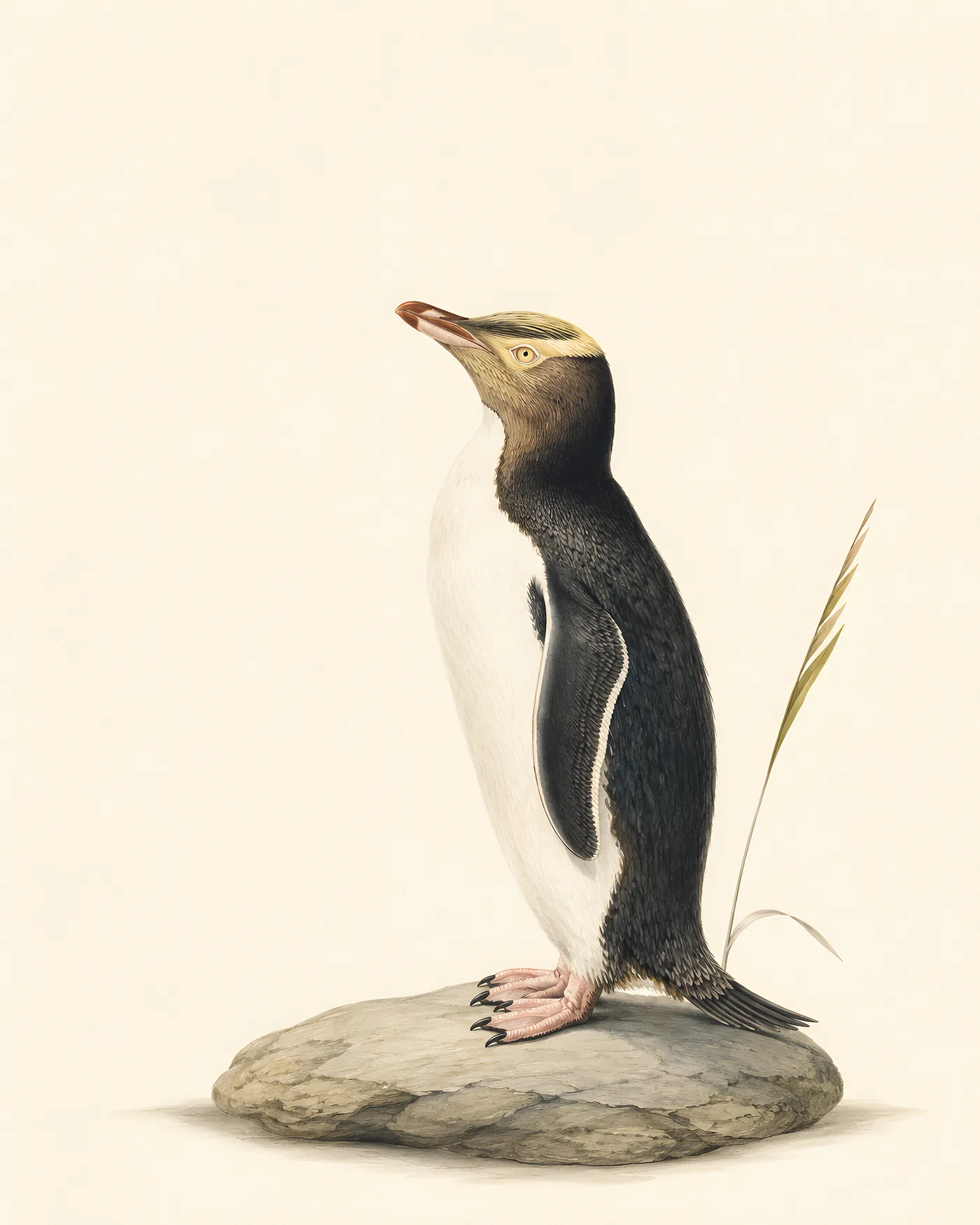
An adult Yellow-eyed Penguin stands around 62 to 79 centimetres tall and weighs roughly 5 to 6 kilograms, the weight rising and falling sharply across the year, making it one of the larger penguins after the Emperor, King and Gentoo. It is a heavy-set, upright bird with a pale pinkish bill and pink feet.
The name does the identifying. The eyes are a striking pale yellow, and a band of bright yellow feathers runs from the eyes back around the crown, encircling the head like a thin gold halo against the slate-grey of the face. The back and flippers are blue-slate, the underparts white. No other penguin carries that pale yellow eye combined with the yellow head-band, and against the green of its forest habitat the effect is unmistakable. Juveniles are duller, with a greyer eye and a fainter band that brightens as they mature.
What it sounds like
The Maori name hoiho translates as noise shouter, and the call earns it. The main display is a loud, shrill, ringing cry, high and penetrating, given at the nest and as birds come ashore. It carries a long way through the coastal forest, which is how mates and rivals locate one another in habitat where, unlike an open colony, birds cannot simply see across to their neighbours. Cornell’s Birds of the World records a repertoire of trumpeting, braying and softer contact calls, but it is the shrill ashore-cry at dusk that gives the species its name and its character.
Range and habitat
The Yellow-eyed Penguin breeds only in New Zealand. The mainland population is strung along the south-eastern coast of the South Island, on the Otago Peninsula and the Catlins, with further breeding on Stewart Island and its outliers and on the subantarctic Auckland and Campbell Islands to the south. The subantarctic islands hold the larger share of the birds; the mainland population, the one most people see, is small and shrinking.
The habitat is what sets the species apart. The Yellow-eyed Penguin is not a colonial nester. It needs coastal forest, scrub or dense vegetation close to the sea, and it nests solitarily, each pair out of sight of the next, sheltered under shrubs, flax, or among tree roots and logs. This is unique among penguins, and it is also the species’ weakness, because that forest fringe has been cleared, grazed and degraded across much of the bird’s mainland range.
Diet
Yellow-eyed Penguins are pursuit divers that feed mainly on small fish, including blue cod, red cod, opalfish and sprat, along with some squid. They forage on the sea floor and through the water column over the continental shelf close to their breeding sites, diving to the bottom in water up to a hundred metres or more and working along it for prey. They are inshore, benthic feeders rather than open-ocean wanderers, which ties them tightly to the health of a relatively small patch of sea near each colony.
That tight link is part of why the species is so vulnerable. Warming sea temperatures, changes in prey, and bycatch in set-net fisheries all hit a bird that cannot simply move its hunting grounds far offshore.
Breeding and nesting
The Yellow-eyed Penguin pairs solitarily and is long-lived and faithful, with many pairs staying together across years and returning to the same patch of forest. The female lays two eggs, usually in September, and both parents share an incubation of roughly six weeks. Both then guard and feed the chicks, which fledge after about three to three and a half months, a long chick-rearing period that demands a reliable supply of fish close to home.
Because the nests are hidden and dispersed rather than packed into a defended colony, the chicks are exposed to a particular set of dangers: introduced predators able to reach them in the undergrowth, and the loss of the vegetation cover that hides them. Where colonial penguins gain some safety from sheer numbers, the solitary hoiho has none.
One of the rarest penguins on earth
The conservation picture is stark and must be stated plainly. The Yellow-eyed Penguin is one of the rarest penguin species in the world, with a total of only around a couple of thousand breeding pairs across its entire range, and the mainland New Zealand population in particular has declined sharply, hit by years with high adult mortality and repeated breeding failures. The IUCN classifies the species as Endangered.
A penguin that walks up off the beach and into the forest to nest alone is also, by the IUCN’s count, among the rarest of all its kind, and the mainland birds are vanishing within a single human lifetime.
The threats are layered. Introduced predators, ferrets, stoats, cats and dogs, take eggs, chicks and adults at the dispersed forest nests. The clearing and grazing of coastal forest has stripped away nesting cover. Set-net fisheries drown adult birds. Warming, shifting seas disturb the inshore fish the species depends on, and disease and heat events have driven die-offs in some years. Conservation groups in New Zealand, working closely with mainland and Maori communities, now run predator trapping, habitat replanting and a dedicated hospital for sick and injured birds. The hoiho appears on the New Zealand five-dollar note, a national emblem, while the bird itself slips toward the edge.