Field Guide
King Penguin
On South Georgia in late winter, the slope above Salisbury Plain holds perhaps 100,000 brown, shaggy juveniles standing in loose clusters without a single adult in sight. The parents are at sea, somewhere north of the pack ice, diving to 300 metres for lanternfish. The chicks - called ‘oakum boys’ by the whalers who named them after the fibrous caulking material they resemble - have not been fed for weeks. Some have been waiting since May. It is now September. This is not neglect. It is the arithmetic of a breeding cycle that no other penguin on earth attempts.
Aptenodytes patagonicus, the King Penguin, is the second-largest penguin alive, smaller only than the Emperor. It breeds not on sea ice but on bare, vegetated ground at subantarctic latitudes, between 45 and 55 degrees south, on a belt of wind-scoured islands that encircles the globe. What sets it apart from every other member of its family is time. The cycle from egg to fledged chick runs 14 to 16 months. That length is the central fact of the King Penguin’s existence, and nearly every unusual behaviour it shows is a consequence of trying to fit that cycle into a year that only has 12 months.
What it looks like
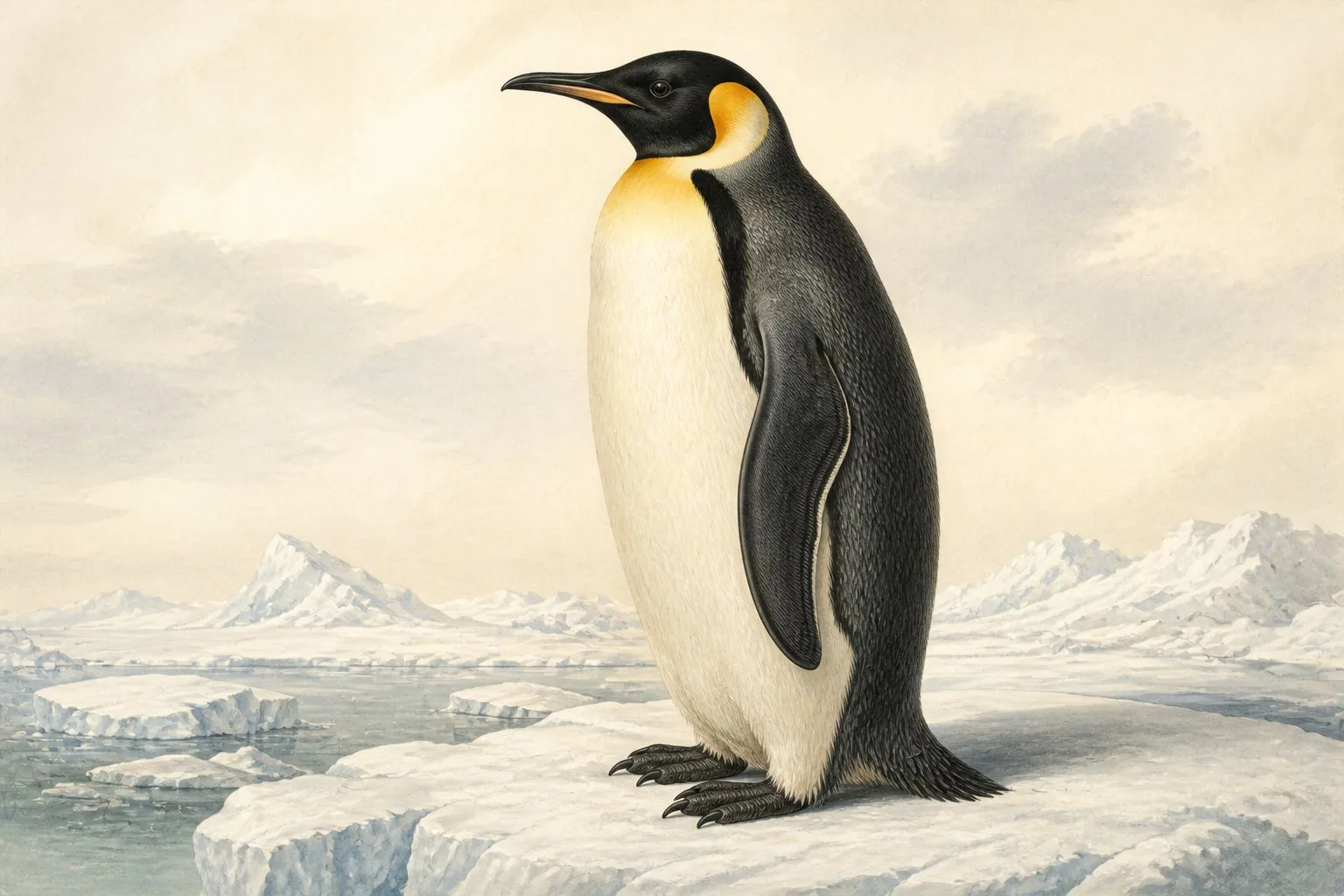
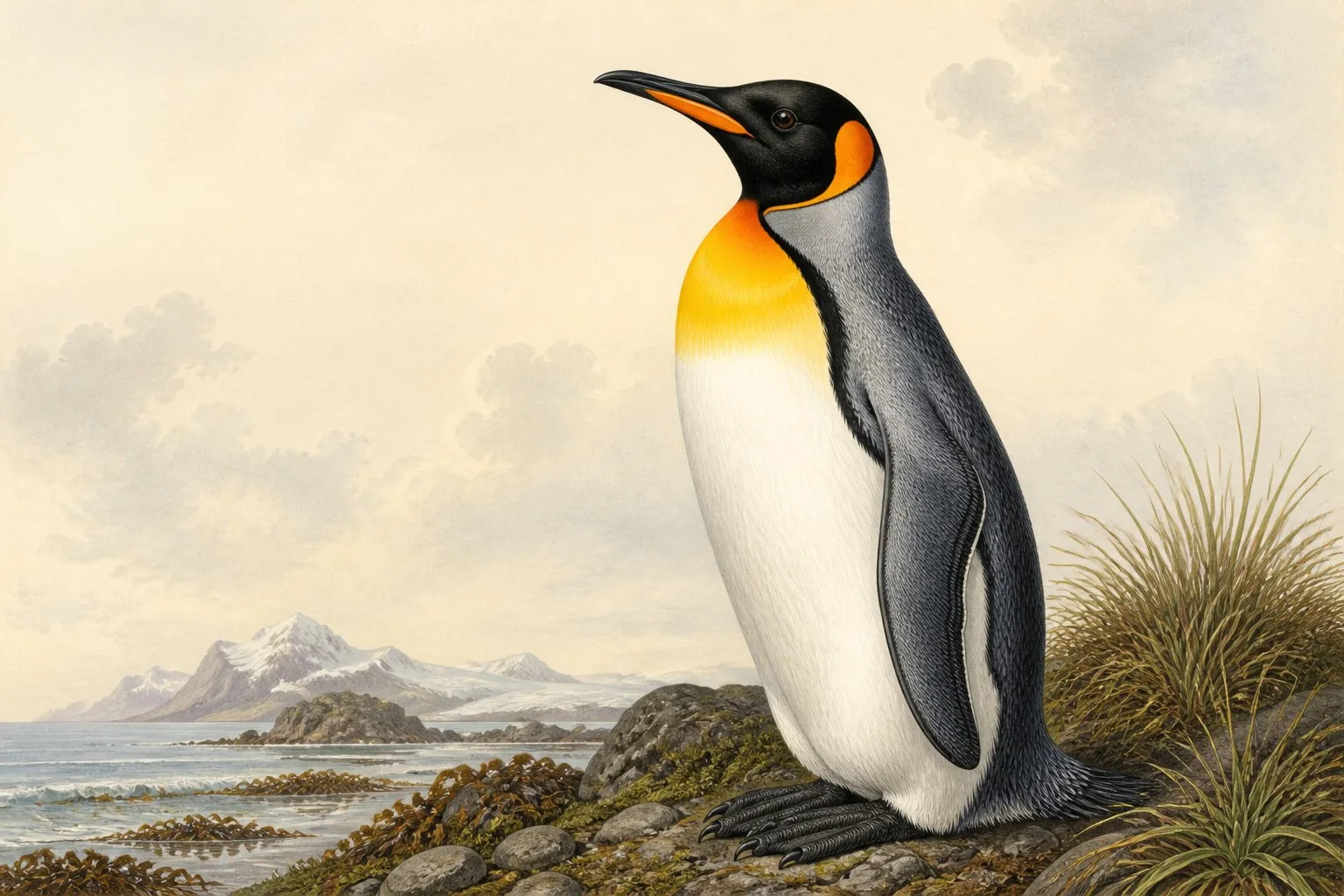
An adult King Penguin is 85 to 95 centimetres tall and weighs between 14 and 17 kilograms, with males slightly heavier than females. Britannica notes that the species is slimmer and more upright than its larger relative, and the posture reinforces this - Kings stand straighter, with a longer neck and a bill that tilts upward in display. The back is a grizzled blue-grey. The chest and underparts are white. The head is black. What defines the bird at a distance is the pair of vivid orange-gold ear patches, teardrop-shaped, that extend down from behind the eye and merge into an orange wash across the upper breast. The lower mandible carries a narrower orange streak. No other penguin in the subantarctic carries that combination of size and colour.
Juveniles are unrecognisable. Covered in long, dense brown down, they were described as a separate species by 19th-century naturalists. They are large enough to prompt confusion - as big as adults, but shapeless and dark. The adult plumage emerges gradually in the second year.
Voice
A King Penguin colony is not quiet. The call at close range is a braying, wheezing trumpet that carries across a rookery of tens of thousands of birds. Birds of the World describes the colony sound as overwhelming - pairs tilt their bills toward the sky and call in coordinated displays. The function is pair-bond reinforcement and individual recognition. In a colony without fixed nest sites, where the same bird returns to the same spot not by landmarks but by sound, vocal signature is the only reliable locator. A parent returning from a two-week foraging trip locates its chick among thousands of others by voice alone - a capacity tested and documented by researchers on Crozet and South Georgia.
Range and habitat
King Penguins breed on the major subantarctic islands. South Georgia holds a large portion of the global population. The Crozet Archipelago, in the southern Indian Ocean, holds a very large population - the colony at Ile aux Cochons was historically counted among the largest single concentrations of King Penguins on earth, though it has declined sharply since the 1980s. South Georgia holds the largest total breeding population, estimated at around 450,000 pairs across its colonies. Kerguelen, Prince Edward, Heard, Macquarie, and the Falkland Islands all support colonies. The species is circumpolar across the subantarctic zone, absent from the eastern Pacific sector. Between breeding seasons, birds range north across open ocean, remaining south of the subtropical convergence but well north of Antarctic pack ice.
The habitat preference - ice-free ground near sea access, with enough shelter from wind to sustain standing rookeries - separates Kings from Emperors, which breed in the dark of Antarctic winter directly on sea ice. Kings choose warmer ground and pay for that choice with a breeding cycle that must span two consecutive seasons to complete.
Diet
The King Penguin is a specialist. Cornell’s Birds of the World notes that lanternfish (myctophids) dominate the diet, comprising more than 99 per cent of prey by number during the breeding season. Squid consumption increases over winter. To reach these prey at depth, Kings dive to recorded depths exceeding 300 metres and can remain submerged for up to 10 minutes. Their flippers - modified forelimbs, not wings - are rigid, dense-boned, and powerful, evolved entirely for propulsion through water. The aerodynamics that shaped the wing of every other bird in this field guide simply do not apply here.
Breeding and nesting
The King Penguin lays a single egg, which both parents incubate on their feet, balanced on top of the tarsal joint and insulated under a fold of belly skin, exactly as the Emperor does. Incubation lasts approximately 54 days. The chick hatches in midsummer. It feeds through autumn, fattening rapidly on fish regurgitated by parents who alternate foraging trips of roughly two weeks each.
By the time winter closes in, the chick is nearly adult size but still wearing brown down. The parents’ foraging trips lengthen as prey moves farther offshore. Feeding becomes infrequent. The chick fasts. Research published in the Journal of Experimental Biology documented fasts of up to five months in King Penguin chicks, during which they lose around 70 per cent of body mass while sustaining core organ function on stored fat. The chick does not starve. It waits.
In spring, feeding resumes. The chick completes its moult to juvenile plumage and fledges - at which point the parents begin the cycle again if the calendar permits. Britannica records that most pairs breed successfully at most twice in every three years, not once annually. The maths of this is hard: a species whose chick takes over a year to fledge cannot synchronise to a 12-month calendar. Pairs that start late in one season will be late again the next, and may lose that chick before it fledges.
The constraint that defines the species
The King Penguin’s breeding biology is unusual enough that it invites a position: among birds that raise a single chick per attempt, the King Penguin runs the longest committed investment cycle in the world, and the entire shape of the species - the long dive capacity, the specialist fish diet, the vocal recognition system, the extraordinary chick endurance - is downstream of that single fact.
The IUCN lists the species as Least Concern. The global population is estimated at approximately 1.6 million breeding pairs, and numbers have been broadly stable in recent decades following the end of commercial exploitation of the islands where it breeds. Some colonies have declined as sea surface temperatures shift prey distribution northward, but the species is not currently under acute pressure.
What is less often stated plainly: a seabird that takes 14 months to raise one chick and breeds at most twice in three years is operating with almost no margin for error. Environmental disruption that delays feeding by a few weeks can collapse an entire cohort. The ‘oakum boys’ standing through a subantarctic winter are not resilient. They are committed. There is no equivalent in the rest of ornithology for what they are enduring.
The King Penguin’s chick is not waiting to grow up. It is waiting to resume - suspended in the gap between what the world’s calendar allows and what the species requires.