Field Guide
Adelie Penguin
In 1911, the British naval surgeon George Murray Levick spent an entire breeding season inside the world’s largest Adelie Penguin colony at Cape Adare, Antarctica. He was the first trained observer to do so. His published account, Antarctic Penguins: A Study of Their Social Habits, described a species of extraordinary social density, furious industry, and complicated loyalty. His unpublished notes - locked away for nearly a century - described something more uncomfortable: that the social contract inside a penguin colony is considerably rougher than the published version suggested.
Both accounts are true. The Adelie Penguin, Pygoscelis adeliae, is one of the most studied birds on Earth, and still one of the least domesticated in the human imagination.
What it looks like
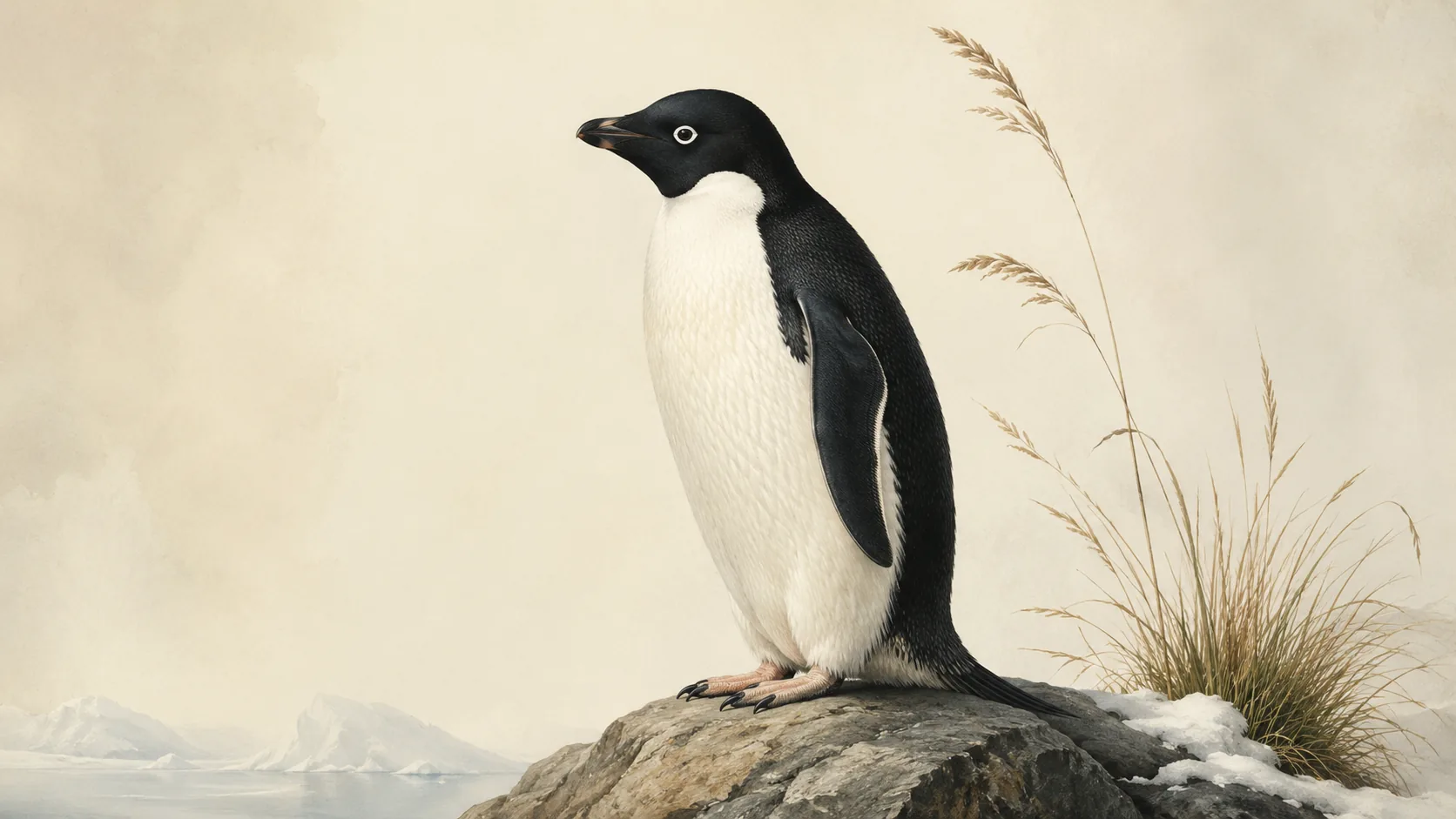
The Adelie stands 70 to 73 centimetres tall and weighs between 3.8 and six kilograms, though males arriving for the breeding season can carry considerably more mass - and shed it fast during the incubation fast that follows. The plumage is clean and unfussy: head, throat, back, and tail are black; the belly is white. What makes the Adelie instantly recognisable is the white ring around each eye, a narrow band of bare skin that gives the bird a fixed, alert expression at all distances.
The bill is short, orange-red, and partly feathered at the base - an adaptation that reduces heat loss in a bird that breeds at temperatures no other penguin species tolerates. The flippers are narrow and rigid, built entirely for propulsion underwater. Cornell’s Birds of the World notes that the Adelie is classified within the genus Pygoscelis, the brush-tailed penguins, alongside the Chinstrap and the Gentoo. All three breed further south than any other penguin genera, and the Adelie reaches further still.
Males and females look alike to the human eye, though males average slightly larger in bill length and body mass.
Voice
The Adelie is not quiet. Colonies of tens of thousands of birds produce a continuous wall of braying, grunting calls that carry across a kilometre of Antarctic beach. Individual birds use calls to locate their mate and their chicks within that noise - a recognition system that must work without visual cues in a colony where every bird looks identical from a distance. Paired birds perform an ecstatic display together: neck stretched skyward, bill pointed at the sky, flippers extended, chest pumping. The call during this display is one of the louder sounds in Antarctic wildlife, and it is directed not at the colony in general but at one specific bird.
Range and habitat across the year
The Adelie is a circumpolar species, breeding on the Antarctic continent and on surrounding islands including the South Orkneys, South Shetlands, South Sandwich Islands, Balleny Islands, and Scott Island. The IUCN lists the species as Least Concern with a large and increasing population - estimated at roughly 3.79 million breeding pairs across 251 known colonies as of 2020.
Breeding colonies occupy bare rock or gravel ground from which snow has melted. The birds need exposed substrate for their stone nests; ice-covered ground is useless. In winter, Adelies move north onto pack ice, resting on floes and hunting in the leads between them. They return to the breeding colonies each October with a consistency that colony researchers describe as near-absolute: most birds arrive within a few days of the same calendar date each year, regardless of weather.
The southernmost colonies, in the Ross Sea region, have been studied continuously since the 1980s. Long-term data from those sites shows that breeding success tracks sea ice conditions closely. Years of heavy ice mean longer foraging trips; longer foraging trips mean thinner chicks; thinner chicks mean lower fledgling survival. This is why, even with a stable overall population, the IUCN flags the species as potentially vulnerable to the long-term ice changes already underway on the Antarctic Peninsula, where some regional populations have declined sharply over the past 50 years.
Diet
Antarctic krill (Euphausia superba) is the primary prey for most Adelie populations, supplemented by ice krill, Antarctic silverfish, and lanternfish. Historical isotope analysis of feathers and bones from museum specimens - work published in the early 2000s - reveals that Adelie diets shifted from heavily fish-based to heavily krill-based roughly 200 years ago, coinciding with the near-extermination of baleen whales and fur seals in the Southern Ocean. The removal of those competitors appears to have made more krill available to penguins; what looks like dietary preference is partly a record of industrial whaling.
Foraging Adelies dive to average depths of around 45 metres and can reach 180 metres. Dive duration averages about 90 seconds. The birds swim at four to seven kilometres per hour in pursuit of prey, with burst speeds reaching 15 kilometres per hour.
Breeding and nesting
Males arrive at the colony first, in late October, and claim the previous year’s nest site if they can. This is not sentiment - it is real estate. A good nest site is elevated, south-facing, and well-drained. The stone nest prevents eggs from sitting in meltwater during incubation. The better the site, the higher the breeding success year after year.
Then the pebble work begins. A male builds his nest from stones, and he will steal pebbles from neighbouring nests when their owners are away. This is well documented, not anecdotal: researchers have marked individual stones and tracked them moving from nest to nest across a colony in the course of a single morning. The thefts trigger chases and fights. A male who is a skilled thief - and a bad victim - ends up with a larger nest than his neighbours, which makes him more attractive to a returning female, which is the point.
Females arrive about a week after males. A pair that bred together the previous year will typically reunite at the same nest site. Two eggs are laid, incubated in alternating shifts lasting two weeks each while the non-incubating parent forages. Incubation takes 32 to 34 days. Chicks fledge roughly 50 to 60 days after hatching, by which time they are approaching adult body mass on a diet of regurgitated krill delivered by parents who are themselves working at the edge of their foraging range.
The stone thief
What makes the Adelie worth understanding - beyond the scale, beyond the statistics - is the gap between how it presents and what it does. The tuxedo pattern suggests formality. The upright posture suggests dignity. The reality is a bird that will cross six nest-lengths to steal a pebble the moment its neighbour looks away, then carry that pebble back with the focused urgency of an animal who understands exactly what it is worth.
Levick noted this in 1912. Researchers have been confirming and elaborating on it ever since. The pebble economy inside an Adelie colony is not background detail; it is the mechanism by which breeding quality is sorted. Stones move toward the males most willing and able to acquire them, which tends to correlate with age, experience, and physical condition. The nest you end up with is a measure of the bird you are.
Every Antarctic field season, researchers watch this play out across colonies of 60,000 birds at once - a continent-scale experiment in competitive nest-building, repeated annually on frozen ground at the edge of the planet.
The Adelie Penguin builds its case from stones, one theft at a time.