Field Guide
Long-tailed Duck
In December, on the open waters off Alaska, a raft of Clangula hyemalis rides a grey swell. The drakes have their long central tail feathers up - black needles lifted at an angle against the sky - and every few minutes one throws back his head and calls. The sound carries clean across the water: a rolling, musical ow-ow-owdle-ow that old hunters recognized a mile out. The whole raft answers.
That image contains the species in miniature: a small sea duck of the high Arctic, built to dive to depths that would stop most waterfowl cold, wearing one of three different wardrobes it will shift through before spring, and making more noise about it than almost any other duck alive.
What it looks like
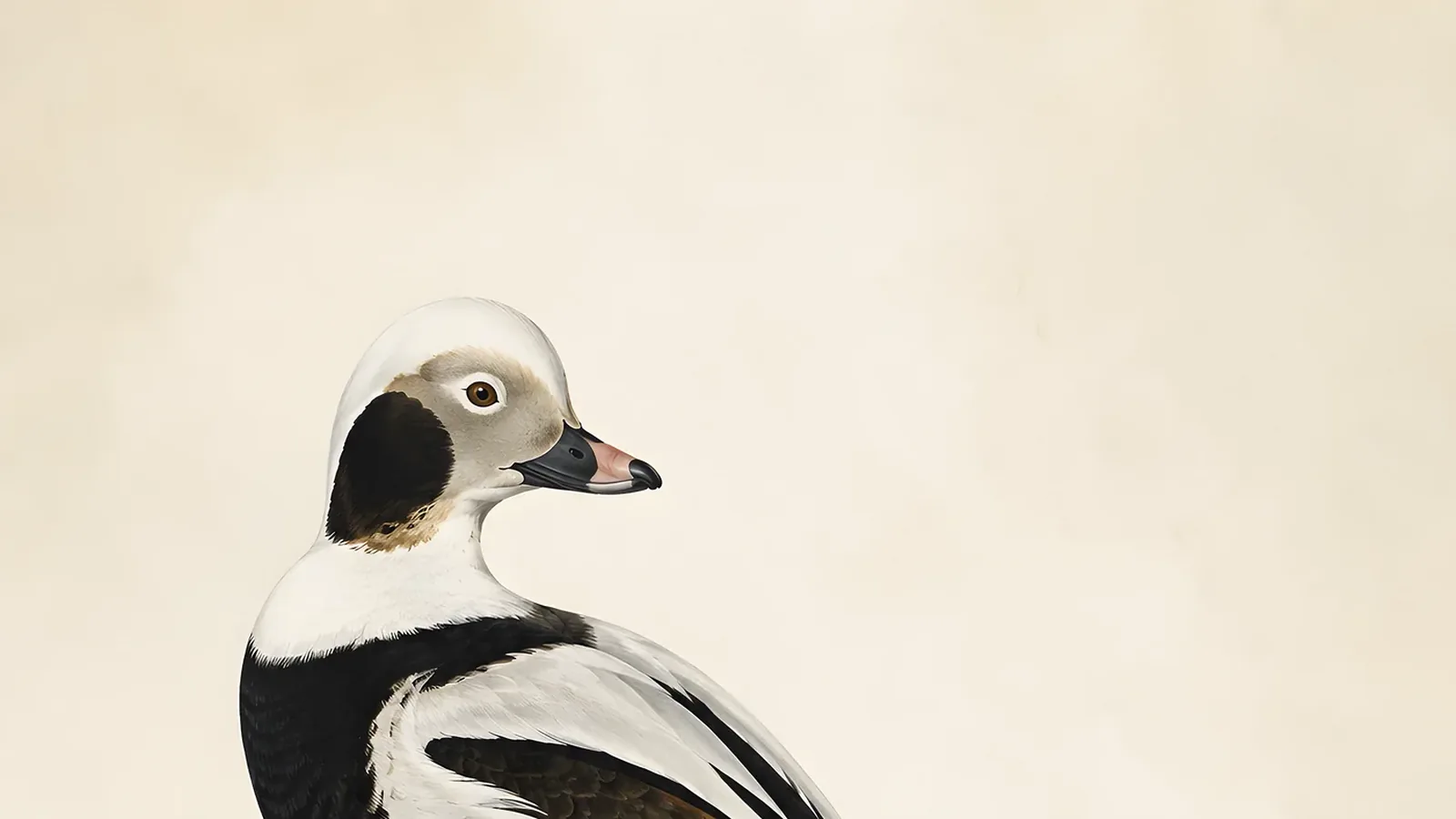
The male Long-tailed Duck in winter plumage is one of the sharper contrasts in North American waterfowl. His head and neck are mostly white, with a bold dark patch on the cheek and a dark breast-band that wraps around the chest like a collar. His back is dark brown to black. From behind, the most arresting feature: two central tail feathers that extend well beyond the rest of the tail as long, tapering black pins - the character that gives the species its name and the silhouette that separates it from every other duck in a winter flock.
Females are smaller - 38 to 43 centimetres against the male’s 48 to 60 when the tail is included - and quieter in pattern: brown above, pale below, with a dark crown and a dark smudge on the cheek. Both sexes share one field mark worth knowing: the wings are solidly dark in flight, no speculum, no white panel, which is unusual for a duck. At rest the bird sits high, tail angled up. In flight it is compact and fast.
| Measurement | Male | Female |
|---|---|---|
| Length | 48 - 60 cm (incl. tail) | 38 - 43 cm |
| Weight | 910 - 1,130 g | 680 - 910 g |
| Wingspan | 66 - 79 cm | 66 - 79 cm |
| Max. recorded lifespan | 22 years | - |
Three coats a year
No duck in North America changes its appearance so many times in a single year. Most ducks molt twice. Clangula hyemalis molts three times, cycling through a winter plumage, a supplemental plumage in late winter and spring, and a summer breeding dress that darkens the whole bird. The Cornell Lab’s Birds of the World database notes the molt sequence in this species is the most complex of any waterfowl - scapulars alone change three times across a year. Ernst Stresemann described the mechanics in 1948, and ornithologist Robert Johnson’s subsequent work on Arctic Alaska populations confirmed the pattern holds range-wide.
Winter males are largely white with dark accents. By summer the head and breast have darkened to near-black. The silhouette stays constant. Everything else shifts.
The Long-tailed Duck undergoes three complete changes of plumage per year - more molts than any other species of waterfowl - which may explain why birders visiting the same bay in January and again in June have sometimes filed them as different species entirely.
The deep diver
Depth is where Clangula hyemalis separates itself from the rest of the family. Most dabbling ducks never go below a metre or two. Even specialist diving ducks like the Greater Scaup seldom push past 10 or 15 metres. Long-tailed Ducks routinely descend to 20 to 30 metres in their search for bottom-dwelling invertebrates, with verified records of individuals reaching 60 metres - a depth achievable by very few birds of any kind. The Audubon Field Guide notes the species is “supposedly able to dive more than 200 feet,” which at roughly 60 metres aligns with what has been documented in Baltic wintering populations.
Forni, Morkūnas, and Daunys, writing in the journal Animals in 2022, confirmed that Baltic wintering Long-tailed Ducks routinely work hard-bottom invertebrate beds at 20 to 30 metres. Their study tracked dietary change after blue mussel stocks - historically over 90 per cent of the hard-bottom diet - declined steeply. The ducks shifted to polychaete worms, barnacles, crustaceans, and small fish: prey taxa in hard-bottom areas doubled from 17 species (1997 to 2001) to 31 species (2016 to 2020). Body condition held steady, suggesting successful adaptation but increased foraging effort.
On breeding grounds, summer diet is aquatic insects, crustaceans, fish eggs, and plant material. The marine invertebrate specialization - and the diving machinery behind it - is a winter adaptation.
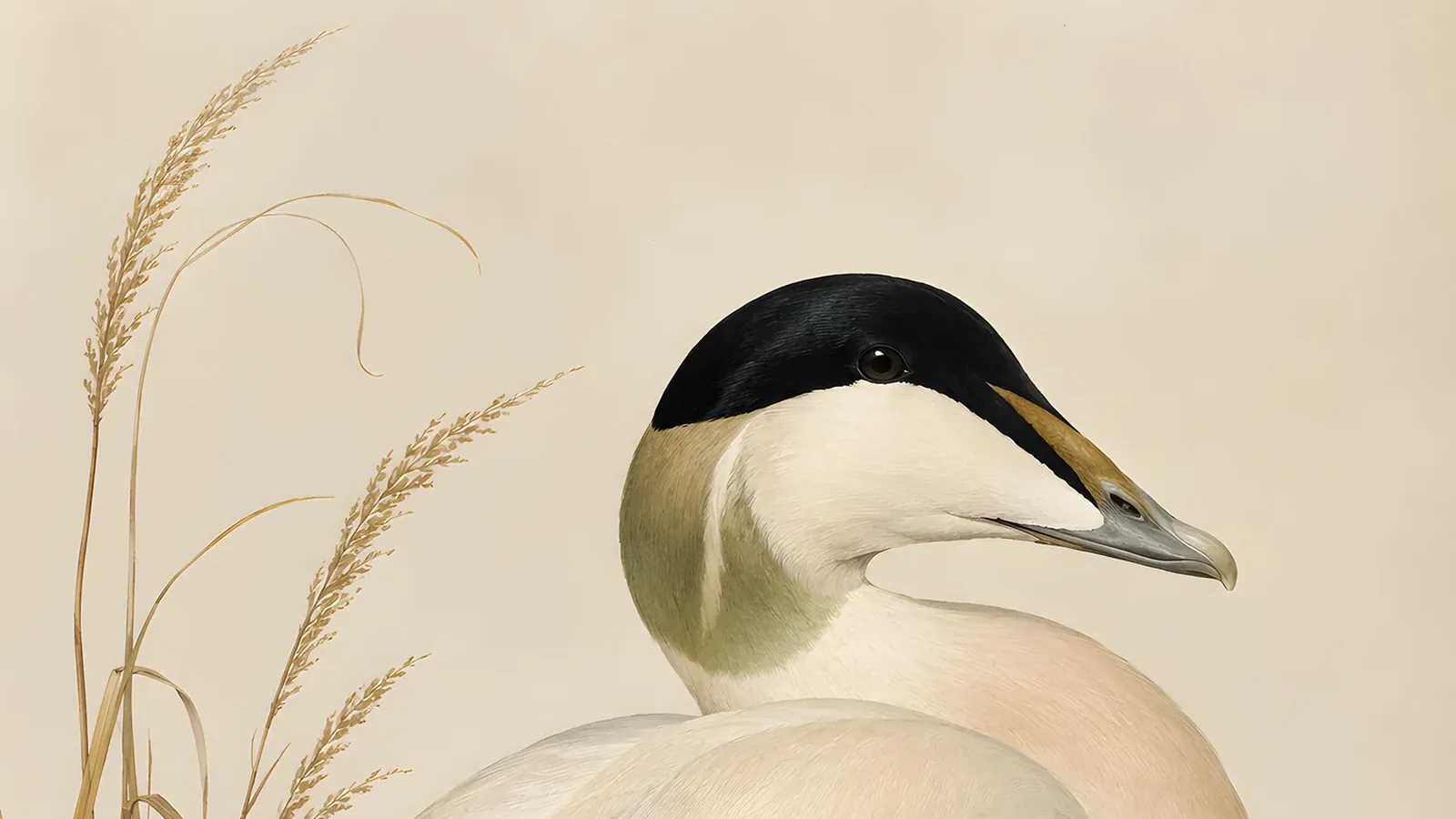
The common eider shares this preference for cold-water invertebrate beds, though it works shallower water and relies on its gizzard to crush hard-shelled prey rather than on depth.
The voice
The male Long-tailed Duck is among the most vocal ducks in the Northern Hemisphere. The courtship call, described by Arthur C. Bent in his 1925 “Life Histories of North American Waterfowl” as ow-owdle-ow repeated in rolling phrases, has made the species recognizable to shore-side observers long before any visual identification could be attempted. The Audubon Field Guide transcribes it as “a musical ow-owdle-ow, ow-owdle-ow.” The sound is bugling, yodeling, far-carrying - quite unlike the flat quacks of dabbling ducks.
Males call through much of the winter and into spring, and rafts of males on good feeding grounds produce a sustained chorus. Females are less vocal, giving clucking and growling notes. The name “Oldsquaw,” used in North American field guides until 2000, referenced the species’ noisiness. The American Ornithological Society retired it in favour of the European standard.
Range and habitat
Clangula hyemalis is a bird of the true Arctic. It breeds across the tundra and taiga zones of northern Canada, Alaska, Greenland, Iceland, Scandinavia, and Russia - the coastal plain and inland hummocks of the high north, wherever freshwater lakes and ponds lie within reach of nesting cover. The breeding range encircles the Arctic in a nearly continuous band.
In winter the picture contracts onto the sea. The great majority of birds move to coastal marine waters: the Baltic Sea, the North Sea, the waters off New England and the Canadian Maritimes, the Great Lakes, and the northern Pacific. Tracking data published by Karwinkel, Pollet, and colleagues in Ecology and Evolution in 2025, following 65 female ducks from three Russian Arctic breeding sites, found that 94 per cent of tagged birds moved to the Baltic Sea for winter. When population counts in the Baltic fall, it is because there are fewer ducks, not because they have moved elsewhere.
The Baltic decline is dramatic. Surveys recorded approximately 4.3 million birds wintering there in 1992 to 1993. By 2007 to 2009 the count had fallen to approximately 1.5 million - a reduction of roughly 65 per cent in under two decades. This trajectory placed the species on the IUCN Red List as Vulnerable (VU) - a status reflecting genuine, documented, ongoing decline rather than precautionary listing. The global population is now estimated at 3.2 to 3.75 million individuals.
The threats are multiple. Entanglement in gill nets set for fish in shallow Baltic waters has caused documented mortality at significant scale. Oil spills affect wintering birds directly. And the prey base itself has shifted as blue mussel populations in some Baltic areas have declined due to changes in salinity and oxygen levels. Karwinkel and Pollet (2025) concluded that the population reduction in the Baltic represents a real decline, not a redistribution - which makes every wintering count consequential.
Breeding
Nesting begins as soon as the Arctic tundra opens up, typically May into June. The female selects a site on dry ground close to water, tucked under low shrubs or tundra sedge, and builds a shallow cup lined with plant material and her own down. She lays six to eight eggs, incubating alone for 24 to 29 days while the male departs to begin the summer molt. Ducklings fledge at 35 to 40 days. First breeding occurs at two years of age. The oldest recorded individual in the wild reached 22 years, though average lifespan runs around 15.
This is a long-lived, slow-reproducing duck. A female that survives to breeding age may return to the same tundra pond for a decade or more. That life-history pattern means any persistent adult mortality - from gill net bycatch, from oil - accumulates quickly. The math of a slow-breeding Arctic bird does not absorb large annual losses.
The Long-tailed Duck is not rare the way a species with a tiny range is rare. There are still millions, and winter rafts in good habitat hold hundreds. What it is, is a bird in measurable retreat. The yodeling chorus on the Baltic in January is quieter than it was thirty years ago - fewer birds, the same cold water, the same bottom to dive. The sound carries just as far. There is simply less of it.