Field Guide
African Penguin
A pair of African Penguins comes ashore at Boulders Beach near Simon’s Town in the late afternoon, picking across granite still warm from the Cape sun. They are small, neat, almost tidy, no taller than a domestic cat sitting up. Then one of them throws its head back and brays, a long wheezing donkey call that carries the length of the beach, and the tidiness falls away. This is a seabird that sounds like a barnyard, nests in burrows on a continent better known for lions, and is, by the most recent reckoning of the IUCN, racing toward extinction faster than almost any bird in this field guide.
Spheniscus demersus is the only penguin that breeds on the African mainland and its offshore islands. It is a warm-water penguin, a creature of the cold Benguela Current that runs up the western and southern coasts of southern Africa, and everything about it - the bare facial skin, the donkey bray, the burrow - is an adaptation to living where penguins are not supposed to live.
What it looks like
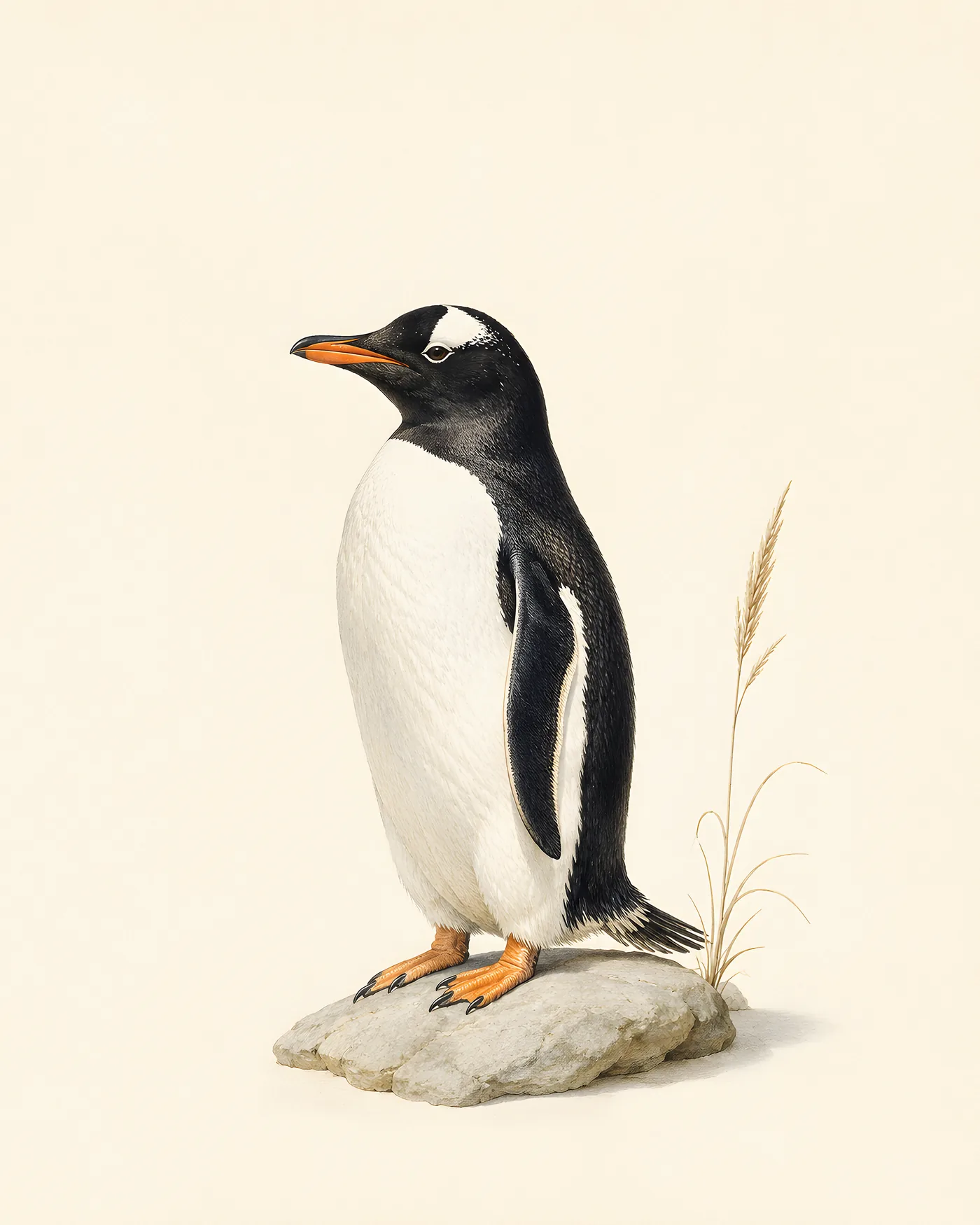
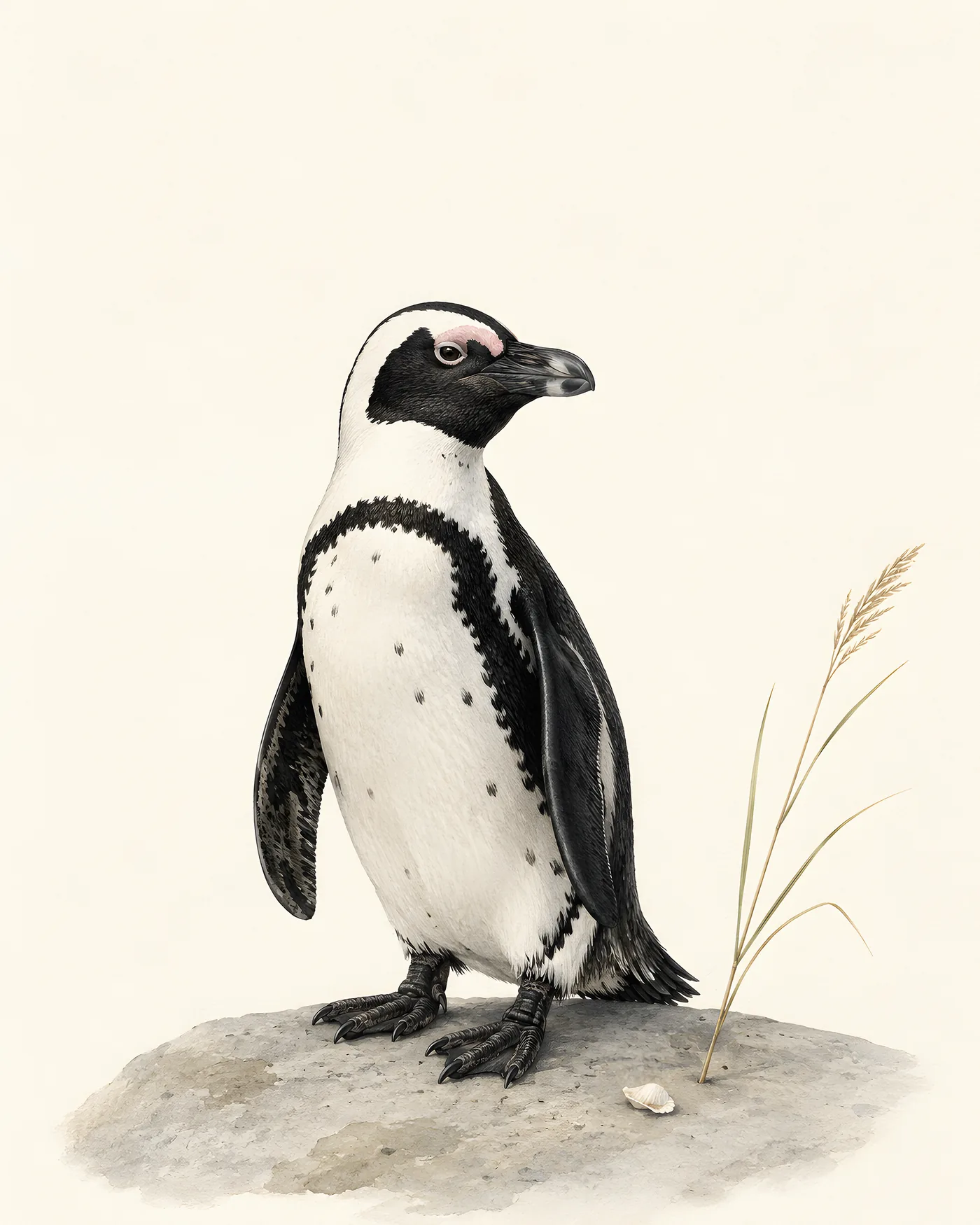
An adult African Penguin stands 60 to 70 centimetres tall and weighs between 2.2 and 3.5 kilograms, with males slightly larger than females. It is a black-and-white bird at first glance, but the markings are specific and worth learning. A single broad band of black sweeps across the white breast and down the flanks in an upside-down horseshoe. Britannica notes that the pattern of black spots scattered across the white chest is unique to each bird, as individual as a fingerprint.
The face carries the species’ two best field marks. A black mask runs from the bill across the eye, and above each eye sits a patch of bare, featherless pink skin. That pink is not decoration. It is a heat-exchange organ. When the bird overheats, blood flows to the bare skin and the patch flushes a deeper rose, shedding warmth to the air, a thermostat worn on the face for a penguin that must cope with African heat rather than Antarctic cold.
What it sounds like
The old name says it plainly. Sailors called this the jackass penguin long before anyone settled on a polite official one, because the bird brays. The call is a loud, wheezing, two-part donkey honk, drawn out and unmistakable, used to advertise a territory, to greet a mate at the burrow and to keep contact across a noisy colony. Cornell’s Birds of the World records a range of softer calls too, including a quiet contact note between paired birds and a sharp bark of alarm. At a breeding colony at dusk, as birds return from the sea, the combined braying can be heard well before the colony comes into view.
Range and habitat
The African Penguin is confined to the coast of southern Africa, breeding on offshore islands and a handful of mainland beaches from Namibia around the Cape and east along the South African coast. The cold, fish-rich Benguela Current is the engine of the whole system. The birds nest in burrows dug into guano, in natural crevices, under boulders and bushes, and increasingly in artificial nest boxes set out by conservation teams. The burrow matters: it shades eggs and chicks from a sun fierce enough to kill them.
Two mainland colonies, at Boulders Beach near Simon’s Town and at Stony Point at Betty’s Bay, have become famous because the penguins waddle among holidaymakers and houses. They are the exception. Most of the species breeds on remote islands, and it is on those islands that the collapse has been measured.
Diet
African Penguins are pursuit divers that feed on shoaling fish, chiefly anchovy and sardine, with squid and small crustaceans taken when the favoured fish are scarce. They hunt by sight in the cold inshore waters of the Benguela system, typically diving to modest depths of a few tens of metres and chasing fast schooling prey underwater. The flippers are stiff, dense-boned paddles, built for propulsion rather than flight, and the streamlined body lets the bird run down anchovy in open water.
The diet is also the heart of the species’ trouble. When sardine and anchovy shift away from the colonies, whether driven by commercial fishing pressure or by warming, shifting seas, the penguins must swim farther for less, and breeding fails.
Breeding and nesting
The African Penguin will breed at any time of year, with regional peaks, and pairs are typically monogamous and faithful to the same nest site across seasons. Both parents share the work. The clutch is usually two eggs, incubated by both adults in turn for around 40 days. Both parents then guard and feed the chicks, which fledge after roughly 60 to 130 days depending on how reliably the parents can find fish.
There is a cruel timing problem built into the species. Adults must come ashore to moult, replacing all their feathers at once over about three weeks, during which they cannot enter the water to feed at all. If the moult or a food shortage strands chicks before they are independent, the chicks are abandoned. Conservation teams in South Africa now run large hand-rearing programmes precisely to catch these abandoned chicks, raise them and release them back to the wild.
A species in freefall
The honest part of this account is the conservation story, because it is now the defining fact of the species. The African Penguin has collapsed. BirdLife and recent assessments record a fall of around three-quarters of the breeding population over roughly thirty years, from tens of thousands of breeding pairs in the early 1990s to fewer than 10,000 pairs by the early 2020s. In 2024 the IUCN moved the species to Critically Endangered, its highest category of threat before extinction in the wild.
A penguin that brays like a donkey and cools itself through bare pink skin is now, by the IUCN’s reckoning, one of the fastest-vanishing seabirds in the world.
The causes are stacked. Commercial fishing has stripped the anchovy and sardine the birds depend on. Historical guano harvesting removed the soft deposits the penguins once burrowed into for shade. Oil spills along a busy shipping coast have killed birds in their thousands. Climate change is shifting fish stocks away from the colonies faster than the penguins can follow. Researchers writing in the journal Ostrich have argued the decline is steep enough that, without intervention, the species could be functionally extinct in the wild within a human generation. The hand-rearing units, the artificial nest boxes and the recently negotiated fishing closures around key colonies are a rearguard action for a bird that, a century ago, numbered in the millions.