Field Guide
African Grey Parrot
Between one and three million Psittacus erithacus were trapped in the rainforests of central and West Africa and sold into the international pet trade over roughly three decades. That number comes from BirdLife International’s analysis of CITES trade data, and it is a number that explains everything about where this species now stands. The African Grey Parrot is listed as Endangered on the IUCN Red List. In Ghana alone, forest surveys conducted between 1992 and 2014 found the population had fallen by more than 90 per cent.
The thesis here is uncomfortable: the birds that live longest in captivity - some reaching 60 years old - represent a direct drawdown on the population of birds in the wild. The African Grey is the most cognitively complex parrot in the world, and that very quality made it the most commercially desirable, and that desirability nearly finished it.
Identification
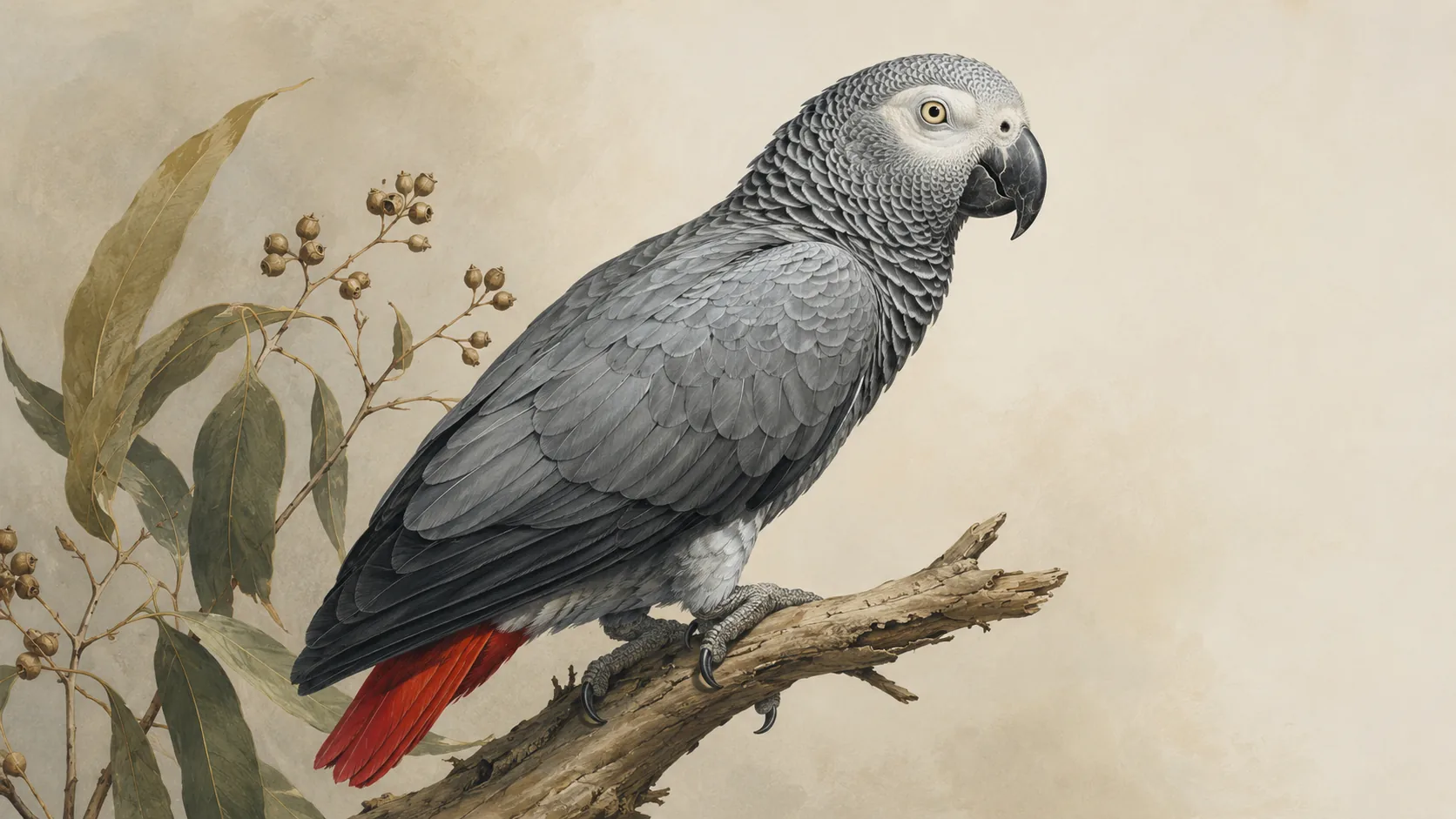
The African Grey is a medium-to-large parrot, 33 to 40 centimetres from bill to tail-tip, weighing 400 to 490 grams, with a wingspan of 46 to 52 centimetres. The body is ash-grey from crown to vent, each feather edged just slightly paler so the plumage has a faint scalloped texture in good light. The face is bare and pale around a stout black bill. The eye is yellow in adults, grey in juveniles.
The tail is the field mark. When the bird lifts into flight or fans its tail in agitation, the feathers are vivid scarlet - a sudden flash of red against grey that is unmistakable in the forest. The Cornell Lab’s Birds of the World account describes the species as “characteristic gray plumage with a highly conspicuous scarlet-red tail,” and that phrasing earns its place.
The only likely confusion species in the African range is the Timneh Parrot (Psittacus timneh), formerly treated as a subspecies and now recognised as a full species by the Cornell Lab taxonomy. The Timneh is smaller, darker grey, and has a maroon-brown rather than scarlet tail. It is confined to West Africa west of the Sassandra River in Côte d’Ivoire. Where the two overlap at the edges of their ranges, size and tail colour together resolve the identification.
Voice
The African Grey does not merely mimic. That distinction matters. Most parrots that repeat human speech are doing what is, functionally, a form of vocal association. The research of Irene Pepperberg at the University of Arizona, conducted over 30 years with a single bird named Alex, showed something different: a bird that could label 50 objects by name, identify seven colours and five shapes, understand the concept of zero, and use language referentially rather than simply repeating sounds.
Alex died in 2007. His last words to Pepperberg were “You be good, see you tomorrow. I love you.” He did not know he would not see tomorrow. He probably did not mean it the way a person would mean it. But the exchange illustrates why researchers have described the African Grey’s cognitive abilities as comparable in some respects to those of a young child, and why that comparison is not sentimental.
In the wild, African Greys are noisy and social. They produce a rolling repertoire of whistles, clicks, and screams at communal roost sites, which can hold several hundred birds. They are not mimics in their wild state in the way captive birds become - the mimicry appears to be a plastic capacity that captivity amplifies.
Range and Habitat
The species occupies the forest belt of central and West Africa, from Sierra Leone east through Ghana, Nigeria, Cameroon, the Congo Basin, and into Uganda and western Kenya, south to northern Angola. A subspecies, princeps, lives on Príncipe island in the Gulf of Guinea.
Cornell’s Birds of the World notes the species “favors humid forests, including edges and clearings” and is also found in oil-palm plantations and cultivated areas near forest. It forages from forest interior to edge, moving through the upper canopy for fruit and palm nuts, and descends to mineral licks - natural clay exposures that may provide sodium and other minerals not available from fruit alone. The elevation range reaches 2,200 metres in East African highland forests.
African Greys roost communally, often in large groups in trees near or over water. Roost sites serve as information hubs: birds track which individuals return full-cropped and follow them to productive foraging patches the following morning. This is not guesswork - it has been documented in field studies as a consistent foraging strategy.
Diet
The diet is primarily fruit, seeds, and nuts. Oil-palm nuts are a key food in areas where plantations abut forest. Figs, papaya, and other soft fruits supplement the diet through wet-season flushes. They take insects and bark on occasion. The mineral lick visits suggest the birds actively seek dietary supplements not available from primary food sources - a level of nutritional awareness that aligns with their cognitive reputation.
Breeding and Nesting
African Greys form monogamous pairs with long-term bonds. They nest in tree cavities, typically 10 to 30 metres above ground in large primary-forest trees. The female lays two to four white eggs and incubates them for approximately 30 days. The male brings food to the nest throughout incubation. Chicks fledge at around 12 weeks but remain dependent on their parents for another two to three years - an unusually long developmental period for a bird, and one that makes the species slow to recover from population loss. A pair may breed once or twice annually, but successful fledging of even one chick per year is not guaranteed.
That slow reproductive rate is part of why the trade figures are so damaging. A species that takes three to five years to reach sexual maturity, raises one or two young per attempt, and loses substantial numbers to trapping at the nest cannot replace harvested adults quickly. Cornell’s Birds of the World characterises the population trend as a “precipitous decline” driven primarily by the international wildlife trade.
Behaviour
The mineral lick is a scene worth stopping on. In the Congo Basin, research published in 2024 documented Grey Parrots visiting forest clearings and clay exposures in groups of dozens, sometimes hundreds, landing briefly to ingest soil, then lifting in a single scarlet-tailed wave when disturbed. The birds coordinate these visits, appear to have regular schedules tied to season and time of day, and show site fidelity - returning to the same clearings over months. The behaviour is not unique to African Greys, but the scale and regularity of their visits to documented sites has allowed researchers to use the clearings as census points. Counting birds at licks is now one of the standard methods for estimating population size in areas where forest survey is difficult.
A forest that has lost its African Greys has not simply lost a bird. It has lost the loudest voice in its canopy, and the species most visible to researchers trying to track what remains.
Conservation
The IUCN listed Psittacus erithacus as Endangered in 2016, upgraded from Vulnerable - a formal acknowledgment that the decline was faster than earlier assessments had captured. Trade was the primary driver: CITES Appendix I listing in 2016 effectively banned international commercial trade in wild-caught birds, but domestic trade and illegal export continue. Habitat loss from logging, agricultural expansion, and urban growth compounds the pressure.
The species can adapt to edge habitat and oil-palm plantations, which offers some buffer. But the core threat is not habitat. A bird that can survive in a plantation cannot survive being trapped. Recovery depends on enforcement, demand reduction, and the long, slow arithmetic of a species that breeds carefully and lives for decades.