Field Guide
American White Pelican
Seven pelicans. A line of them, unhurried, moving through the shallows of a prairie lake in formation - wings half-lifted for balance, those improbable orange bills dipping in unison. They are not chasing. They are herding. A loose crescent closes slowly inward, compressing the minnows against the shoreline until escape is impossible and the scooping becomes almost effortless. Then they surface, drain, swallow, and begin again.
Pelecanus erythrorhynchos - the red-billed pelican - is not the pelican most people picture. It does not plunge from height. It does not live at the coast. It is an inland bird, a prairie bird, a bird of glacier-cut lakes in the northern plains and intermountain basins. And it is vast: with a wingspan reaching 290 centimetres, it is among the largest birds on the continent by any measure that matters in the air.
The thesis of this bird is cooperation. Everything about its life history - the colony, the communal crescent, the shared islands, the long molt that tracks the breeding cycle - points toward a species that solved the problem of open-water fishing not through individual athleticism but through coordinated effort. It is worth taking seriously as a strategy.
What it looks like
At 127 to 165 centimetres from bill-tip to tail, and weighing between 4,540 and 9,000 grams, the American White Pelican is one of the heavier flying birds on the continent. The wingspan of 244 to 290 centimetres puts it in the company of the Trumpeter Swan and the California Condor - birds measured not in size but in wingloading and thermal efficiency.
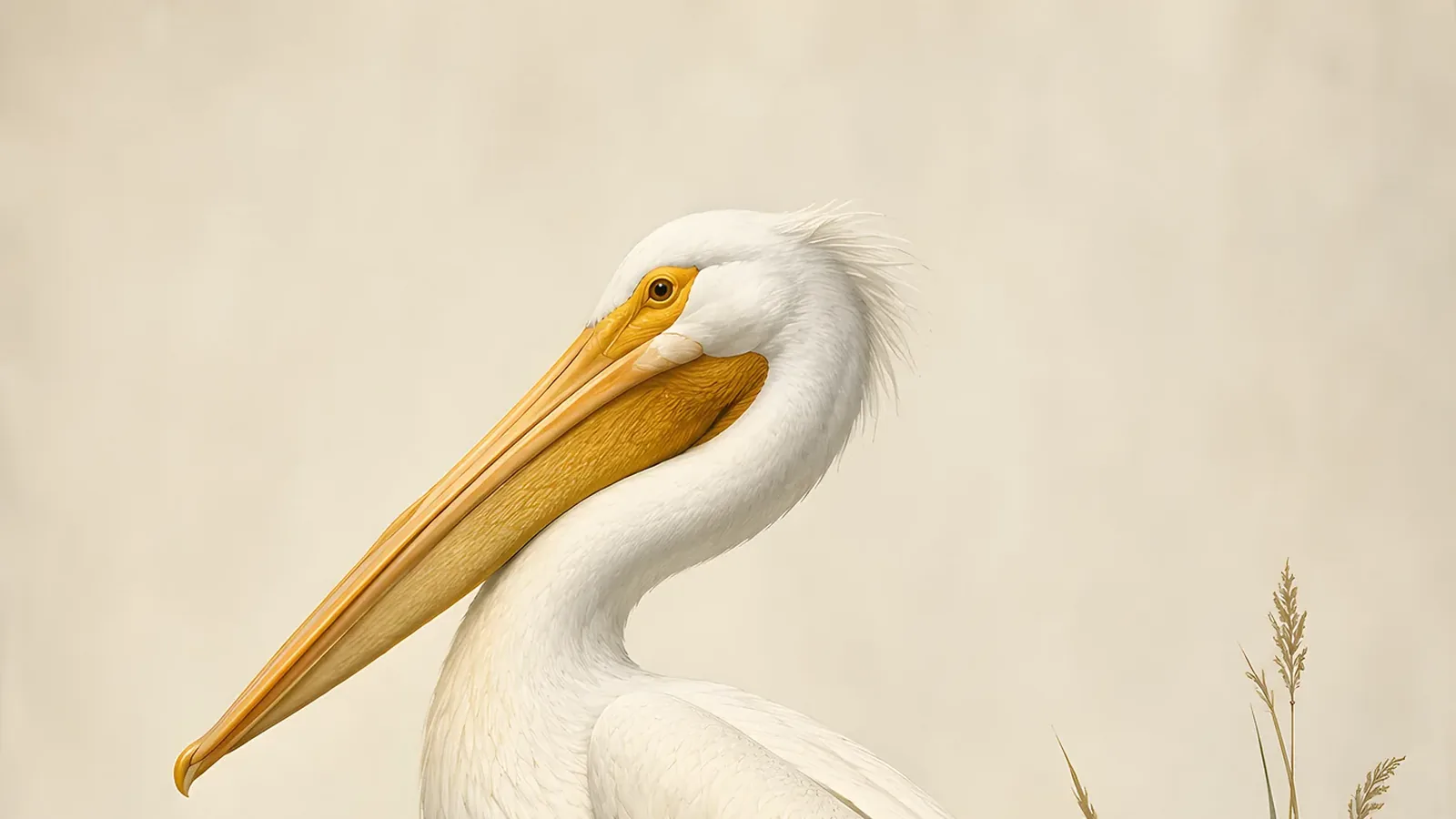
In breeding plumage, the body is entirely white with a suffusion of pale yellow on the breast. The flight feathers - primaries and outer secondaries - are jet black, visible only when the wings are spread. The legs and feet are orange-yellow. The eye is pale yellow, ringed in a bare orange-yellow orbital patch that flushes more vividly during the breeding season. The bill is flat and extraordinarily long: 29 to 39 centimetres of horn-coloured mandible terminating in a hook, with the expandable gular pouch hanging below like folded fabric.
In flight the silhouette is unmistakable. The neck is retracted, S-folded against the breast in the manner of a heron. The black wingtips trail behind in a long, flat plane. Groups soar in long lines on thermals, wheeling in unison - a single organism, apparently - before gliding down toward the next water. They rarely flap when soaring conditions allow.
Non-breeding and juvenile birds carry a similar pattern but the bare parts fade from orange to yellow-grey, and the nuptial structures (discussed below) disappear entirely.
Fishing as a team
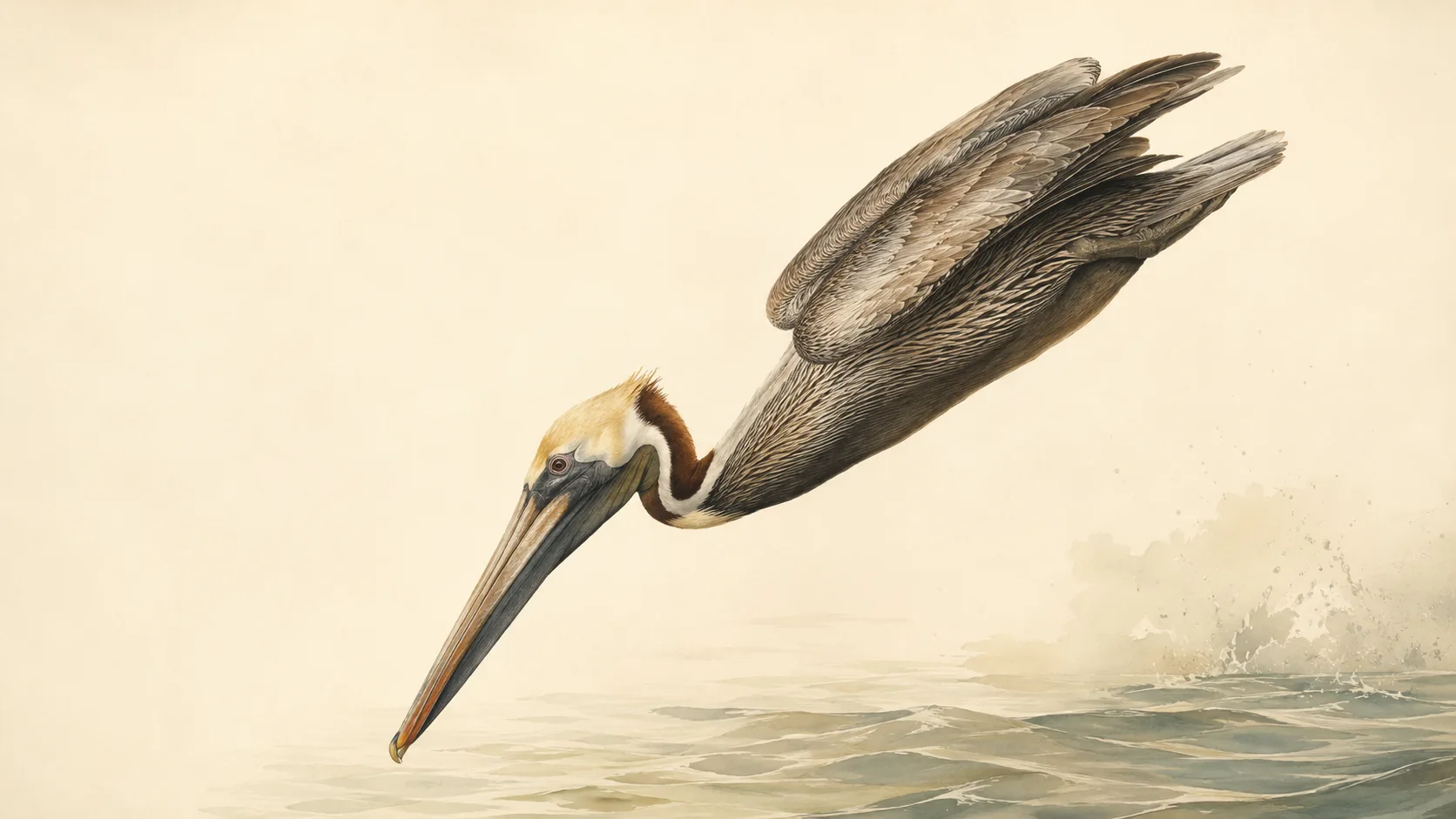
The foraging method separates this species from every other pelican in North America. The brown pelican is a soloist - it identifies a fish from altitude and falls on it, bill-first, from as high as 20 metres. Pelecanus erythrorhynchos never plunge-dives. It feeds exclusively from the surface, and it feeds more effectively in groups than alone.
J.G.T. Anderson, studying American White Pelicans in western Nevada (1991, Colonial Waterbirds 14: 166-172), documented the mechanics in detail. Groups of two to six birds achieved the greatest foraging success per individual, with strike frequency increasing as the group closed on a school and reaching an upper asymptote at around four birds. Groups work cooperatively, swimming side by side and synchronously dipping their bills into the water in a coordinated drive. Fish are pushed ahead of the advancing line, concentrated into shallower water where lateral escape is limited, and then scooped. Anderson demonstrated the fish-driving function directly using weighted decoys drawn through the water.
Foraging sometimes occurs at night, particularly in breeding season when adults range far from nesting islands to find food - up to 50 kilometres or more according to Evans and Knopf (1993). By day, pelicans also steal fish from other waterbirds opportunistically, a tactic documented in multiple studies. The diet consists almost entirely of non-game fish - carp, suckers, tui chub, minnows - small schooling species with no commercial value and of minimal economic concern. Crayfish and amphibians appear occasionally but are secondary.
The gular pouch is the instrument of capture, not storage. It can expand to hold several litres of water, which the bird drains by tilting the bill forward before swallowing. The fish goes down. The water drains out. The process takes only a few seconds, which is why a feeding line of pelicans has that characteristic rhythm - dip, pause, tilt, swallow, dip again.
| Measurement | Range |
|---|---|
| Body length | 127 - 165 cm |
| Wingspan | 244 - 290 cm |
| Weight | 4,540 - 9,000 g |
| Bill length | 290 - 390 mm |
| Breeding colony size | Hundreds to thousands of pairs |
| Foraging range from colony | Up to 50 km |
The breeding horn
Pelecanus erythrorhynchos is the only pelican species on earth that grows a horn on its bill. Both sexes develop it. Both shed it after laying. It appears in early breeding season as a laterally flattened, keratinous plate - roughly 2.5 to 7.5 centimetres across, seated about 7.5 centimetres behind the bill tip on the upper mandible. It looks like a shark fin made of fingernail.
The structure is technically called a nuptial tubercle or nuptial plate. Its function remains incompletely understood, but the leading interpretation positions it as a visual signal of reproductive fitness - a badge of status within the colony analogous to the elongated plumes of a breeding egret or the inflated throat sac of a frigatebird. It may also play a role in mild territorial displays: adults have been observed engaging in bill-fencing at nest boundaries, and the plate could serve either as a target for these exchanges or as reinforcement against them.
After the eggs are laid, the plate is shed. It simply falls away, leaving the bill smooth and uniform. The whole episode - growth, display, loss - occupies roughly eight weeks.
The breeding horn of Pelecanus erythrorhynchos is unique among the world’s eight pelican species. It grows in both sexes, serves the breeding season, and vanishes completely once eggs are laid. No other pelican grows anything like it.
Range and habitat
The breeding distribution is emphatically inland. Colonies are established on islands in freshwater and alkaline lakes across the prairie lakes of North Dakota, Montana, Minnesota, and continuing north through Alberta, Saskatchewan, and Manitoba. A secondary cluster breeds in the Great Basin - Utah, Nevada, and California’s Klamath Basin. The requirement is specific: remote, low-lying islands free of mammalian predators, close enough to productive shallow-water foraging grounds.
The species does not breed on the coast. This is a consistent point of confusion for observers who encounter American White Pelicans wintering in coastal bays and estuaries from central California through the Gulf Coast states and into Mexico. The coastal habitat is strictly seasonal - birds arrive in autumn and depart in spring, following a migration that takes them over the interior of the continent in broad thermal-soaring flocks. They migrate by day, gaining altitude on thermals and gliding for long distances before gaining height again.
In winter, the habitat shifts from freshwater to coastal: salt bays, estuaries, and warm-water lakes in the southern tier. Texas populations around Corpus Christi and the Gulf Coast lagoons are among the most accessible wintering concentrations in the country.
Diet
The American White Pelican is a dietary generalist within the broad category of “small fish available in shallow fresh water.” Evans and Knopf (1993) documented the predominance of non-game species in stomach contents: carp, suckers, tui chub, minnows, and similar bottom or mid-water schooling fish predominate. Fish are typically consumed at less than half the bill’s length - small enough to swallow whole without manipulation. Larger prey items occasionally appear but are unusual.
Crayfish and salamanders are taken in some regions, particularly where fish density is low. Studies in catfish aquaculture ponds have documented pelicans foraging on hatchery fish, consuming an average of around 550 grams per foraging trip and occasionally up to 3 kilograms in a single session. This has brought the species into occasional conflict with commercial fish operations, though its impact on wild fisheries remains a matter of ongoing research (Meyer et al., 2016, North American Journal of Fisheries Management 34: 57-67).
Breeding colonies
The colony is the fundamental social unit. American White Pelicans do not nest alone. Colonies range from a few hundred to several thousand pairs, with nesting densities that can reach 1,000 nests per hectare on the right island (Minnesota Breeding Bird Atlas). Territories within the colony are defended but tiny - sometimes less than a metre of separation between adjacent nests.
The nest is a shallow scrape in bare soil, gravel, or sand, sometimes lined with pebbles or adjacent vegetation. Both sexes incubate. Two eggs are laid per clutch, but siblicide is common and only one chick typically survives to fledging. Incubation takes roughly 30 days. Chicks fledge at approximately 10 weeks. Adults do not begin breeding until their third year, sometimes their fifth.
King and Anderson (2005) estimated approximately 134,000 breeding adults in North America for the period 1998-2001. Partners in Flight’s current estimate puts the global breeding population at approximately 450,000 individuals. The North American population doubled between 1980 and 2000, recovering from lows associated with pesticide use, shooting, and colony disturbance in the mid-twentieth century. Breeding Bird Survey data for 1966-2019 show sustained increase. The IUCN lists the species as Least Concern (LC).
A thought on scale
The largest pelican colony in Minnesota - at Marsh Lake, on the Minnesota-South Dakota border - holds between 15,000 and 22,000 nests in peak years, accounting for up to 84 per cent of the state’s entire breeding population (Minnesota Breeding Bird Atlas). One lake. One island chain within it. Nearly the whole of a state’s population.
This is what colonial nesting looks like taken to its logical conclusion: all the eggs in one basket, on purpose, because the island is safe and the fish are close and there is a deep evolutionary logic in numbers that makes a colony of 20,000 pelicans harder to disturb than any scattered individual could ever be. The cooperative fishing line on the prairie lake is not a curiosity or a trick. It is the same logic writ small - birds that solved, across deep time, the problem of feeding in open water by deciding not to do it alone.