Field Guide
Blue-and-yellow Macaw
Every morning in the Venezuelan llanos, pairs of Ara ararauna leave their roost trees before first light and fly toward a clay lick on the riverbank. They land in numbers, cling to the exposed earthen wall, and eat mud. The behaviour looks strange from the outside. From the inside, it is a solution to a serious problem: the seeds these birds eat throughout the day contain alkaloids and other plant toxins that would otherwise accumulate to dangerous levels. The clay binds those compounds in the gut and passes them harmlessly. The Blue-and-yellow Macaw does not simply eat food. It manages its own chemistry.
That is the thesis here. This is a more sophisticated bird than it looks from a distance.
Identification and appearance
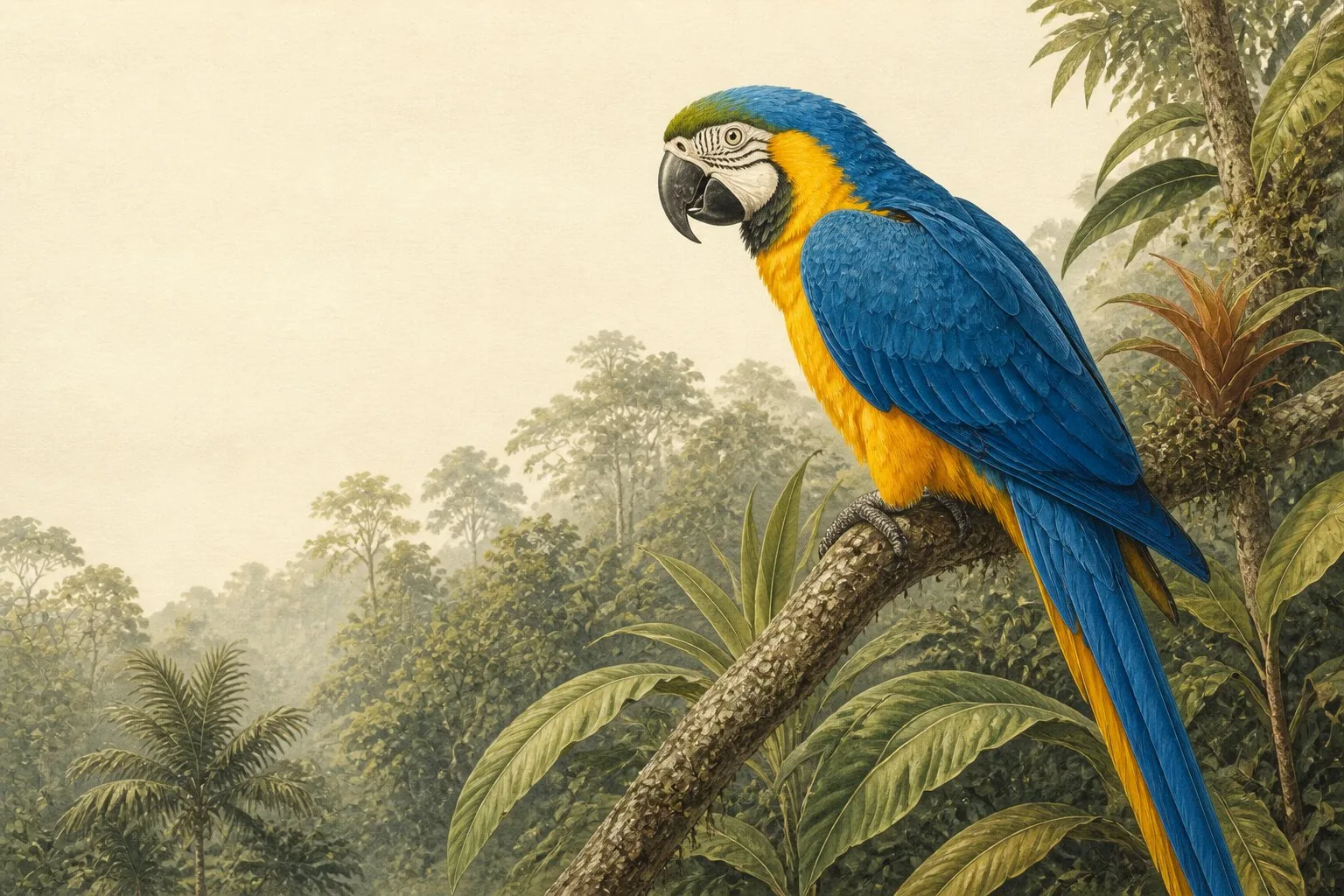
At 81 to 91 centimetres from bill to tail tip and up to 1,300 grams, the Blue-and-yellow Macaw is one of the largest parrots on earth. The weight and the long tail together account for most of the visual drama. Cornell’s Birds of the World describes the plumage precisely: dull green forecrown, blue upperparts from crown to tail, a bare white facial patch crossed by lines of small black feathers, a blackish green chinstrap below that, and bright yellow on the underparts, underwing coverts, and the underside of the tail. In flight, the contrast between the cobalt-blue back and the chrome-yellow breast is visible from a long way off.
The bill is black and deeply curved - built for cracking the hard-shelled palm nuts that form the core of the diet. The tail is long and graduated, roughly half the bird’s total body length. The eyes are pale yellow in adults.
There is no reliable plumage difference between sexes. Males average slightly heavier, but the overlap is wide enough that sex cannot be determined by sight alone.
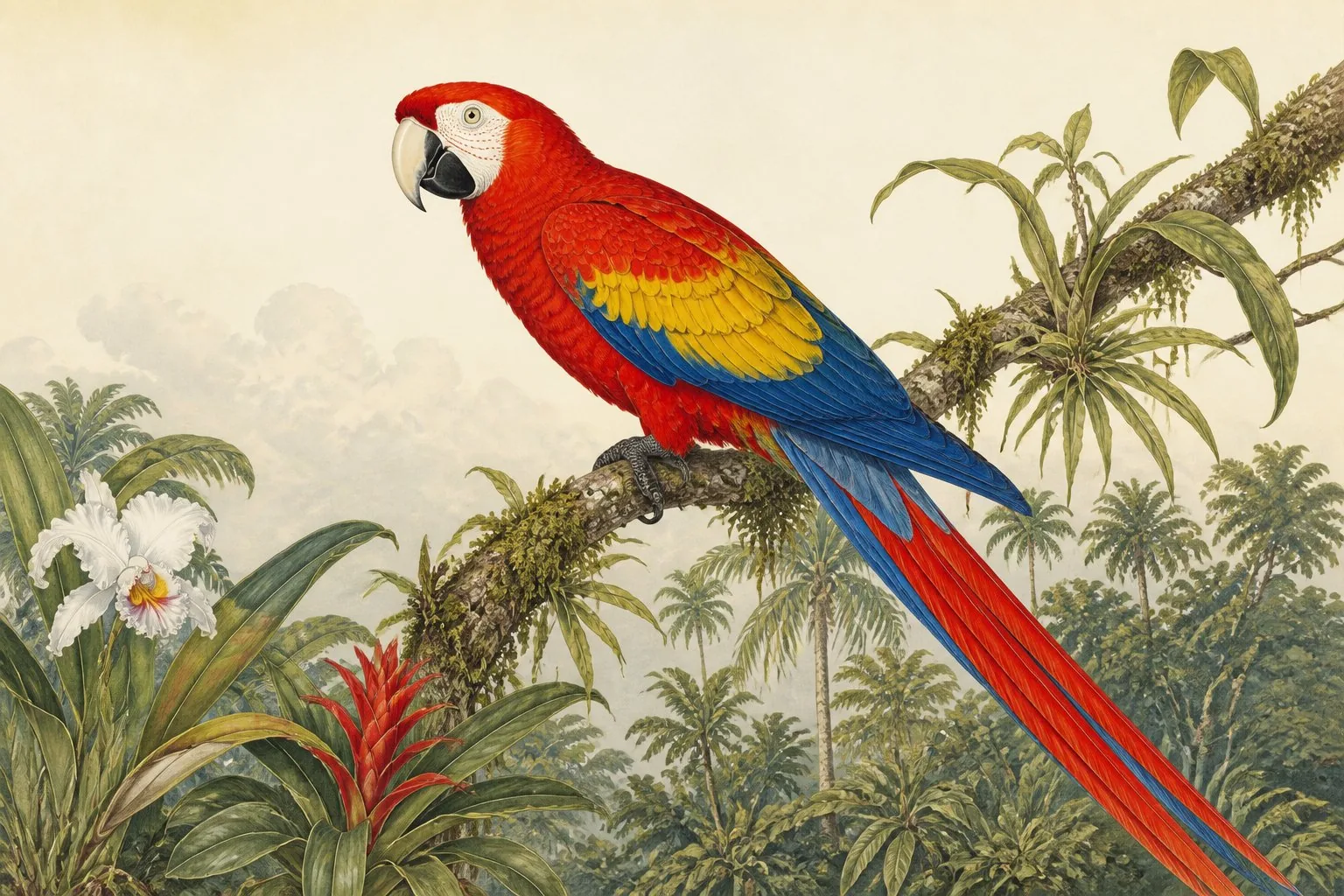
The species this bird could be confused with in the wild is limited. The Scarlet Macaw has a red back rather than blue, and yellow only on the wing coverts. The Hyacinth Macaw is larger, entirely blue, and restricted to a narrower range. Within the shared Amazonian lowlands, the Blue-and-yellow’s yellow underparts and bare white face make it distinctive at any reasonable range.
Voice and sound
The Blue-and-yellow Macaw is loud. The contact call is a harsh, carrying screech - described in the field literature as a raucous aah-aah-aah - audible across open water for a kilometre or more. Pairs flying together stay in constant vocal contact. The alarm call is different in quality: shorter, more abrupt, and repeated rapidly when a raptor appears.
Inside the pair bond, the repertoire is quieter. Paired birds produce soft contact calls during mutual preening, and juveniles use a persistent begging call that carries into the second year. The species is a capable mimic in captivity, though mimicry plays a smaller role in wild social life than it does in African Greys or Amazon parrots.
The call is one of the defining sounds of tropical South American forest. In areas where populations are healthy - parts of the Pantanal, the llanos of Venezuela, undisturbed Amazonian várzea - the morning flight of macaw flocks at first light is audible well before it is visible.
Range and habitat
The natural range runs from eastern Panama south through Colombia, Venezuela, Trinidad, and the Guianas, east across the Amazon basin to Brazil, and south to Bolivia and Paraguay. Cornell’s Birds of the World places the northern limit at eastern Panama and notes the absence of the species from most of central Brazil’s cerrado interior. The range is large but patchy, tracking the distribution of specific forest types rather than filling the entire basin.
Preferred habitat is seasonally flooded várzea forest and gallery forest along rivers. The species also uses palm savanna, forest edge, and secondary growth where large nut-bearing palms persist. It is not a bird of closed, mature rainforest interior. It needs edges and openings, particularly where Mauritia palms grow, whose fruit are a critical seasonal food source.
The IUCN lists the species as Least Concern, with a large range and a population believed to remain above the thresholds for threatened status. Numbers are declining across much of the range due to habitat loss and the collection of young birds for the pet trade, but the overall population has not crossed the decline rate that would trigger a category change.
Diet
The diet is built around hard-shelled seeds and palm nuts. Birds use their powerful bills to crack Mauritia and other palm fruits, and their muscular tongues to extract the seed. They take other seeds, some fruit pulp, and flowers seasonally. The clay-lick behaviour - observed throughout the range at riverbank exposures - is directly connected to diet: the unripe seeds most macaws eat at peak availability contain phytotoxins, and the ingested clay acts as a buffer.
Foraging happens in pairs or small groups. Large congregations at mineral licks are an exception, not the daily norm. The birds fly long distances between roost, mineral lick, and feeding area - movements of 30 kilometres in a morning are documented in telemetry work from Venezuela.
Breeding and nesting
The Blue-and-yellow Macaw pairs for life, or close to it. Pairs remain bonded year-round, roost together, and fly wing-to-wing - a posture that Animal Diversity Web notes as characteristic when paired birds travel together. The bond is visible from the ground.
Nesting takes place in tree cavities, almost always in large dead palms or other snags with existing holes. The species does not excavate. It relies on natural cavities or those enlarged by other species, which makes the availability of large old trees a hard limit on breeding density in any given area.
Breeding in most of the range runs from November through March. Clutch size is two to three eggs. Incubation runs 24 to 28 days, and the female takes the majority of incubation duty while the male provisions her at the cavity. Chicks fledge at roughly 13 weeks but remain dependent on the parents for months after first flight. Breeding occurs every one to two years rather than annually, which limits how quickly a population can recover from hunting or trapping pressure.
Sexual maturity arrives at three to four years. The species is long-lived: wild birds may reach 50 years, and the Animal Diversity Web compiles records of wild lifespans in that range, with captive birds under good management matching those figures.
A behaviour worth knowing
The clay-lick is the most-studied behaviour in the wild ecology of this species, and it repays attention. At licks in the Peruvian and Venezuelan lowlands, researchers have recorded groups of 30 or more macaws of several species converging at the same exposed riverbank, clinging to the vertical face, and eating actively for 20 to 40 minutes before the morning heat drives them off. The birds are nervous at the lick - it is an exposed position with few escape routes - and will flush en masse from a single alarm call.
What the research has established is that the ingested clay is not a random mineral supplement. The specific compounds that the clay sorbs are those produced by the plants the macaws depend on in the late dry season, when ripe fruit is scarce and unripe seeds become the primary food. The behaviour is seasonal, peaking when seed toxin loads are highest. It is, in short, a solution that tracks the problem.
A bird that calculates its detoxification schedule against the fruiting phenology of the palms it depends on is not a simple animal. The Blue-and-yellow Macaw is not simple.
The clay lick is where the bird’s intelligence becomes visible: a 50-year-old animal, paired for life, managing its own pharmacology before the sun clears the canopy.