Field Guide
Jackdaw
In October 2015, Gabrielle Davidson, then at the University of Cambridge’s Department of Psychology, published the results of a study conducted in a single Cambridgeshire village. She had spent three consecutive days approaching jackdaw nest boxes wearing one mask while removing chicks for weighing, and a different mask while simply passing by. Over the following four days she returned wearing each mask in turn and recorded how quickly the birds re-entered their nests. The jackdaws responded defensively to the mask they associated with disturbance. They returned to their chicks faster when the researcher wearing the threatening face looked directly at them, rather than downward. They were not responding to the mask alone. They were reading her gaze.
The study, published in Animal Behaviour, was the first to demonstrate gaze-sensitive face recognition in wild birds. The jackdaw had known Davidson’s face all along. The bird simply wanted to know where she was looking.
This is the thesis of the Coloeus monedula: it is a small crow with a very large social brain, living at close quarters with human beings, and paying close attention.
What it looks like
The jackdaw is 34 to 39 centimetres long - a shade shorter than a Rook, noticeably smaller than a Carrion Crow. Weight runs from around 220 to 270 grams. Wingspan spans 64 to 73 centimetres.
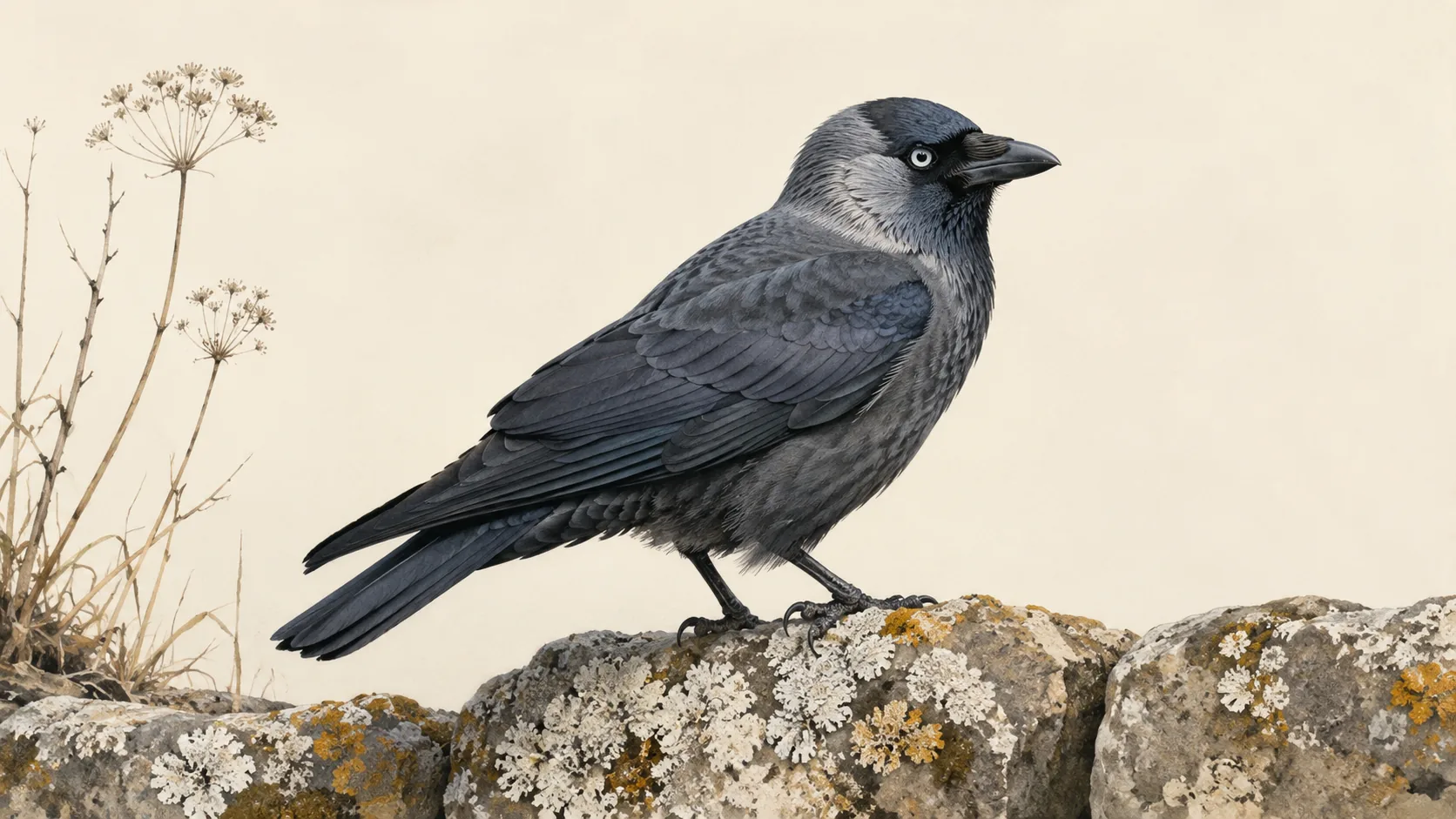
The body plumage is black, with a faint purple or blue gloss on the crown and flight feathers depending on the angle of the light. The nape and sides of the neck are a pale blue-grey, sometimes described as a hood, which gives the bird a two-toned silhouette that separates it immediately from its larger corvid relatives. The face is black. The bill is short and stubby compared to a crow’s.
The single most striking field mark is the eye. Adults carry a pale silver-yellow iris that seems to float against the dark face - an eye that registers as almost white at a distance. Young birds have blue irises that darken through the first year. You can date a young jackdaw by the colour of its eye.
Males and females are visually identical in the field. The species was long called Corvus monedula; the genus is now generally recognised as Coloeus, reflecting its distinctness within the corvid family.
Sound and flight
The call is a sharp, clipped tchack - a single hard note that carries across open ground and from which the common name directly derives. Pairs and flocks produce a rapid chack-chack that rises into a complex, chattering din at a roost site. The voice is nowhere near as resonant as a Rook’s cawing or a Raven’s deep kronk, but at a winter roost of several hundred birds it is unmistakable.
Flight is fast and slightly buoyant. Jackdaws twist and dive in a way that larger corvids do not - the acrobatic tumbling display flights at dusk, performed in pairs above rooftops, are one of the more conspicuous late-winter spectacles in any British village.
Range and habitat across the year
The BTO’s Breeding Bird Survey records a UK breeding population of around two million pairs - a 140% increase since 1967, one of the larger expansions documented among British passerines. The jackdaw occupies roughly 83% of UK grid squares in the breeding season and 85% in winter. The main gaps are northwest Scotland and parts of northwest Ireland. Winter numbers are supplemented by birds arriving from Scandinavia and northern Europe.
Across its global range the jackdaw extends through Europe, western Asia, and western North Africa. The IUCN lists the species as Least Concern, with a range estimated between one and ten million square kilometres.
Habitat is broad. The jackdaw forages on open farmland, pasture, and coastal grassland; nests in towns, villages, sea cliffs, and mature woodland. It is most frequently recorded in villages during breeding season. The BTO notes particular population gains on grazing farms in the north and southwest of England, where open grassland provides reliable invertebrate foraging alongside the cavity-rich buildings that the birds prefer for nesting.
Diet
The jackdaw is omnivorous and opportunistic. Outside the breeding season, plant material - grain, seeds, fruit, and berries - makes up the bulk of the diet. Through spring and summer the balance shifts toward invertebrates: beetle larvae, leatherjackets, earthworms, caterpillars. Clutch-raiding from other birds’ nests does occur, as it does across the corvid family; the fraction is small relative to plant and invertebrate intake.
Breeding and nesting
Jackdaws nest in cavities. Tree holes, cliff faces, chimneys, church towers, barns, and large nest boxes are all used. The chimney association is old enough to have entered British folk memory, and the RSPB notes it as the most characteristic nesting site in suburban contexts. Within a colony, competition for good cavities is intense.
The BTO records an average first clutch date of 30 March, with a range from 12 March to 18 April. Clutch size is four to five eggs - pale blue or mint-green, speckled with brown and grey. Incubation runs 17 to 18 days and falls primarily to the female. Fledging takes a further 31 to 32 days. One brood per year.
Konrad Lorenz, writing in the mid-twentieth century, documented the jackdaw’s social hierarchy in detail: pair-bonded birds share the same rank within the flock, and a female’s status rises to match her partner’s at the moment of pairing. The pair bond is lifelong - genetic studies, as Wikipedia summarises from the primary literature, have found no evidence of extra-pair copulation, which is unusual for a socially monogamous bird and sets the jackdaw apart even within the corvids.
The eye that watches back
Jackdaws have pale irises for the same reason that humans do: the light-coloured eye makes the direction of gaze legible to an observer. In most birds, the iris is dark, which conceals gaze direction. A corvid study published in the journal Current Biology in 2008, led by Auguste von Bayern and Alex Kacelnik at Oxford, showed that jackdaws can follow human gaze through solid barriers to locate hidden objects - a cognitive operation requiring the bird to model another individual’s perspective.
A later Cambridge and Exeter study found that jackdaws use their pale eyes to deter rival birds from entering their nest site: when an artificial eye model with a conspicuous pale iris was placed near a nest box, intruding jackdaws were significantly deterred compared to a dark-eyed control. The eye is not just a receiver of social signals. It is a transmitter.
This is perhaps the most specific thing you can say about the jackdaw: it has evolved, alongside humans and in proximity to them, a social communication system that partly depends on the same anatomical feature that makes human eye contact legible across a room. Whether that parallel is convergent evolution or some deeper ecological entanglement with a species that built the towns it nests in is not a question the field has settled.
The bird watching you from a chimney pot in any British market town is not doing it passively. It is reading your face, assessing your direction of travel, and making a calculation. The calculation is probably about your intentions toward its nest.
It is not the largest crow on the roofline. It is the most attentive one.