Field Guide
Island Scrub-Jay
Santa Cruz Island sits 40 kilometres off the California coast, and it has been isolated long enough to produce its own bird. Not a subspecies - a full species, found nowhere else in the world, on a piece of land you can drive across in an hour. The Island Scrub-Jay holds the distinction of being the most geographically restricted corvid on earth, and possibly the most geographically restricted songbird in North America. There are roughly 2,000 of them. They all live here, and this is all there will ever be.
What it looks like
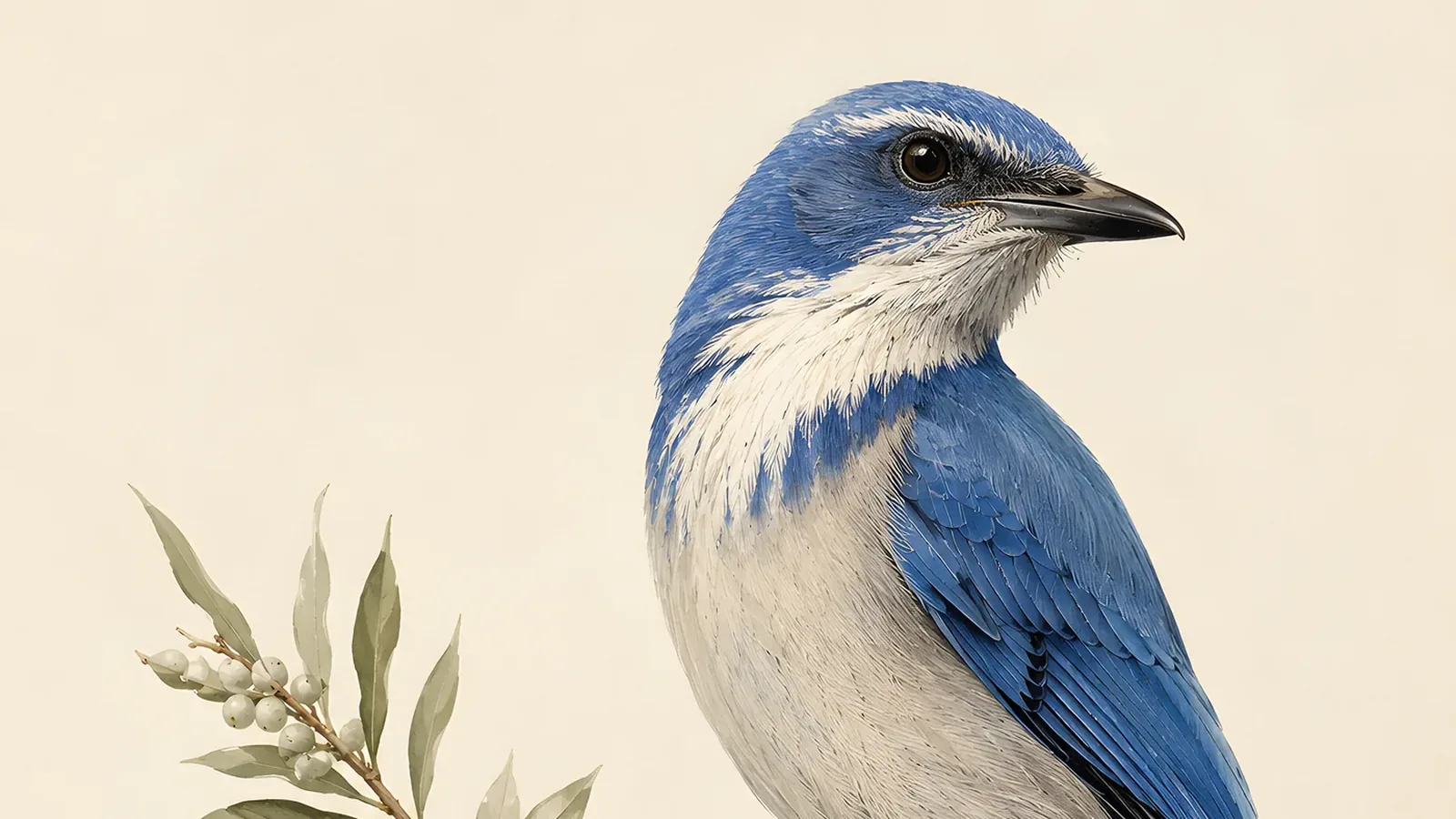
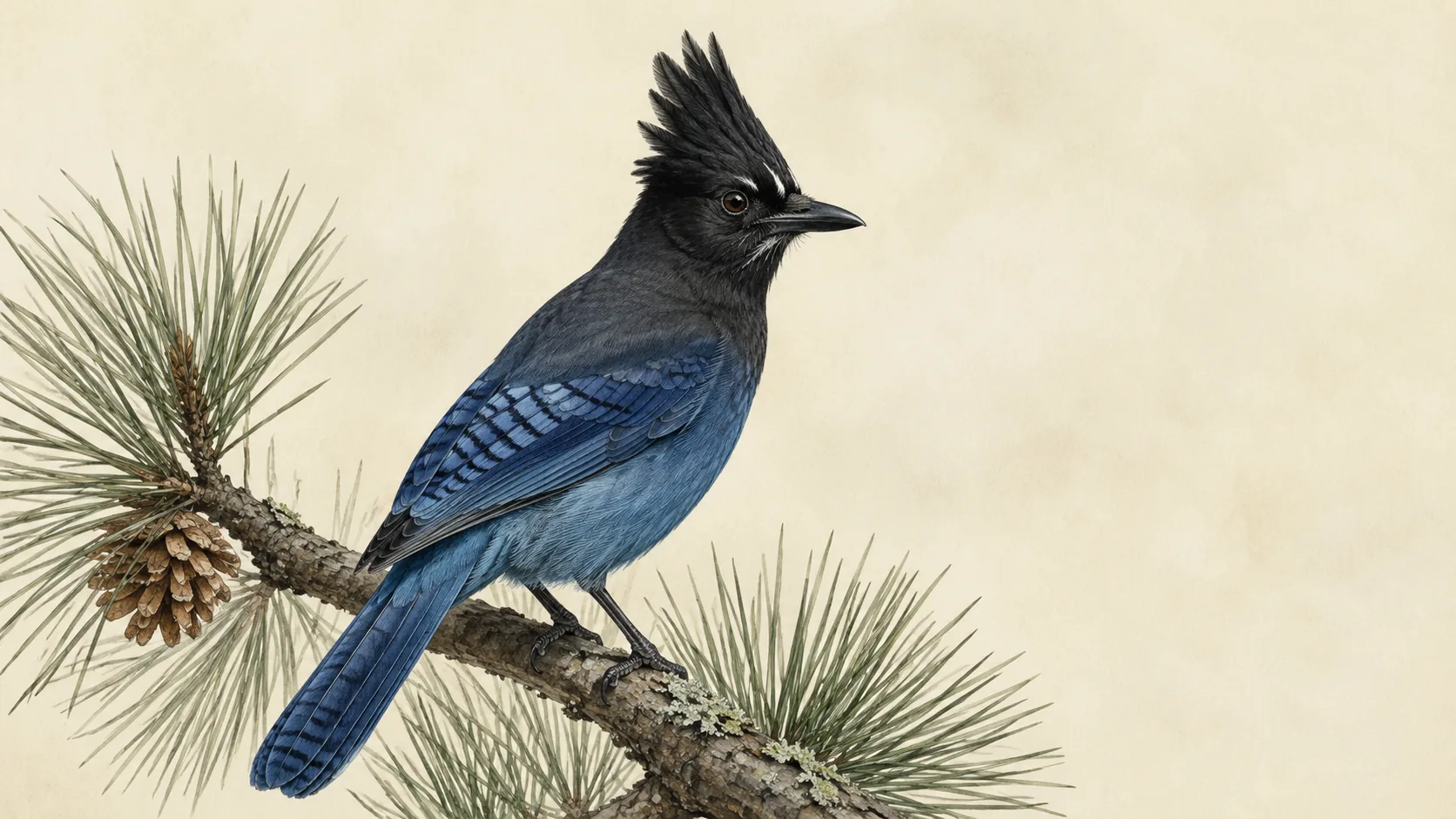
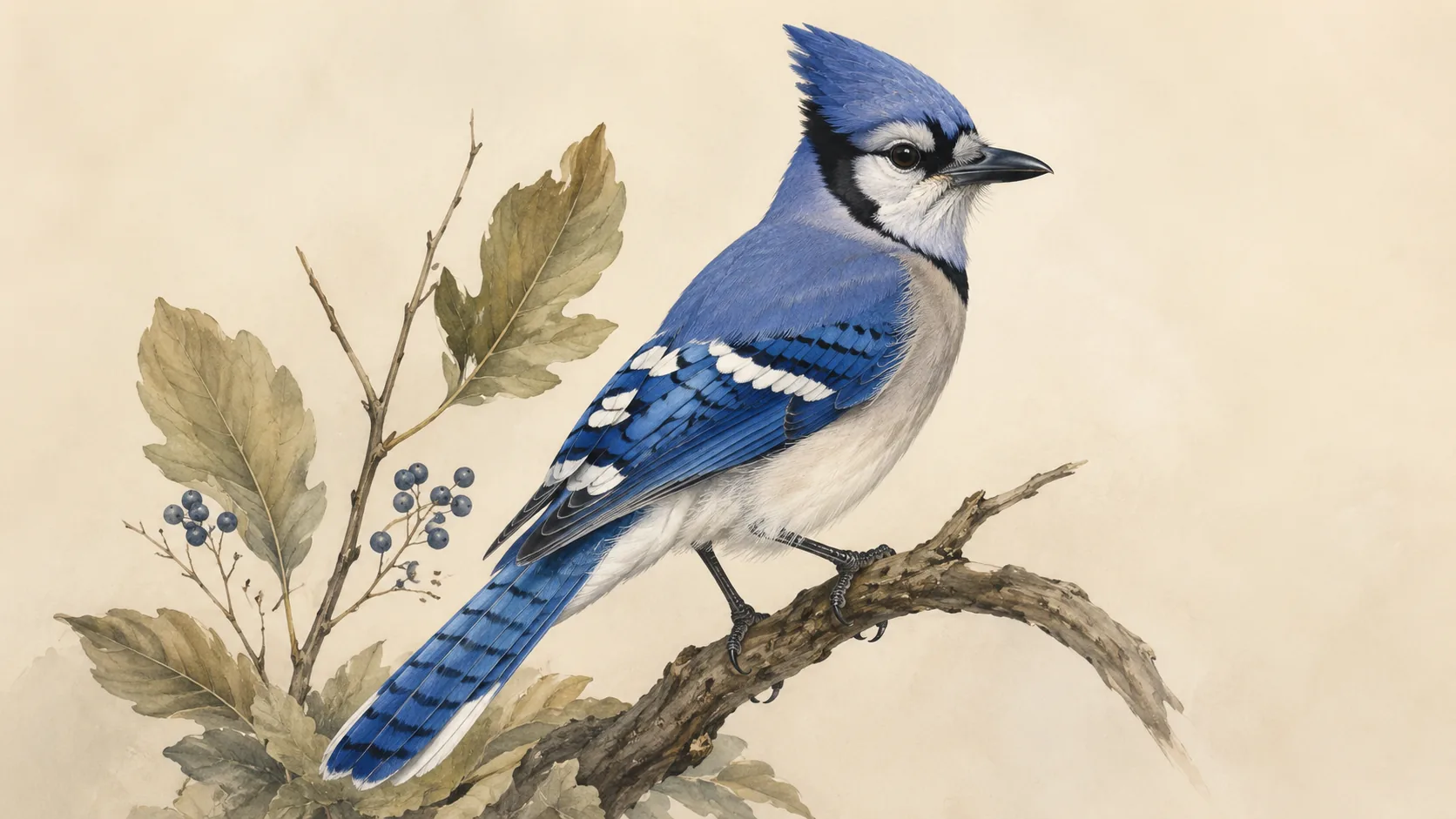
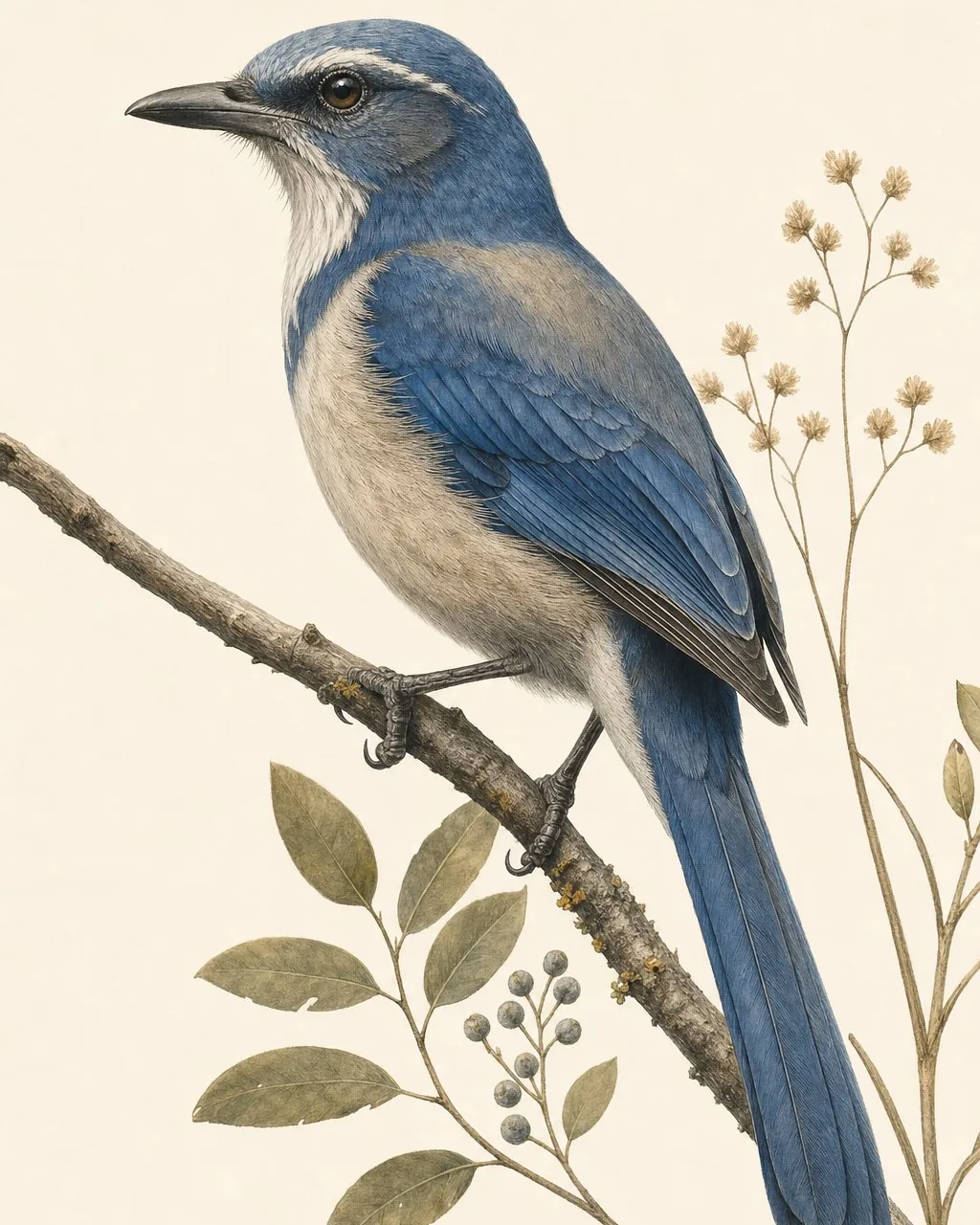
Larger, more saturated and more deliberate than the Florida Scrub-Jay, its closest relative. The Island Scrub-Jay is 15 to 20 percent larger than mainland California Scrub-Jays, with a heavier bill and a noticeably deeper blue coloration. The blue of the back, wings, tail and crown is vivid, not the dusty blue of many corvids. The underparts are grey to off-white, with a blue necklace across the breast. There is no crest, unlike the Steller’s Jay.
The bill is the most immediately striking difference from the mainland species: heavier, more powerful-looking, and distinctly hooked at the tip. This is a working tool, not an ornament.
In behavior the bird is typical of scrub-jays - confident, curious, semi-tame around visitors - but with a quality of ownership, of belonging absolutely to this particular island, that mainland birds do not quite project. This is, after all, the only home there is.
| Measurement | Range |
|---|---|
| Length | 30 - 33 cm |
| Weight | 97 - 130 g |
| Wingspan | 38 - 43 cm |
| Lifespan | 10 - 18 years |
“Island gigantism is the tendency of island populations to evolve larger body size when released from mainland predators and competition. The Island Scrub-Jay is a textbook example.”
Voice
Calls are similar in type to mainland scrub-jays: harsh, jay-like shrieks and scolding notes, softer conversational sounds between mates and family groups. The voice is slightly lower-pitched than the California Scrub-Jay, consistent with the larger body size.
Range and habitat
The entirety of the range is Santa Cruz Island, the largest of the Channel Islands off the coast of Southern California. The island is 250 square kilometres. The jay occupies the whole of it - chaparral, oak woodland, riparian scrub along seasonal streams, coastal sage scrub at lower elevations. It is not habitat-restricted within the island in the way that the Florida Scrub-Jay is restricted to open scrub. It can use most of the island’s vegetation types.
The National Park Service owns 76 percent of the island as part of Channel Islands National Park. The Nature Conservancy holds the remainder. No development occurs on either portion.
Diet
The Island Scrub-Jay’s heavier bill is a clue to its ecology. On the mainland, scrub-jays cache acorns, which they harvest with a generalist jaw structure. On Santa Cruz, the bird faces the same island ecology that drives gigantism and bill elaboration elsewhere: fewer competitors, different prey size distributions, and possibly the influence of larger-bodied prey that a stouter bill can handle.
Studies have found that Santa Cruz jays are significantly more likely than mainland relatives to prey on the large Island Scrub Lizard, a reptile that mainland scrub-jays would find difficult to subdue. The heavier bill may be, in part, a lizard-hunting tool.
Otherwise the diet is typical corvid - acorns, berries, insects, eggs, small vertebrates, carrion.
Breeding
Breeding season runs from March through June. The nest is a bulky cup of sticks lined with finer materials, placed in an oak or dense shrub. Both parents incubate three to four eggs for roughly seventeen days. The fledglings remain with the parents for an extended period, learning foraging skills.
Unlike Florida Scrub-Jays, Island Scrub-Jays do not appear to have cooperative breeding with helpers at the nest, though the social structure has not been studied as intensively as the Florida population.
A single point of failure
The entire world population of a vertebrate species on 250 square kilometres is a situation that focuses the mind. There is no meta-population to rescue a failing core. There is no source population to recolonize after a catastrophe. Santa Cruz Island is not a subset of the Island Scrub-Jay’s range. It is the range. All of it.
The historical threat to the bird was the degradation of the island itself. Introduced pigs, sheep and non-native plants transformed large portions of the island’s vegetation over two centuries of ranching. Without native oak woodland and chaparral in reasonable condition, the jay’s food supply and nesting sites are compromised.
The removal of feral pigs from Santa Cruz Island between 2005 and 2006 - a program that involved aerial hunting and that generated considerable controversy - was one of the most successful island restoration projects in North American history. Within years of pig removal, native vegetation was recovering in patterns visible from aerial photography. The jay population appeared to stabilize.
The current IUCN listing is Vulnerable, based on the small population size and restricted range. The primary ongoing risk is not habitat quality but stochasticity - a disease, an extreme drought, an introduced predator, a catastrophic fire. Any one of these events at scale could do what habitat degradation alone could not.
Avian West Nile Virus arrived in California in 2003 and has affected corvid populations on the mainland. The Channel Islands have so far remained free of the virus. If West Nile crosses to Santa Cruz - via a single infected mosquito in a sufficient density of susceptible birds - the consequences could be severe. A population of 2,000 birds with no evolutionary immunity to the virus and no refugia to retreat to.
Management now focuses on monitoring the population through regular surveys, maintaining the restored habitat, and planning for potential disease response. Whether those plans are sufficient depends on which of the possible catastrophes arrives first, and how quickly a response can be mounted on an island 40 kilometres from the California coast.
It is a species that has been made rare by nothing more than the simple mathematics of island biology. Cut off long enough, and a population becomes a species. Become a species on a small enough island, and your rarity is not misfortune - it is the definition of what you are.