Field Guide
Spotted Towhee
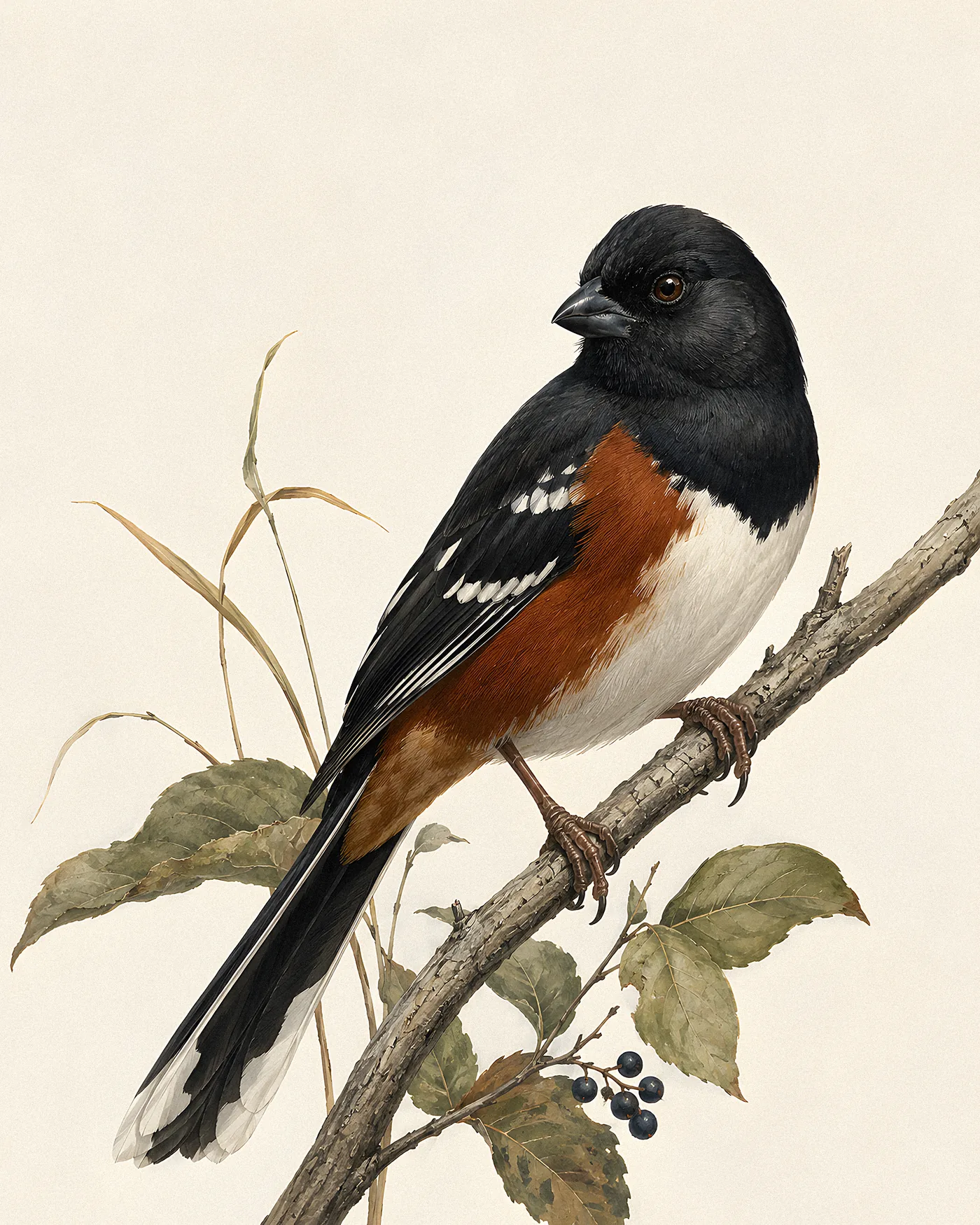
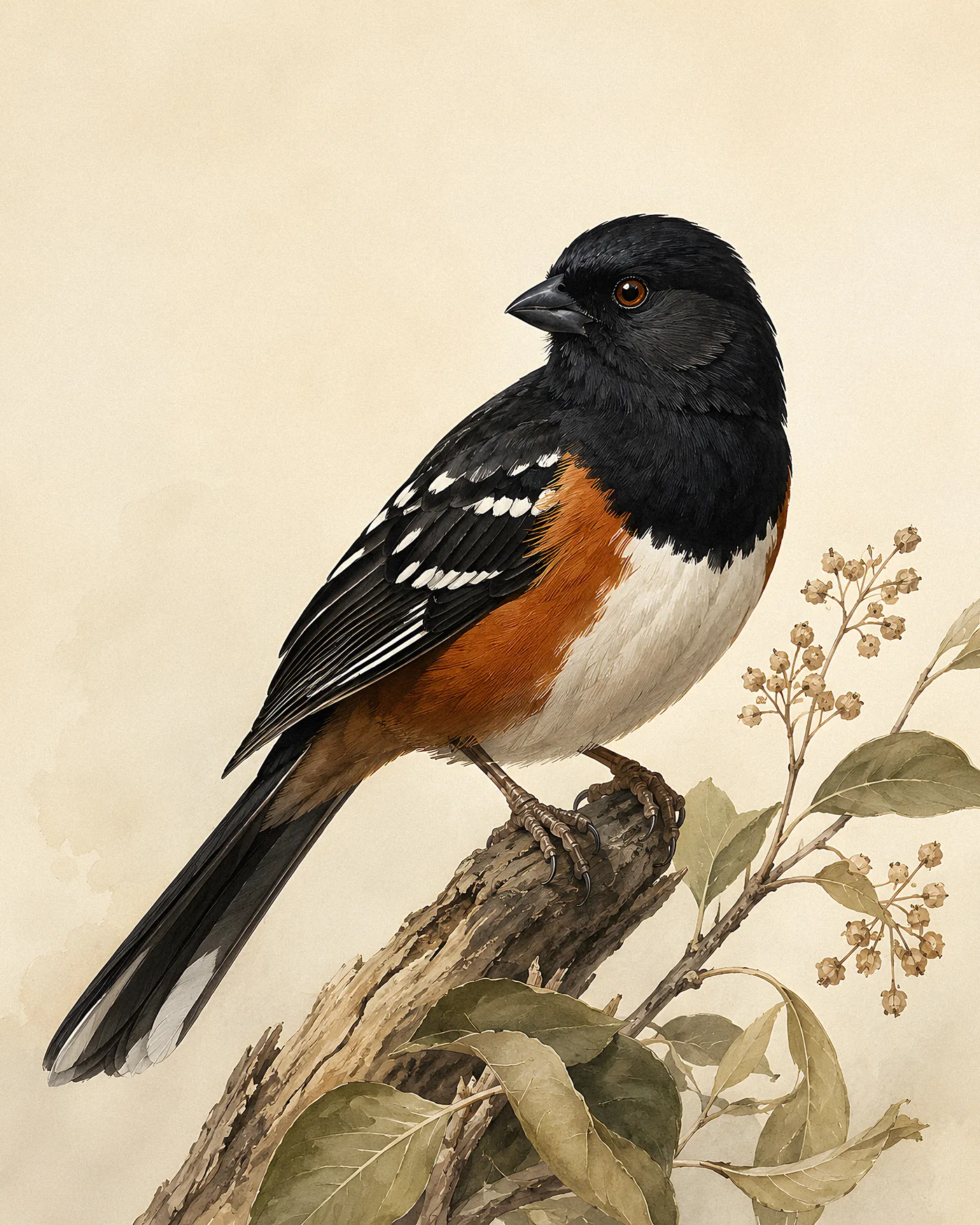
A chaparral slope above a California canyon, dry and bright, and from somewhere inside a manzanita comes a buzzy, insistent trill. The singer is invisible until he climbs to the top of the bush to deliver it again: a large dark sparrow in a black hood, his back and wings spangled with rows of white spots, rufous along the flanks and white on the belly, the whole thing lit by a red eye. He is the western cousin of the Eastern Towhee, and for most of the twentieth century the two were considered the same bird.
The Spotted Towhee is what the eastern bird becomes when you carry it across the Great Plains: same shape, same swagger, same double-scratch in the leaf litter, but dressed for the West in a coat dusted with white.
What it looks like
The male is jet black over the head, throat, back, wings and tail, with rich rufous sides and a white belly between them - the towhee pattern exactly. What sets him apart from the eastern bird is the spotting. Cornell Lab describes the upperparts and folded wings as marked with bright white spots and bars, a spangled effect the Eastern Towhee lacks almost entirely. The tail is long and dark with white corners that flash when the bird drops across an opening.
The female follows the same plan in grey-brown rather than black, keeping the white spotting, the rufous flanks and the white belly. Cornell Lab puts the species at 17 to 21 centimetres long and 33 to 49 grams, a third larger than a Song Sparrow and twice as heavy, with a wingspan around 28 centimetres and the heavy conical bill the family shares. The eye is red in most of the range.
What it sounds like
The voice is the clearest line between this bird and its eastern twin. Where the Eastern Towhee sings a tidy drink-your-tea, the Spotted Towhee tends to drop the opening notes and lead straight into the buzzy trill, so the western song is often just a fast, raspy zzzzzzz delivered from the top of a shrub. Cornell Lab notes that the song varies geographically, but the buzzy quality is the constant.
The call is a whiny, rising, cat-like mew, harsher and more nasal than the eastern bird’s clean chewink. Add the constant rustle of a towhee raking the leaf litter and you have a bird that, like its eastern relative, announces itself by sound long before it shows.
Range and habitat
Pipilo maculatus is a bird of dense, dry brush across western North America, from southern British Columbia and the interior West south through the Pacific states and into the mountains of Mexico. It wants the same structure the eastern bird wants - thick shrubby cover over a litter floor - but finds it in western forms: chaparral, manzanita and scrub oak, sagebrush edges, streamside thickets, clear-cut regrowth, and the shrubby corners of gardens and parks throughout the West.
Birds in the milder, lower parts of the range are largely resident; those breeding at higher elevations and in the colder interior move downslope and south for winter. Cornell Lab and the IUCN both list the species as Least Concern, with a large and stable population estimated in the tens of millions.
Diet
Like the Eastern Towhee, this bird is a ground forager with a signature move: the two-footed backward double-scratch that kicks leaf litter aside to expose food beneath. The racket of it is a reliable way to find a towhee you cannot see.
The diet swings with the season. Cornell Lab records that breeding-season food is mostly animal - ground beetles, weevils, ladybird beetles, crickets, grasshoppers, caterpillars, moths, bees and wasps, plus millipedes, sowbugs and spiders from the litter. In autumn and winter the balance tips to plants: acorns, berries and seeds including buckwheat, thistle, raspberry, blackberry, poison oak, sumac and nightshade, along with cultivated oats, wheat and corn at the edges of farmland.
Breeding and nesting
The nest is built on the ground, or very low in a shrub, and well hidden. Cornell Lab describes a cup of bark strips, grass, twigs and leaves lined with finer grasses and animal hair, tucked into leaf litter beneath a shrub or a clump of grass. The female does the building.
She lays three to five eggs, creamy to greyish and speckled, and incubates them for about 12 to 14 days. The young leave the nest early, at around 9 to 11 days, often before they can fly, and the parents keep feeding them for roughly another month while they learn the ground-foraging trade. The Spotted Towhee is also a frequent host to the Brown-headed Cowbird.
Split from the Eastern Towhee only in 1995, the Spotted Towhee is the same bird remade for the West, its black coat dusted with white spots.
What to watch for
The Spotted and Eastern Towhees are a textbook case of one species becoming two. They were lumped as the single Rufous-sided Towhee for decades, until 1995, when differences in plumage, voice and genetics persuaded the authorities to split them along the line of the Great Plains. Where the two ranges brush together on the western edge of the plains, they still occasionally interbreed, a reminder of how recent the division is.
For the watcher in the West, the practical guide is simple. A large dark towhee in dry brush, spangled with white, mewing like a cat and raking the litter with both feet, is this one. Coax it into the open and the spotted coat is unmistakable - a bird the tradition of Audubon would happily have set against its western thicket.