Field Guide
Spectacled Eider
For decades, ornithologists knew where the Spectacled Eider spent its summers. They knew where it bred, what it ate on the breeding grounds, how it nested. What they did not know - what no one knew - was where 300,000 birds went every October and did not return from until spring.
The species disappeared. Completely. Every autumn, every bird left the Alaskan and Russian Arctic coasts and vanished into the Bering Sea region. Surveys found nothing. No winter flocks were documented. No records existed of a winter roost. The birds were simply gone for half the year, and science did not know where they were, or even that they were all together. They might have been scattered across thousands of miles of open ocean. They might have been somewhere obvious, hiding in plain sight behind weather too bad for survey aircraft. No one knew.
That gap in knowledge persisted until 1995. What happened that year is one of the more astonishing moments in twentieth-century ornithology, and it began, like most good field work, with someone deciding to put a transmitter on a duck.
What It Looks Like
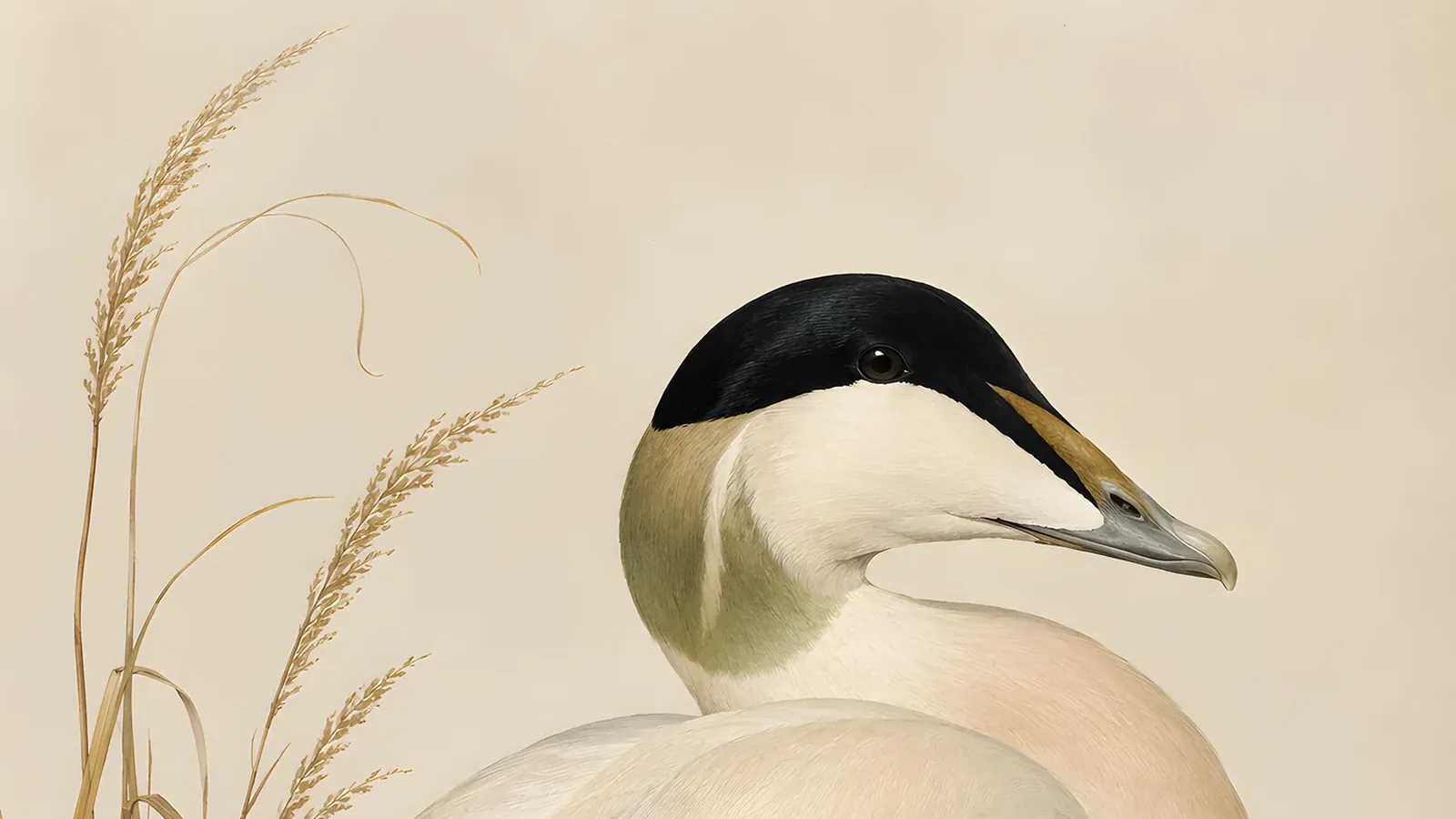
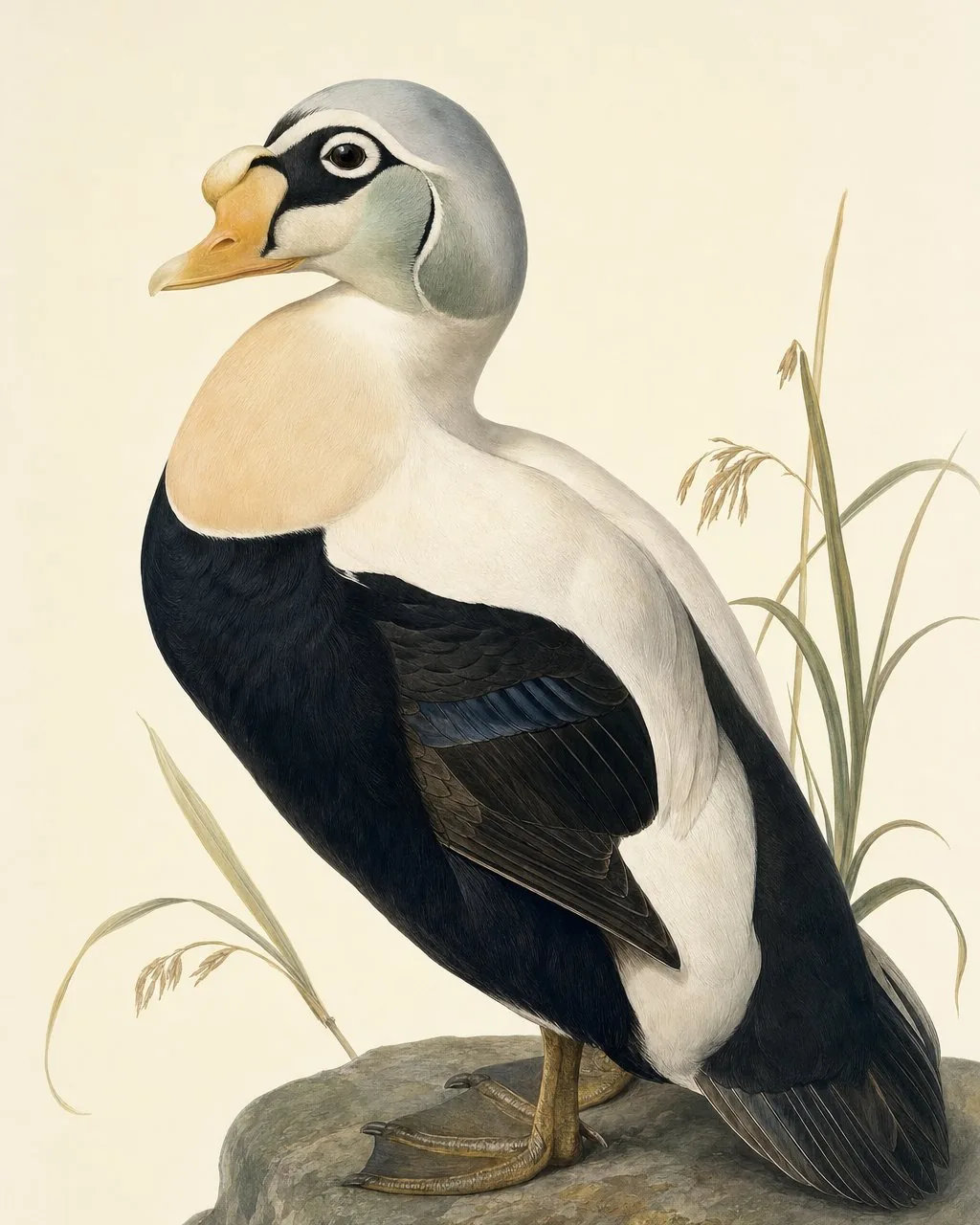
The Spectacled Eider is a large, heavy-bodied sea duck, close in size to a common eider but instantly separable from anything else in its range by one feature: the eye patches.
The breeding male carries large, circular patches of white feathers around each eye, ringed sharply in black. The patches are pale - almost luminous - against the rest of the head, which is pale green with a suffusion of soft color across the crown and nape. The bill is orange, fleshy, and feathered far down toward the tip in the manner of all eiders. The body is white on the back and sides, black on the breast and belly. The contrast is stark in good light. The overall effect of the circular eye patches on the green and white head is genuinely unusual - the bird looks as though it arrived in the Arctic wearing deep-sea diving apparatus that no one else was issued.
Females are a warm brown with fine dark vermiculation across the body, the pattern typical of eiders. But even the female shows the eye-patch structure - a pale buff or whitish area around each eye, less defined than the male’s sharp goggle but still recognizable. Once you have seen a male, you can pick a female Spectacled Eider out of a mixed flock by the suggestion of the spectacle alone.
The bill feathering in this species extends further onto the bill than in other eiders, giving the head a distinctive bulbous profile that helps separate it at distance. The bill itself is more compressed laterally than in the common eider. The overall silhouette on water is a large, rounded, buoyant duck riding high.
Measurements
| Measurement | Range |
|---|---|
| Length | 52 - 57 cm |
| Weight | 1,500 - 2,200 g |
| Wingspan | 86 - 93 cm |
| Lifespan (wild) | 10 - 20 years |
Voice
The Spectacled Eider is not a vocal bird outside the breeding season, and even on the breeding grounds the sounds are understated for a duck its size. Males give a soft, dove-like cooing during courtship - a low, exhalatory sound rather than the loud quacking associated with dabbling ducks. The call has been written as a soft who-who-whoo, repeated with the head tossed back and the bill pointed skyward in the classic eider display posture.
Females give a low, grating croak when alarmed near the nest. Contact calls between birds on the water are quiet enough to go unheard at any distance. In winter aggregations on the Bering Sea, birds are largely silent. The quiet may be functional - the Arctic Ocean in winter is the loudest natural environment on earth, full of wind and grinding ice. A quiet call travels no distance at all. A quiet flock stays hidden.
Range and Habitat
The Spectacled Eider breeds on coastal Arctic tundra. In North America, the breeding range is centered in western Alaska, with the densest populations historically on the Yukon-Kuskokwim Delta, one of the largest river deltas in North America - a vast, low, waterlogged plain of tundra ponds, sedge meadows, and brackish lagoons where the Yukon and Kuskokwim rivers meet the Bering Sea. Breeding also occurs on the North Slope of Alaska near Barrow. In Russia, breeding populations are distributed along the Arctic coast of Siberia.
Breeding habitat is wet coastal tundra close to water - small ponds, lakeshores, and the margins of tundra rivers. The birds arrive in May when ice is still thick and depart in August and September.
“I have held a satellite transmitter no larger than a matchbox that, strapped to the back of a Spectacled Eider near the Kashunuk River, led researchers through a winter of radio silence and poor weather to a patch of open water in the Bering Sea pack ice where 333,000 birds were sitting together, entirely unknown to science, as they had presumably been sitting every winter for longer than anyone had been looking.”
And then they were gone. Every autumn the birds left, and winter surveys of the Bering Sea - a difficult, dangerous, and logistically expensive proposition in the best of conditions - turned up nothing.
Diet
The Spectacled Eider is a diving duck that feeds almost entirely on benthic invertebrates - animals living on or in the seafloor. On the Bering Sea, the primary winter prey is bivalves: clams, mussels, and cockles dug from shallow-water sediments. The birds also take amphipods, crustaceans, polychaete worms, and other bottom-dwelling invertebrates.
Diving from the surface, birds reach depths of ten to twenty meters in foraging areas. The bill and tongue musculature of eiders is adapted for crushing hard-shelled prey. Clams are swallowed whole and crushed internally. On breeding grounds, freshwater invertebrates, plant material, and sedge seeds supplement the diet during the short Arctic summer.
The winter concentration in the Bering Sea pack ice is almost certainly tied to a specific foraging opportunity: the shallow banks and shelves south of St. Lawrence Island, where water depths and sediment types support high densities of the bivalves the birds depend on. The birds position themselves where food is concentrated enough to sustain 333,000 individuals through a winter, diving through leads in the pack ice to reach the bottom.
Breeding
Birds arrive on the tundra breeding grounds in late May, pairing apparently completed or near-completed before arrival. The nest is placed on the ground, typically close to a tundra pond or lake margin, often with sedge or grass providing partial concealment. The nest cup is lined with down plucked from the female’s breast - the soft, insulating material that makes eider down commercially valuable and that keeps eggs viable through sub-freezing Arctic nights.
The female incubates the clutch of four to six olive-buff eggs alone. Shortly after incubation begins, the male departs the breeding area and moves to molting sites on the coast. This is the standard eider pattern. The female is left to incubate through the Arctic summer, leaving the nest only briefly to feed, losing body mass through the incubation period.
Incubation runs roughly 24 days. The ducklings are precocial and follow the female to water within a day of hatching. Females sometimes gather with their broods in loose groups for the remainder of the summer, providing some collective vigilance against Arctic foxes, which are the primary nest and chick predators.
The Discovery
In the early 1990s, the Spectacled Eider was in documented decline. Breeding populations on the Yukon-Kuskokwim Delta had dropped by more than half since the 1970s. The species was listed as Threatened under the Endangered Species Act in 1993. Recovery planning was difficult for an obvious reason: you cannot protect a species if you do not know where it spends half its life.
In 1995, USGS researchers working near the Kashunuk River in Alaska began attaching satellite transmitters to Spectacled Eiders before the birds left the breeding grounds. The transmitters were small platform transmitter terminals, the kind used on marine mammals, adapted for waterfowl. Each transmitted a location fix when a satellite passed overhead.
Through October and into November, the signals moved. Birds left the coast and moved into the Bering Sea. And then the signals clustered. Not scattered across open water, not distributed along the coast - clustered, tightly, in a small area of pack ice southwest of St. Lawrence Island. The researchers looked at the coordinates. They ran them again. They checked for equipment error.
What the transmitters had found was a polynya - a persistent area of open water maintained in pack ice by wind, current, and upwelling. Around and within this polynya, in a patch of the Bering Sea that winter survey flights had either missed or had never flown over in the right conditions, sat the winter aggregation of the entire Spectacled Eider population. Not some of the birds. Essentially all of them.
Aerial surveys confirmed it in 1996. An estimated 333,000 Spectacled Eiders were gathered in an area small enough to survey in a single day. They were packed tightly on the water and on surrounding ice, diving through leads in the pack to reach the seafloor below. The population that had been listed as Threatened was not, as feared, reduced to some unknowably small scattered remnant across the Bering Sea. It was intact, concentrated, and completely invisible to every prior survey method that had been tried.
The implications were immediate. The winter site - now called the St. Lawrence Island polynya wintering area - became a focal point for conservation concern. Three hundred and thirty-three thousand birds in one place means three hundred and thirty-three thousand birds at risk from a single event: an oil spill, a catastrophic shift in sea ice, a failure of the bivalve populations on the shallow banks below. The discovery that the birds were not scattered was reassuring in one sense and alarming in another.
The satellite technology that made the discovery possible had been available for less than a decade. The birds had been using that polynya presumably for far longer - perhaps for centuries, perhaps longer than the species had been documented in any form. They had wintered in that patch of Bering Sea ice every year, unknown, while ornithologists who knew them well spent summers on the tundra counting nests.
What Else Don’t We Know
The Spectacled Eider is better understood now than it was in 1994. Researchers know the wintering site, understand the diet, have measured population trends across multiple decades of breeding surveys in Alaska. The Yukon-Kuskokwim Delta population has stabilized after the steep declines of the 1970s and 1980s, though the factors driving those declines - lead poisoning from ingested shot, changes in Arctic fox predation pressure, and possible shifts in Bering Sea food webs - are not fully resolved.
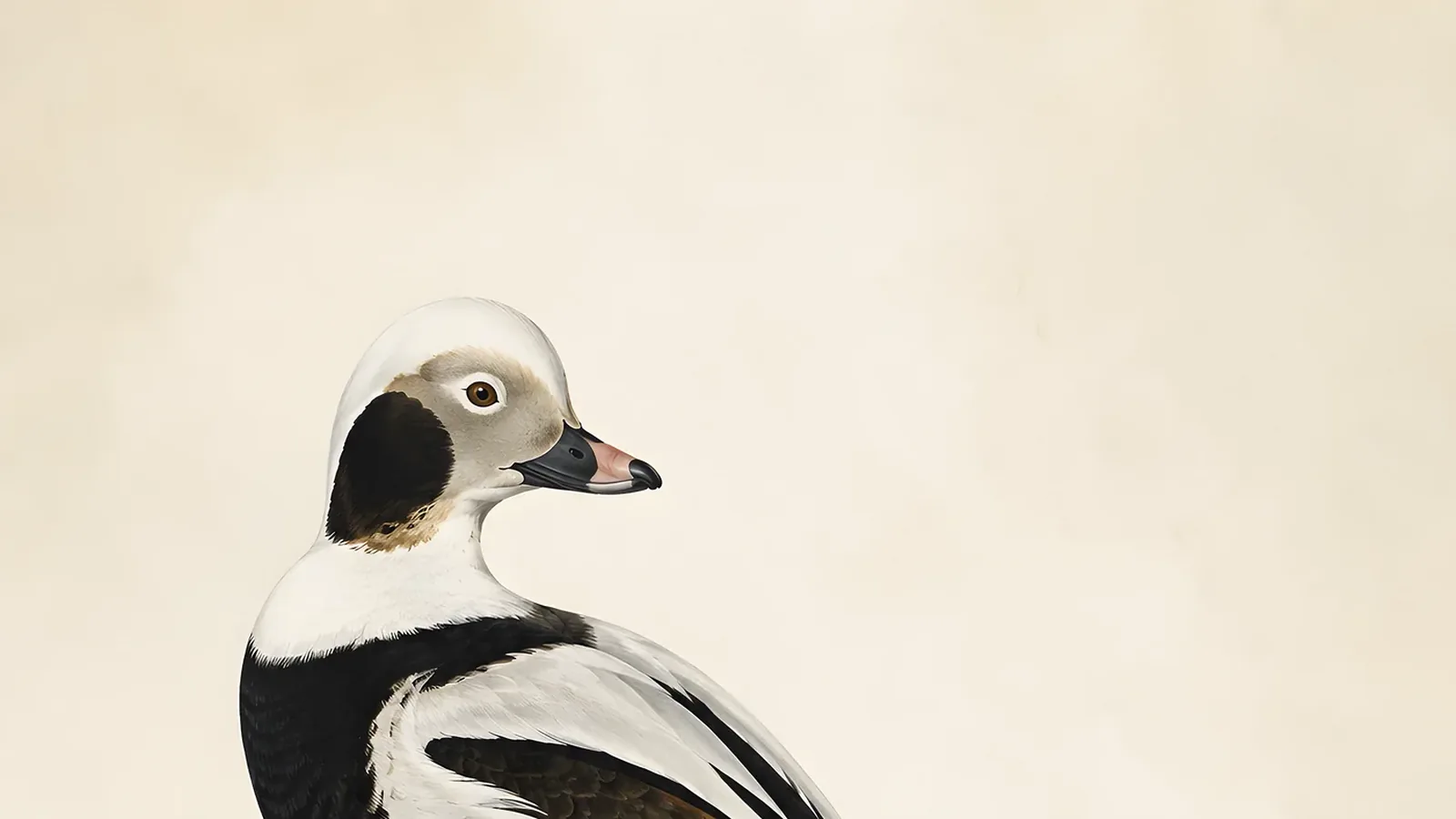
But the 1995 discovery should be read as a warning about confidence, not just a story about a gap filled. The Spectacled Eider was a well-studied species with a long research history, and the entire world population wintered unknown in a small area for as long as anyone had been paying attention. The long-tailed duck winters across enormous stretches of the same sea. Other species that breed in the Siberian Arctic have wintering grounds that are speculative at best.
The Arctic is not well-surveyed in winter. It is cold, dark for months, ice-covered, and far from any infrastructure that supports regular aerial survey. The effort required to find 333,000 Spectacled Eiders was significant, and it succeeded. The question worth holding is what has not yet been found because the effort has not yet been made.
What sits in the pack ice right now, gathered, unknown, waiting for someone to put a transmitter on it and follow the signal?