Field Guide
Brown-capped Rosy-Finch
It is August in a talus basin above 13,000 feet in Colorado, and you have earned whatever you are looking at.
The snowfield below the cirque wall has shrunk to a grey wedge. A dozen small birds work its upper edge, hopping across the ice crust, pausing, pecking. No cover, no tree, not even a stem of willow. Nothing between them and the sky except the cold radiance off the rock. These are Leucosticte australis, the Brown-capped Rosy-Finch, and they are doing exactly what they have always done: finding insects frozen on the snow surface, pulling seeds from the melt-line, living at the absolute edge of what a bird can metabolise. The wonder is not that they are rare. The wonder is that the mountain keeps a few of them at all.
What it looks like
The gray-crowned rosy-finch and the Brown-capped are often described together, and the comparison is the fastest field lesson either species will teach you.
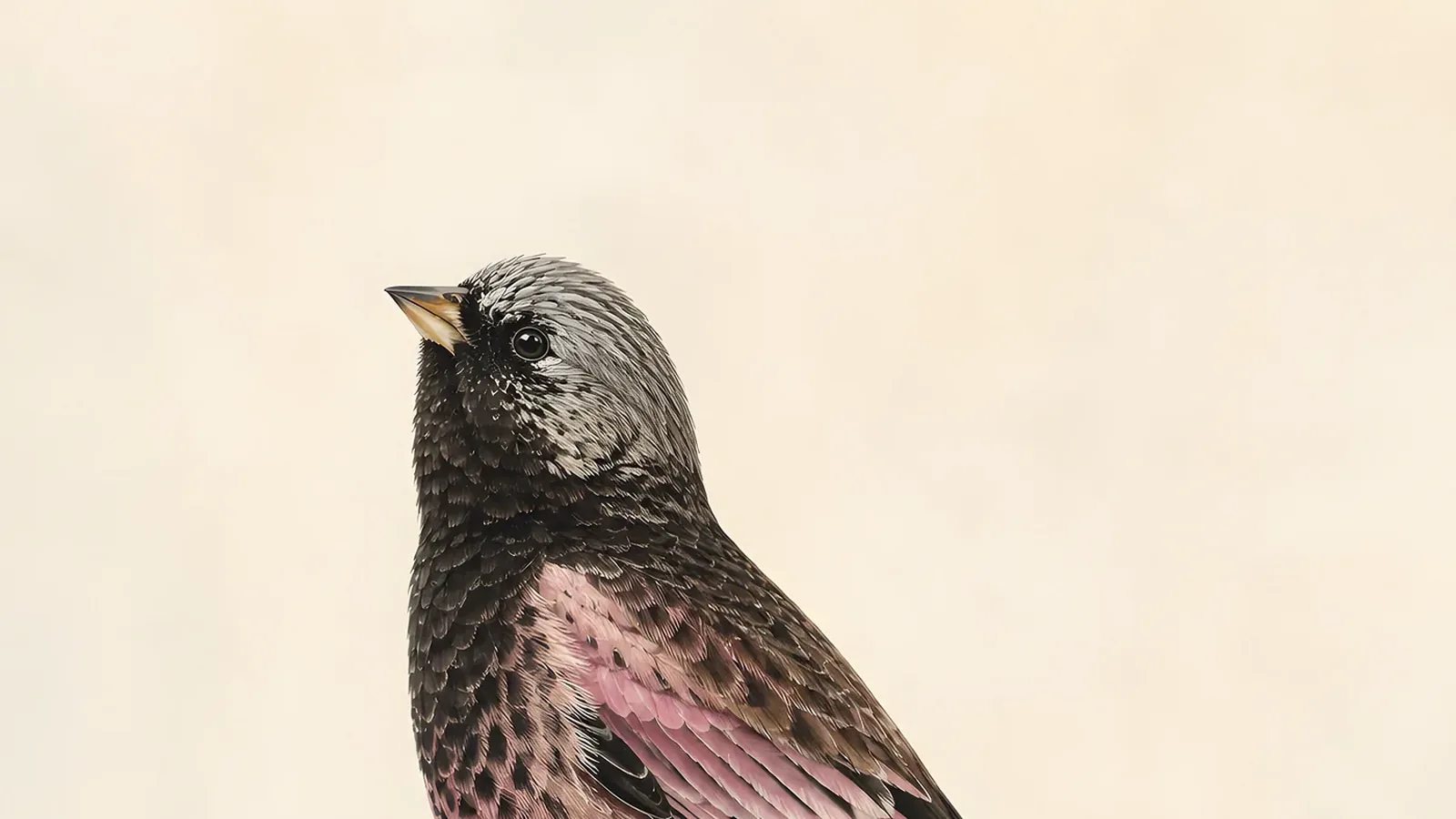
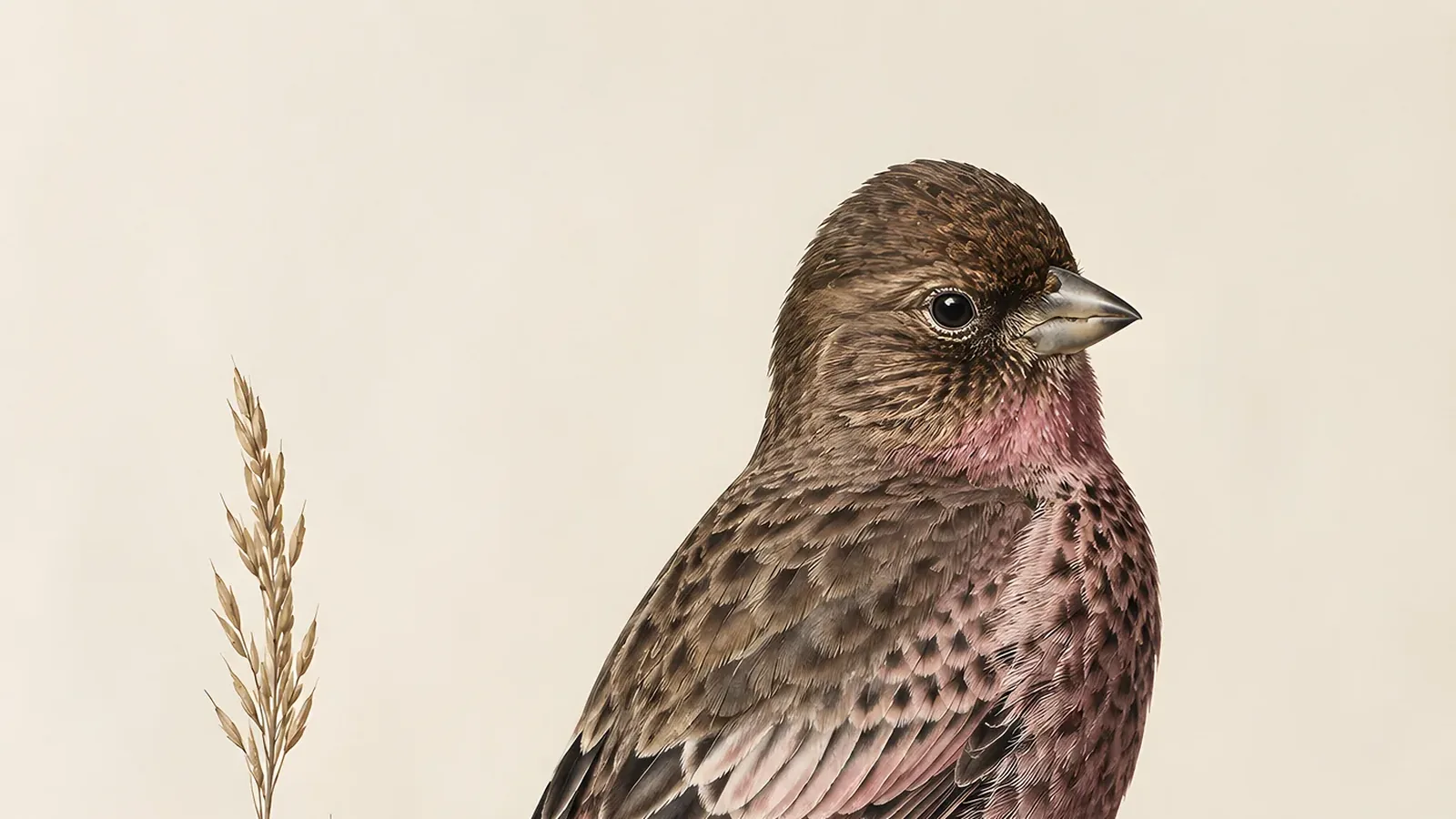
The Gray-crowned carries a neat silver arc from behind the eye around the back of the crown. You cannot miss it if it is there. Look at the Brown-capped and it is not there. The head is entirely warm chocolate-brown, crown to nape to cheek, continuous with the colour of the back and breast. A small black forehead patch contrasts above the bill, giving the face an alert, clean expression. No silver. No grey.
That is the field mark. The absence of grey.
| Measurement | Brown-capped |
|---|---|
| Body length | 14 - 16 cm |
| Weight | 26 - 37 g |
| Wingspan | 33 - 36 cm |
| Lifespan (wild) | up to 9 years recorded |
Below the brown breast, the belly and rump flush pink - the rose for which the whole group is named. Rosy edges wash the wing coverts and flight feathers, visible at rest and vivid in flight when the bird banks across a snowfield. Males carry the colour at full saturation. Females wear the same pattern, muted: pinkish rather than rosy, brown rather than rich. Both sexes have a black bill in summer that yellows through winter. The tail is long and forked, giving the silhouette more elegance than the size would suggest.
In winter flocks, when Brown-capped birds mix with Gray-crowned and Black Rosy-Finches at lower-elevation feeders in Colorado valleys, the all-brown head remains the instant separator. Every other rosy-finch in that flock will show grey somewhere on its head. This one will not.
The highest, smallest range
The Brown-capped Rosy-Finch has the most restricted breeding range of all three North American rosy-finches. That is a sentence that carries weight.
Its breeding range is, essentially, Colorado. A narrow extension reaches into extreme southern Wyoming. The southern boundary just crosses into north-central New Mexico. Remove Colorado from the map and this species nearly disappears from it.
Within Colorado, it nests above treeline, typically above 11,500 feet and most densely between 13,500 and 14,200 feet - among the highest elevations of any nesting bird on the continent. It places its nest in cliff crevices, under talus boulders, in the recesses of abandoned mine shafts, in old Cliff Swallow nests where the pre-built mud cup saves construction effort. The female does the building: a bulky cup of moss, dry grass, and rootlets, lined with finer material, sometimes feathers. She incubates alone for roughly 12 to 14 days. Clutch size is three to five eggs, white and unmarked. Nestlings fledge at around 18 days. One brood per year, constrained by the brevity of the alpine summer, which is measured in weeks not months.
In winter the birds descend. Not far - they are altitudinal migrants, not long-distance ones. Foothill valleys, lower parklands, the edges of mountain towns. They gather in flocks, sometimes large ones, and will come to feeders. They may roost in barns, old buildings, or caves. On calm clear days in January, flocks have been recorded commuting back up to ridge crests at altitude even when temperatures drop below -35 degrees Celsius, riding thermal margins where wind has exposed the ground.
What it sounds like
The voice is low and flat. A series of cheep notes, the same contact call repeated, used to hold the flock together across wind and talus. No elaborate song. Males deliver a version of the call in extended, undulating display flights during the breeding season, a long circular repetition of that same note, more sustained than complex. It is the call of a bird that does not waste energy on flourish.
In winter flocks the chatter of many birds becomes a mild murmur, easy to hear before you see the birds themselves. Learn the low, falling chip and you will find them in the foothills before they find you.
Diet at the snowline
The snowfield foraging is the signature.
In summer the birds work the retreating edge of every persistent snowfield in their range, picking insects - flies, beetles, moths - that have been wind-carried onto the ice and immobilised by cold. A frozen fly is easy prey. It does not move. Seeds exposed as snow pulls back from the alpine meadow edge provide the rest of the summer diet. The American Ornithological Society’s Birds of North America account documents clutch size at a mean of 4.14 eggs (Watson et al.), and the species’ reliance on snowfield-edge invertebrates as the primary nestling food underscores how tightly the breeding calendar is tied to the melt schedule.
Come autumn the diet shifts to seeds almost entirely: grama grasses, pigweed, lovegrass, knotweed, mustard, thistle, bluegrass, white marsh-marigold. In valleys and at feeders the birds are seed specialists, working whatever the mountain has dropped onto the lower ground.
Breeding
The Brown-capped Rosy-Finch is a Tipping Point species. The 2025 State of the Birds report designates it among the 42 North American species that have lost more than 50 percent of their population in the past 50 years and face the steepest path to recovery.
Breeding at this altitude is a sprint, timed to the snow.
Nesting begins when cliff faces above 13,000 feet become accessible, typically late May to June. The window to fledge young before alpine weather closes again is narrow. No second brood is possible. Everything - nest site selection, incubation, provisioning - runs on the tight schedule that altitude imposes.
Because nest sites are cliff crevices and talus, survey work is exceptionally difficult. Colorado Parks and Wildlife surveys completed between 2018 and 2023 (Bernier, UC Santa Cruz and CPW) used line transects across 57 mountain basins to produce the first rigorous range-wide population estimate: between 116,000 and 148,000 individuals. This is more than three times the prior Partners in Flight estimate of roughly 45,000, which reflects improved methodology rather than actual growth. The trend direction across all sources is the same: decline.
Nowhere higher
Here is the argument this bird makes, simply by existing where it does.
The National Audubon Society’s 2019 climate modelling (Survival by Degrees) projected that under a two-degree warming scenario, the Brown-capped Rosy-Finch would lose 99 percent of currently suitable habitat. Ninety-nine percent. The comparable figure for the Black Rosy-Finch is 79 percent, and for the Gray-crowned, 48 percent. The disparity reflects geography. The other two species have range breadth and latitude to work with. They can shift. This one cannot.
DeSaix et al. (2022, Diversity and Distributions) modelled the species’ ecological niche against climate projections and found that precipitation-as-snow, mean temperature in the warmest month, and elevation are the dominant predictors of habitat suitability - three variables all moving in the wrong direction simultaneously. The analysis further found that population persistence under future conditions may require rapid in-situ genetic adaptation to novel climate states, a demanding ask of a species already restricted to one state’s alpine zone.
Watson et al. (2025, USGS) used 22 years of mark-recapture data from the New Mexico wintering site - the only location where all three rosy-finch species regularly co-occur - to estimate annual survival and project breeding distribution trends. The southern end of the range, already the thinnest part, is projected to become climatically unsuitable first.
The mechanism is simple to describe and hard to solve. Warming compresses alpine tundra from below, as shrubs and subalpine vegetation advance upslope. Snowfield area shrinks, removing the foraging habitat the species depends on in summer. The birds are already nesting at or near the highest elevations available. There is no higher. And because the Southern Rockies are geographically isolated from other mountain ranges, there is no northward corridor to follow even if dispersal were possible.
A species with a continent-spanning range has options. The Brown-capped Rosy-Finch has one mountain range, one state, one narrow band of the highest ground, and a warming climate that is, year by year, reducing what even that offers. It is the most range-restricted of the three rosy-finches. It nests higher than almost any other North American bird. It has already lost more than half its population over the past half-century.
The question now is not whether the alpine will change. It will. The question is whether enough of the high country remains cold enough and snowy enough, long enough, for this bird to hold on to what is left.