Field Guide
Broad-tailed Hummingbird
You hear a male Broad-tailed Hummingbird before you see him. Across a high mountain meadow, somewhere up in the Rockies where the columbines and paintbrush are blooming, a thin metallic trill rises and crosses the air like a wound-up cricket. It is not a song. It is the sound of his wings. The note travels well in thin mountain air, and a birder learns to scan for the bird the moment it starts, because the trill arrives first and the hummingbird follows.
That self-made siren is the signature of the species. The Broad-tailed Hummingbird is a bird of high western elevations, breeding higher up the mountains than almost any other North American hummingbird, in meadows and open pine forest where the nights run cold well into summer. It is built to survive that cold, and it announces every arrival with two specially shaped feathers.
What it looks like
This is a medium-small hummingbird, around 10 centimetres long, weighing roughly 3.2 to 3.6 grams, with a wingspan near 13 centimetres. Cornell Lab notes that the female tends to run slightly larger than the male, which is the usual hummingbird pattern.
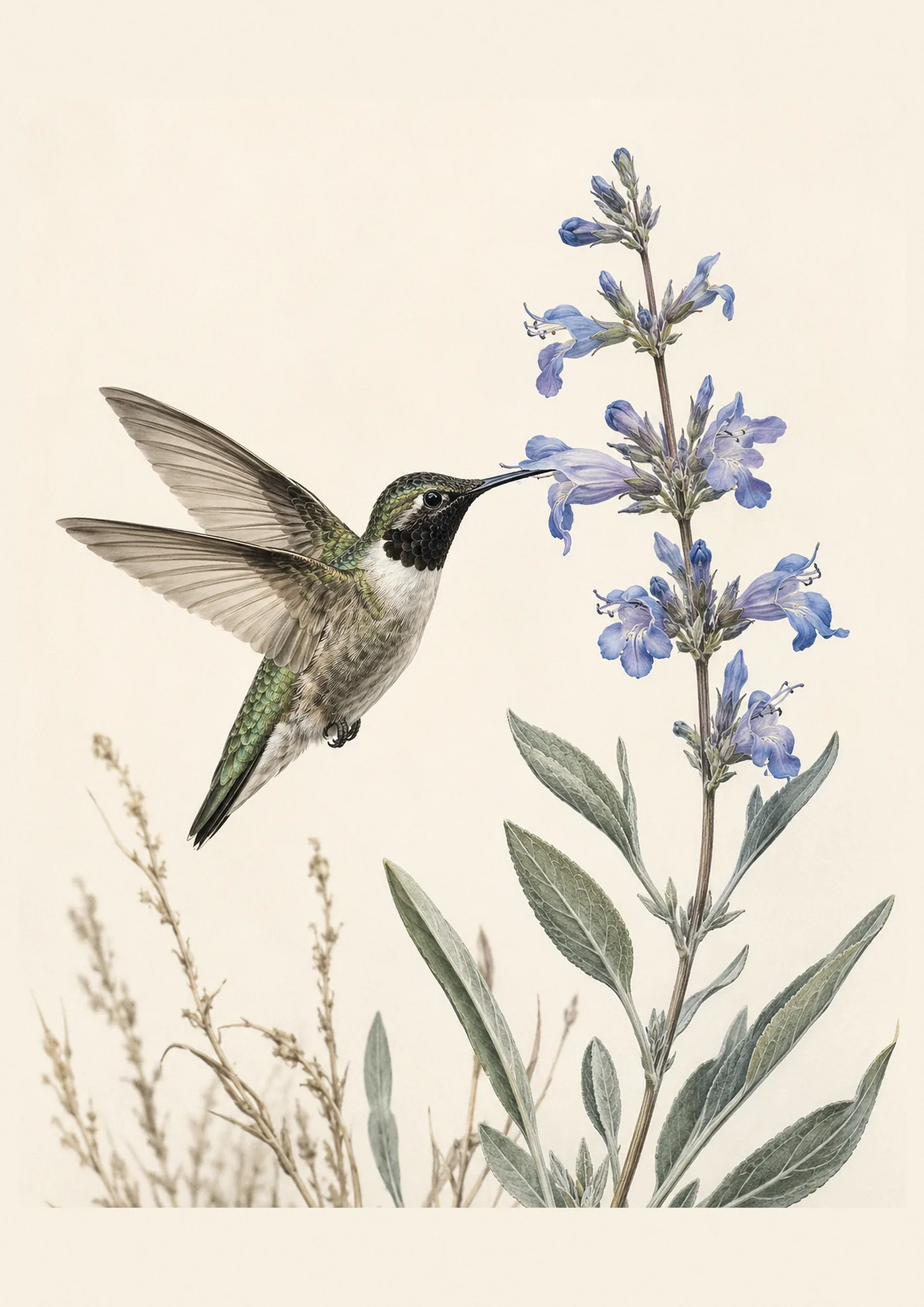
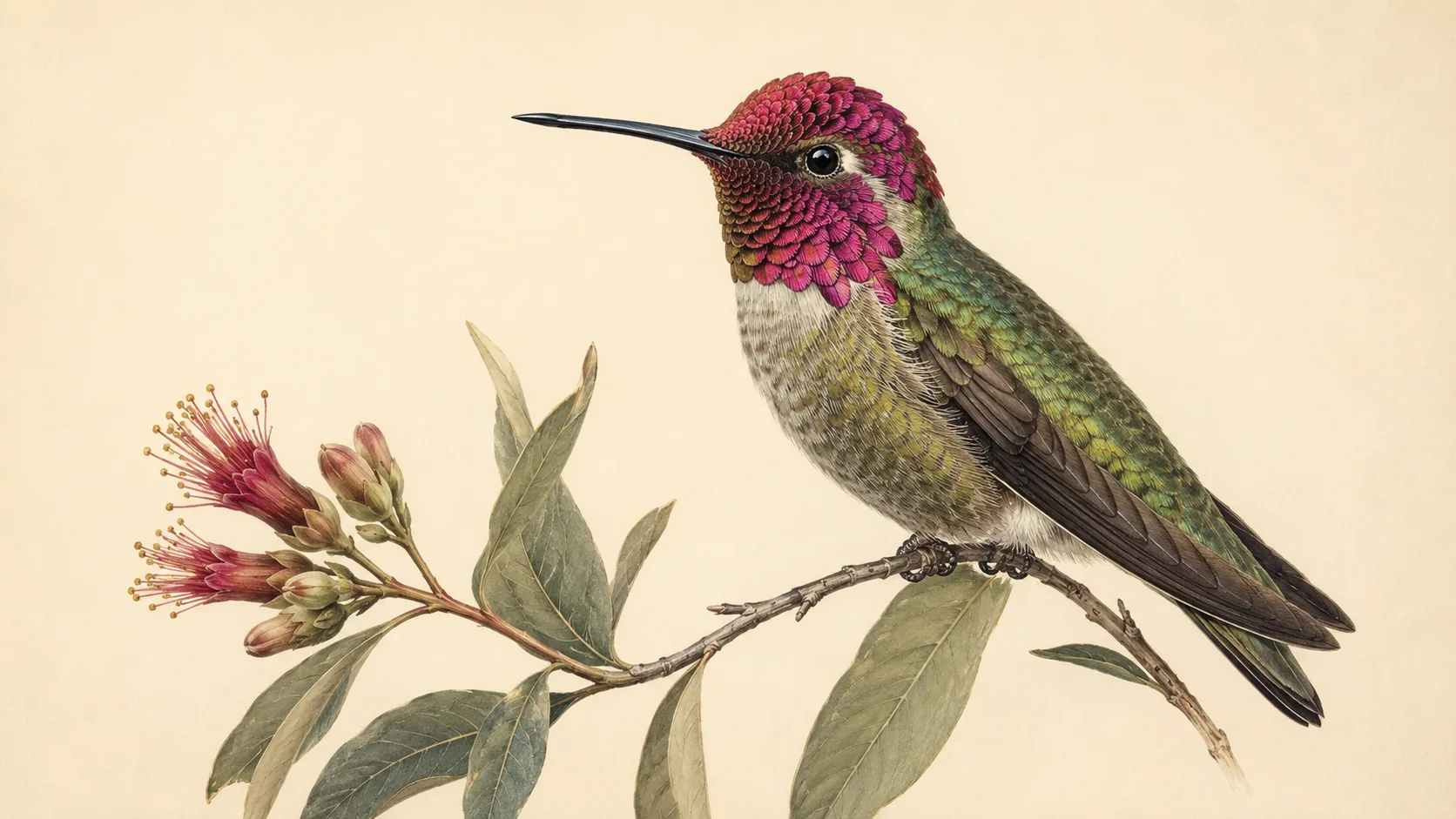
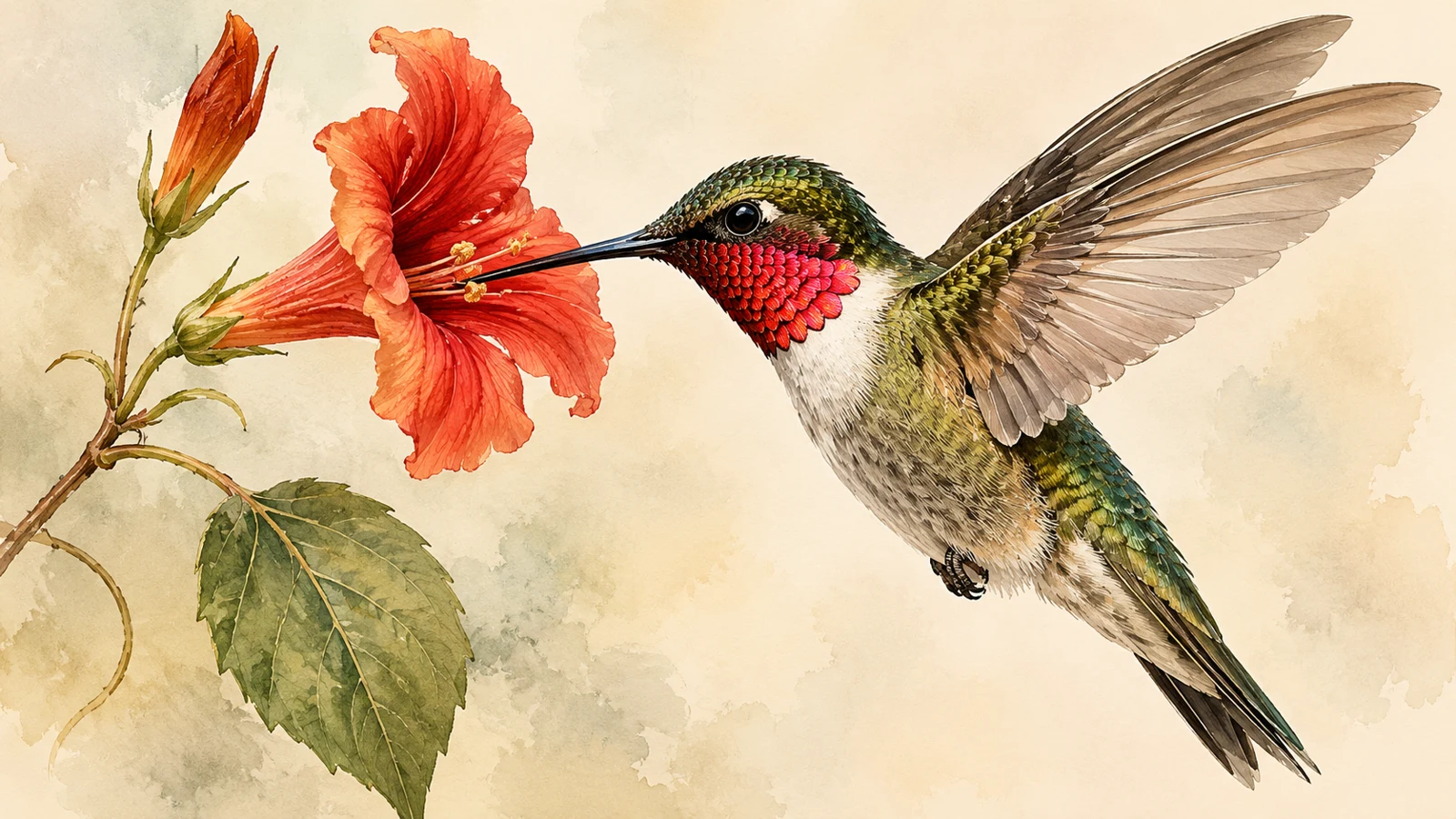
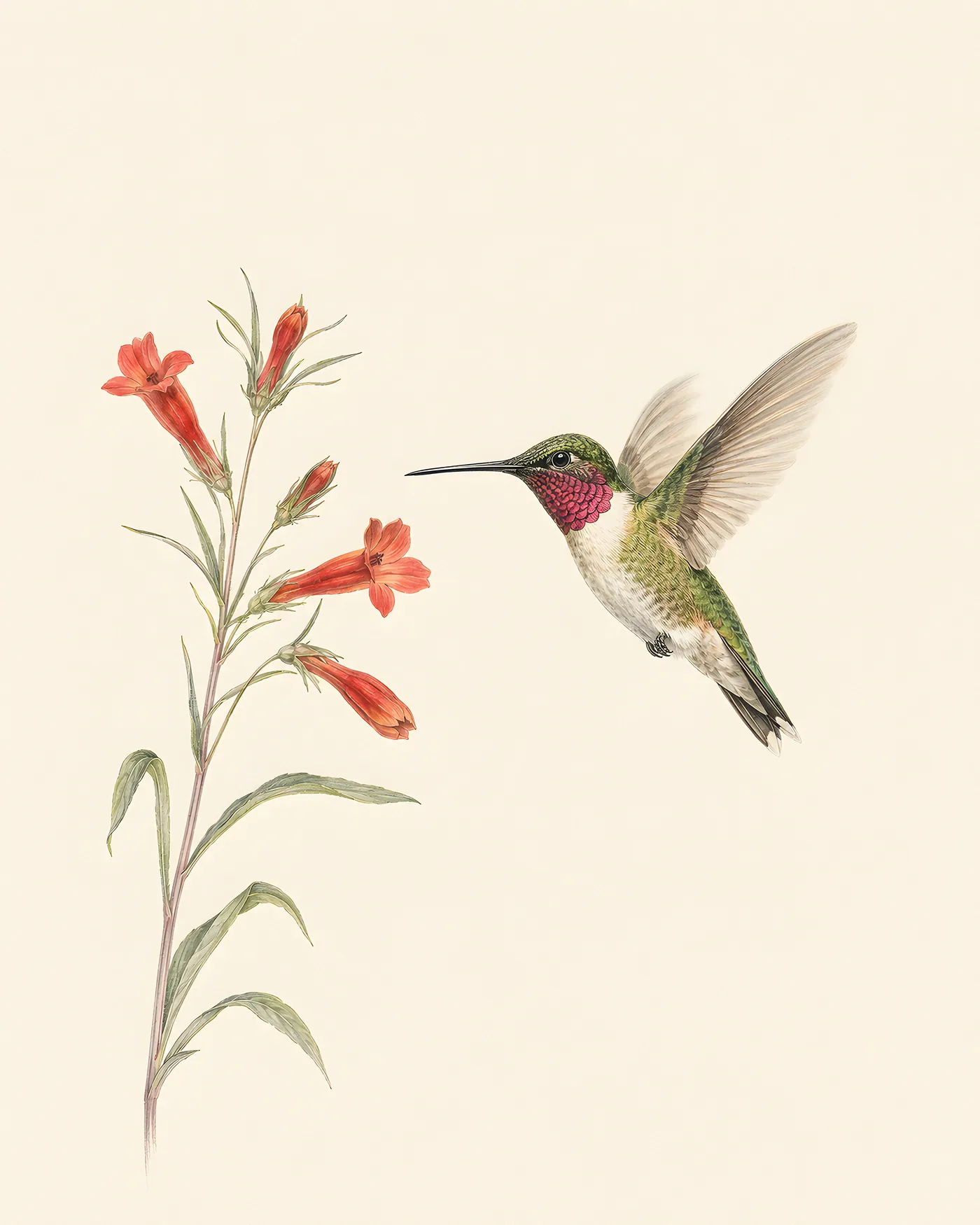
The adult male carries an iridescent rose-red gorget across the throat, cleaner and pinker than the orange of his Rufous and Allen’s relatives. His back and crown are bright metallic green, his underparts white washed with green and buff along the flanks, and a white eye-ring stands out on the face. In good light the throat glows like a coal; turn him out of the sun and it goes to dull grey, the same structural trick every gorget plays.
The female is the subtler bird. She is metallic green above, pale below, with cinnamon-buff flanks, a finely spotted throat and cheeks, and the same neat white eye-ring as the male. She is easily confused with female Rufous and Calliope hummingbirds where their ranges overlap, and the safest marks are her larger size, the buff flanks, and that pale eye-ring on an otherwise plain face.
What it sounds like
The famous sound is not made with the throat at all. As the male flies, air passes rapidly through the narrowed tips of his ninth and tenth primary wing feathers and sets up a high, metallic, cricket-like trill. Cornell Lab records it as audible up to 75 metres away, which is why the bird so often announces itself across an entire meadow. Worn or moulting feathers dull the trill, so an older male late in the season sounds quieter than a fresh one in June.
The vocal repertoire is plainer. The common call is a sharp, dry chip, often run into a rapid series, chip chip chip chip, given in chases and disputes around flowers and feeders. But it is the wing-trill that carries the territory, and the male leans on it during his courtship dives, climbing high and plunging while the feathers sing for him.
Range and habitat
Selasphorus platycercus is a bird of the mountain West. It breeds at high elevation through the Rocky Mountains and ranges from the western United States and the very south of western Canada down through the highlands of Mexico to Guatemala. The favoured ground is open montane habitat: subalpine meadow, pinyon-juniper, pine-oak and aspen woodland, and the flowery edges where forest meets clearing, often well above 2,000 metres.
Most of these birds are migratory, the males arriving first on the breeding grounds and the females close behind, with the bulk of the population wintering in southern Mexico and Guatemala. Some southern populations stay put year-round. The IUCN lists the species as Least Concern, with a large population spread across a wide mountain range, though high-elevation breeders are among the birds most exposed to a warming climate shifting the timing of mountain blooms.
Diet
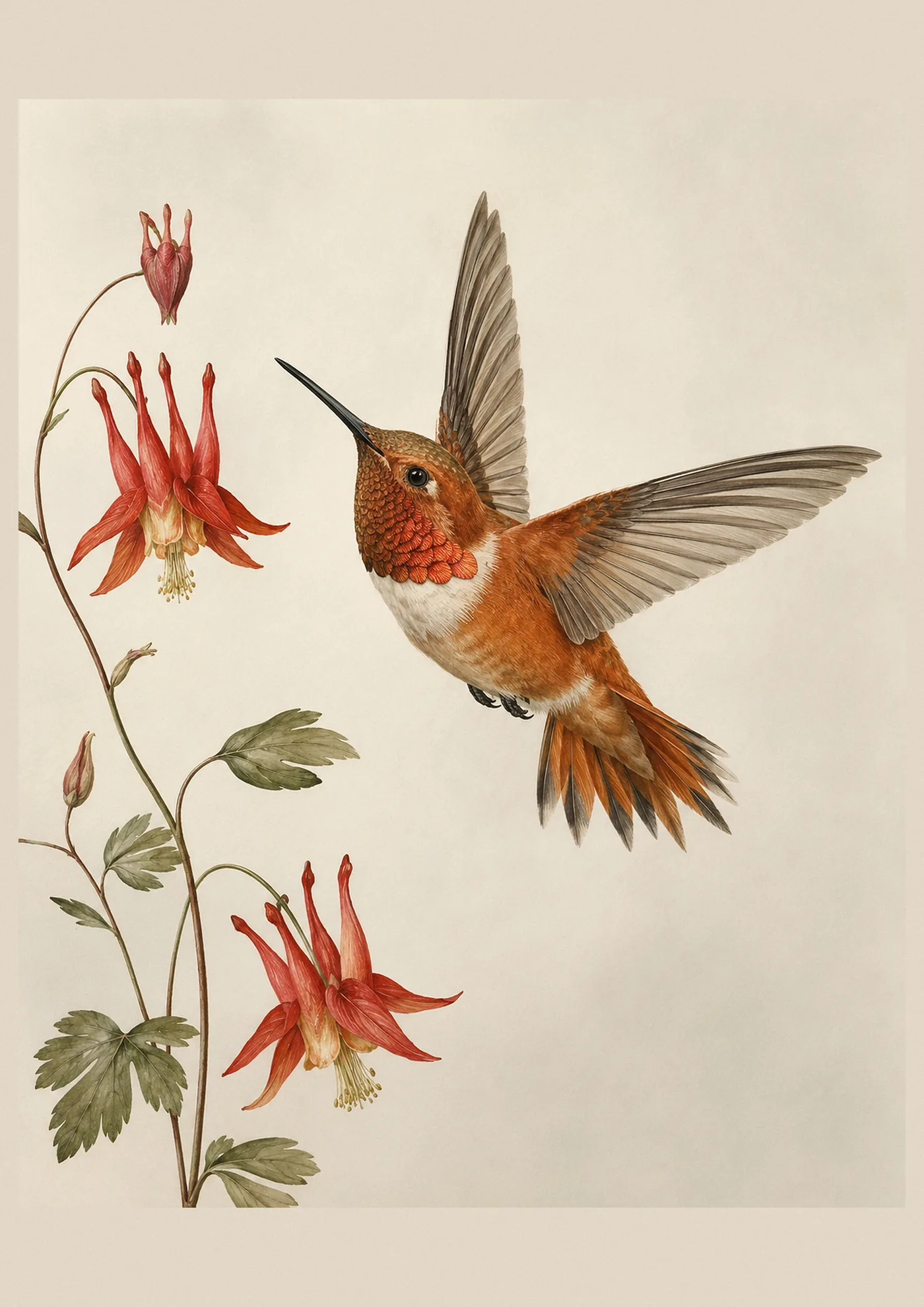
Nectar drives the bird. The Broad-tailed Hummingbird works the tubular, often red flowers that hummingbirds pollinate, columbine and Indian paintbrush and scarlet gilia high in the meadows, along with garden plantings and feeders lower down. The match between bird and bloom is close: many of these mountain flowers are shaped for a hummingbird’s bill and time their nectar to the bird’s season.
Insects and spiders provide the protein, hawked from the air, gleaned from foliage, and lifted from webs. As with every hummingbird, the sugar is fuel and the insects are substance. The female in particular needs a steady supply of small invertebrates to build eggs and feed nestlings, and no Broad-tailed lives on nectar alone.
Breeding and nesting
The male takes no part in family life beyond the display. After the dives and the trilling, he mates and moves on, leaving everything that follows to the female. She builds the nest by herself in four or five days, a small cup of plant down and fibres bound with spider silk and camouflaged outside with lichen and moss, usually saddled on a low horizontal branch and often sheltered from above. Cornell Lab notes that females show strong site fidelity, with the majority returning to the same nesting spot from one year to the next.
She lays two white eggs and incubates them alone for roughly 16 to 19 days, a notably long stretch driven by the cold mountain nights. The chicks hatch naked and helpless and take around 10 to 12 days to feather out, fed throughout by the female. The cold she nests in is no accident of timing but the central problem of her life, and it shapes the next, stranger fact about the species.
The cold-night trick
High in the mountains, a summer night can drop near freezing, and a bird weighing three grams cannot store enough fuel to burn through the dark at full metabolism. The Broad-tailed Hummingbird’s answer is torpor. On cold nights it lets its body temperature and heart rate fall steeply, dropping into a deep, sleep-like state that slows its energy use to a trickle until the sun returns and it warms back to life. It is one of the reasons this species can breed where few other hummingbirds dare to.
A bird small enough to perch on a pencil survives freezing mountain nights by switching itself almost off, then waking with the sun as if nothing had happened.
So when the metallic trill crosses a Colorado meadow in June, it is the sound of a bird that has solved two hard problems at once. It advertises itself with feathers rather than a voice that thin air would swallow, and it survives the cold that comes with the altitude by powering down each night and restarting each dawn. Watch for the rose-red throat and the white eye-ring, but listen first. The wings will tell you he is there.