Print Shop
from $39
Any 2 prints save 10 percent. Any 3 or more save 15 percent. Applied automatically at checkout.
Fine-art Sandhill Crane plate in the Audubon style.
Each print is made to order. You can cancel within 12 hours of ordering, after which it goes into production and cannot be cancelled. Secure checkout via Stripe.
Printed on Hahnemuhle Photo Rag 308gsm.
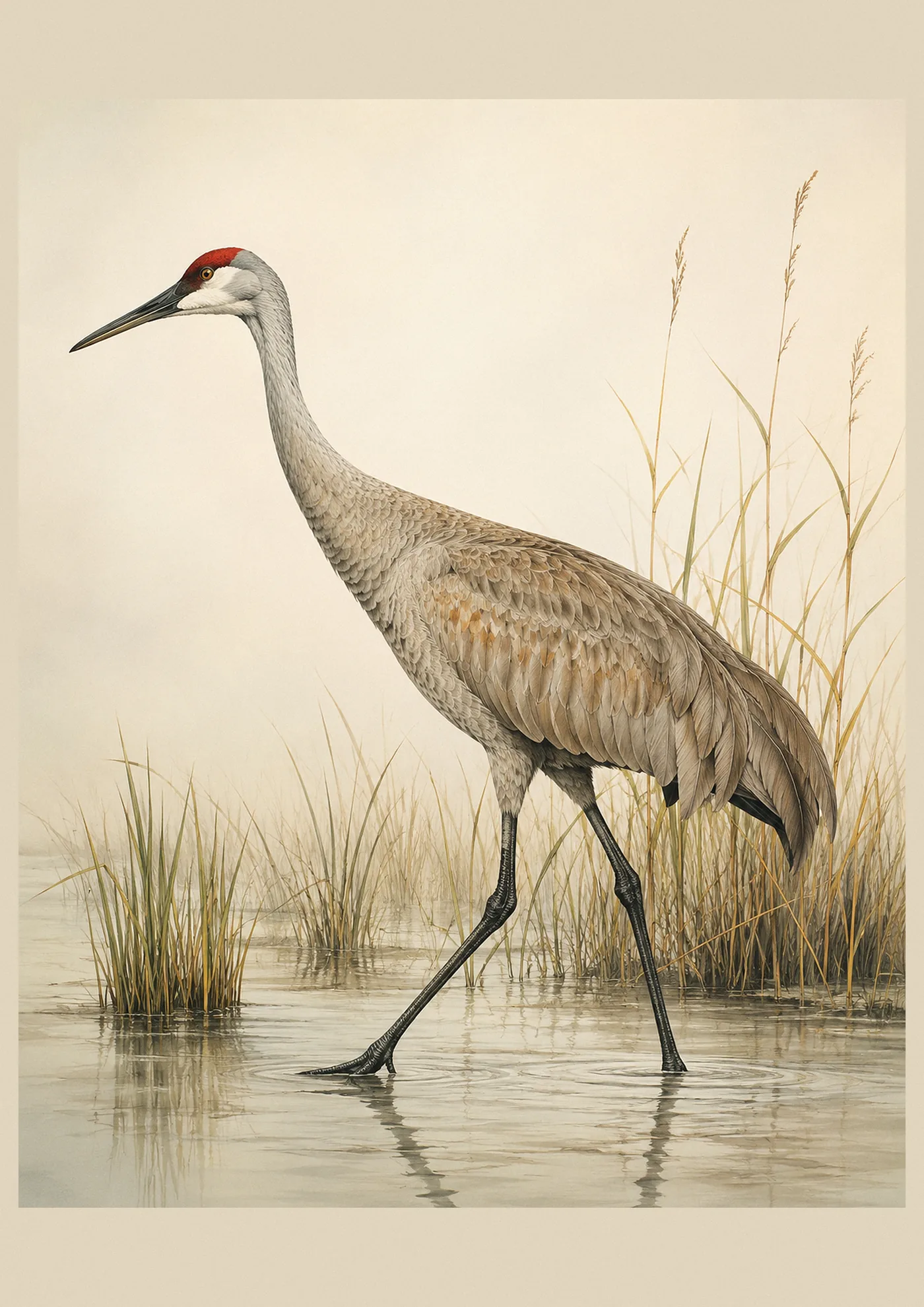
Slate grey, soft as wet ash. A bare crown of red skin. The Sandhill Crane stands in the marsh, head lifted, the long neck and trailing plumes held in that unmistakable upright poise. Reed browns and the pale gold of standing water fill the foreground; the bird simply rises out of the horizontal. It is drawn in the Audubon-style palette, all restraint and patience, exactly the colours the crane belongs to.
Antigone canadensis measures between 97 and 122 centimetres from bill to tail, with a wingspan of up to 213 centimetres and a weight of up to five kilograms. That is not a small bird in a marsh. And yet it is a continental traveller. Every March, more than half a million Sandhill Cranes converge on the Platte River in central Nebraska in the largest gathering of cranes anywhere on Earth. They stage there for three to five weeks, feeding on waste corn and gaining roughly 20 percent of their body weight before fanning north and northwest to breeding grounds that reach into Alaska and across the Bering Strait into eastern Siberia.
The call carries for several kilometres across open wetland: a deep, rolling bugle produced by a windpipe that is partially coiled inside the breastbone. Two birds duetting is a territorial proclamation and a pair-bond display at once. Breeding pairs are socially monogamous and generally stay together across multiple seasons.
The oldest banded Sandhill Crane on record was at least 37 years old.
In the tradition of Audubon, a patient bird at rest in the marsh it has used for two and a half million years.
Full field guide: /species/sandhill-crane/
Each print is made to order through our global print partner and shipped from the production lab nearest you - allow a few days for printing plus local tracked delivery.
Each print is made to order. You can change or cancel it within 12 hours of ordering. After that it goes into production and can no longer be cancelled, though we will always put right anything that arrives damaged.
The available sizes (up to 24x30 inches) and any framed finishes are shown above. Choose yours before checkout.
Yes - each print is sized to fit standard frames. Framed finishes are offered on many prints.
Because each print is made to order, contact us within 14 days of delivery and we will put it right.