Field Guide
Hooded Oriole
In a Southern California backyard in April, a slender orange bird hangs upside down beneath a palm frond, its bill working at the dry fibre on the underside of the leaf. It is sewing. The Hooded Oriole stitches its nest directly to the palm, pushing fibres up through the frond and pulling them tight from below, until the leaf itself becomes the roof of a hanging pouch. Where the suburbs planted palms, this bird followed, and a range that once stopped short of the city now runs through it.
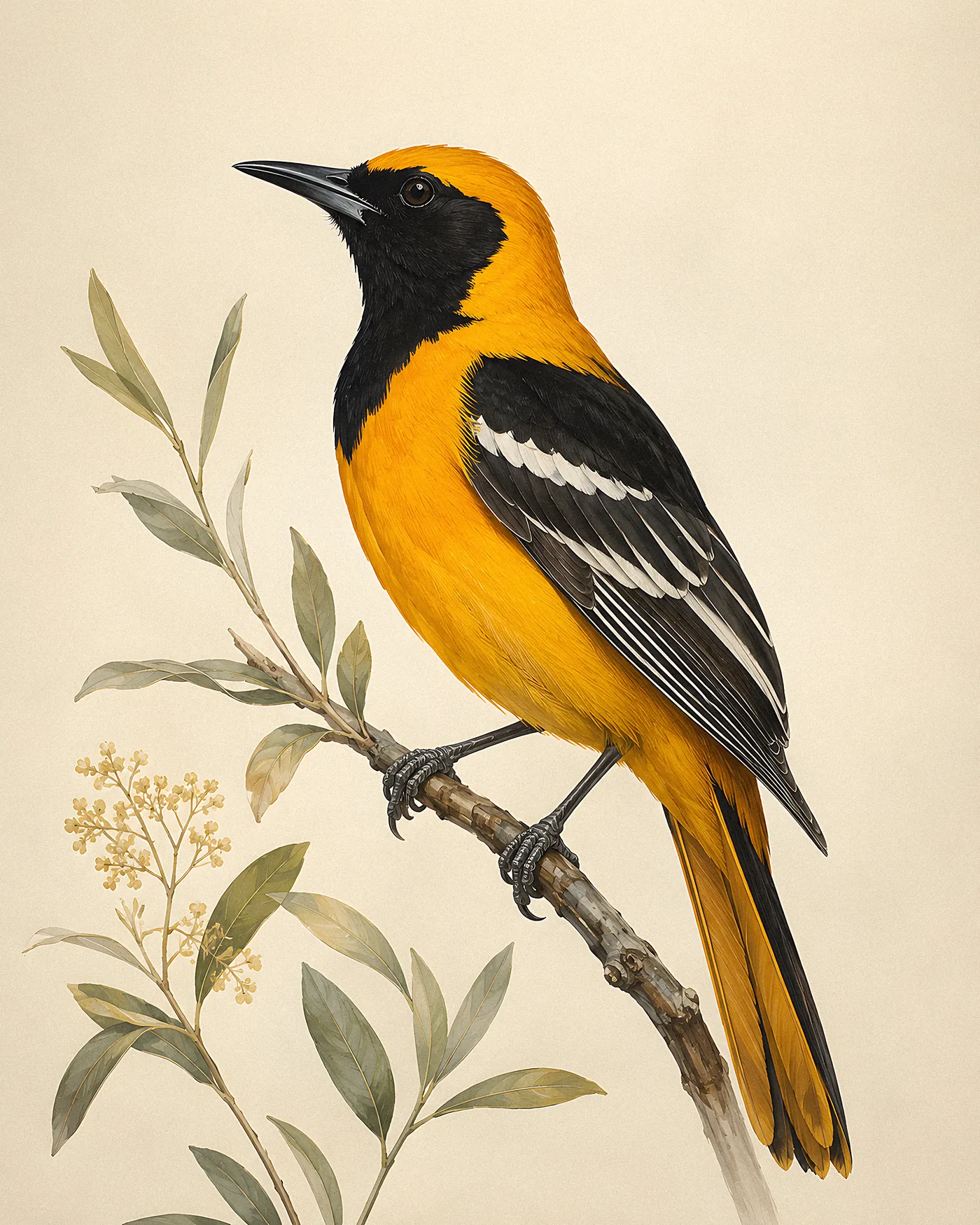
The Hooded Oriole is the slimmest and most elegant of the western orioles, a long-tailed bird with a downcurved bill and a particular fondness for the trees people plant.
What he looks like
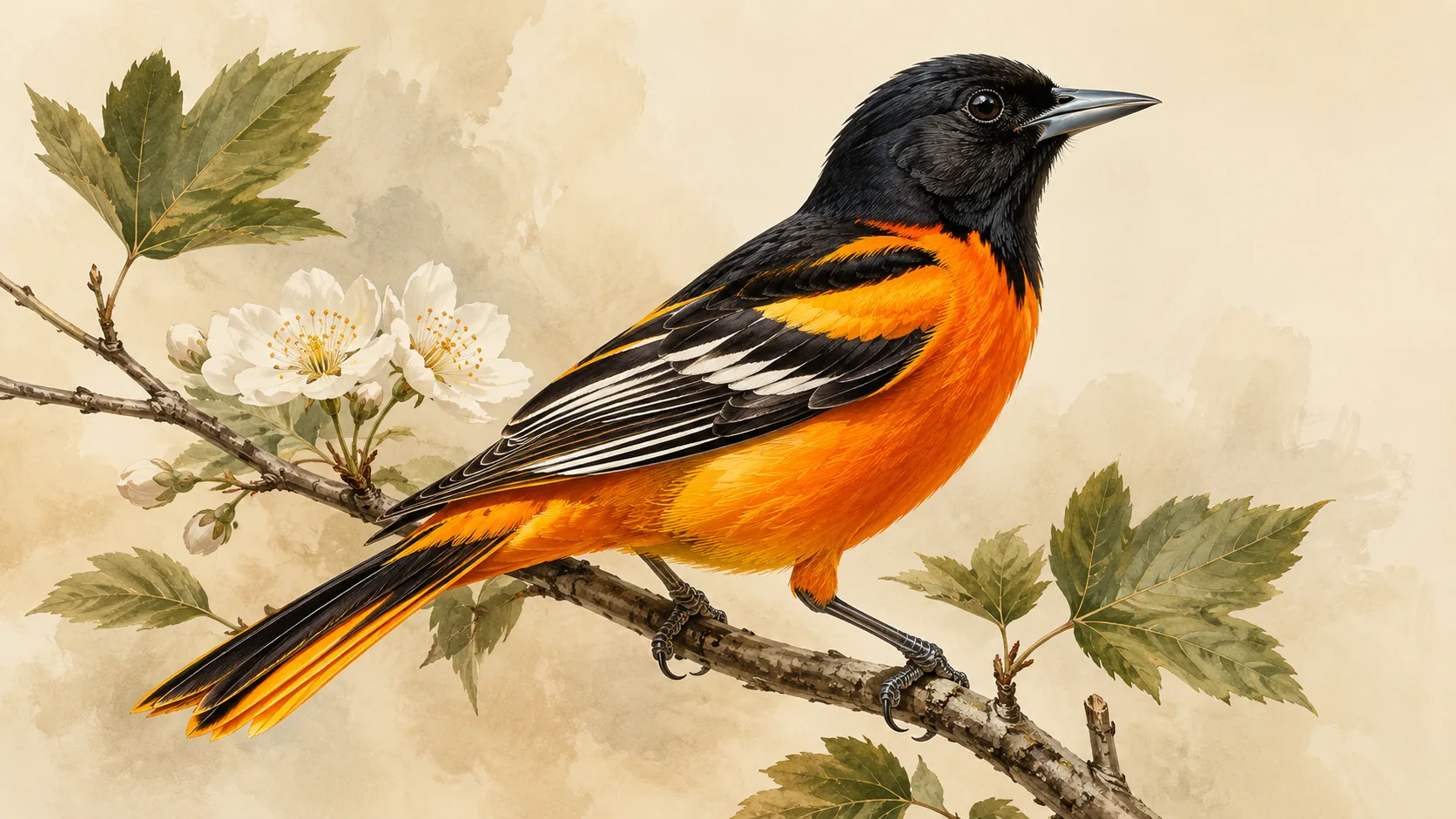
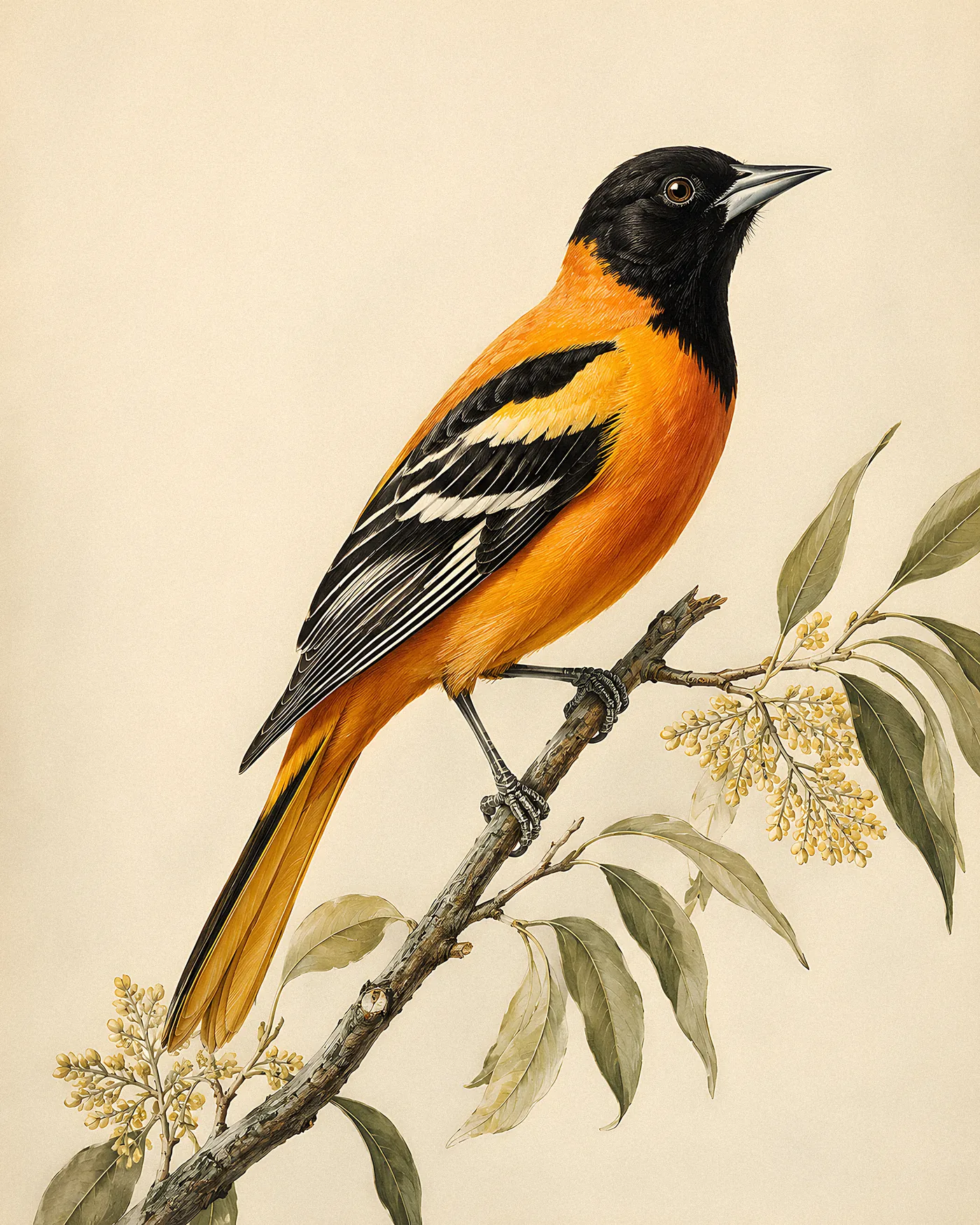
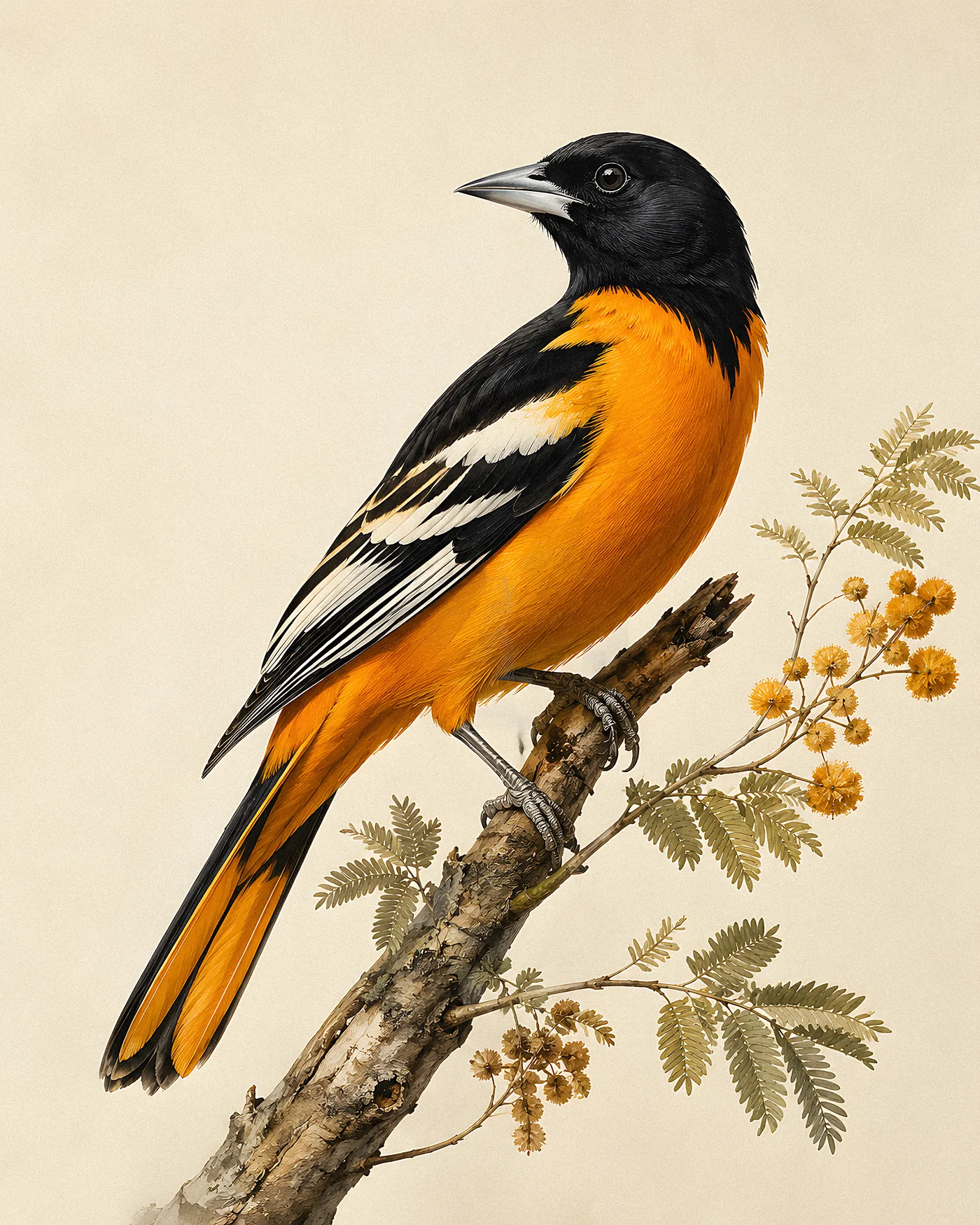
The breeding male is bright orange to orange-yellow on the head, underparts and rump, with a black face and throat, a black back, and black wings marked by two white bars. The colour can run from deep orange in eastern birds to a more yellow tone in the west. His shape is the giveaway as much as his colour: he is slender, long-tailed, and carries a noticeably curved bill, more decurved than the straight daggers of the Baltimore or Bullock’s. That curve and that slimness give him a more delicate look than any of his relatives.
The female and immature are olive-yellow above and yellow below, plainer and greener than a female Bullock’s, with two thin white wing bars and the same slender build and curved bill. The bill shape and the long, slim silhouette identify her even when the colour is muted. First-year males show a black throat patch before they finish acquiring the full black face, an in-between plumage that often puzzles backyard watchers.
What he sounds like
The song is a hurried, jumbled warble, short and abrupt, the notes run together rather than the clear separated whistles of the larger orioles. Cornell Lab notes that the male sometimes folds imitations of other birds into the song. The overall effect is nasal and slightly whiny, lacking the flute-like quality of the Baltimore. The common call is a sharp, rising wheet and a chatter, both given freely around the nest and the feeder.
It is a vocal, conspicuous bird in suburban gardens, often heard before it is seen, calling from a palm or working noisily through a flowering shrub.
Range and habitat
Icterus cucullatus breeds across the southwestern United States, from California and the desert Southwest through southern Texas, and south through most of Mexico into Belize. It favours open woodland, thickets, palms, riparian groves and shade trees, very much including the planted trees of suburban yards.
Its range has shifted with human planting. Cornell Lab records that ornamental palms, especially fan-leaved species, were quickly adopted by the Hooded Oriole and helped it expand. At the same time the species declined sharply in southern Texas in recent decades, a fall linked partly to nest parasitism by Brown-headed and Bronzed Cowbirds, with some signs of a modest recovery and the bird remaining fairly common farther west. Most birds migrate south into Mexico for the winter, though small numbers now linger through the cold months at sugar-water feeders in the milder parts of the Southwest.
Diet
The Hooded Oriole is an insect eater that also leans hard into nectar. It takes caterpillars, beetles, wasps, ants and other insects, gleaned from foliage and bark, and supplements them with wild berries and cultivated fruit. Its taste for nectar is pronounced: it visits flowers and, very readily, hummingbird feeders, and it has a trick of piercing the base of a flower with its pointed bill to rob the nectar without entering the bloom.
That nectar habit makes it one of the orioles most likely to share a garden with hummingbirds, jostling at the same sugar-water ports. Within its range it also comes to orange halves and jelly, but it is the hummingbird feeder that most often brings it in close.
Breeding and nesting
The nest is a woven hanging pouch, and the palm association is the species’ signature. Where other orioles drape a nest over a branch tip, the Hooded Oriole frequently attaches its nest to the underside of a palm frond, sewing the fibres up through the leaf and stitching the pouch in place so that the frond shelters it from above. It also uses slender tree branches, but the palm-frond nest is the one that defines the bird.
The pouch is tightly woven from plant fibres and grasses, increasingly with synthetic material worked in where it is available. Both parents tend the young. The species is a frequent host to cowbird parasitism, which has weighed on the southern Texas population in particular, the cowbird laying its eggs in the oriole’s nest for the smaller bird to raise.
The Hooded Oriole did not wait for old palms. It rode the ornamental nursery trade north, one planted fan-palm at a time, and made the suburbs its breeding range.
The bird the gardens built
Most range expansions in North American birds are slow and natural. The Hooded Oriole’s owes a clear debt to the garden centre. As Southern California and the Southwest filled their yards with ornamental palms, the bird that likes to sew its nest under a frond found new breeding habitat waiting in every cul-de-sac. It is one of the cleanest cases of a native bird tracking a human planting fashion into ground it did not previously hold.
For the backyard watcher, that makes it an unusually accessible jewel: a tropical-looking oriole that nests in the palm over the patio and drinks from the hummingbird feeder. The IUCN lists Icterus cucullatus as Least Concern across its wide range, even as the eastern edge of that range, in Texas, has had a harder time. Plant a palm, leave the sugar water out, and there is a real chance the slimmest oriole will come and stitch its nest above your head.