Field Guide
Sanderling
The wave retreats and the bird charges after it, bill down, legs a pale blur. The next wave rolls in and the bird sprints away from it just ahead of the water, then turns and chases the retreat again. This has been going on since before you arrived, and it will continue after you leave. The Sanderling is working the surf zone with the focus of an animal that knows exactly what it is doing.
What it is doing is extracting mole crabs, coquina clams, and sand hoppers from the wet sand in the brief seconds each receding wave exposes them. The strategy is efficient. The beach is long. The bird needs to keep moving.
What it looks like
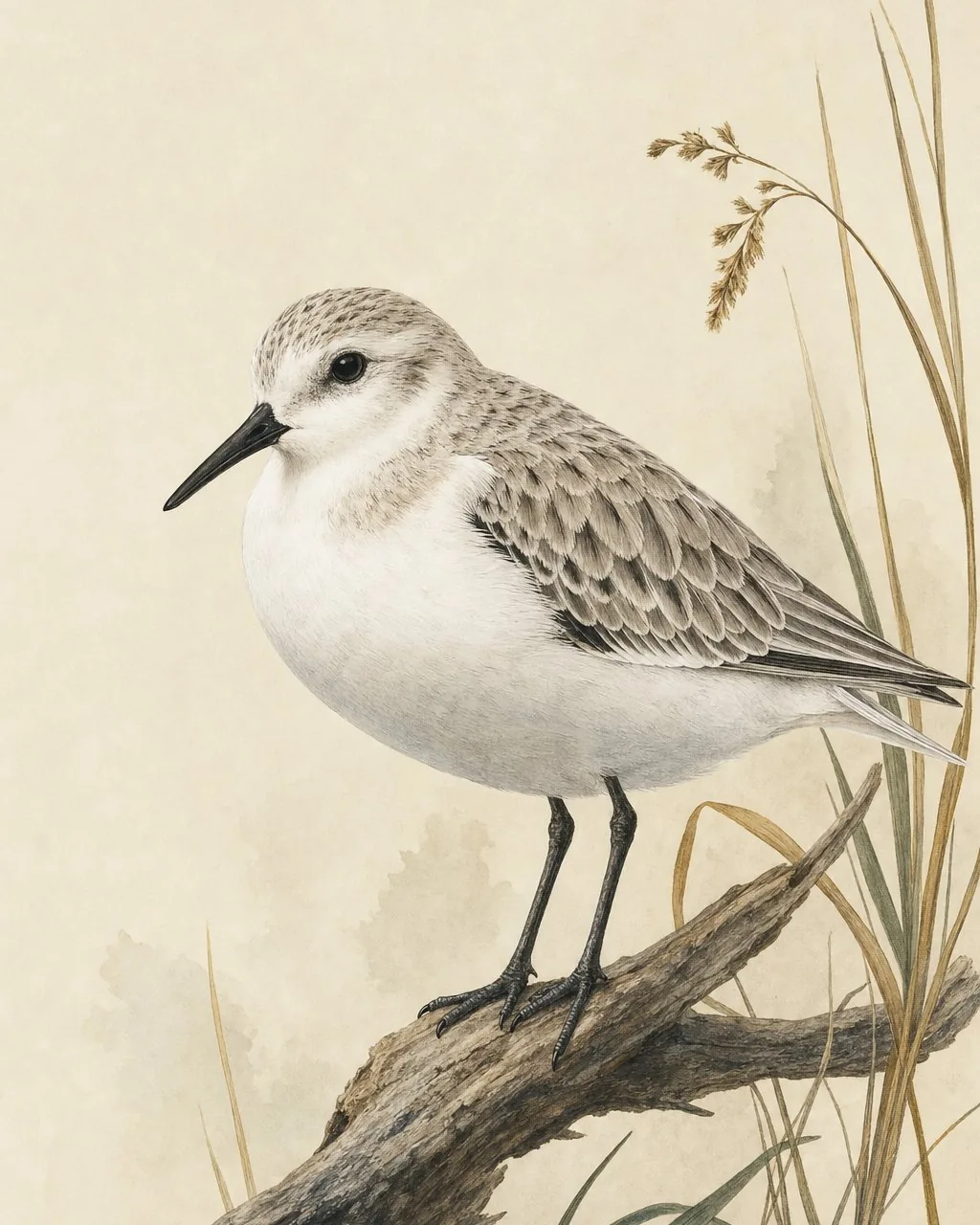
The Sanderling in winter is the palest small shorebird on the beach. Nearly white below, pale grey above, with a small dark shoulder spot where the wing meets the body and a white wingstripe visible in flight. The bill is short and straight, the legs black. At a glance it can look entirely white, especially against wet sand in bright light.
In breeding plumage - seen on birds migrating northward through May and early June - the head, neck, and upper breast become a warm rufous-orange, and the back gains rufous edging on the feathers. This plumage is striking but brief, and most Americans see it only on spring migrants moving through coastal locations like North Carolina or Maine.
Young birds in late summer and early autumn have a spangled back - dark-centered feathers with pale fringes giving a scaled or spotted appearance. They retain the characteristic pale underparts.
The wingbeat in flight is fast and straight. Flocks wheel over the surf in tight synchrony, showing white below as they bank.
| Measurement | Range |
|---|---|
| Length | 18-20 cm |
| Weight | 40-100 g |
| Wingspan | 35-43 cm |
| Lifespan | 5-13 years |
Voice
A soft, short wick or wik-wik in flight, often given rapidly from flushed or moving birds. When feeding, essentially silent. The calls are unobtrusive - the Sanderling identifies itself to the observer by behavior, not by voice.
“Forty Sanderlings on the August beach at dusk, sprinting back and forth in front of a beach full of people who were barely noticing them. The birds were doing what they do regardless: pure function, pure appetite, pure efficiency at the edge of the sea.” - field notes, Outer Banks, North Carolina
Range and habitat
The Sanderling breeds in the high Arctic, one of the northernmost-breeding shorebirds. Nesting occurs on rocky tundra in northern Canada, Alaska, Greenland, Svalbard, and the Siberian Arctic coast - dry, sparsely vegetated ground, often on ridges or hillsides above the wet tundra.
The winter range is as close to global as a shorebird can manage. Sanderlings winter on sandy beaches from Massachusetts and Oregon south through the length of South America. They winter on the coasts of Europe, Africa, the Indian Ocean, Southeast Asia, and Australia. A Sanderling on a Cape Hatteras beach in December and a Sanderling on a Namibian beach in December are in the same species’ winter range.
The habitat requirement is simple and specific: wet sandy beach in the surf zone. Rocky coasts, mudflats, and gravel shores are not used. The Sanderling is a surf-runner by design and by diet.
Diet
Mole crabs are the key prey item at most sandy beach wintering sites in North America. The mole crab (Emerita species) is a small crustacean that burrows just below the sand surface in the wave swash zone and filters plankton from each retreating wave. The Sanderling’s strategy is to probe the sand the instant the wave retreats, before the mole crab can dig back in. This requires speed. The bird has it.
Sand hoppers, coquina clams, and small worms round out the beach diet. Where beaches have been heavily impacted by human use and mole crab populations have declined, Sanderling numbers have also declined. The bird needs a productive beach, not just any sandy coast.
On the breeding grounds, Sanderlings switch entirely to insects - the only significant protein source available on the high Arctic tundra in summer.
Breeding
The Sanderling’s breeding system is among the strangest in the shorebird world. In some populations, an individual female mates with two males sequentially and produces two clutches. The first male incubates the first clutch while the female mates with and produces a second clutch for the second male, then either deserts or assists with incubation herself.
This polyandrous system appears in a minority of populations and is not universal. Many pairs are simply monogamous. But the occurrence of simultaneous polyandry in a fraction of females makes the Sanderling one of the better-documented cases of flexible mating system in birds.
Both sexes, where they both participate, incubate the four eggs for about three weeks. Chicks are precocial. The Arctic breeding season is so short - six to eight weeks of viable weather - that the birds must move with urgency from arrival through chick-rearing to departure. Adults typically leave before their chicks are fully grown, which fledge and then move south independently.
The surf zone
The Sanderling is a specialist in one of the most energetically productive and physically challenging habitats on the coast. The surf zone - the strip of sand between the limit of wave run-up and the water’s edge - is continuously disturbed, constantly resupplied with prey, and completely inaccessible to most birds. The Sanderling has made this strip its province.
The speed that defines the bird’s wave-chasing behavior is not frantic energy expenditure. It is calibrated response to a moving opportunity. Prey exposure time in the swash zone is measured in seconds. The bird that hesitates misses the crab. The sprint away from the incoming wave is not panic. It is the routine maintenance of a feeding position that has to move constantly because the food source moves.
Populations have declined globally by an estimated 20-30% over recent decades. Causes include changes in Arctic breeding habitat from warming, loss of key stopover sites, and changes to beach management practices that affect prey availability. The Sanderling is not yet a bird in crisis - its global range and numbers remain substantial - but the downward trend has been sustained long enough to register concern.
Closing
Find a long sandy beach in winter on either coast. Walk the surf line. The Sanderlings will be running. They have been running this same surf on this same beach through ten thousand winters, give or take, chasing the retreat of each wave and outrunning the next one. Watch long enough and the energy in the running becomes something beyond mere feeding. It becomes the quality of a life organized entirely around the space between the sea and the shore.