Field Guide
Ruddy Turnstone
The bird shoves its bill under a flat rock at the waterline and levers it over with a quick, practiced tilt of the head. Underneath: a small crab, two isopods, a tangle of sand fleas. The bird eats quickly and moves to the next rock, working methodically down the line of mussel-crusted boulders while the tide retreats. It does this all day on coasts all over the world.
The Ruddy Turnstone is one of the most widely distributed shorebirds on earth. It breeds in the high Arctic and winters on every coastline that offers rocky or mixed substrate. In between, it undertakes migrations of extraordinary length - some individuals travel 30,000 kilometres or more in a single annual cycle.
What it looks like
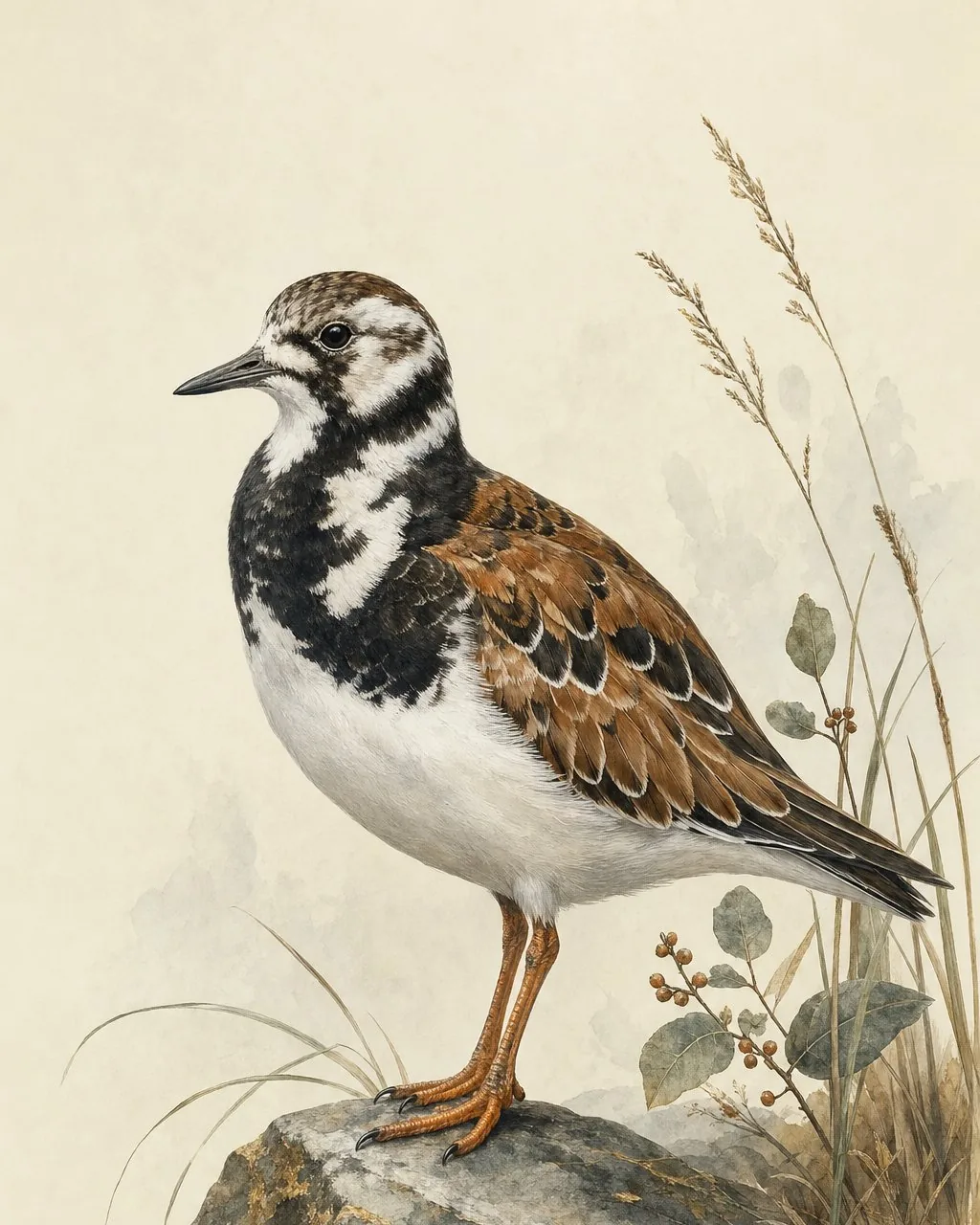
In breeding plumage, the Ruddy Turnstone is one of the most patterned shorebirds alive. The back is a patchwork of bright orange-rufous, black, and white - not subtle, not gradual, but sharply demarcated in blocks of color that look almost like a stylized design. The head is white with a complex black mask-and-stripe pattern that varies individually enough that experienced observers can recognize known birds. The breast-band is solid black. The belly is white.
The bill is short, slightly upturned and wedge-shaped at the tip - designed for prying, not probing. The legs are orange. In flight, the wing pattern is a bold display of white and dark that makes the bird look even more graphic than at rest.
In winter plumage, the bird trades the orange-rufous back for duller brown, the head pattern becomes less crisp, and the breast-band softens. The orange legs and pied wing pattern remain. Juveniles resemble winter adults with scaly upperparts.
The bill shape is the key to understanding the bird’s behavior. It is not a probe-bill. It is a lever.
| Measurement | Range |
|---|---|
| Length | 21-26 cm |
| Weight | 85-150 g |
| Wingspan | 50-57 cm |
| Lifespan | 5-19 years |
Voice
A chattering, rapid tuk-a-tuk or kitititit - mechanical and quick, often given in flight or when disturbed from a feeding flock. The call carries well over surf noise. Alarm calls are sharper and more insistent. On the breeding grounds, the display song is a rolling, liquid trill quite unlike the winter calls. At most times and places, the voice is functional and plain - the bird’s appeal lies in its appearance and behavior, not its song.
“We found three hundred birds working the mussel bar at low tide, moving along it as a unit, flipping and prying. When a larger gull approached, the whole flock rose as one with that rattling call, circled once, and dropped back to the exact same mussel bar and resumed exactly where they had stopped.” - field notes, New Jersey coast
Range and habitat
The Ruddy Turnstone’s breeding range is Arctic and sub-Arctic: rocky coastal tundra in northern Canada, Alaska, Greenland, Scandinavia, and across the Eurasian Arctic coast. In North America, the bulk of the breeding range is in the Canadian Arctic Archipelago.
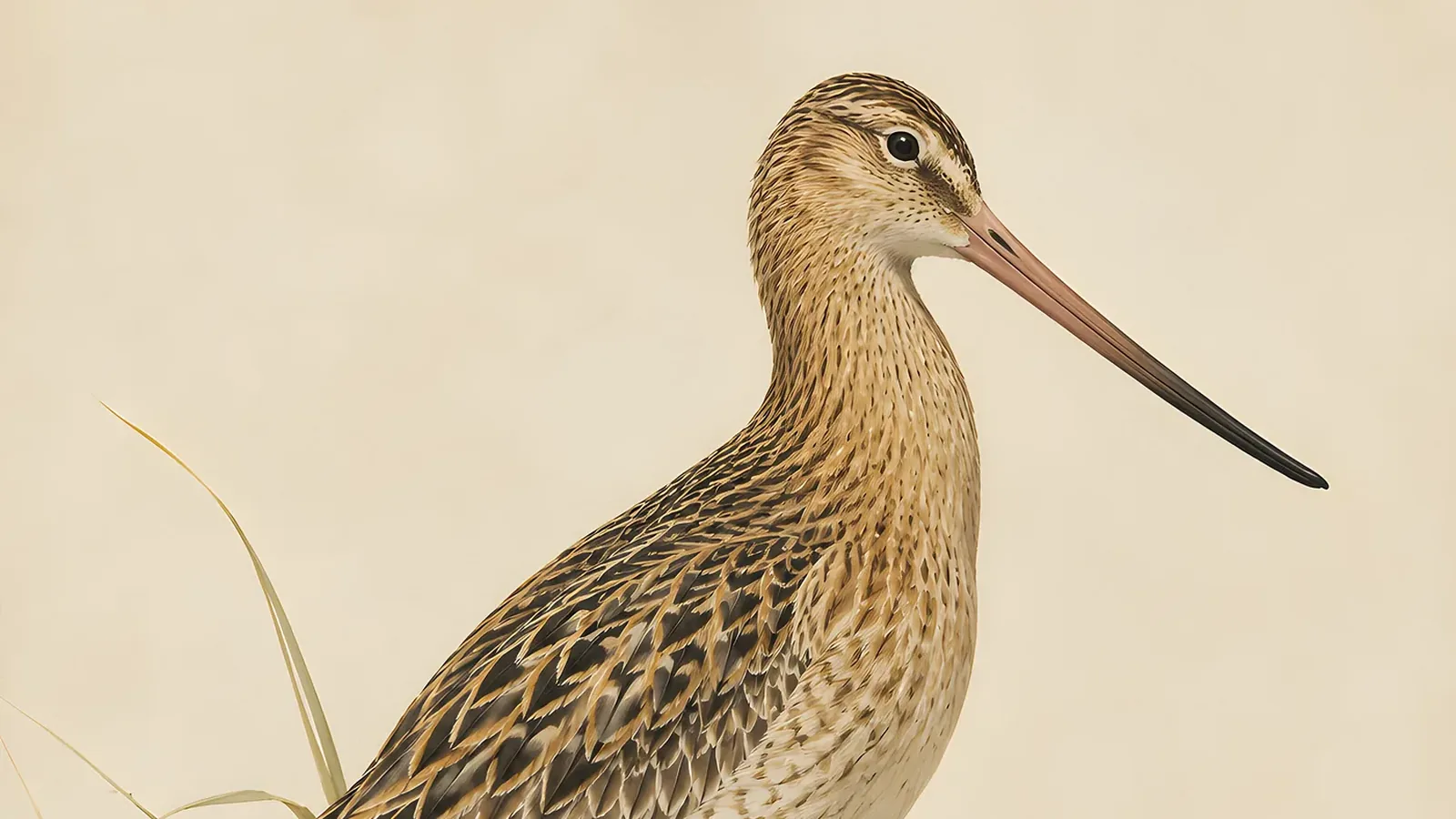
The winter range is the world’s coastlines. Turnstones winter on the coasts of western Europe, Africa, the Indian Ocean, Southeast Asia, Australia, and the Pacific Islands. In the Americas, they winter from the US coasts south through Central America and the entire coastline of South America. A turnstone on a beach in Massachusetts in winter may have a nest 6,000 kilometres north, and a wintering bird on a Brazilian beach may have just arrived from the Canadian tundra via a non-stop ocean crossing comparable in distance to that of the Bar-tailed Godwit.
Preferred habitat is rocky or mixed substrate: rock-and-mussel beaches, jetties, gravel shores, kelp wrack lines, reef flat margins. The bird also works sandy beaches where wave action concentrates drift material, and has been recorded feeding on the carcasses of large marine animals. Flexibility is the species’ great asset.
Diet
The name is literally descriptive. Ruddy Turnstones flip rocks. They also flip shells, seaweed, drift wood, clumps of wrack, dead fish, and anything else that might conceal prey underneath. The bill is thick enough and the bird strong enough to turn stones heavier than itself using the wedge shape as a pry.
Prey underneath the objects includes crabs, amphipods, isopods, worms, small molluscs, and insects. On beaches with dense mussel beds, the turnstone uses the wedge bill to pry open smaller mussels directly. On beaches where carrion is available, it will feed on dead fish. The diet is broadly opportunistic as long as the food source is exposed by prying action.
At horseshoe crab spawning aggregations - most famously in Delaware Bay in May - turnstones join massive aggregations of other shorebirds to feed on newly laid horseshoe crab eggs scattered through the sand. The energy gained at Delaware Bay fuels the final leg of the northward migration to the Arctic.
Breeding
Breeding turnstones arrive on the Arctic tundra in late May and early June. The nest is a simple scrape in open tundra, often near the coast, partially lined with plant material. Both sexes incubate the usual four eggs. Incubation lasts about three weeks.
After hatching, parental roles shift. In many pairs the female departs early, leaving the male to brood and guard the chicks through fledging. This pattern - female departure before the young are independent - is common in Arctic-breeding shorebirds and reflects the extreme time pressure of the short Arctic summer, where starting the southward migration earlier gives females a competitive advantage.
Chicks are precocial and follow the parent from the nest within hours. They grow quickly on the insect and invertebrate abundance of the tundra summer and fledge in about three weeks.
A citizen of every coast
The Ruddy Turnstone is one of those birds whose global range makes the planet feel smaller. A bird with a band from an Arctic breeding study turning up on a beach in Argentina. An individual identified by its head pattern on a New Jersey jetty in August, then photographed on a Moroccan reef flat in November. The same species working kelp beds in Tasmania and mussel bars in Scotland.
The cosmopolitan distribution comes with a vulnerability: populations relying on key staging stopover sites can be devastated by disruption at those sites. Delaware Bay, where turnstones gather to fuel the last sprint north, is the most critical North American stopover. The horseshoe crab spawning that supplies the energy has declined substantially from historical levels due to overharvesting of horseshoe crabs for bait. Turnstone body mass at Delaware Bay in May has fallen, and the proportion of birds arriving in the Arctic in good enough condition to breed successfully has declined with it.
Population trends for the Ruddy Turnstone overall show a decline of roughly 50% since 1974, though the data are uneven across the global range. The Delaware Bay situation is the clearest documented causal chain: less food at the stopover, thinner birds on the breeding grounds, lower productivity, fewer young entering the population.
Closing
You can find a Ruddy Turnstone on almost any rocky or mixed-substrate coastline in the world outside the breeding season. It is the bird lifting the rock. Watch long enough and you will see it pry open a mussel, excavate under a clump of kelp, eat something you never identified. It has been doing this on coasts that its ancestors helped shape by turning over invertebrate communities at the margins of the sea. Small bird. Wide world. Busy bill.