Symbolism
That Scream in Every Eagle Movie Is Not an Eagle
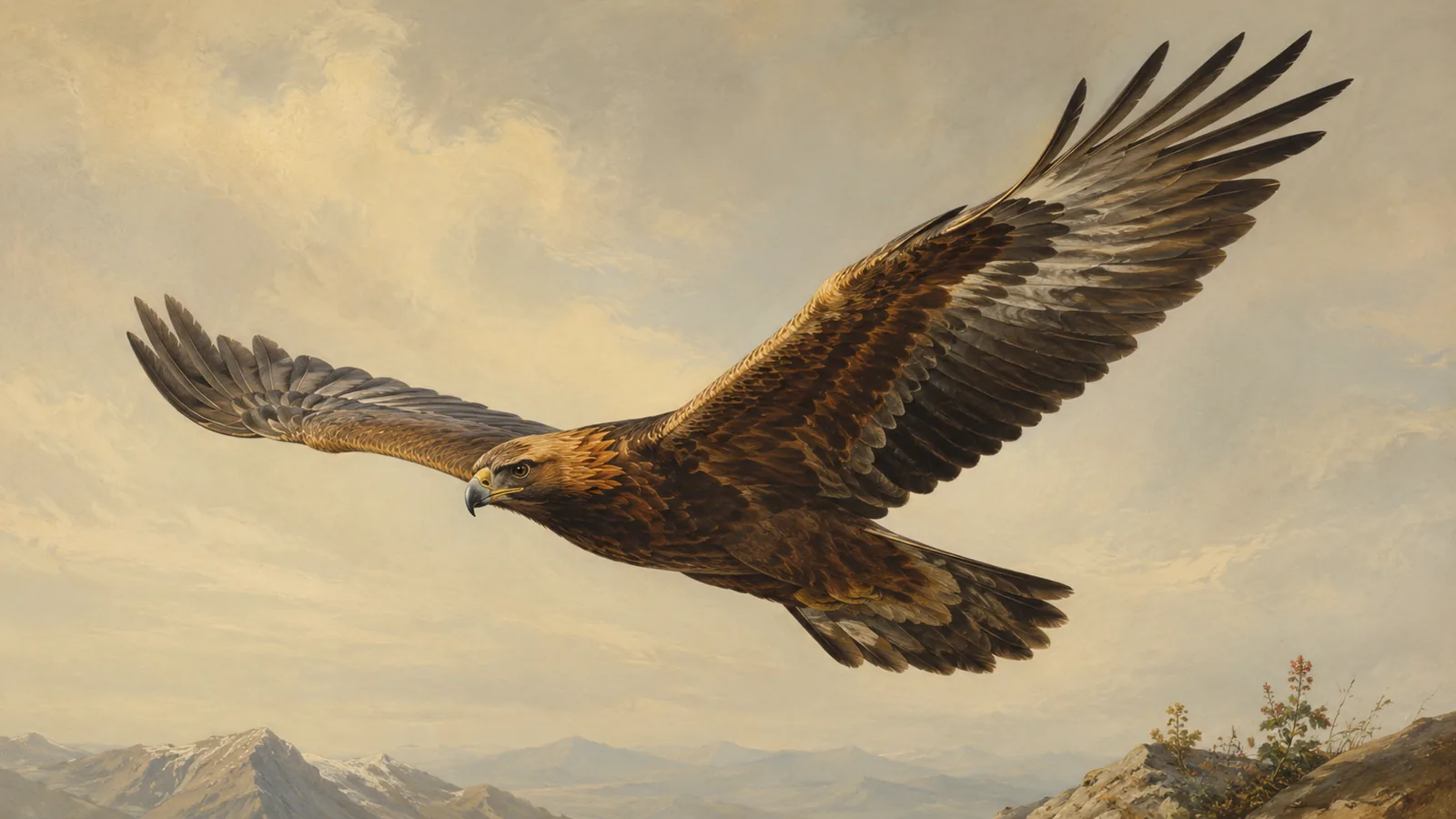
That bone-chilling raptor scream in every American film - the one that plays over bald eagle close-ups, over wilderness montages, over the national symbol spreading its wings against a blue sky - is not the bald eagle.
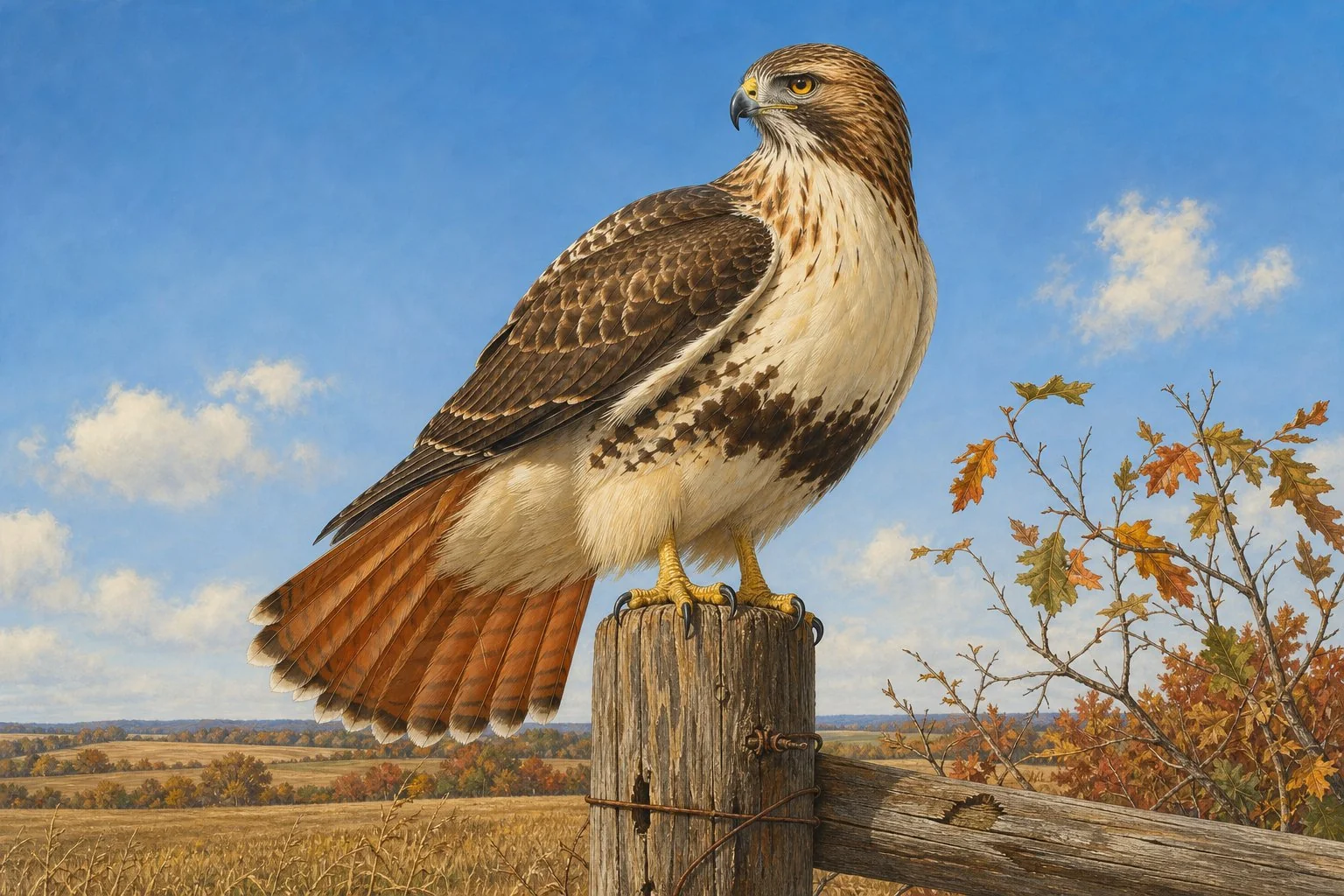
It is the red-tailed hawk.
The bald eagle’s actual call is a high, thin sequence of chirping whistles. Nature writers have described it as “a seagull with laryngitis” and “a cross between a dog toy and Betty Boop.” America’s national symbol, the bird printed on every dollar seal and presidential podium, sounds undignified at close range. Hollywood sound designers figured this out and quietly fixed the problem. They film the eagle, then in post-production they replace the call.
The bird sitting on the highway fence post every few miles across the continent - the common one, the one nobody thinks about - provides the voice of American power. Nobody knows they are listening to the wrong bird.
The Colbert Report ran for nine years of political satire. Every episode opened with a bald eagle and the red-tailed hawk scream. America satirized itself with a national symbol that could not be itself, and the red-tail covered for it the whole time.
What the Bird Actually Does
The red-tailed hawk’s call is a 2-3 second raspy descending scream, rendered phonetically as “kee-eeee-arrr,” reaching roughly 100 decibels. The bird uses it for territorial defense, mate communication, and alarm. It evolved to carry across open landscapes because that is where the red-tail hunts.
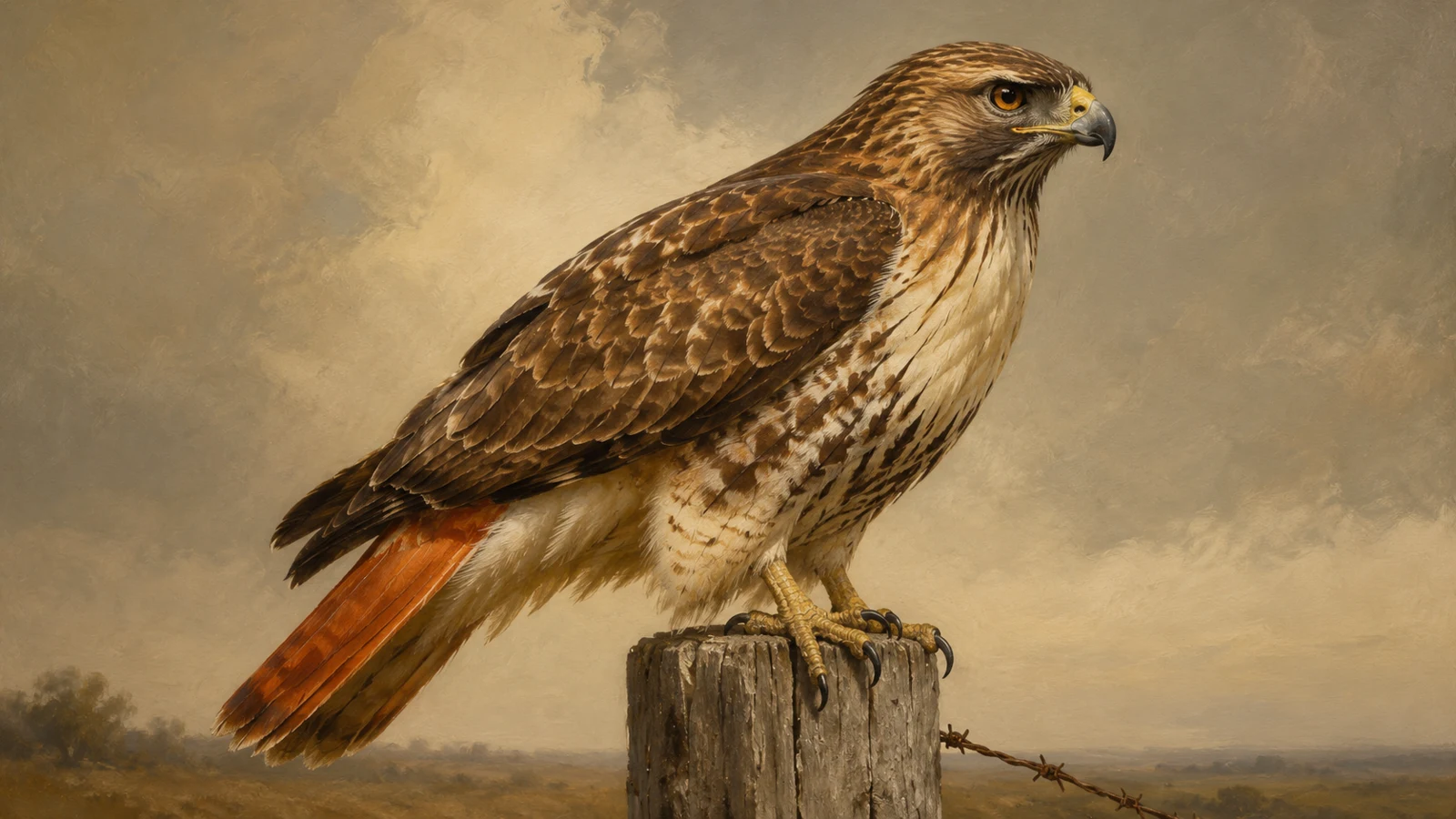
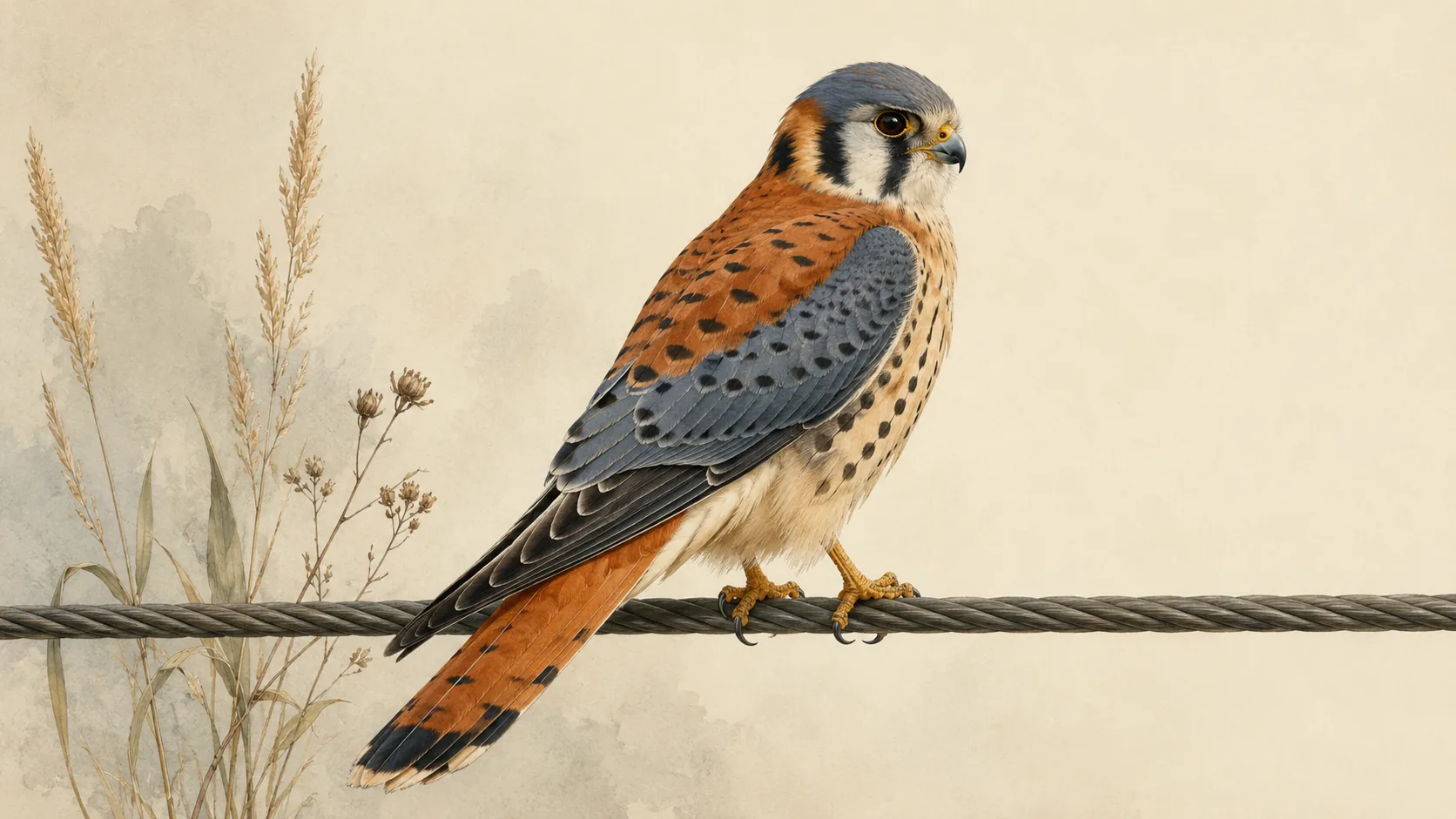
There are approximately 2 million red-tailed hawks across North America. This is the most commonly observed large raptor on the continent, larger than the American kestrel that shares the same roadside perches. They perch on fence posts, utility poles, and highway overpasses. They sit completely motionless for extended periods, then drop with lethal precision.
That stillness is not inaction. A University of South Florida study documented red-tails using 270 hunting perches and found that hawks spent significantly more time on a perch before attacking than before giving up. The patience is deliberate. The hawk sits and watches with a precision no human observer can perceive, then acts at exactly the right moment.
This behavior pattern - elevated position, motionless patience, sudden decisive action - is not metaphor. It is what the bird does. The symbolism mapped onto it because the behavior generates exactly that pattern.
What the Hawk Sees That You Cannot
Red-tailed hawks have approximately 1 million photoreceptors per square millimeter. Five times human density. Each eye has two foveae, the zones of maximum visual concentration - one facing forward for binocular depth perception during a strike, one facing laterally for wide-field scanning while perched. A red-tail at 800 feet altitude can resolve objects roughly 5-10 centimeters across. Trained red-tails have been documented making successful kills from 700-900 feet.
They also see ultraviolet light. Humans have three types of cone cells. The red-tailed hawk has four, including UV-sensitive cones. A 1995 study in Nature by Viitala and colleagues demonstrated that closely related raptors detect vole urine trails through UV reflectance, essentially following glowing highways that humans cannot see to prey that appears to be hiding in empty grass.
Indigenous people watching a hawk stare at bare ground before diving successfully, and apparently finding something invisible there, reasonably concluded the bird saw beyond the physical. They were literally correct. It does. Science only confirmed this in 1995. They had known it for centuries.
The Hidden Name
The name “red-tailed hawk” marks a hidden identity, not an obvious one.
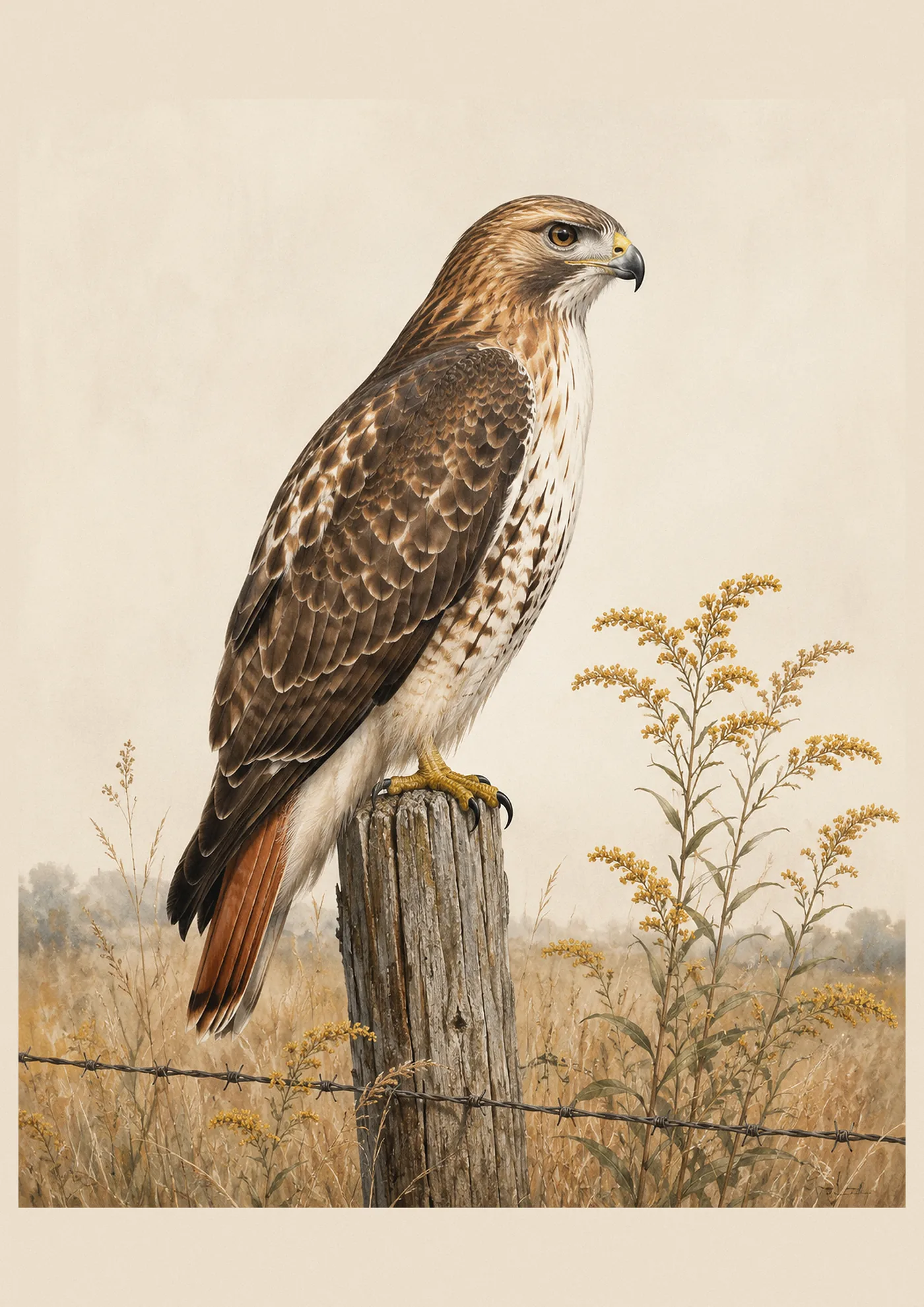
Immature birds - ages 0-2 years - have no red tail. They carry brown barred tails indistinguishable from several other buteo species in field conditions. Adults develop the brick-red tail at roughly two years old, but they display it clearly only from below in flight or when perched facing away. The classic view from the front shows the streaked belly band and brown back. Most casual observers who identify a “red-tailed hawk” have not actually seen the red tail at all.
The most commonly seen large raptor in North America is named for a feature most people never clearly see. The common bird has a hidden identity. This is either a good metaphor or it is simply how taxonomy works. Both things can be true.
Cetan: The Lakota Warrior Hawk
The Lakota word for hawk is “Cetan.” In Sioux mythology, Cetan is not a category of bird but a specific entity - a Great Hawk personifying speed and exceptional vision, invoked by shamans before battle to grant warriors predatory clarity. Cetan was called upon for warriors entering combat and hunters who needed precision.
The most documented specific case belongs to Tashunka Witko, known in English as Crazy Horse.
Multiple sources from people who knew him confirm the same ritual preparation. Before battle, Crazy Horse tied a single red-tailed hawk feather to his horse’s tail. He dusted himself and his horse with powdered dirt from a molehill. He wore a battle necklace. He wore no eagle feathers. The one feather was a red-tail’s.
This is attested by Lakota and Arapaho witnesses across multiple engagements, including the Battle of the Little Bighorn in 1876. Arapaho warrior Water Man described Crazy Horse riding closest to the soldiers: “All the soldiers were shooting at him, but he was never hit.”
The most celebrated warrior in Lakota history carried no eagle feathers - the standard Plains warrior symbol. He carried the feather of the bird people drive past on the highway every day. That was the one that mattered.
The Lakota vision quest ceremony, Hanbleceya, translates roughly as “crying for a vision.” It involves a four-day fast. Hawk encounters during this period were read as warrior guidance. The ceremony is one of the Seven Sacred Rites of the Lakota. The hawk’s appearance during a vision quest was not coincidence to be dismissed. It was communication requiring interpretation.
Cherokee: The Tlanuwa
In 1887-1888, ethnographer James Mooney conducted field research with the Eastern Band of Cherokee. His findings were published in 1900 in the 19th Annual Report of the Bureau of American Ethnology, under the title Myths of the Cherokee. This is the earliest systematic academic documentation of specific tribal hawk symbolism.
The Cherokee hawk archetype is the Tlanuwa: a pair of enormous supernatural hawks that nested in cliff caves at the confluence of Citico Creek and the Little Tennessee River, in what is now Blount County, Tennessee. The Tlanuwa hunted along the river, taking dogs and children. A medicine man eventually lured them away. The nest site is a real place. The stories about it were recorded from Cherokee elders who remembered them.
The Tlanuwa is not specifically a red-tailed hawk. It is a sky-being, a supernatural raptor figure at the apex of Cherokee cosmology. Cherokee cosmology positions birds as inhabitants of the Upper World, the sky realm. Hawks were guardians of the East direction - where the sun rises - marking beginnings. Hawk feathers decorated ritual objects. Dancers wore neckpieces of rattlesnake skin with hawk feathers, symbolizing speed and confidence.
Ojibwe, Hopi, Zuni: Three Different Meanings
The mistake in most online hawk symbolism content is treating all Native American hawk relationships as one thing. They are not.
The Anishinaabe and Ojibwe tradition links the hawk specifically to gwayakwaadiziwin - honesty. The hawk’s flight is straight and purposeful. The symbolism is ethical, not martial. The hawk is also a messenger in Ojibwe tradition: it carries prayers to the spirits and returns with guidance. This is a fundamentally different relationship from the Lakota warrior hawk.
The Hopi connect the red-tailed hawk to the Sun God. The hawk’s Hopi name is Palakwayo. It appears in the kachina pantheon and in the Soyal ceremony - the winter solstice ceremony marking the return of the sun. Hawk kachinas are among the first to appear in Soyal. The connection is solar and ceremonial, not martial.
The Zuni tradition connects the hawk to warriors specifically - closer in emphasis to the Lakota warrior association, but arrived at through a separate tradition.
Three nations. Three distinct relationships with the same bird. The online habit of writing “in many Native American cultures, the hawk represents…” collapses specific documented traditions into a fog that serves none of them.
The Hawk Versus the Owl
The contrast between hawk and owl symbolism is explicit across multiple traditions and is one of the sharpest distinctions in the documented record.
Across the Lakota, Omaha, Cheyenne, Fox, Ojibwe, Menominee, Cherokee, and Creek nations, the owl carries associations with the dead, death omens, or the spirits of the recently deceased. Apache and Cree traditions read dreams of owls as warnings of approaching death. Owl calls heard at night signal death in the community. The owl’s nocturnal nature, silent flight, and forward-facing eyes made it uncanny in ways a diurnal hunting bird is not.
The hawk carries opposite valence. Where the owl is associated with the Lower World and darkness, the hawk is associated with the Upper World and the sun. The Hopi framework makes this explicit: hawk clans are solar and protective. The Plains and Eastern Woodlands nations show the same pattern. The hawk hunts by day in plain sight. It is visible, purposeful, and associated with clarity. The owl acts in darkness and concealment.
This distinction reflects direct behavioral observation over centuries. The birds behave differently and the symbolism tracks the behavior.
The Feather Laws
Under the Migratory Bird Treaty Act of 1918, possessing red-tailed hawk feathers is a federal crime. This applies to feathers found on the ground. Penalties reach $500 and six months imprisonment for misdemeanor violations; commercial violations are felonies.
Enrolled members of federally recognized tribes may legally possess hawk feathers through the tribal exemption under 50 CFR Part 22. The U.S. Fish and Wildlife Service operates the National Eagle Repository in Commerce City, Colorado, established 1995, which distributes feathers to enrolled tribal members for religious and cultural purposes. A parallel system covers hawks and other raptors.
The legal outcome is an inadvertent convergence. Indigenous traditions restricted hawk feathers to ceremonial contexts and specific ceremonial roles. Federal law now independently restricts the same feathers, for different reasons, arriving at a similar result: only enrolled tribal members may obtain them through formal channels. A non-Native American who finds a red-tail feather on a park path cannot legally keep it. The bird’s feathers remain, in a real legal sense, ceremonially exclusive - protected by two separate frameworks that arrived at the same restriction from completely different directions.
The Messenger Role - How It Actually Works
Across the documented traditions where hawks appear as messengers, the mechanism is contextual, not categorical. A hawk appearing is not automatically a message. Context determines meaning.
A hawk appearing when a decision is being made: pay attention to your instincts. A hawk circling overhead at a ceremony: the moment has spiritual weight. A hawk calling in an unexpected location or out of season: warning. A hawk diving at a person: challenge or test.
The prescribed response documented across ethnographic sources is consistent: stop, observe, remain still. Do not dismiss the appearance. Treat it as communication requiring interpretation. In some traditions, the hawk carries prayers back from the spirit world as confirmation - a response to what was previously asked.
The messenger role connects to what human observers could actually see. Hawks appear suddenly from height. They see what humans cannot see. They act with precision on information no observer can access. The inference that the hawk knows something you do not is a reasonable inference from watching perch hunting behavior. It is also, as the UV vision research demonstrates, literally accurate.
The Red Tail Itself
The fire symbolism attached to the brick-red tail in contemporary content - root chakra, vitality, passion, elemental fire - does not appear in documented tribal ceremonialism. No specific pre-contact or early-contact source maps the tail color to fire symbolism. This appears to be a post-1970s New Age attribution layered onto the bird.
Within formal Native American hawk ceremonialism, the specific species was often less important than the category. Feathers of multiple hawk species were used ceremonially depending on availability and the relationships established within a particular tribal tradition. The species-specific red-tail tail color as a distinct spiritual symbol seems to have been developed by non-Native writers, not by the nations who used the bird.
The internet aggregation of “hawk symbolism” into generic spiritual content is largely post-2000. The specific traditions - Cetan, Tlanuwa, Palakwayo, gwayakwaadiziwin - are documented. The vague pan-Native hawk-as-spirit-guide content is not. The difference matters. One is documented oral tradition recorded by ethnographers working with elders. The other is content.
What the Bird Is
Two million red-tailed hawks across North America. Fourteen recognized subspecies. Standard brick-red tail in adults, brown barred tail in first-year birds, dark morphs and intermediate morphs across the range. The most commonly seen large raptor on this continent, sitting on the nearest highway overpass, probably watching something move in the grass below that you cannot see.
Crazy Horse wore one feather. It was a red-tail’s.
The bald eagle sounds like a dog toy. The red-tailed hawk provided the national voice, the warrior feather, the solar messenger, and the UV-sight proof that some birds genuinely see what humans cannot.
The common bird on the fence post is not common.