Field Guide
Eastern Whip-poor-will
You hear it before you process what it is.
From somewhere in the unlit trees - a hundred yards, two hundred, impossible to judge - a voice hammers the same three syllables over and over without pause, without variation, without apparent need to breathe. Whip-poor-WILL. Whip-poor-WILL. Whip-poor-WILL. A patient listener once counted 1,088 repetitions delivered in an unbroken run. By the time you think to count, you are already twenty calls behind, and the woods are full of it, and the moon has not yet risen, and somewhere out in the dark a bird is watching you with eyes that catch the light like embers.
Antrostomus vociferus. The second name means, literally, “loud-voiced.” The family is Caprimulgidae - the nightjars, the goatsuckers, an old order of birds whose anatomy is built for exactly this: the dark, the insect-laden air, the night.
This is the argument of the Eastern Whip-poor-will. It is a creature that has organised its entire existence around the moon.
What it looks like
The bird is 22 to 27 centimetres long and weighs between 43 and 65 grams - roughly the mass of a large lemon. The wingspan runs 46 to 48 centimetres. It is not a small bird, but it vanishes completely the moment it lands.
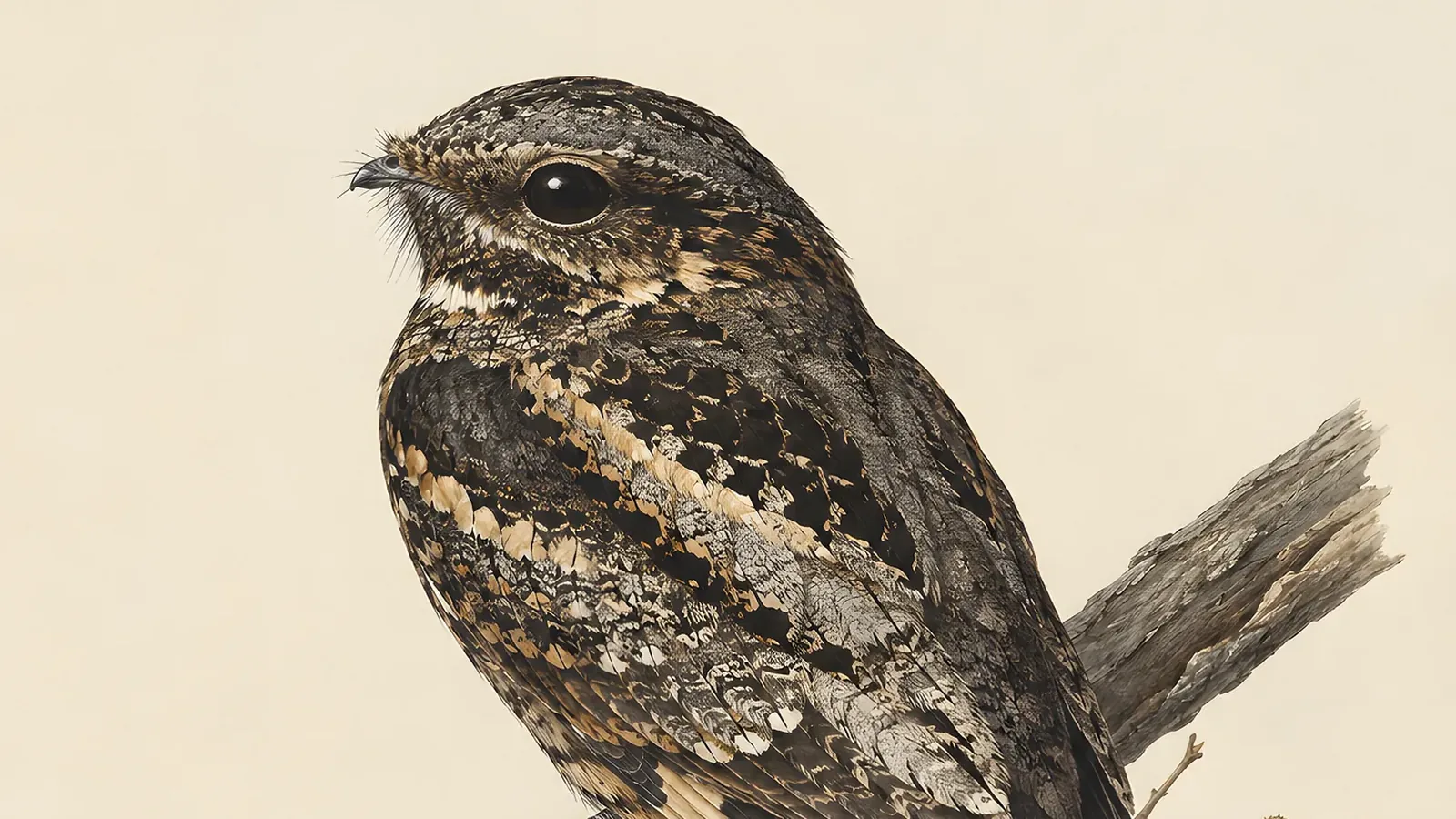
The plumage is the trick. Every feather on the back, crown, and wings is a collaboration of grey, brown, buff, and black - fine stippling and streaking that reproduces, with uncanny fidelity, the pattern of dead oak leaves drifted against dark forest soil. The Cornell Lab describes the overall effect as “brindled,” a word borrowed from tawny dogs, and it is exactly right. There is no single bold colour anywhere. The bird is a texture, not a colour. Motionless on a branch or on the ground, it does not look like a bird at all. It looks like the place it has chosen to be.
The sexes differ only at the edges. Males carry white corners on the tail and a white throat bar that cuts cleanly across the black chin. On females, both marks are warm buff rather than white. Neither mark is visible when the bird is at rest in full camouflage mode. In flight, the male’s white tail corners flash briefly in torchlight - the most reliable field mark in a creature that offers very few.
The face is flat and wide, the bill tiny and almost comically small for a bird that swallows moths whole. The real feeding apparatus is the gape - a vast, bristle-fringed opening that extends well past the eyes when spread, a net more than a beak. The large dark eyes sit forward, giving the bird a binocular field appropriate for a visual hunter.
| Measurement | Range |
|---|---|
| Length | 22 - 27 cm |
| Weight | 43 - 65 g |
| Wingspan | 46 - 48 cm |
| Lifespan (wild) | up to 15 years |
| Conservation status | Near Threatened (NT) |
| Clutch size | 2 eggs |
| Incubation | 19 - 21 days |
The voice
Vociferus is not hyperbole. The call of the Eastern Whip-poor-will is one of the loudest sounds a bird this size produces anywhere in North America, and the male sings it from dusk until well past midnight throughout the breeding season. Each three-syllable phrase lasts roughly 0.6 seconds. The pitch rises through the phrase - introductory notes around 1.5 kHz, the final stressed syllable peaking near 3 kHz - and the cadence is metronomic. There is a brief chuck note before each phrase, audible at close range, that the species uses as a contact call between mates during the day.
The specific epithet, vociferus, is well earned. Audubon himself wrote of lying awake listening to the bird call through the night from the woods outside his camp, the count eventually becoming impossible to follow.
The song is territorial advertisement and mate attraction compressed into a single repeated phrase. It is also, it turns out, a fairly reliable sign that the moon is coming. The bird sings most intensely in the nights around the full moon. When the lunar cycle is wrong, the forest goes quiet.
Breeding by the moon
The Eastern Whip-poor-will does not build a nest. The female lays two eggs - whitish, finely marked with brown and grey - directly on the leaf litter of the forest floor, usually near the edge of a clearing, under the partial cover of a shrub or fallen branch. Incubation takes 19 to 21 days, shared between both parents though the female carries most of the daylight hours. The chicks fledge in roughly 20 days.
What stands out is not the nesting itself but its timing.
The birds lay their eggs in synchrony with the lunar cycle, such that hatching falls on average about ten days before the full moon. This means the nestlings’ first two weeks of life - the period of maximum food demand - coincide with the brightest nights of the month. The Cornell Lab of Ornithology notes this directly: egg-laying is timed so that young hatch during a waxing moon, and the adults can forage more efficiently in bright moonlight throughout the nestlings’ critical early growth.
English, Nocera, and Green (2018, Ecology and Evolution, DOI: 10.1002/ece3.4077) studied 38 whip-poor-will nests over three years in Ontario and found that moth abundance and moonlight both showed positive associations with daily chick survival rates. The picture they describe is not a simple clock but a negotiation: when food peaks and lunar peaks align, productivity is highest. When they diverge, pairs compensate by initiating additional nesting attempts within the same season.
The broader aerial-insectivore guild - swifts, swallows, nightjars - showed synchronised negative population change points across North America beginning in the 1980s, as Smith, Hudson, Downes, and Francis documented in PLoS One in 2015 (DOI: 10.1371/journal.pone.0130768). The whip-poor-will is part of that pattern. Its breeding is finely tuned to lunar-insect abundance cycles that, over the past four decades, have become less reliable.
What it eats
The whip-poor-will is an aerial insectivore, catching prey in flight. It hunts from a perch or from low coursing flight, launching short sallies into the air after large insects and returning to the same branch or a nearby one. The gape opens wide, the bristles around the bill edge may help channel insects inward, and the prey is swallowed whole.
Moths are the primary target, especially the larger Lepidoptera that fly through open-woodland edges on warm nights. Large beetles and mosquitoes round out the diet, as Kenn Kaufman’s Lives of North American Birds records. The bird does not drink water separately. It takes moisture from its prey.
Foraging is strongly light-dependent. The bird’s large eyes are adapted for dim light, and activity is highest in the hours around moonrise and moonset. On overcast moonless nights, calling and foraging both drop markedly. This is the core vulnerability of the species: it is a visual hunter in a world that is becoming less predictable, with fewer moths available and, in some areas, increasing light pollution disrupting the lunar cues the bird has relied on for its entire evolutionary history.
Range and the decline
The Eastern Whip-poor-will breeds across the eastern two-thirds of North America, from Pennsylvania and Michigan south to the Gulf states, west through the Great Plains, and north into southern Canada. It winters mainly in the southeastern United States and down through Central America into Guatemala and Nicaragua. The Audubon Field Guide notes that some birds winter in areas that overlap with the summer range of the Chuck-will’s-widow - a close relative in the same family that occupies a similar acoustic niche in the Deep South.
The species is listed as Near Threatened on the IUCN Red List. The population has declined by an estimated 69 percent since 1970 according to North American Breeding Bird Survey data. The causes are not fully resolved but point consistently toward two pressures. The first is the collapse of insect biomass, particularly large moths, driven by pesticide use and habitat change. The second is the loss of open woodland and early-successional forest, the edge habitat the whip-poor-will requires. Fire suppression across much of its range has allowed formerly open woodland to close into dense, unsuitable canopy. Wintering grounds in Central America face ongoing deforestation.
The bird is still widespread. It is not gone. But the nights in much of Pennsylvania are quieter than they were in 1970, and the decline shows no sign of reversing.
Roosting unseen
By day the whip-poor-will becomes the ground it rests on. The leaf litter does not hide the bird. The bird becomes the leaf litter.
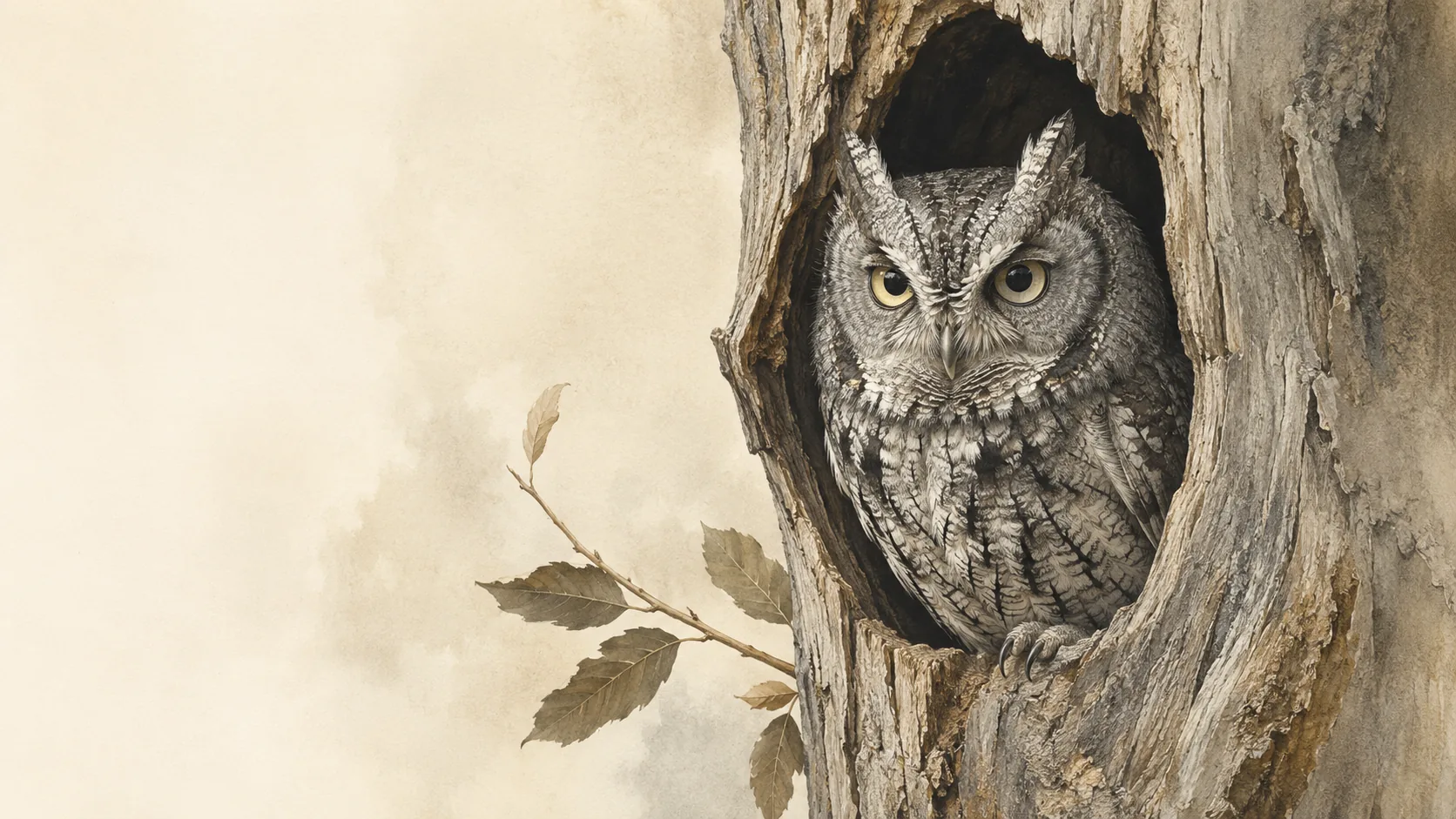
The eastern screech-owl roosts by pressing itself against a tree cavity entrance, motionless, eyes half-open. The whip-poor-will takes a different approach entirely. It lands on a branch and lies along it lengthwise, belly parallel to the bark, or settles onto the forest floor and simply disappears. The cryptic plumage, which in motion is merely beautiful, at rest becomes functional invisibility. Observers have stepped within a metre of a roosting bird before it flushed, and some birds do not flush at all - they tighten their posture and hold, relying on the pattern to carry them through the disturbance.
This is the full equation of the species. By night, the loudest voice in the woods, hammering a name against the dark, guided by moonlight to its moths. By day, a silence so complete it might as well not exist. A banded female recovered on the same Kansas territory 13 years after first capture tells us the individual endurance is real - these are not brief lives.
The argument the whip-poor-will makes is about timing. Everything it does - the breeding timed to the waxing moon, the foraging timed to the moth flights, the roosting timed to the light - is a precise calibration against the natural world’s rhythms. What is happening now is that those rhythms are shifting, and the bird is trying to keep up. Whether it can is the open question. For the moment, on a warm May night in the oak-hickory woods of the mid-Atlantic, you can still hear it working the problem. One phrase at a time. Again and again. Into the dark.