Field Guide
Red Crossbill
The spruce cone is sealed. Its scales are pressed together in overlapping armour, protecting the seeds inside. For most birds, this is an impasse. The Red Crossbill fits its bill between the scales, and then - not cracking, but levering - spreads the scales apart with a sideways flex of the jaw. The seed is exposed, and the tongue rolls it out. The cone falls. The bird moves to the next one.
The crossed bill is not a deformity. It is a key, and the cone is the lock. Ornithologists have known this for centuries, but the full depth of the story - the coevolution, the cryptic diversity, the nomadism - has only become clear in recent decades.
What it looks like
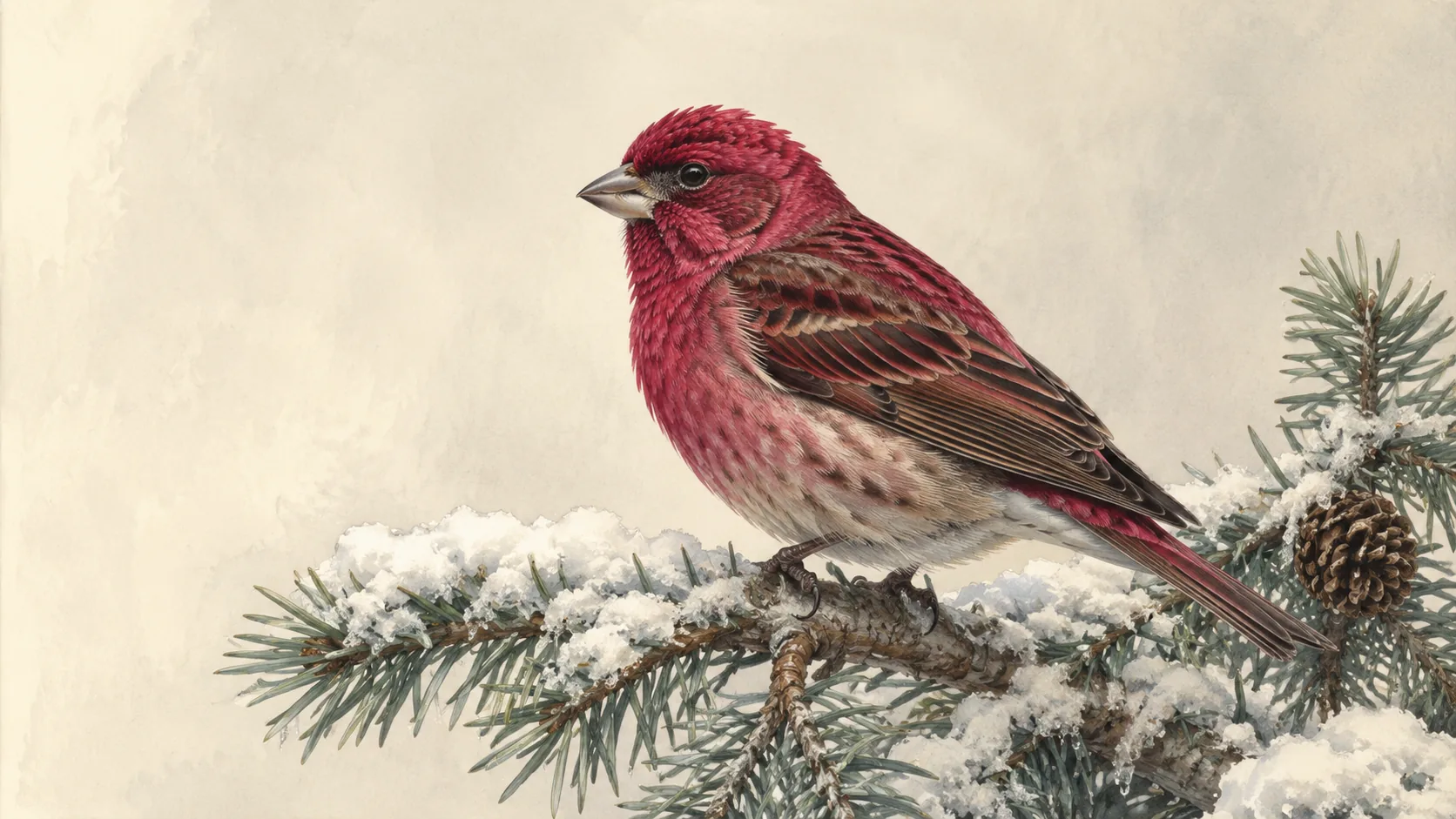
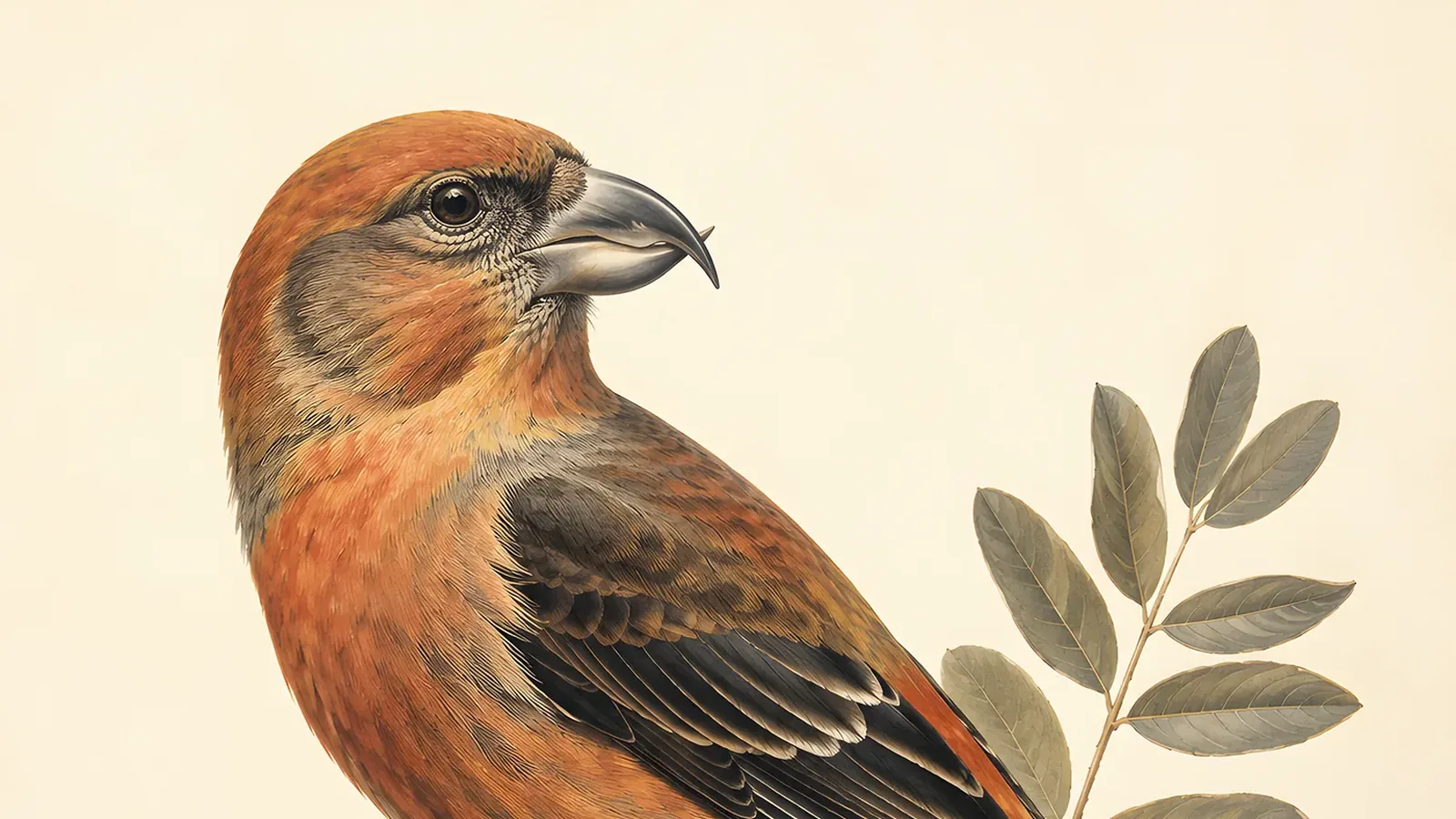
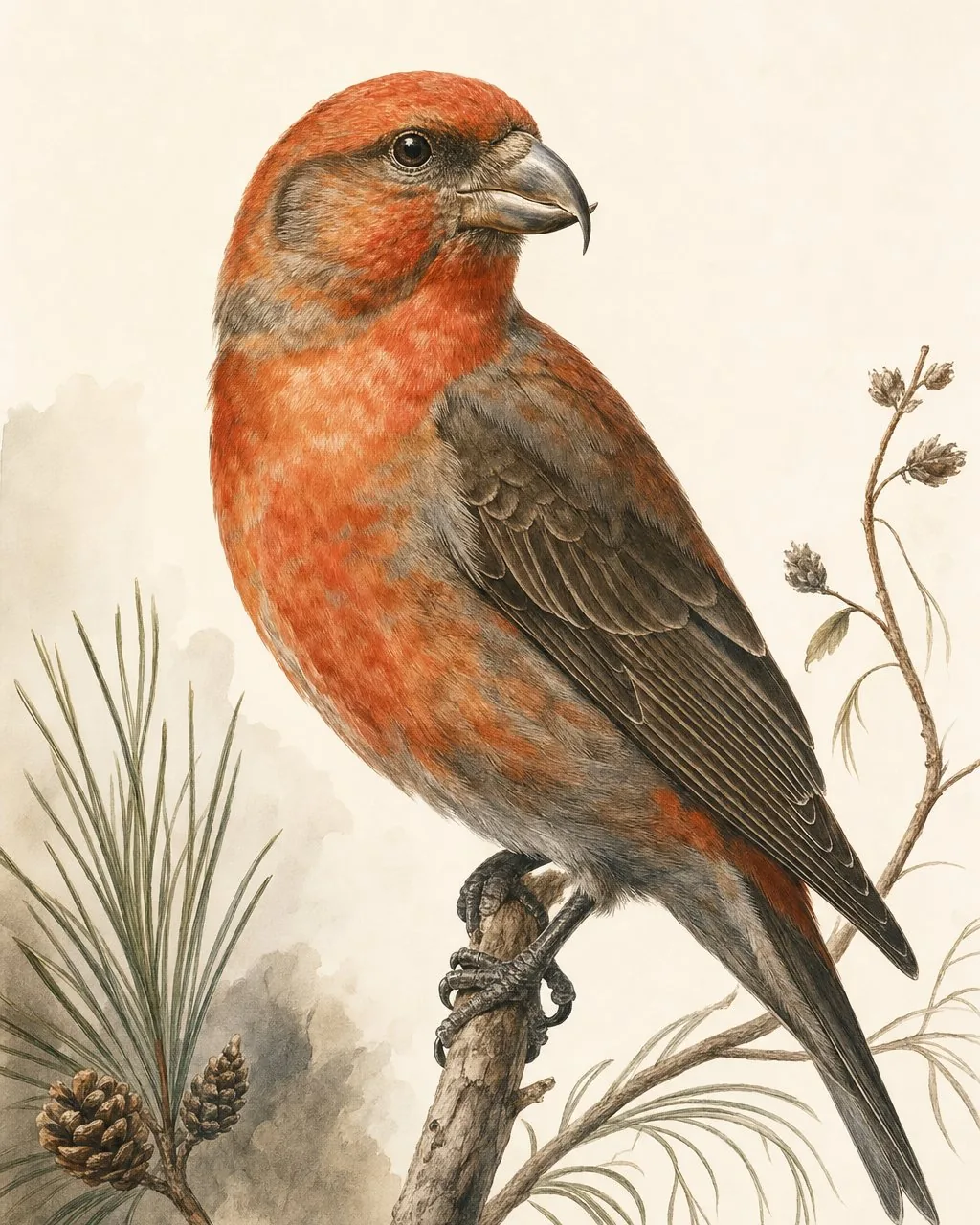
The male is a brick red to orange-red bird with dark brown wings and tail. The shade varies considerably - some males are deep carmine, others nearly orange. The female is yellow-green to olive, also with dark wings. Both sexes share the one character that makes identification immediate and final: the bill.
The mandibles cross at the tip, the lower jaw curving one way and the upper the other. Which way they cross varies individually. The crossing is visible at surprisingly close range, and in the hand it is unmistakable. Young males are yellow-orange and slowly acquire red over their first two years.
The body is compact, the wings noticeably pointed, the tail slightly forked. In flight the bird gives a distinctive jip-jip call and the underwing pattern of pale wing stripe is visible. It travels in small flocks, often heard before it is seen.
| Measurement | Range |
|---|---|
| Length | 14-20 cm |
| Weight | 20-50 g |
| Wingspan | 25-32 cm |
| Lifespan | 5-10 years |
Voice
The flight call is the critical field mark - not for the species, but for what ornithologists now call “call types.” A Red Crossbill utters a sharp jip or kip or a more complex two-syllable note, and the exact quality and pitch of this call varies systematically across the species. In North America, researchers have identified at least ten distinct call types, each associated with a different average bill size, geographic range, and preferred conifer species.
This is the crossbill mystery that has occupied researchers for decades. Do these call types represent separate species? The answer is probably yes, for some of them. One type - the Cassia Crossbill, Loxia sinesciuris - was formally described as a separate species in 2017, confined to lodgepole pine forests in the South Hills of Idaho, where it has co-evolved with a local pine population over thousands of years.
The others remain in a state of biological uncertainty. They do not interbreed freely. They prefer different conifers. Their bills differ in size and shape in ways that track cone morphology. But they lack the full genetic separation that formal species status requires. The Red Crossbill may be a species complex in the process of speciation, caught mid-divergence.
“When you learn the crossbill calls, you realize the flock overhead is not a single thing. Different birds calling from the same spruce - different types, different bills, different histories, different conifers they evolved on. Invisible diversity, audible if you know how to listen.” - field notes, Oregon Cascades
Range and habitat
Nomadic. This is the governing fact of the Red Crossbill’s existence. It breeds wherever conifer cone crops are heavy, without regard for season or latitude. A pair may nest in British Columbia in January if the spruce is producing. The same birds may move to the Oregon Cascades in June if the fir crop is better there. They have been found breeding in every month of the year across their combined range.
The range itself is vast and variable: boreal forest across Canada and Alaska, the mountain ranges of the West, the Appalachians, and occasionally the Atlantic coast on irruptive years when northern cone crops fail and the birds push south and east. Maine and the Northeast see crossbills regularly in good flight years.
Preferred conifers vary by call type: spruce, pine, Douglas-fir, hemlock, and larch are all used. The bird’s entire life is organized around finding the next cone crop.
Diet
Seeds of conifer cones, extracted with the crossed bill. The technique is efficient enough that a crossbill can open dozens of cones in an hour. The birds are messy workers - half-open cones fall to the ground below a feeding flock, and the litter of dropped cones is often the first sign that crossbills are in the trees above. They supplement with other seeds, berries, and insects, particularly when feeding young, but cones drive everything.
The different call types prefer different conifers, and their bill sizes have co-evolved to match the scale thickness and seed size of those preferred conifers. Type 2 has a small bill suited to spruce. Type 4 has a larger bill suited to ponderosa pine. This is the coevolution in action - a species diversifying along the axis of its food source.
Breeding
Nomadic breeding is driven entirely by food. When cone crops are heavy, crossbills will breed. They build a well-insulated cup nest in a conifer, typically on a horizontal branch well out from the trunk. The female incubates two to four eggs for about two weeks while the male feeds her. Both parents feed the young, which fledge in about three weeks.
The chick’s bill is straight at hatching. The characteristic cross develops over the first few weeks as the chick begins to practice the prying movements that will define its feeding technique for life. Young birds that have not yet developed the full cross can manage with a straight bill - but poorly.
The arms race with conifers
Conifers and crossbills are locked in an evolutionary conflict that has been running for millions of years. Conifers “want” - in the selective sense - to keep their seeds inside the cone long enough for wind dispersal. Crossbills “want” the seeds for food. The result is an arms race: conifers with tighter, thicker, harder-to-open cones, crossbills with bigger, stronger, more precisely crossed bills.
The Cassia Crossbill exemplifies this most clearly. Isolated on South Hills lodgepole pines - which have evolved unusually thick scales under pressure from crossbill predation - the crossbill population there has evolved the largest bills of any crossbill type, capable of opening cones the other types cannot. Remove the crossbills and the cones become less thick over generations. Remove the thick cones and the large bills lose their advantage. The two are bound together.
This is the Red Crossbill story in miniature: not one bird and one conifer, but a web of ongoing coevolutionary relationships, differentiated by geography and tree species, in the process of becoming separate species. The bill that looks like a mistake is the product of millions of years of very precise selection.
Closing
When you hear the call overhead in a stand of spruce - that bright, sharp jip-jip - stop and listen before you look up. Note the pitch. Is it the two-note call of Type 2, sharp and clipped? Or the more musical, rising type of a larger-billed bird? You cannot reliably type crossbills by sight. The call is where the hidden diversity lives. What looks like a single species moving through your trees may be two or three convergent lineages, each carrying a different history with a different tree, each tuned to a different cone.