

There is a trick in the name of Paradisaea apoda, and the trick tells you something about how far a beautiful thing can travel before the truth falls away.
When Carl Linnaeus formally described this species in 1758, he had never seen a live bird. What he had were trade skins - prepared by Papuan hunters who removed the legs to reduce weight for long ocean voyages, then sold through Ternate and Banda into Lisbon and Amsterdam and eventually into the cabinets of European collectors. The legless skins, with their impossible cascade of yellow and white plumes, suggested to scholars that the birds must float perpetually in the upper air, feeding on celestial dew, descending only when they died. Linnaeus took the myth as fact. Apoda: the footless ones. The species name has never been corrected, because taxonomy does not correct for poetry.
The Greater Bird of Paradise has legs. It is a forest bird, a frugivore and arthropod hunter, native to lowland and hill forests from sea level to roughly 950 metres across a narrow range: the Aru Islands of eastern Indonesia and the southern lowlands of New Guinea from the Timika district east to the Fly and Strickland river drainages. It is, by any practical measure, a common and widespread bird. The IUCN lists it as Least Concern. And yet it remains, after two centuries of natural history, the bird that European imagination turned into a creature of pure sky - because a hunter on a trading boat once cut off its feet.
What he looks like
The male is 43 centimetres long, excluding the two central tail wires that extend well beyond the body. The female runs shorter at roughly 35 centimetres, uniform maroon-brown above and below, built for sitting invisible on a nest cup in the forest interior.
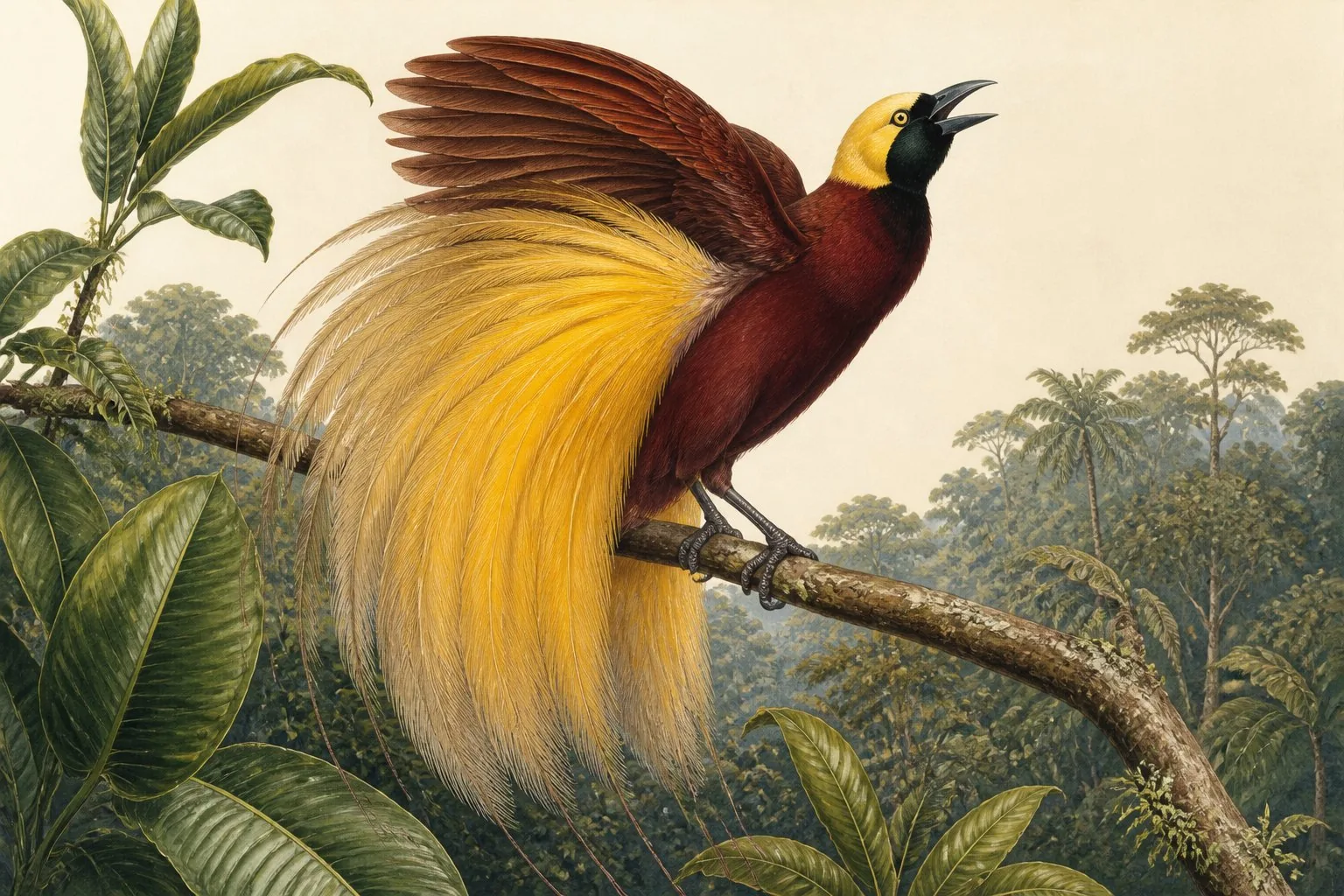
He is not subtle. The crown and upper breast are washed pale yellow-gold, shading to a deep maroon-brown on the back, wings, and belly. The throat is iridescent green, catching light with the quality of shot silk. From the flanks extend the plumes - long, filamentous, pale yellow at the base shading to white at the tips - which he can lift and spread until they arch entirely over his back and obscure his body from view. His bill is blue-grey. His iris is yellow.
The female’s plainness is not an accident. She builds the nest alone, incubates alone, and feeds the chicks alone in a landscape thick with raptors. The male’s role ends at the lek.
The lek
The display ground is a traditional communal perch - a particular emergent tree or a set of cleared branches used year after year by a rotating cast of up to 15 males. Display runs in two seasons, broadly March through May and August through December, which together give this species an unusually long breeding window for a tropical forest bird.
At first light, before sunrise, the males begin calling. They hold a position on the perch, spread and raise the flank plumes, and then drop into a sequence of set postures - wings forward and low, body horizontal, head thrown back, plumes erected into a shivering white cascade over the back. The most extreme pose inverts the bird entirely: he hangs upside-down from the branch with plumes spreading below him like a suspended fountain. Cornell’s Birds of the World notes that each segment of the display is coordinated with one of eight distinct call variants, linking vocal and visual performance into a single scored piece.
The female watches from nearby. She makes the selection. She may visit multiple leks over multiple seasons before she commits to a particular male - or to none. The male she chooses will not help raise the chick. He will, instead, continue displaying until his plumes wear down or a younger competitor displaces him from his perch.
This system - polygyny, female choice, extreme male ornamentation, zero male parental investment - is the textbook example of runaway sexual selection. The argument runs back to R. A. Fisher and was extended into empirical territory by researchers studying Paradisaeidae across New Guinea over the past 50 years. The Greater Bird of Paradise is as close to a pure test case as field biology offers.
Voice and range
The call is a loud, repeated mechanical “wowk” or “wauk” - penetrating through dense canopy, carrying at distances that locate the lek long before the display becomes visible. During peak courtship the males call from pre-dawn through mid-morning, then less frequently through the afternoon, slowing to silence after dusk.
The range is tighter than the bird’s fame would suggest. Two subspecies divide it: P. a. apoda on the Aru Islands, and P. a. novaeguineae across the southern New Guinea lowlands. A small introduced population was established on Little Tobago in the West Indies between 1909 and 1912 by Sir William Ingram, a British politician and businessman who purchased the island as a sanctuary to protect the species from the plume trade; ornithological surveys after 1966 found no evidence of survivors. The island population almost certainly died out.
Within its native range the species occupies the lowland and foothill forest belt. It does not reach higher-altitude montane forest, which is occupied by other members of Paradisaeidae, and it does not use heavily disturbed agricultural land. The dependence on structurally intact lowland forest is the primary ecological constraint on its range - and the primary long-term concern for a species currently classified as stable.
Diet and habitat
The diet is fruits and arthropods. The Australian Museum’s account of the species describes foraging across the forest canopy, with fruits taken whole and passed through intact (this species is a seed disperser for several lowland forest trees, including some figs and forest fruiting trees). Insects and other arthropods, especially larger beetles and caterpillars, are taken during the nesting season and fed to chicks.
The habitat is tall, structurally complex lowland forest. This is not a bird of the edge or the secondary growth. The traditional lek sites require old emergent trees. The nest requires dense cover within the forest interior. The bird is, structurally, a forest specialist - and the history of ornithology on New Guinea is the history of the gradual recognition that forest specialists do not survive forest loss.
Plumes and the trade
The CITES Appendix II listing reflects a specific historical reality. Through the 19th century and into the early 20th, the plume trade was a substantial industry: thousands of male birds killed annually for the millinery markets of London and Paris, where the plumes of Paradisaeidae were among the most valued ornaments in women’s fashion. Alfred Russel Wallace, who observed Greater Birds of Paradise displaying on Aru in the 1850s, described the spectacle in terms that remain among the most precise field accounts in Victorian natural history writing. By the time legislation in the United States and Britain began restricting the plume trade (1900-1922), the impact on Aru populations was substantial enough to be noticeable.
The legal hunting by Papuans for ceremonial use has never been classified as a conservation threat. The feathers have carried social and ceremonial significance in New Guinea cultures for centuries, and the IUCN assessment treats this take as sustainable at current levels. It is the commercial export trade - now prohibited - that was the threat. The species has recovered enough from that era to hold Least Concern status today.
What endures
What stays, after the biology is accounted for, is the myth that Linnaeus built into the formal name: the footless bird that lives only in the air. It is a convenient myth because it captures something real about the viewing experience - a creature so elaborately built for display that the functional parts, the legs, the nesting, the seed dispersal, feel secondary to the spectacle of the plumes.
But the legs are there. And so is the forest. And so is the female on the nest, invisible in maroon-brown, doing most of the work. The most overdesigned creature in the canopy turns out, when you account for all of it, to have a perfectly legible ecology. The name got it wrong. The bird got it right.
The male Greater Bird of Paradise builds nothing, feeds nothing, and protects nothing. What he does, in two bursts each year, is perform. The female decides if the performance was worth a clutch of eggs. So far, across millions of years, she has said yes often enough to keep the species common.