Field Guide
McKay's Bunting
On a morning in late May, on the bare volcanic tundra of St. Matthew Island in the Bering Sea, a small bird stands on a rock outcrop and sings into wind that has not known a human being for months. He is, against that grey stone and that grey sky, almost entirely white. The black at his wing tips is so limited it reads, at first, as shadow. No other songbird on the continent looks like this.
Plectrophenax hyperboreus, McKay’s Bunting, is one of the rarest regularly-occurring breeding birds in the United States, and in one specific sense it is the most extreme. The breeding male is the whitest songbird in North America - whiter than a Snow Bunting, whiter than anything on the mainland. That whiteness is not accident. On islands where snow can persist into June, it is the nearest thing a small bird has to armour.
What it looks like
The breeding male is the standard against which all other pale birds should be measured. He is white on the head, white on the body, white on most of the wing. The only departures from that white are the outer wing tips and a narrow band across the tail base, both black. In some birds a faint grey or buff wash marks the back, but many individuals are clean white all over except for those restricted dark areas.
Compare him with his close relative the Snow Bunting - a species with whom he was once considered conspecific - and the difference is immediate. A Snow Bunting male carries a broad black back and considerably more black in the wings. McKay’s carries almost none of either. He is the more extreme bird.
The female is a softer study: buff-brown streaking on the head, back, and sides of the breast, white underneath, white wing patches reduced compared to the male. She can be confused with a female Snow Bunting in the field, though she shows on average more white and less brown.
The bill is short, seed-cracker strong, and pale horn-coloured. Legs and feet are black, built for walking on cold ground and gripping rocky surfaces rather than perching in vegetation.
| Measurement | Range |
|---|---|
| Length | 18-20 cm |
| Weight | 30-50 g |
| Wingspan | 30-33 cm |
| World population | ~19,000-32,000 (declining) |
Two islands in the Bering Sea
The breeding range of McKay’s Bunting is, in practical terms, two islands. St. Matthew Island and the adjacent Hall Island, both uninhabited, both rising from the central Bering Sea roughly 300 kilometres from the Alaskan mainland, are where almost every McKay’s Bunting on Earth comes to nest. Together they cover approximately 332 square kilometres. That is the foundation on which this bird’s entire population rests.
St. Matthew sits in some of the most inhospitable weather in North America. Fog, low cloud, and near-constant wind are the summer norm. Human visitors are rare. The island was used briefly as a military weather station during the Second World War, and surveyed by biologists in 1982, 1983, and 2003 by Johnson, DeCicco, Matsuoka, and Sowls, whose work on nesting ecology appeared in The Wilson Journal of Ornithology in 2013. That study documented clutch sizes, nest success rates, and the species’ preference for rock crevices, driftwood piles, and - strikingly - the hollows of whale bones washed ashore on the beaches.
Breeding surveys in 2018 and 2019 (Richardson, Amundson, Johnson, Romano, Taylor, Fleming, and Matsuoka, writing in Ornithological Applications in 2024) found that the population had declined 38 per cent from an estimated 31,560 individuals in 2003 to around 19,481 in 2018. The high-density coastal breeding areas had contracted, with birds shifting to higher elevations. The research concluded that McKay’s Bunting meets the criteria for Endangered under IUCN standards, a stark step up from its current Near Threatened listing. The cause of the decline is not yet fixed, but the shift in distribution toward higher elevations during a period of exceptionally warm weather and reduced spring snowpack points clearly toward climate.
Outside breeding season, the species winters along the western Alaska coast from Kotzebue Sound to the Alaska Peninsula - a nonbreeding range of around 72,000 square kilometres, modest but vast compared to where the bird was born.
The whitest songbird
The whiteness of McKay’s Bunting is not purely cosmetic. Breeding males arrive on the islands before snowmelt is complete - sometimes in April, when most of St. Matthew is still under ice - and the near-white plumage provides a degree of camouflage in those early weeks that darker plumage simply would not. By the time the tundra is bare brown and green through summer, the male is conspicuous. He does not seem to care.
The relationship with the Snow Bunting (Plectrophenax nivalis) is close and complicated. Genetic analysis by Winker, Glenn, and Faircloth, published in PeerJ in 2018, found no fixed genetic differences between the two species, with evidence for divergence-with-gene-flow beginning roughly 241,000 years ago. They have not simply separated and stopped speaking. Where McKay’s Buntings winter on the Alaskan coast and encounter Snow Buntings moving through the same beaches and dunes, hybrids occur. They are, in effect, distinct enough to be classified as separate species but close enough to produce fertile offspring - a rare and biologically interesting position to occupy.
The question of whether they remain two species or collapse back into one will be answered over time by genomics. For now, the field distinction holds: if the bunting in front of you is nearly all white, with only token black at the wing tip and tail, you are looking at McKay’s.
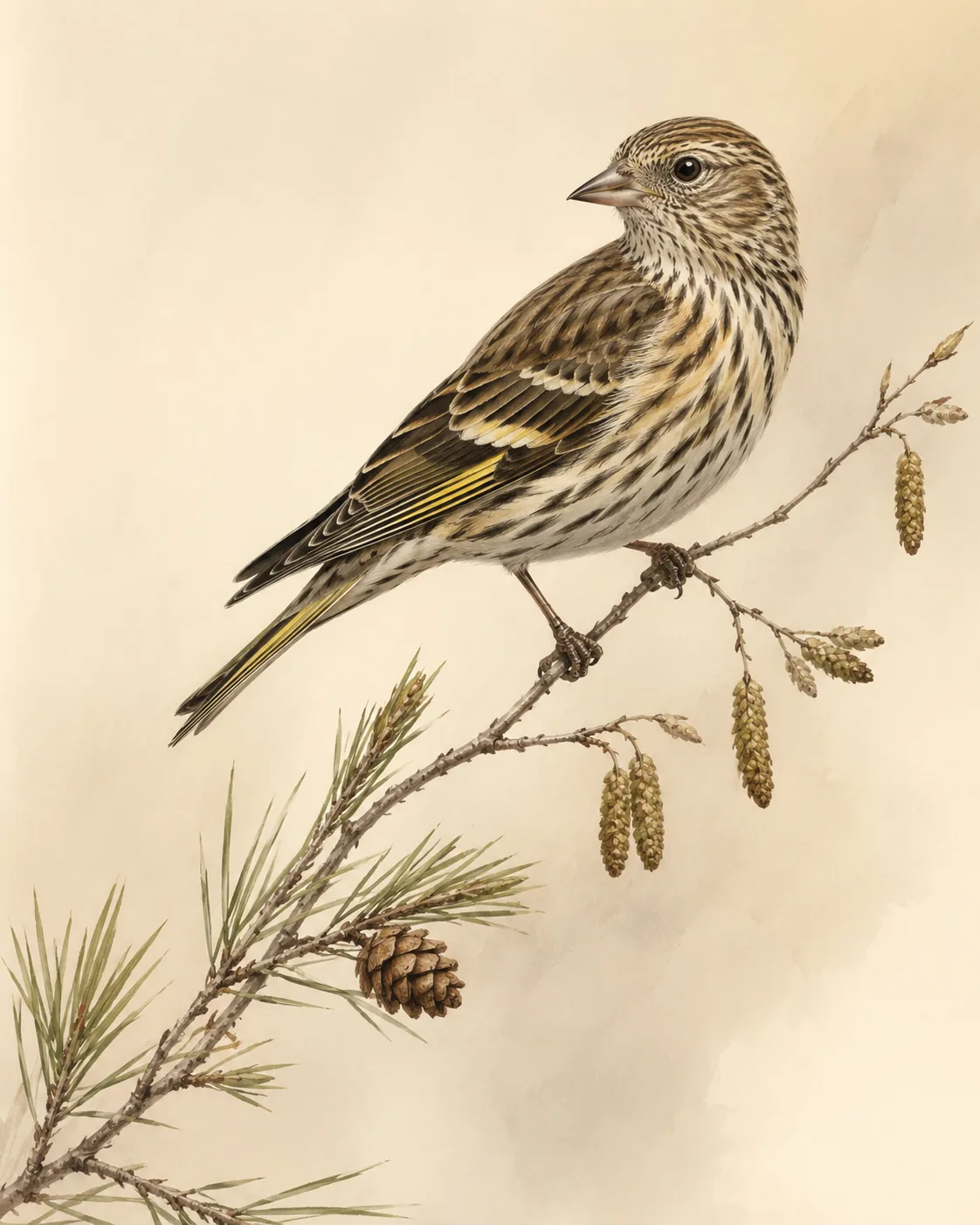
A pine siskin weighed against McKay’s Bunting is a useful illustration of how different the Calcariidae longspur family is from the finches - the siskin’s thin, pointed bill built for extracting seeds from tight cones is a world away from the bunting’s heavy, rounded bill built for cracking open seeds swept across frozen ground by Bering Sea wind.
What it sounds like
The song has been described as a rich, warbling series of whistled phrases, melodious and carrying, something between the fluid outpouring of an American Goldfinch and the piping sweetness of a Fox Sparrow. It is loud for the bird’s size, and it needs to be: the wind on St. Matthew Island is rarely still, and a male holding territory on an exposed scree slope must project.
The calls include a soft musical rattle and a quick, fluty descending whistle. Both carry well in the open tundra habitat. Pairs in the nesting season exchange quieter contact notes around the nest site.
The song is heard in full only on the breeding islands. Wintering birds on the Alaskan coast are typically quieter, reduced to call notes and the occasional short subsong in the low scrub of beach edges. A birder on the western Alaskan shore in November or December who hears a musical rattle from a pale bird flushing off the snow has a reasonable chance of encountering one of the few thousand McKay’s Buntings still in existence.
Diet
Like most longspur-family birds, McKay’s Bunting is a generalist at the table. On the breeding grounds, the summer diet leans heavily on insects and spiders - the arthropod bloom that accompanies the brief subarctic summer supplies protein for adults and for growing chicks.
Later in the season and through winter, the diet shifts to seeds. On the wintering coast, the birds work beaches and low coastal tundra for grass seeds, rush seeds, and any grain carried by the wind. In some years small crustaceans and marine invertebrates stranded at the tideline add to the winter diet.
Foraging birds walk, they do not hop. They move methodically across the ground, picking up seeds with that short, strong bill, occasionally digging lightly into soft substrate or snow crust to reach buried items.
Breeding
Nesting begins in late May, when St. Matthew Island is still partly snow-covered. The nest is built by the female in a sheltered cavity - a rock crevice, a gap under a boulder, a hollow in a driftwood log, or the curved interior of a whale bone. The cavity insulates the eggs against wind and cold, and conceals them from the few predators the island supports.
The clutch is three to five eggs, occasionally more, pale greenish-white and spotted with brown. The female incubates alone for roughly 12 to 14 days while the male defends territory and brings food. Both parents feed the chicks, which fledge at around 10 to 12 days old.
Johnson and colleagues found in their 2013 nesting study that hatching success was high compared to Snow Buntings at other Arctic sites, suggesting the island environment - with its low predator pressure and absence of rats or introduced competitors - historically favoured the species. The key threat is not predation but the slow rewriting of the habitat itself as the climate shifts.
The white is not innocent beauty. It is camouflage for a bird that arrives before the snow retreats, armor fashioned for two small islands at the edge of the world.
The argument for caring about McKay’s Bunting is not especially complicated. It is one of a very small number of birds whose entire breeding population fits within an area smaller than greater London. Its white plumage evolved in isolation on those specific islands, under those specific pressures. If St. Matthew Island becomes climatically unsuitable - if the snowpack that still covers the ground in May when the first birds arrive is gone by April, year after year - there is nowhere else for Plectrophenax hyperboreus to go. The Snow Bunting has a continent of high-latitude habitat to retreat to. McKay’s Bunting has two islands, and they are not moving.
The bird that stands on the rock and sings into the Bering Sea wind, almost entirely white against the grey, is not just beautiful. It is the whole population, concentrating itself each year in one tiny place, betting everything on the constancy of a landscape that is no longer constant.