Field Guide
Rose-breasted Grosbeak
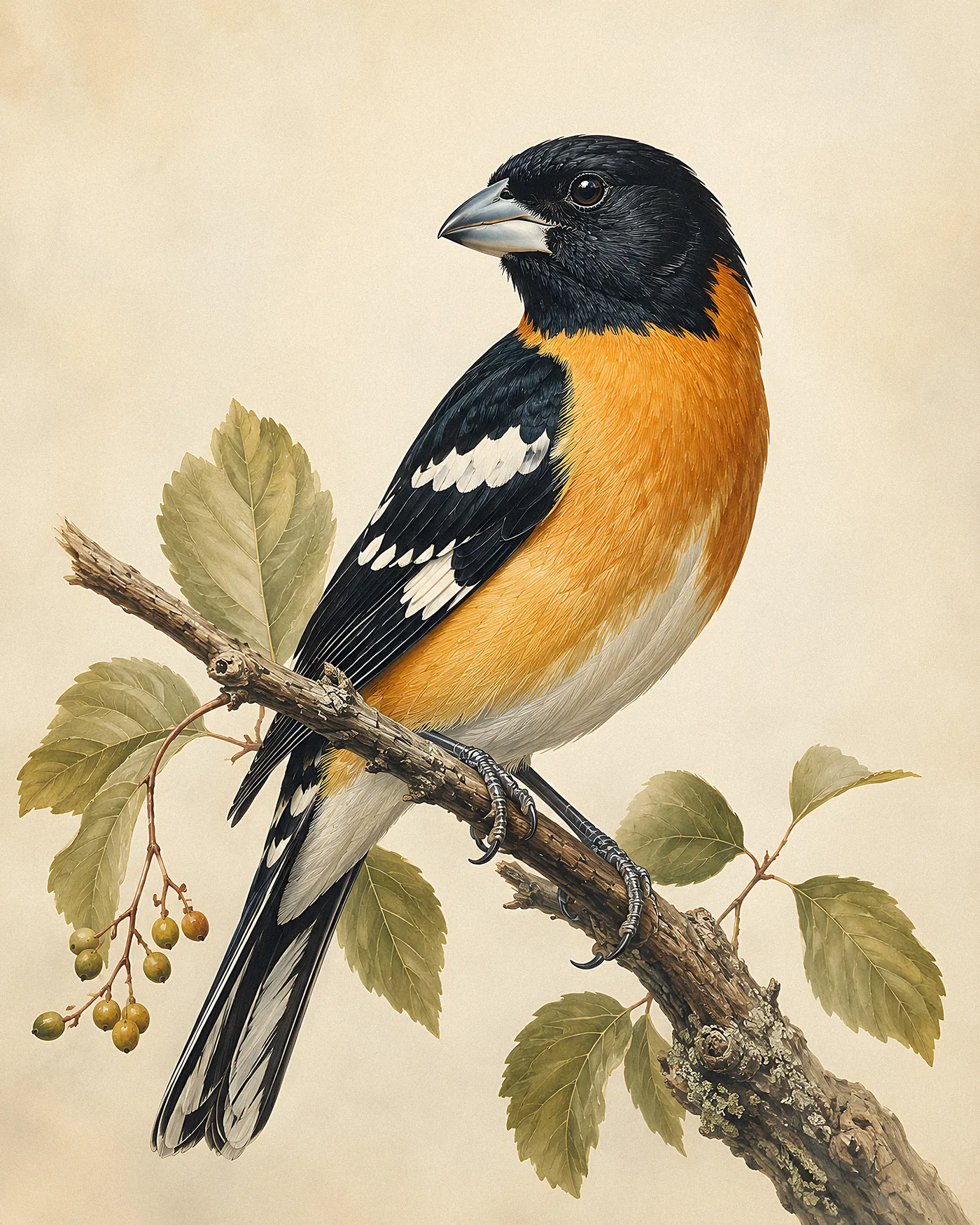
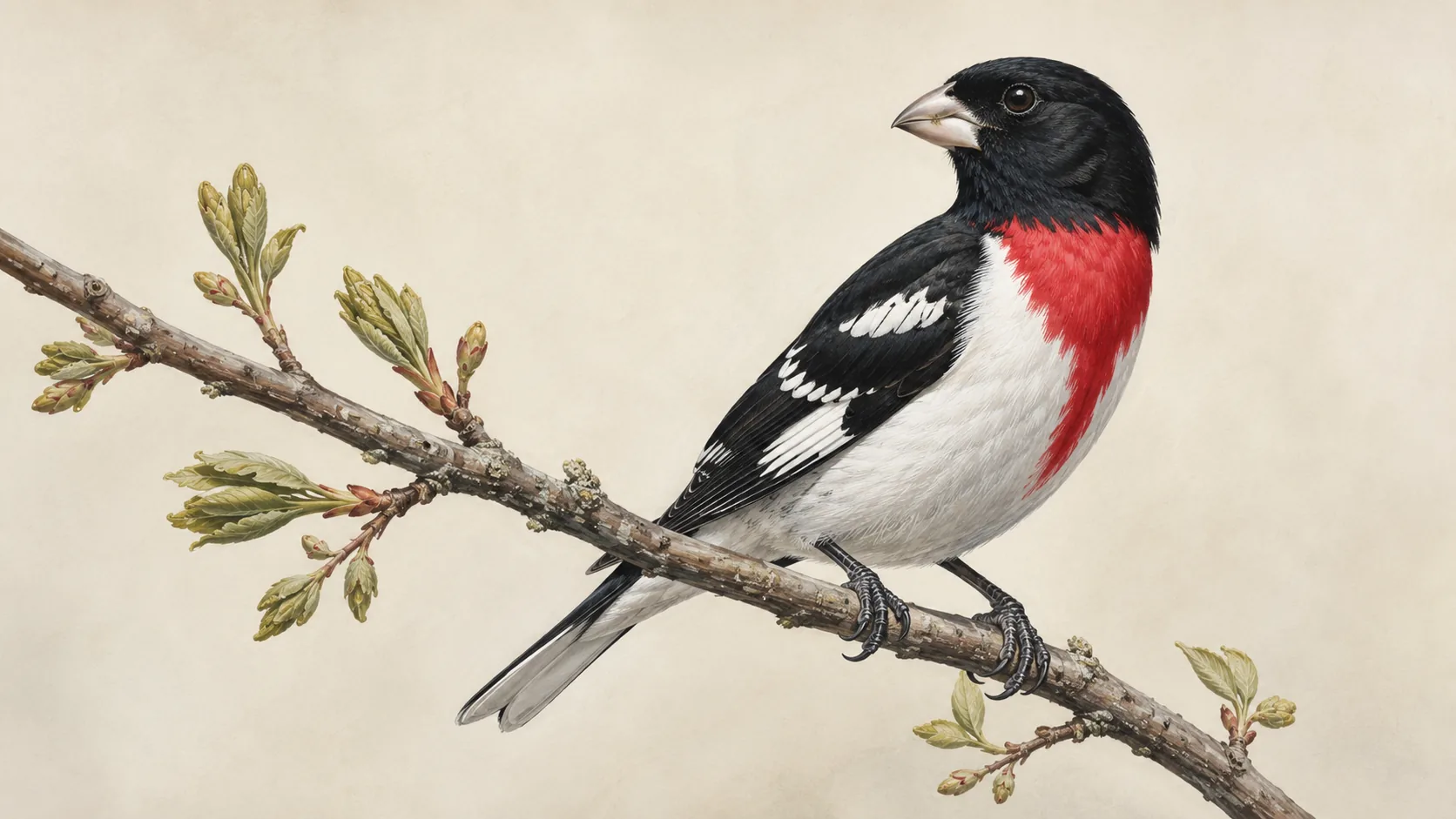
A male Rose-breasted Grosbeak arrives in a Wisconsin garden in the first week of May, usually overnight, usually unannounced. One morning the feeder holds the usual chickadees and finches. The next, there is a bird the size of a small cardinal, black and white and carrying a triangular smear of rose-red across the chest, cracking sunflower seeds with a bill built like a pair of pliers. He looks as though he flew through something freshly painted and did not stop to check.
He will not stay long. The Rose-breasted Grosbeak is a long-distance migrant passing through on its way north, and the feeder is a fuel stop, not a destination. But the bird repays the brief attention. The rose breast is one of the cleanest field marks in eastern North America, and behind it sits a bird that breaks one of the quieter rules of songbird family life: this is a species where the male shares the nest.
What he looks like
The breeding male is unmistakable. Black head, black back, black wings and tail, with white underparts, white wing flashes and a white rump. The signature is the triangular patch of brilliant rose-red across the breast, and in flight the same rose colour flushes the wing linings, so a male overhead shows pink where you expect white. The bill is the heavy, pale, conical ‘grosbeak’ tool the family is named for, blunt and powerful, built for cracking seeds rather than probing.
The female is a different bird entirely, and the cause of much confusion. She is dark grey-brown above, darker on the wings and tail, with black-streaked white underparts and a bold pale eyebrow over a buff crown stripe. She reads as a large, heavily marked finch or an oversized sparrow. The shared giveaway between the sexes is that same massive pale bill. Cornell Lab notes the species shows very little size difference between the sexes, with females only marginally smaller. In autumn the male moults into a scaly, brown-fringed plumage closer to the female’s, keeping only a hint of the rose, and even then the rosy wing linings can betray him in flight.
What he sounds like
The song is the bird’s other calling card. Cornell Lab describes it as a rich, sweetly whistled warble built of many notes that rise and fall, patterned much like an American Robin’s song but smoother and more musical. The common shorthand is a robin that has taken singing lessons. It carries well from the canopy, where a singing male often perches at the very top of an oak or beech.
Unusually, the female sings too, a quieter version of the same warble, often from the nest. The call most birders learn first is the sharp, penetrating chink or eek, a note Cornell likens to the squeak of a sneaker on a gym floor. Most striking of all, males have been recorded singing softly while sitting on the eggs, a habit that fits a bird whose paternal role runs deeper than the songbird norm.
Range and habitat
Pheucticus ludovicianus breeds in moist deciduous and mixed woodland, second-growth, shrubby forest edges, parks and well-treed gardens across the northeastern and north-central United States and much of southern and central Canada. It favours edges over deep interior forest: the boundary where a wood meets a stream, a pasture or a road.
It is a genuine long-distance migrant. The species winters in forests and semi-open country through Central America and northern South America, reaching middle elevations and highlands. Cornell Lab records many birds crossing the Gulf of Mexico in a single night on the journey, while others track the coast around it. Birds wintering in Panama and northern South America tend to come from the eastern part of the breeding range, those in Mexico and Central America from the west. The North American Breeding Bird Survey has logged a slow decline since the 1960s, and the species also faces trapping for the cage-bird trade on its wintering grounds, an impact Cornell describes as not fully measured.
Diet
The grosbeak is an omnivore with a heavy seed-cracking bill, and roughly half its annual diet is animal matter. Cornell Lab lists beetles, caterpillars, grasshoppers, true bugs, bees, ants and sawflies, along with spiders and snails. The vegetable half runs to elderberries, blackberries, raspberries, mulberries and juneberries, the seeds of smartweed, pigweed, foxtail and milkweed, plus tree buds and blossoms.
It forages by gleaning slowly through dense foliage, often high in the canopy, and will hover to snatch food from a leaf tip or fly out to hawk an insect from the air. At the feeder the preference is plain: sunflower seed, taken with what Cornell calls abandon. During spring migration grosbeaks can arrive at feeders in small parties, empty a sunflower tray and move on within days.
Breeding and nesting
This is where the bird earns its place. Both sexes build the nest, a loose, open cup of twigs, grasses and weed stems lined with finer material, set in a fork of a shrub or small tree at the woodland edge. Cornell Lab records a typical clutch of three to five pale, blotched eggs, with four the norm.
Incubation is shared. The female sits through the night and most of the day, but the male takes a turn for several hours, and both birds brood and feed the young. Cornell puts incubation at 13 to 14 days and the nestling period at around 10 days, with the young leaving as early as 9 and as late as 12, then depending on the adults for roughly three more weeks. Shared incubation by the male is uncommon among songbirds, and the singing-on-the-nest habit makes the Rose-breasted Grosbeak one of the more quietly remarkable fathers in the eastern woods.
The behaviour worth watching
Most of what makes this bird memorable is compressed into a few weeks each spring, because for the birder at a feeder the Rose-breasted Grosbeak is a bird of passage. It appears, dazzles and departs for the canopy or the tropics. The temptation is to file it as a pretty migrant and move on.
That undersells it. The rose breast and the robin-with-lessons song are the surface. Underneath sits a bird that does what most songbird males never do: it sits the eggs, it broods the chicks, it sings while incubating. The division of labour at a Rose-breasted Grosbeak nest is closer to a true partnership than the songbird default of a singing male and a sitting female.
The bird with the bleeding-heart breast is also one of the few whose father sings on the nest while he keeps the eggs warm.
So when the male turns up overnight in the first week of May, cracking sunflower seeds and flashing pink under the wings, he is worth more than the glance the colour earns him. Watch him for a week if you can. He will be gone to the treetops soon, and to Panama by autumn.