Field Guide
American Crow
In the autumn of 1999, a dead crow was found in the Bronx. Then more crows, in Queens, in Westchester, then across the Hudson. Cornell Lab ornithologist Kevin McGowan had been banding American Crows in upstate New York for years, tracking individual birds by their leg bands, building what would become one of the longest continuous studies of any corvid. Then West Nile virus hit, and the birds he had been watching for a decade started disappearing. Some populations lost 70 per cent of their birds in two years. The crow - the most visible, the loudest, the most omnipresent bird in North America - turned out to be among the most vulnerable vertebrates on the continent to a mosquito-borne flavivirus from sub-Saharan Africa.
That collision of facts is where Corvus brachyrhynchos becomes interesting. Not as a symbol of death, which it has been since Poe at least, but as a measure of ecosystem health, a social animal whose collapse reveals something real about how disease moves through a landscape, and whose recovery - still incomplete in some regions, according to Cornell’s monitoring data - is not guaranteed.
What it looks like
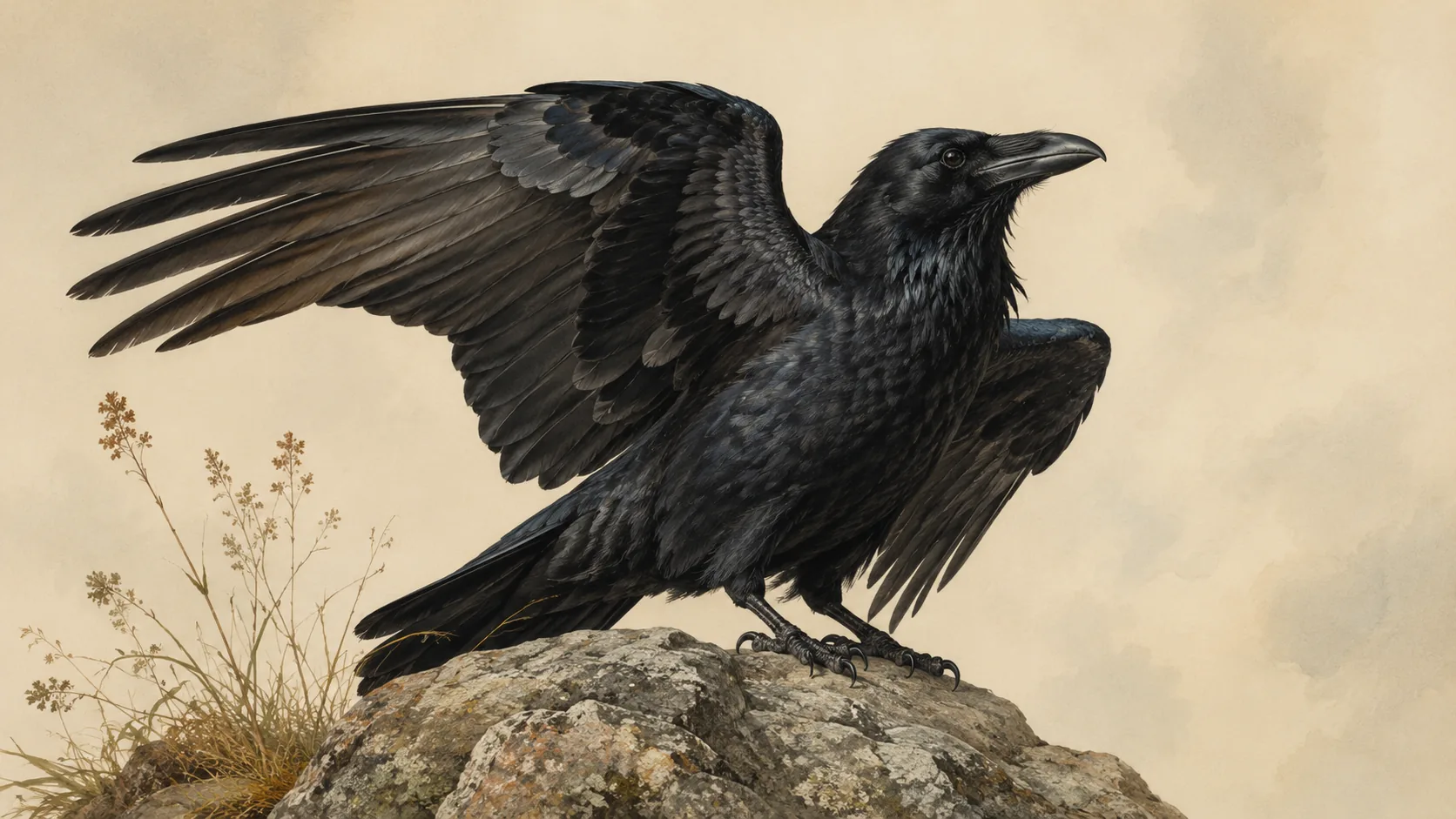
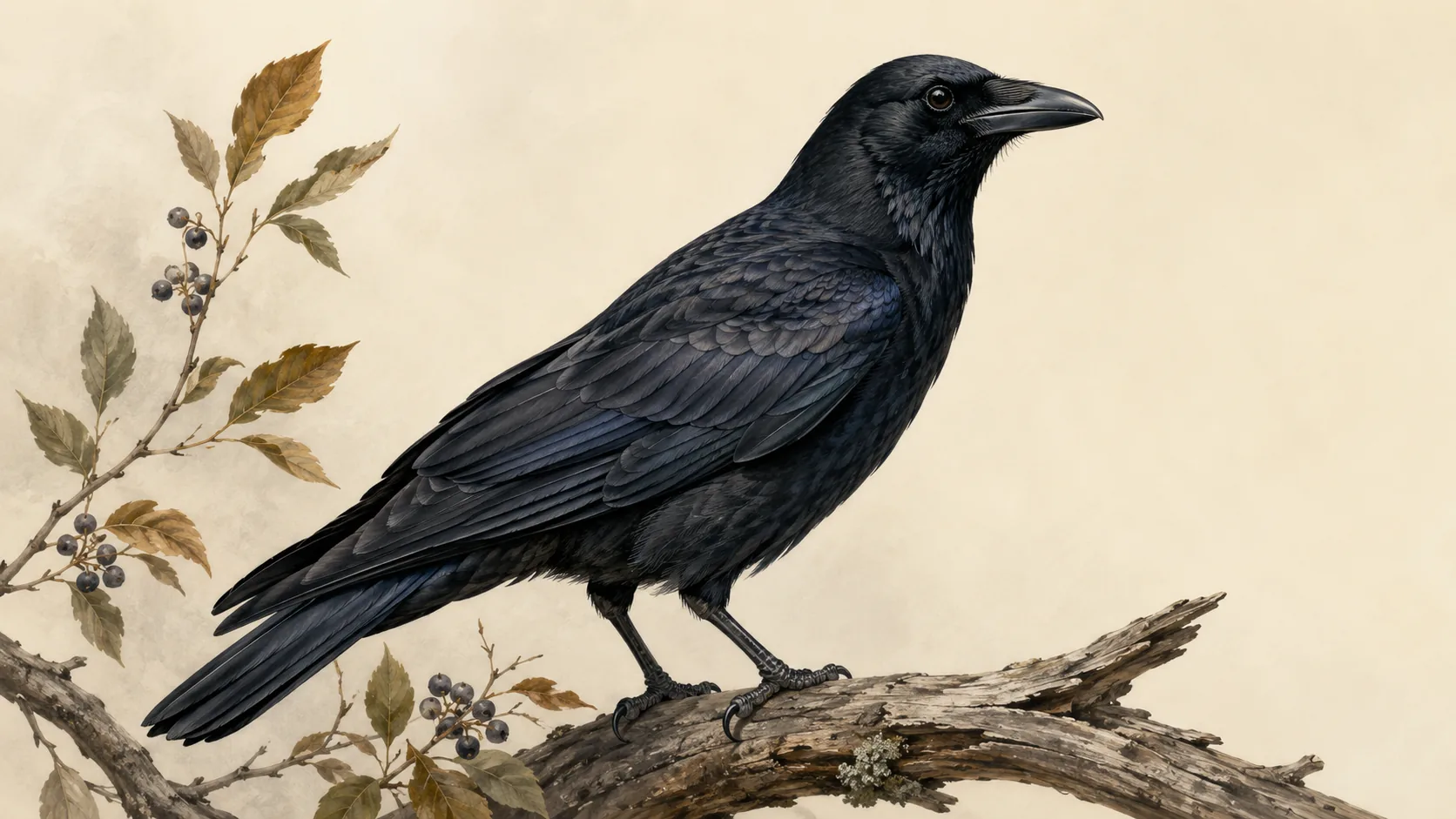
The American Crow is all black. Not nearly black, not dark with iridescent green like a European Starling, but uniformly, completely black from the bill tip to the tail tip including the legs and feet. The iridescence is there if you catch it right - purple and blue sheens in direct sun - but the working identification is a large, all-black bird with a fan-shaped tail, a heavy straight bill, and a slow wingbeat that looks deliberate rather than fluttery.
Size at a glance:
| Measurement | Range |
|---|---|
| Body length | 41 to 53 cm |
| Weight | 311 to 623 g |
| Wingspan | 86 to 99 cm |
The size range reflects genuine variation across the continent - western birds trend larger than southeastern birds. Both sexes look identical. Juveniles have a browner cast to the black in their first year, and a softer, sometimes slightly pinkish bill base that hardens by the second autumn.
The birds to rule out are the Common Raven, the Fish Crow, and in the far northwest until recently, the Northwestern Crow. The Common Raven is substantially larger - roughly the size of a Red-tailed Hawk - with a wedge-shaped tail, a curved culmen, and a throaty, hollow croak rather than a crow’s familiar caw. The Fish Crow, in the southeastern and Atlantic coastal states, is nearly identical but smaller, and its call is a nasal two-note uh-uh that carries a different quality. Where the two species overlap along the Atlantic seaboard, that call difference is often the only reliable field mark.
Voice
The standard caw is not one call. It is a vocabulary. American Crows produce rattles, soft coos between mates, a nasal begging call from juveniles that carries into their second year, and a rapid caw-caw-caw alarm that functions as a community broadcast system - squirrels respond to it, other songbirds flush in response to it, and anyone who knows bird language can read a woodland by listening to where the crows are pointing.
Mobbing is a separate performance. When a crow finds an owl roosting in daylight, it recruits. One bird calls, two arrive, then a dozen, calling continuously, diving at the owl, sometimes for an hour or more, until the predator gives up the roost. The functional value is genuine: owls that are mobbed repeatedly tend to shift their hunting territory. A crow mob is not theatre. It is enforcement.
Range and habitat across the year
The American Crow breeds across North America from Alaska and northern Canada south to northern Baja California, the Gulf Coast, and Florida. Audubon’s field guide describes the range as covering most of the continental US and southern Canada, with birds absent only from the interior deserts and the highest mountain elevations.
Northern and interior populations are partially migratory, some individuals moving 2,500 kilometres between summer breeding grounds and winter concentration areas. Birds of the World notes that in the same species, some individuals travel that distance twice each year while others remain within 25 kilometres of their territories year-round. The variation is not fully explained by geography.
The habitat requirement is open landscape with trees - farmland, woodland edge, riparian corridors, suburban streets, city parks. The crow has followed humans into environments that would have had no crows before European settlement: feedlots, landfills, irrigated agricultural land in otherwise arid country. It is not a forest specialist or a grassland specialist. It is an edge specialist, and humans have made more edge habitat than any other force on the continent.
Winter roosts are a separate phenomenon. Individual birds may commute 80 kilometres each evening to join communal roosts that, in cities like Sacramento, Fort Worth, and Auburn in New York, number in the tens of thousands. The roost confers warmth and information - birds that found good food during the day are followed back to those sites the next morning by birds that watched them arrive plump-bellied the night before.
Diet
Omnivorous is an understatement. Audubon’s field guide lists insects, spiders, snails, earthworms, frogs, small snakes, shellfish, carrion, eggs, nestlings of other birds, seeds, grain, berries, and fruit. Crows drop hard-shelled walnuts onto road surfaces and wait for cars to crack them. They cache food in scattered sites, covering each cache with a leaf or grass stem, and retrieve a high proportion of what they store. They watch where other crows cache and steal from those sites. Counter-caching - burying and then immediately relocating a food item if another crow was watching - has been documented in controlled studies.
They do eat eggs and nestlings. The fraction of their diet that comes from other birds’ nests is real but small: foraging observations consistently place it well below 5 per cent of feeding events. The reputation is larger than the behaviour.
Breeding and the family structure
Nesting begins in February in the south and as late as April in northern populations. The nest is a large cup of sticks, bark strips, and plant fibres, lined with softer material, placed in the crotch of a tree from three to 30 metres high. Clutch size runs four to six eggs, pale green to olive with brown markings. Incubation lasts approximately 18 days.
What separates the American Crow from most North American songbirds is cooperative breeding. Young from previous years, rather than dispersing to breed on their own, frequently stay with the natal family group and help raise younger siblings. McGowan’s long-term study in New York found that 80 per cent of observed nests had at least one helper present. Some birds remain as helpers for six years before attempting to breed independently. Females begin breeding at an average age of 3.3 years, males at 4.9 years. A family group at a single nest may include two parents, two or three helpers, and the current year’s nestlings - five or six birds cooperating on one brood.
The fitness advantage appears real: nests with helpers fledge more young than pairs nesting alone. The helpers are not merely tolerated. They build, they feed the incubating female, they brood nestlings, and they mob predators.
The West Nile question
Birds of the World records that the introduction of West Nile virus to North America in 1999 “devastated populations across the continent, an impact that is still evident.” The IUCN lists the species as Least Concern - its global range and adaptability are too large for any other designation - but the population declines in the virus’s first decade were unlike anything a common corvid had experienced in the twentieth century. Breeding Bird Survey data from the early 2000s showed declines of 45 per cent or more in some regions within five years.
The crow recovered, in most places, imperfectly. Some populations have rebounded. Others have not returned to pre-1999 levels. The bird that was described, with some accuracy, as possibly more abundant in the early twenty-first century than at any point in its history turned out to be more fragile than anyone expected.
The crow is not a symbol of anything except the health of the landscape it lives in. When it goes silent, something is wrong. When it returns, the same.