Field Guide
Red-breasted Sapsucker
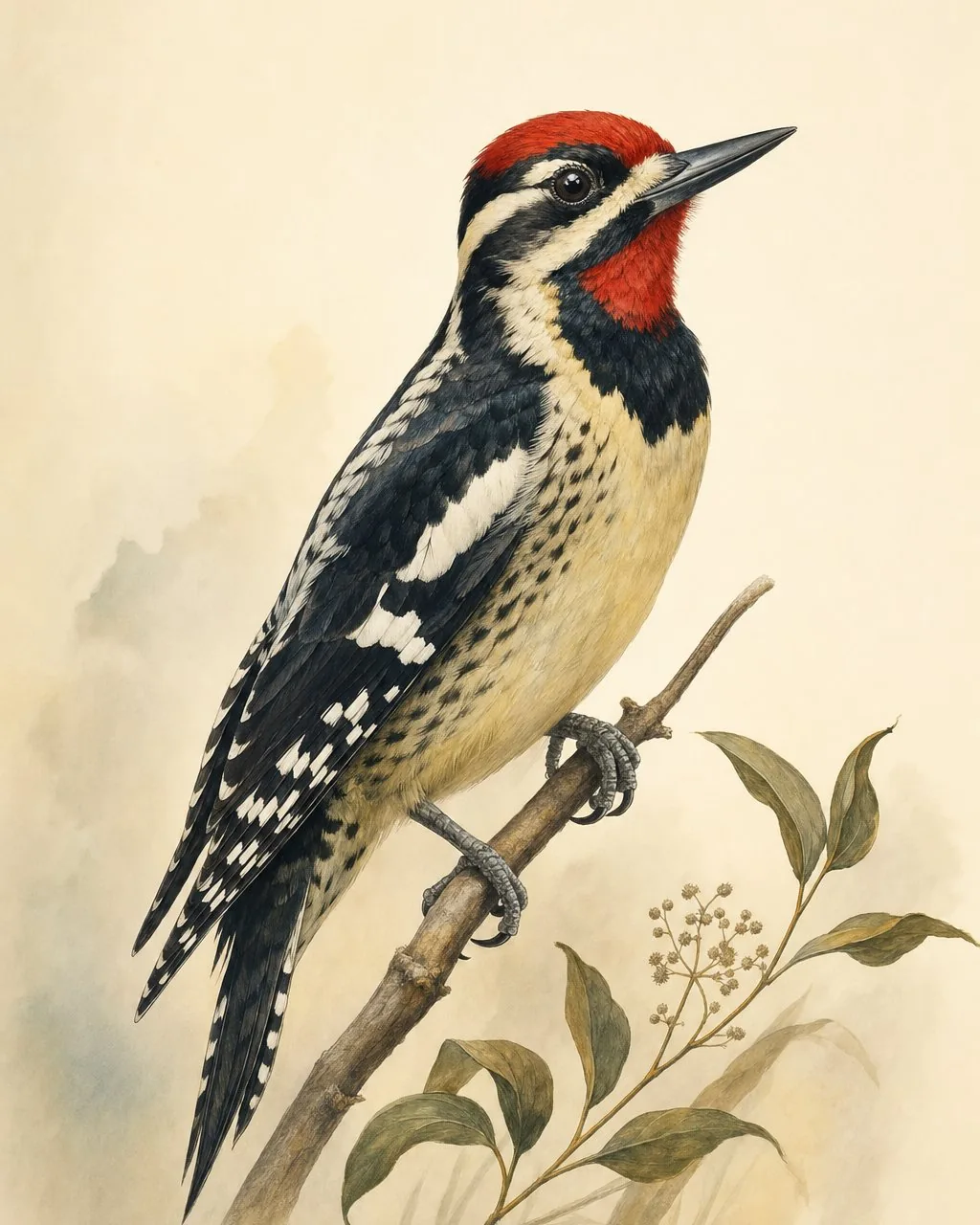
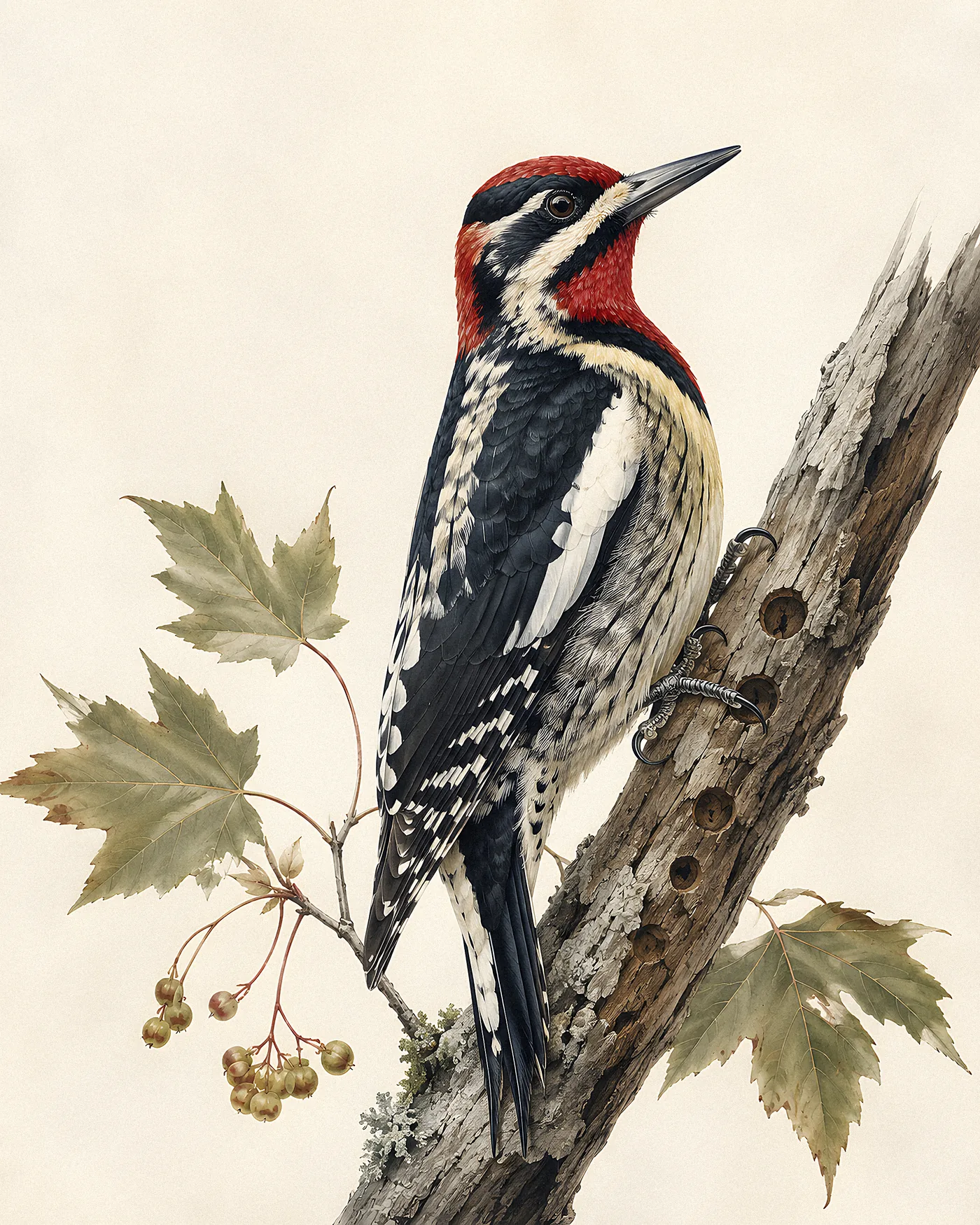
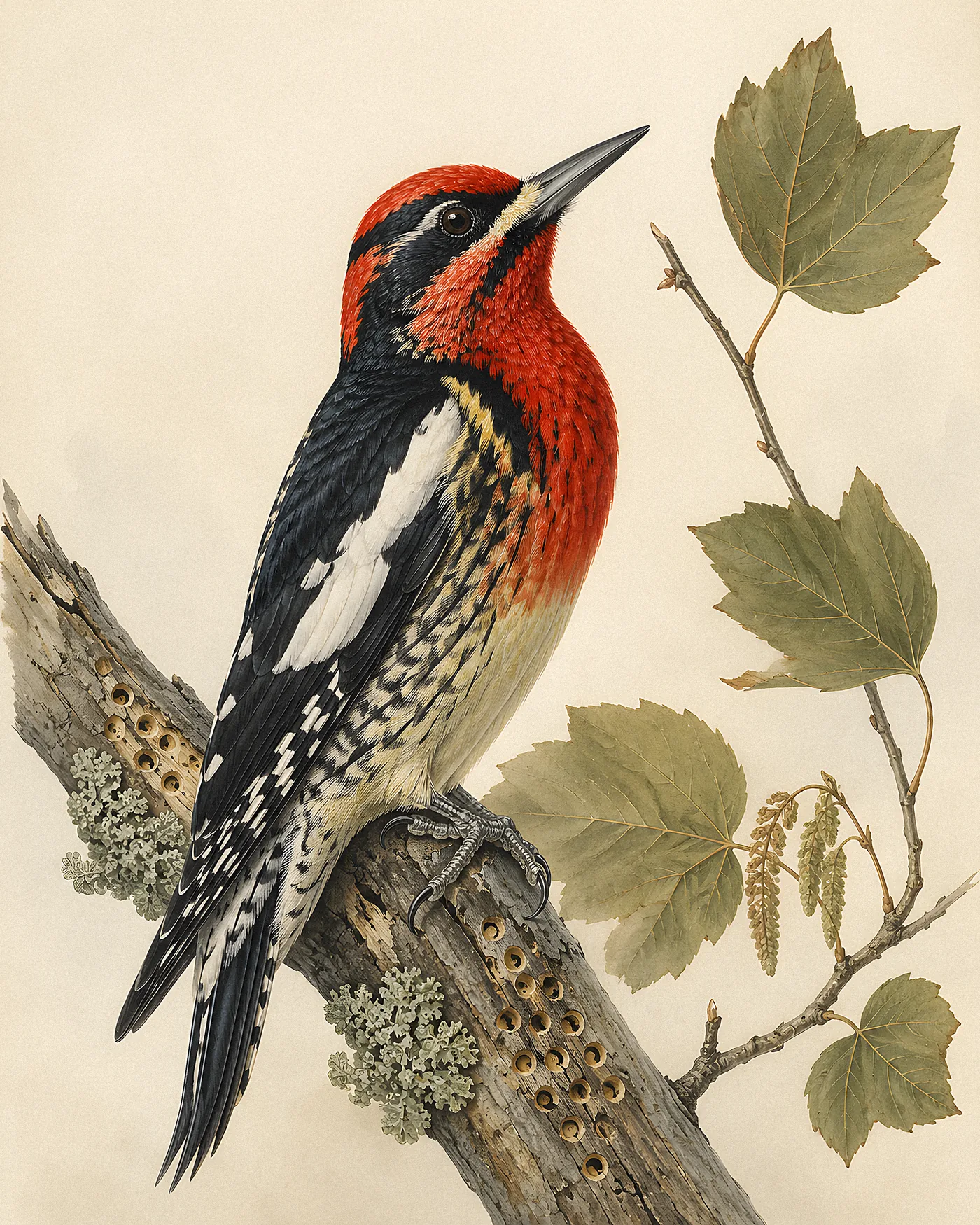
A coastal forest in the Pacific Northwest, fog still in the canopy, and a horizontal line of small square holes circles a hemlock trunk, each one beaded with sap. The bird that drilled them is higher up, working a fresh row, and when it leans out from the trunk the whole front of it is red - not a cap or a throat patch but the entire head and breast, a deep crimson hood that runs down onto the chest. Behind that hood the back is the familiar sapsucker mix of black and white. This is the most colourful of the four North American sapsuckers, and the most simply marked.
The Red-breasted Sapsucker does the same work its relatives do - it drills sap wells and tends them like a farmer - but it announces itself with a flood of red that no other sapsucker can match.
What it looks like
The defining feature is obvious. Cornell Lab describes the entire head, throat and upper breast as a deep, smoky red, far more extensive than the neat red cap and throat of the other sapsuckers. There is a small white spot in front of the eye, the back and wings are barred and patched black and white, a long white stripe shows on the folded wing, and the lower belly carries the pale yellowish wash all sapsuckers share. The result is a bird that looks, at a glance, as though it has dipped its whole front in red.
Crucially for the watcher, male and female look the same. Where the Yellow-bellied and Red-naped Sapsuckers can be sexed by their throat colour, the Red-breasted’s red hood covers exactly the area you would use to tell the sexes apart, so the two are effectively identical in the field. Cornell Lab puts the bird at 20 to 22 centimetres long and 39 to 68 grams, medium-sized for a woodpecker, with a wingspan in the region of 37 to 43 centimetres.
What it sounds like
Like the other sapsuckers, this is a comparatively noisy woodpecker. The common call is a nasal, cat-like wheer or mewing note, querulous and falling, often the first sign of the bird before it is seen. It also gives sharp, scratchy notes and a churring alarm around the nest.
The drumming is the family signature and a useful identification key. Rather than the steady, even roll of most woodpeckers, sapsuckers drum in a distinctive stuttering rhythm - a quick burst that slows into irregular, spaced taps, closer to Morse code than to a drumroll. Once learned in the forest, that broken cadence flags a sapsucker even when the bird is out of sight.
Range and habitat
Sphyrapicus ruber is the Pacific coastal sapsucker. Cornell Lab records it breeding from southeastern Alaska and coastal British Columbia south through the Coast Ranges and Cascades of Washington and Oregon into northern California, with a southern form continuing down the mountains of southwest Oregon and California. It favours wet coastal and montane forest - conifers, mixed woodland, and the deciduous trees of streamsides and forest edges - where sap runs well and soft, decaying wood is available for nesting.
In winter many birds drift to lower elevations and a little farther south, some reaching Baja California, and they turn up readily in orchards, gardens and riverside trees. Where the breeding range of the Red-breasted meets that of the Red-naped Sapsucker in the interior mountains, the two hybridise, a sign of how recently this group of look-alikes diverged. Cornell Lab and the IUCN both list the species as Least Concern.
Diet
The name is the method. Cornell Lab describes the sapsucker drilling two kinds of wells: neat rows of shallow holes that tap the sugary phloem just under the bark, tended through the day and lapped with a brush-tipped tongue, and deeper holes that reach the watery xylem. The bird maintains its well rows like a crop, returning again and again to the same trunk.
Insects are the other half of the diet, and the two halves connect. The oozing sap attracts ants and other small insects, and the sapsucker takes both - lapping sap and snapping up the insects drawn to it. Cornell Lab notes that when feeding nestlings the adults gather arthropods, especially ants, and sometimes dip them in the sap wells before delivering them, apparently for the added value. Berries and fruit round out the menu.
Breeding and nesting
The nest is a cavity the birds excavate themselves, usually in a dead or diseased trunk where the wood is soft enough to dig efficiently. Both sexes share the excavation. Because the red hood hides the usual cues, the division of labour is the same as in the other sapsuckers rather than anything the plumage reveals.
Cornell Lab records a clutch of five to six white eggs, sometimes four to seven, incubated by both parents for about 11 to 15 days, with the male taking the night shift. The young are fed by both adults and leave the nest at around 23 to 28 days. The parents then keep feeding the fledglings for roughly another ten days and, remarkably, teach them the sapsucking habit directly, leading them to the wells.
No other North American sapsucker wears red across the whole head and breast, and none hides the difference between male and female so completely.
What to watch for
Two things make this bird easy once you know them. The first is the red. Any sapsucker on the Pacific slope with its entire head and breast flooded crimson is this one - the Yellow-bellied and Red-naped both keep their red to a tidy cap and throat. The second is the well rows. Find a trunk ringed with tidy horizontal lines of square holes, sap beading at each, and you have found a sapsucker tree, whoever drilled it.
It is worth lingering at such a tree. The wells the Red-breasted Sapsucker maintains feed far more than the sapsucker itself: hummingbirds, warblers, kinglets and even small mammals come to drink at them, so a single bird quietly underwrites a corner of the whole forest. A crimson-headed sapsucker tending its rows on a foggy coastal conifer is a scene the tradition of Audubon would have rendered with relish.