Field Guide
Common Swift
The screaming starts in May and it is over by August. For roughly 14 weeks every summer, Apus apus - the Common Swift - fills the airspace above British towns with a sound that is, once learned, impossible to mistake: a shrill, carrying shriek that arrives from no visible direction and vanishes just as abruptly. Then, without ceremony, the swifts are gone. They will not touch anything solid again until the following spring.
This is the bird’s central, organising fact. The Common Swift lives almost entirely in the air. It forages in the air. It bathes in the air by flying through rain. It collects nesting material from the air - feathers and scraps carried up on thermals. It mates in the air. It sleeps in the air, ascending at dusk to heights of one to three kilometres and entering a state of half-sleep with one hemisphere of the brain at a time, drifting on the wind, coasting through the dark. The RSPB notes that a swift may fly approximately two million miles over the course of its lifetime. The word ‘approximately’ is doing modest work in that sentence.
What it looks like
At 16 to 17 centimetres long and 35 to 56 grams - about the weight of a letter - the swift is not a large bird. Its wingspan runs from 42 to 48 centimetres. In the hand, if you were ever to hold one (injured birds occasionally ground themselves), it looks like a compressed cigar of black-brown feathers, soft and dense, with a white chin patch and a shallow forked tail. The feet are tiny: all four toes point forward, an arrangement suited for clinging to vertical surfaces but useless on flat ground. A swift set down on a lawn cannot take off again unaided. It has to be tossed gently into the air.
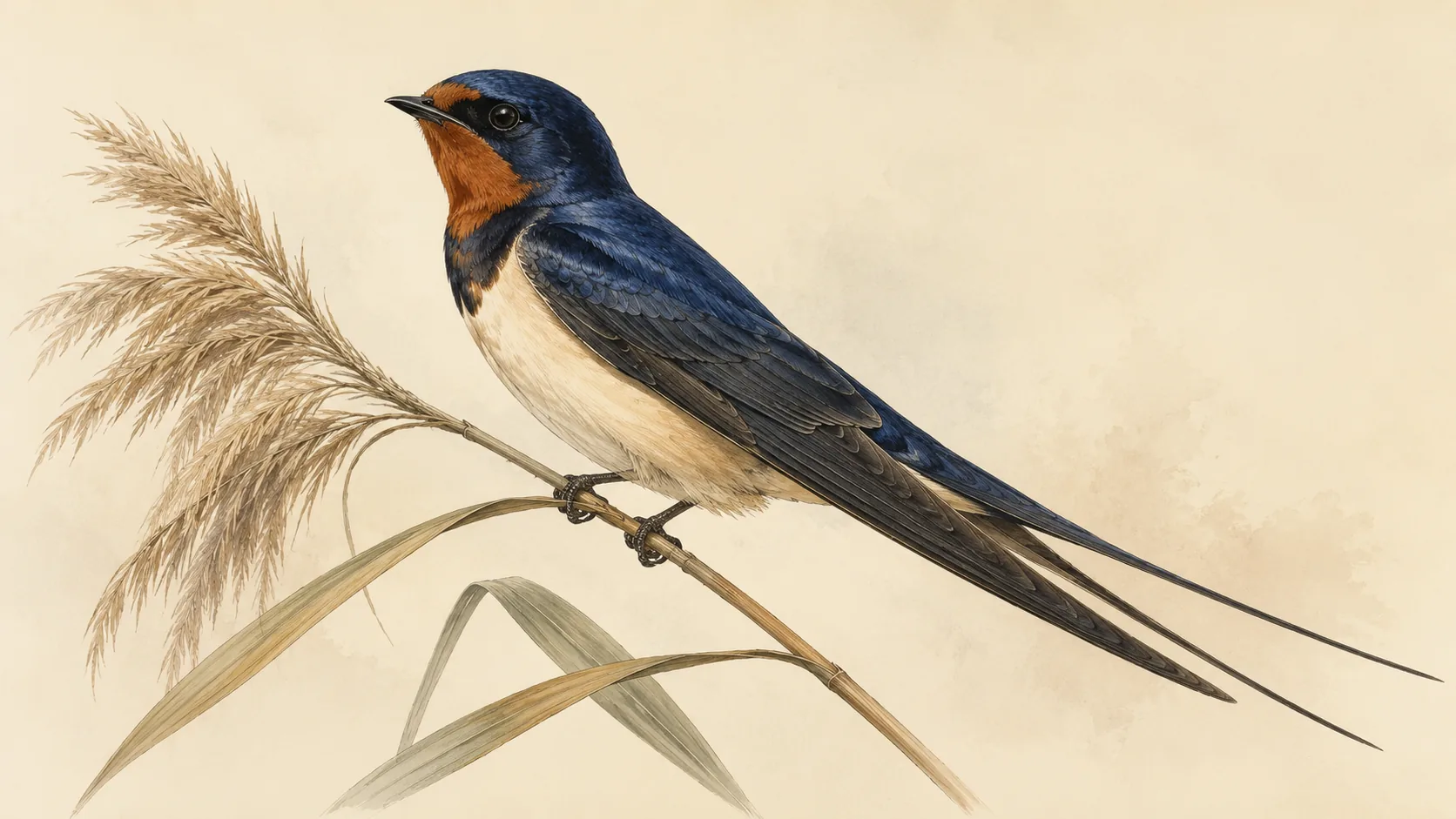
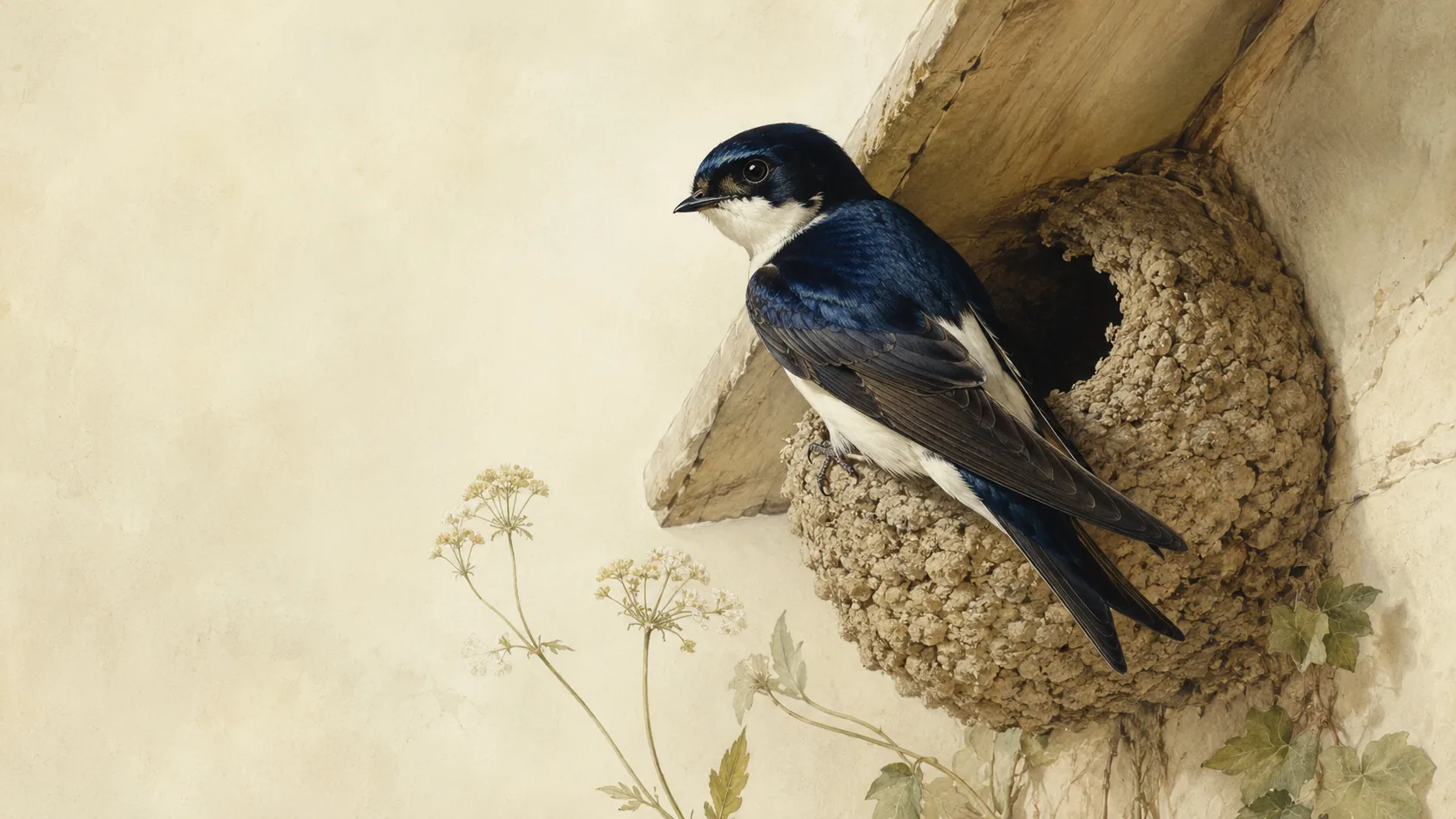
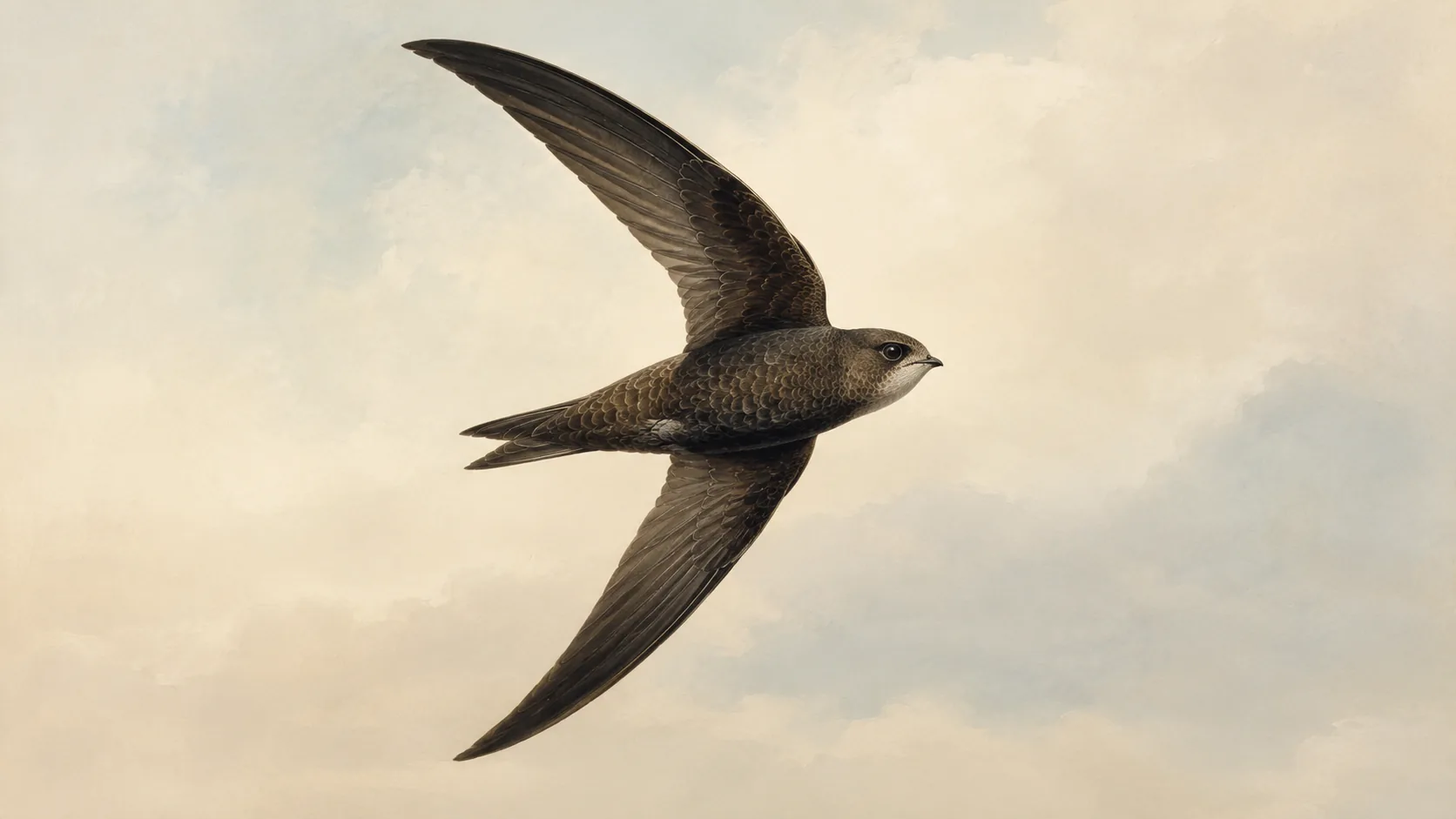
In the air it is a different animal entirely. The silhouette is unmistakable: narrow sickle-shaped wings swept back at the wrist, a bullet-shaped head, a tail closed to a point in level flight or spread slightly when manoeuvring. Against an overcast sky it appears entirely black. In direct sun, the brown tones show and the white throat flashes briefly as the bird banks. No other British bird holds quite this shape. Swallows and house martins - both present in similar airspace and often confused with swifts by new observers - have broader wings, pale undersides, and a more looping, undulating flight. The swift drives forward. It does not dip and rise. At top speed in level flight it has been recorded at 69 miles per hour, which makes it among the fastest birds in the world on a horizontal trajectory.
Voice
The call is the scream. A high, piercing shriek produced by groups of birds chasing each other at rooftop height - what swift-watchers call ‘screaming parties’ - these chases concentrate around colony buildings on warm summer evenings. The birds are not alarmed. They are socialising, and probably reading the nesting sites. The sound carries several hundred metres, rising and falling as the group sweeps in and out of earshot. It announces itself before the birds are visible and persists after they have banked away around a roofline.
Range and the year’s shape
The Common Swift breeds across a range that runs from western Europe and northwest Africa east to Lake Baikal and northern China. Cornell’s Birds of the World documents its breeding presence from Scandinavia south to the Mediterranean, with its wintering grounds in Central and southern Africa. In the UK it breeds across most of the country, most numerously in the south and east.
The annual calendar is compressed. Swifts arrive in the UK from late April through May. By early August, adults that have fledged their young begin departing. By late August, the sky that had held thousands of birds is quiet. The total British residency - from first arrival to last departure - spans roughly 14 weeks. The rest of the year is spent over Africa, where the birds continue to forage aerially, never once sleeping on solid ground.
Migration distances are considerable. The annual round trip from breeding grounds in England to wintering areas in sub-Saharan Africa runs to approximately 22,000 kilometres, according to the RSPB.
Diet
The swift eats nothing but what it can catch in open air: flying insects and airborne spiders riding on silk threads. It sweeps its wide gape through swarms of aphids, mayflies, small beetles, and flies. During the breeding season, a parent bird compresses collected insects into a bolus held in a throat pouch - research referenced by the Animal Diversity Web records approximately 300 insects per bolus - and returns to the nest to deliver it. In cold, wet weather, flying insects disappear. Adults can travel far afield in search of clear skies and insect activity. Their chicks, left behind, cope by entering a semi-torpid state, slowing their metabolism and surviving on reserves for periods of up to 10 to 15 days without food.
Breeding and nesting
Swifts pair for life, and pairs return to the same nesting crevice year after year. The nest itself is minimal: a shallow cup of whatever material the bird can collect in flight - feathers, scraps of vegetation, the odd seed head - bound together with saliva. Nest sites are inside buildings: under roof tiles, in the soffits of older houses, in church towers, in gaps in masonry. The entrance is a hole barely wider than the bird’s body.
Clutch size runs from one to four eggs, typically two or three. Incubation lasts 19 to 20 days, with both parents sharing the duty. Fledging takes between 27 and 45 days - a wide range that reflects how food availability shapes development speed. Young birds reach sexual maturity at two years old. Cornell’s Birds of the World records the oldest known individual as a bird ringed as a chick and recovered alive 21 years later.
The adaptation no one expects
Swift chicks do not merely tolerate starvation. They exploit it. When food fails and the adults are absent, a chick’s body temperature drops, its heart rate slows, and growth effectively pauses. Days pass. The chick waits. When the adults return with food, growth resumes at pace. This is not distress: it is a finely calibrated response to the unpredictability of aerial insect supply, built into the species over millions of years of evolution in places where weather and insect emergence are not reliably synchronised.
The adults carry a corresponding resilience. Birds of the World documents a juvenile swift weighing 57 grams that survived three weeks without food. This capacity for managed suspension - neither full activity nor full torpor - sits outside what most birds can manage, and it is one of the traits that makes the swift such a successful aerial specialist.
Conservation
The IUCN lists the Common Swift as Least Concern globally, with an estimated population of 95 million to 165 million mature individuals. The UK picture is considerably darker. The RSPB reports a decline of 66 per cent between 1995 and 2022 - from an index of 10 birds in 1995 to roughly three by 2022. The species was added to the UK Red List of Birds of Conservation Concern in 2021.
The causes are debated and likely multiple. Modern building methods seal the roof-edge gaps that swifts require. Renovation of older housing stock destroys established colony sites. Insect populations across agricultural Europe have declined substantially, which reduces prey availability for birds that depend entirely on aerial insects. The BTO has been running monitoring and nest-site recording programmes in response; the RSPB’s Swift Mapper citizen-science project reached 100,000 records as of 2024, building the colony map that conservation planning requires.
Swift bricks - hollow nest boxes designed to be mortared into new construction at eaves level - represent the most practical near-term response. They are inexpensive, permanent, and require no maintenance. The birds that locate a swift brick tend to return to it for decades.
The common swift spends every night of its non-breeding year asleep in the sky. The scale of that adaptation should stop you for a moment.
The swift does not inhabit our buildings the way a house sparrow does, or our gardens the way a robin does. It inhabits our air, briefly, on its way between two continents. The fact that it chooses to breed in our rooftops is a coincidence of architecture - our buildings happened to replicate the cliff faces and hollow trees the species used before towns existed. We have been removing that coincidence, building by building, renovation by renovation, for fifty years. What is being lost is not a tenant. It is a tenant that sleeps in flight, feeds in flight, and mates in flight, and that has been doing so over these islands since before recorded history.