Field Guide
Mississippi Sandhill Crane
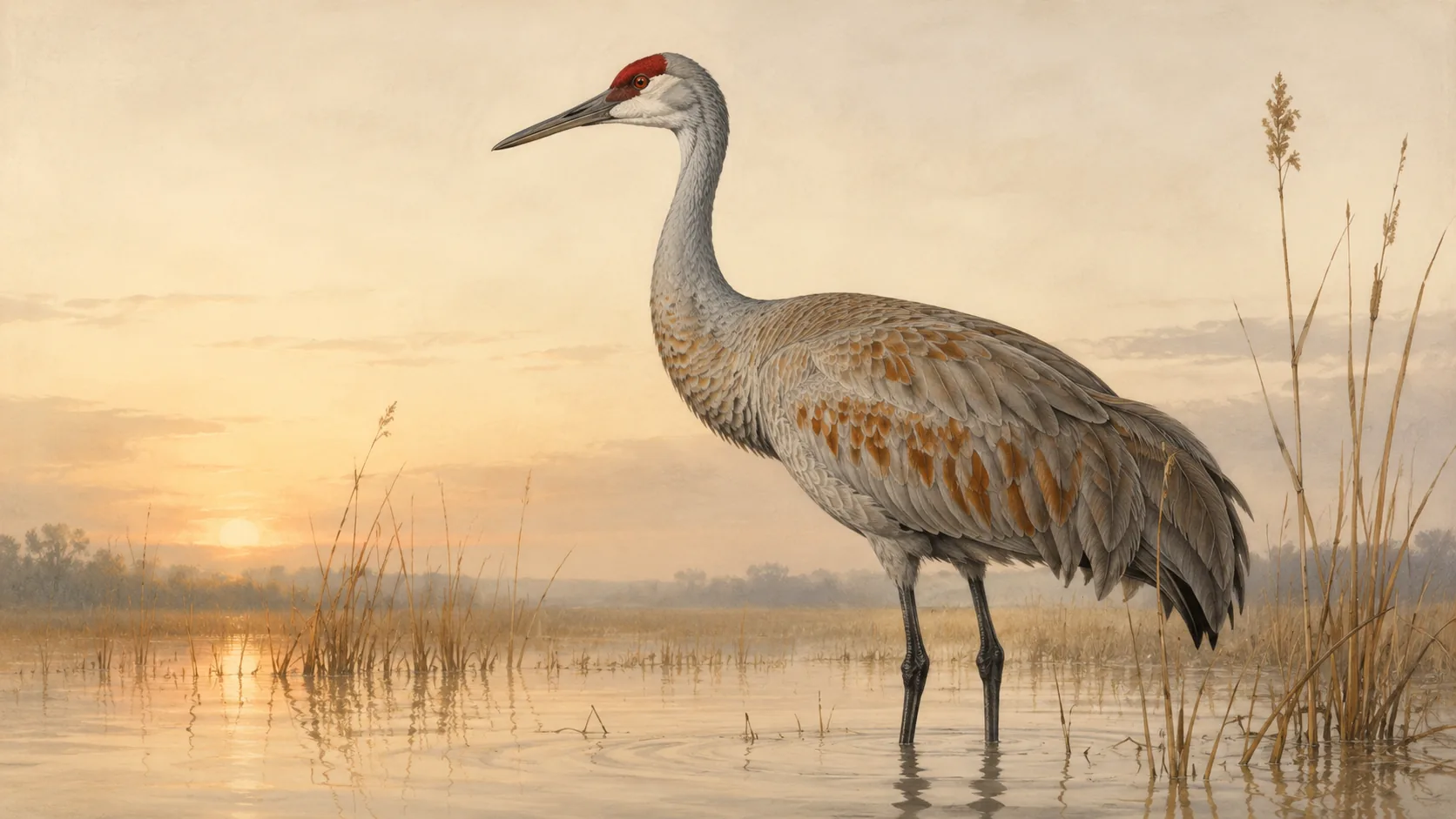
Stand in the burned section of a wet pine savanna in Jackson County, Mississippi, in early spring. The longleaf pines are black-trunked. The wiregrass is scorched to the waterlogged clay. Out of the grey, two large birds move across the open ground in long, measured strides, probing the exposed earth with straight, heavy bills.
These are Antigone canadensis pulla - the Mississippi Sandhill Crane. They are not passing through. They live here, and only here, and they have never lived anywhere else within documented memory. There is no migration. There is no second population. This one piece of coastal Mississippi is the entire world of this subspecies.
The argument this page will make is not a comfortable one: the Mississippi Sandhill Crane is alive today because of an unbroken chain of human decisions that began fifty years ago and cannot stop. It has no margin for error, and it knows nothing about that.
What it looks like
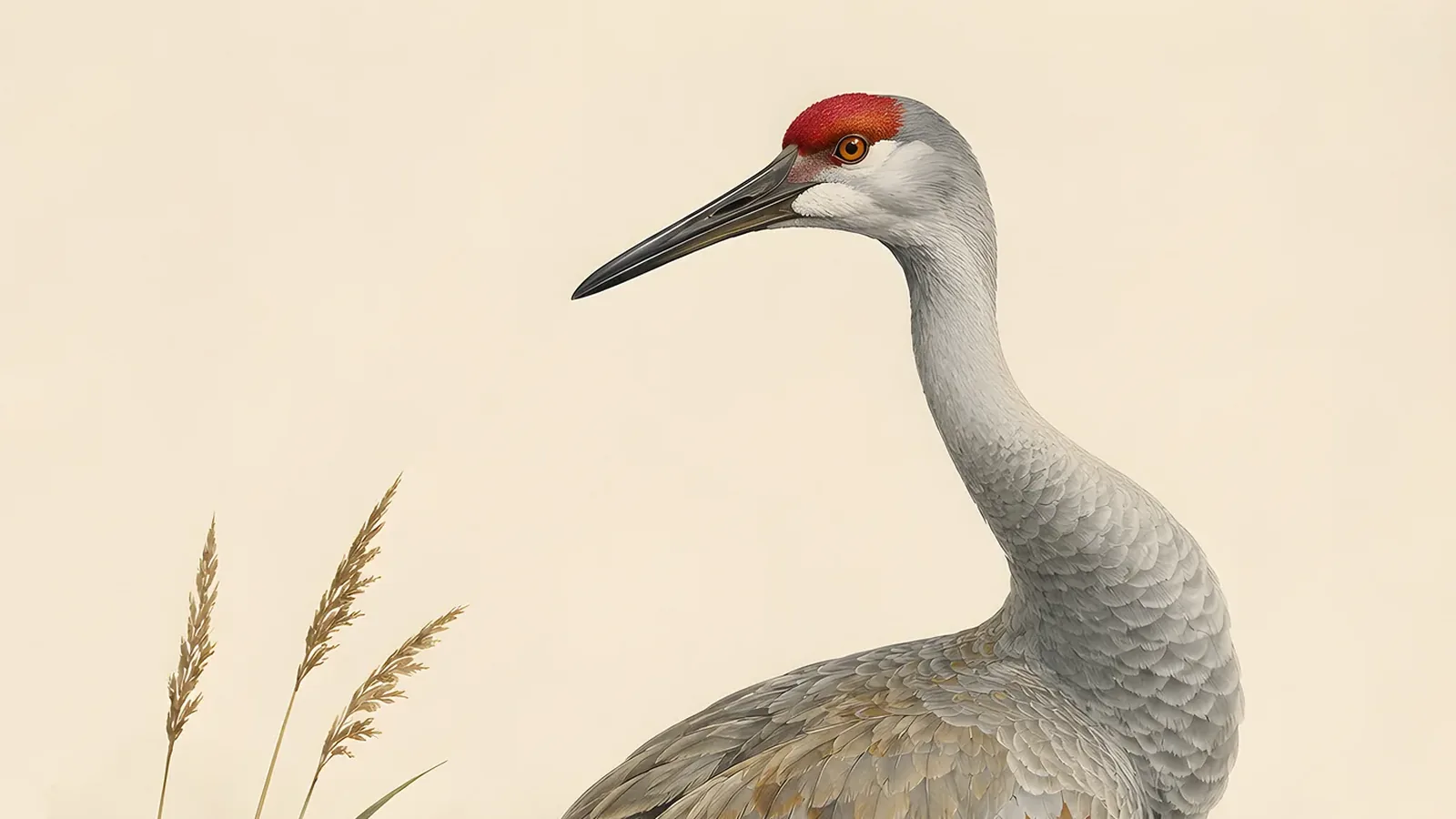
A. c. pulla is a large wading bird, 100 to 120 centimetres in body length, with a wingspan of 185 to 200 centimetres and a weight of roughly 3.2 to five kilograms. It stands approximately one metre at the shoulder. The posture is crane-typical: neck long and upright, legs long and dark, bill heavy and straight.
What separates it from most sandhill crane images you have seen is the colour. Gee and Hereford, writing in their 1995 USGS monograph on the subspecies, describe pulla as “consistently much darker” than other southern sandhill populations. Where the migratory Greater Sandhill Crane reads as pale grey in field conditions, the Mississippi bird is a deep, cold slate - darker in the body, darker on the neck. The bare red crown patch and white cheek are present as in all sandhill cranes, but the surrounding plumage makes them read more conspicuously against the dark grey frame.
| Measurement | Range |
|---|---|
| Body length | 100 - 120 cm |
| Wingspan | 185 - 200 cm |
| Weight | 3.2 - 5.0 kg |
| Lifespan (wild) | up to 36 years |
The rusty brown staining that commonly appears on sandhill crane body feathers - an iron oxide wash from preening behaviour - is also found on pulla, though observers in the field note the dark base plumage makes it harder to read. Juveniles hatch cinnamon-buff and progressively grey over their first year. The red crown develops in the second year.
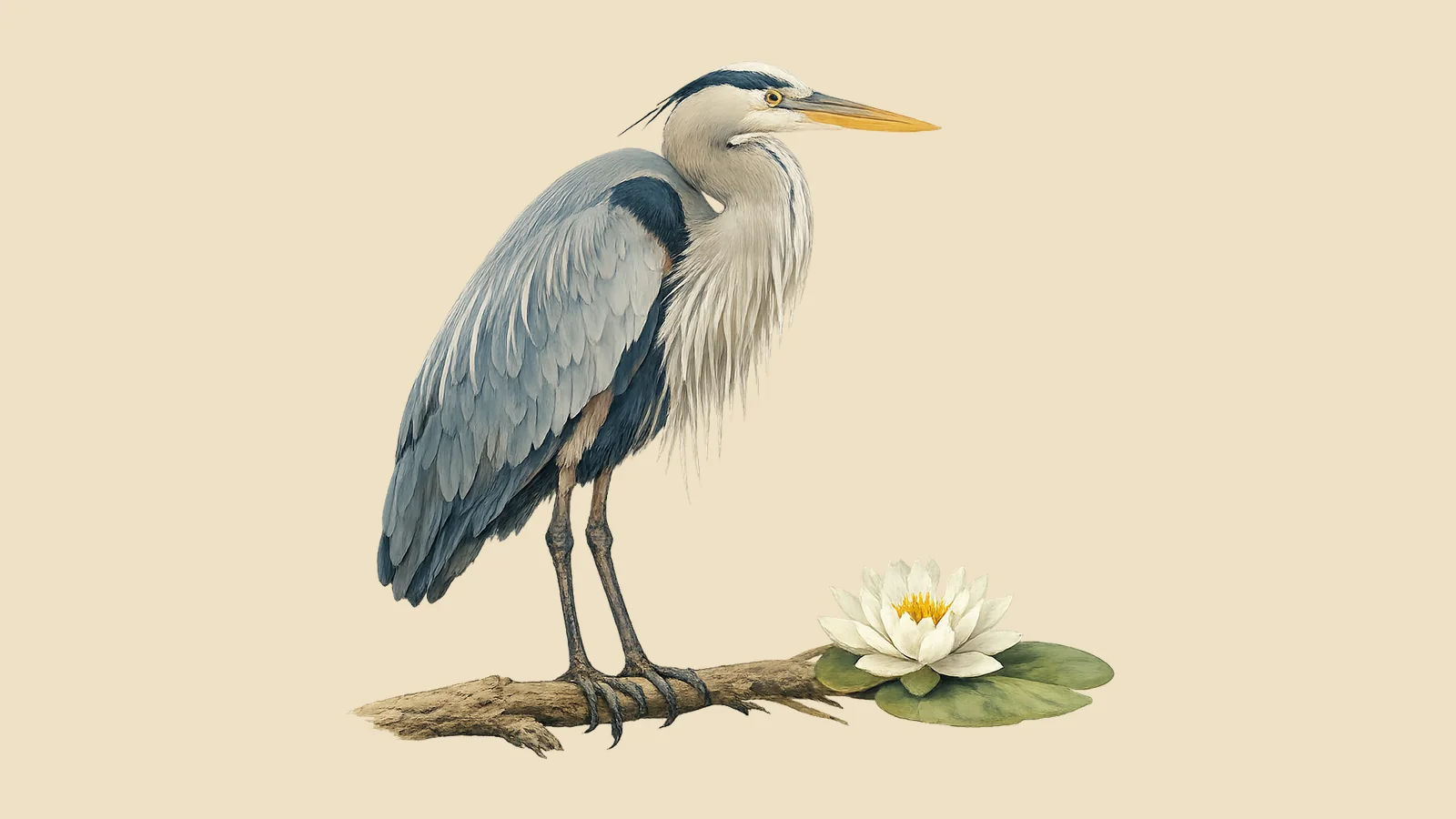
In flight, the bird is unmistakable if you know to look for it: neck extended forward, legs trailing behind, the long wings beating with a slow mechanical authority. A great blue heron folds its neck into an S in flight. Cranes do not.
One county in Mississippi
The historical range of the Mississippi Sandhill Crane was never large. Before European settlement, the subspecies occupied wet pine savannas along the Gulf Coastal Plain of southeastern Mississippi, from east of the Pascagoula River to the Jackson County line, with northern limits roughly 15 kilometres north of the town of VanCleave. The Center for Biological Diversity records isolated populations in adjacent Louisiana and Alabama, but these were extirpated - Louisiana lost its cranes by the 1910s, Alabama by the 1960s.
What sustained the crane in Jackson County was a specific and unusual ecosystem: the wet pine savanna, dominated by longleaf pine (Pinus palustris) over a grass layer of wiregrass and other low vegetation, all rooted in poorly drained, waterlogged clay soil. Scattered tupelo-cypress swamps interspersed the grassland. This landscape held water in winter, dried partially in summer, and was maintained in its open structure by frequent fire - before European settlement, by lightning and by controlled burning by Indigenous peoples.
Mississippi Sandhill Cranes require, by the account of every management study conducted at the refuge, three distinct habitat types used in rotation through the year: open wet savanna for feeding and nesting, wooded wetlands and swamp edges for shelter and secondary foraging, and open clear ground where birds can watch for predators. The savanna is not optional. It is the foundation.
The 30-bird low point
By the mid-20th century, the savanna was disappearing. Timber companies acquired the tracts after World War II and converted them to slash pine plantations, a transformation that required ditching and draining the waterlogged clay. Fire suppression was built into plantation management - fire was an enemy of timber production. By the early 1970s, what had been more than 40,000 hectares of suitable savanna on the Gulf Coastal Plain had contracted to roughly 10,500 hectares. Housing development, highway construction, and industrial expansion absorbed the rest.
The crane population fell with the habitat. By 1973, when the U.S. Fish and Wildlife Service listed the subspecies under the newly enacted Endangered Species Act, approximately 30 to 35 birds remained alive. Gee and Hereford (1995, USGS Patuxent Wildlife Research Center) note a low-point estimate in the 1970s consistent with fewer than three dozen wild individuals - a number that falls below any reasonable threshold of self-sustaining population dynamics.
The Endangered Species Act of 1973 was new legislation, untested. Its first major application was here. The Mississippi Sandhill Crane National Wildlife Refuge was established on 25 November 1975 - the first national wildlife refuge in the United States established under the authority of the Endangered Species Act as its founding legislation. The initial land purchase of 1,749 acres from The Nature Conservancy came on that date. Refuge acreage has since grown to nearly 20,000 acres.
A federal lawsuit made the refuge larger. In 1976, the National Wildlife Federation sued the Department of Transportation, arguing that Interstate Highway 10 bisected crane habitat in violation of Section 7 of the Endangered Species Act. The Circuit Court reversed a lower-court dismissal and ruled in favour of the crane. The settlement generated funding that expanded refuge holdings. It was the first major successful ESA Section 7 litigation on behalf of a single subspecies.
Captive breeding had begun even earlier. The U.S. Fish and Wildlife Service started a captive flock at Patuxent Wildlife Research Center in Maryland in 1965, before the ESA existed. Gee and Hereford (1995) document the development of hand-rearing techniques that used visual isolation from human handlers - technicians wearing sheets to conceal their human form - to prevent the cranes from imprinting on people. From 1981 onward, the Patuxent program released captive-raised birds into the wild flock. The Audubon Nature Institute’s Species Survival Center in New Orleans and White Oak Conservation in Florida later joined the captive network. White Oak, which entered the program in 1994, has since released 68 Mississippi Sandhill Cranes into the refuge.
Fire and the savanna
The crane’s survival is built on fire as much as on captive breeding. Without regular prescribed burns, the wet pine savanna converts to closed forest within years - shrubs colonise the wiregrass openings, hardwoods follow, and the open structure the crane requires disappears into canopy.
Billodeaux, Hereford, and Gray, writing in the Proceedings of the Eleventh North American Crane Workshop (2010), documented how the refuge balances two competing demands: growing-season burns, conducted in late spring and early summer, are the most effective tool for suppressing encroaching woody vegetation and restoring open savanna structure. But growing-season burns also coincide with the nesting period. Managers evaluate distance to active nests, disturbance thresholds, and smoke drift before each burn unit is lit. The study found that nesting cranes tolerate burns conducted with appropriate precautions, and that collaboration between refuge wildlife biologists and fire management officers allows growing-season burning to continue without unacceptable nest failure.
Between 2020 and 2023, refuge managers treated 8,885 hectares with prescribed burns - roughly 44 percent of the refuge’s total area over four years. Additional mechanical removal of woody vegetation supplemented fire where burning was constrained by proximity to development. The refuge sits in Jackson County, which has grown substantially in population since 1975. Smoke from burns now drifts over suburbs. That constraint is real and is not getting smaller.
What it sounds like
The call is the standard sandhill crane repertoire - a loud, rolling bugle, karrrr-oo, resonant and carrying. The trachea of adult sandhill cranes is partially coiled within the breastbone, which adds resonating length and produces the distinctive rattling quality that separates crane calls from heron or egret vocalisations. The Mississippi bird uses the same call structure as the species at large.
Mated pairs perform a unison call, coordinated between partners, functioning as territory proclamation and pair-bond reinforcement simultaneously. Young birds give softer, higher calls. Adults calling from nesting or foraging habitat are audible across the open savanna at considerable distance - one of the practical benefits of a flat, open landscape for a bird whose survival depends on pair cohesion across large home ranges.
Breeding and the long recovery
Mississippi Sandhill Cranes are permanently monogamous. A pair that forms will remain paired for life, returning to the same general nesting territory each year. Sexual maturity arrives between three and four years of age - earlier, Gee and Hereford (1995) note, than in Florida sandhill cranes, a distinction likely reflecting the specific selective pressures on this small and isolated population.
Nesting begins in late winter. The nest is a low mound of plant material built from vegetation at hand - wiregrass, sedge, marsh plants - anchored near the edge of a swamp or in open savanna, near water but not in it. The clutch is typically two eggs. Incubation lasts approximately 30 days, shared by both parents. Only one chick generally survives - sibling competition in crane nests is fierce, and the smaller egg is rarely as viable. Chicks walk within hours of hatching. Fledging occurs at around 65 to 75 days.
The wild flock counted 174 birds in December 2023, up 26 percent from the 2019 count of 138 - the most recent comprehensive survey data available from the North American Crane Working Group. From 2020 through 2023, biologists detected an average of 64 nests per year. An average of 9.2 chicks fledged annually across those four years, ranging from five to 13. The minimum needed to maintain population balance is closer to 10 to 15. The flock is growing, but it is not growing with any margin to spare.
The primary mortality driver remains predation. Coyotes, bobcats, raccoons, raptors, and feral dogs all take chicks and adults. Over 90 percent of current breeding adults are descended from captive-raised birds. The wild flock, in the biological sense, is a managed population - held in a particular piece of Mississippi by habitat work and annual releases, counted individually, and assessed each year against a survival threshold that has not yet been comfortably cleared.
“The refuge is the first national wildlife refuge in the country for which the Endangered Species Act was used as its establishing legislation.” - U.S. Fish and Wildlife Service, Mississippi Sandhill Crane National Wildlife Refuge
The sandhill crane as a species is one of the conservation success stories on the continent - roughly 10 million birds across North America, flocking by the hundreds of thousands on the Platte River each spring. The Mississippi Sandhill Crane is a related bird living a completely different existence: sedentary, isolated, genetically constrained, and entirely dependent on the continuation of decisions made by people who mostly will never see it.
What the Mississippi Sandhill Crane ultimately represents is a question about the minimum. How small can a population get and still come back? What combination of habitat management, captive release, fire, and time can hold the line against extinction for a bird that has already lost its range, its genetic diversity, and its natural population structure? The answer at 174 birds in 2023 is: possibly. The burned pine savanna is there. The cranes are in it. The fire keeps it open. Whether that is enough is a calculation that runs without pause every breeding season, in Jackson County, where there is no second location to fall back on.