Field Guide
Rook
In February, before any deciduous tree in England has opened a bud, the elms and beeches above a rookery are already full of noise. The birds have been back for weeks. Sticks are being assessed, stolen, defended. A pair that mated last year are reinforcing a cup of twigs that has occupied the same fork since before anyone living in the farmhouse below was born. Corvus frugilegus, the Rook, is the most conspicuously social corvid in Europe, and the February rookery - chaotic, loud, already purposeful - is as good a place as any to begin understanding what that means.
The Rook is not the most famous crow in Britain. That status belongs to the Carrion Crow, solitary and calculating, or to the Raven of Tower mythology. But a case can be made that the Rook is the more interesting bird: the one that solved a Cambridge laboratory’s tool-use problems on the first trial; the one whose nesting colonies have occupied the same trees for a century or more; the one that has shaped the look of the British countryside as surely as the hedgerow.
What it looks like
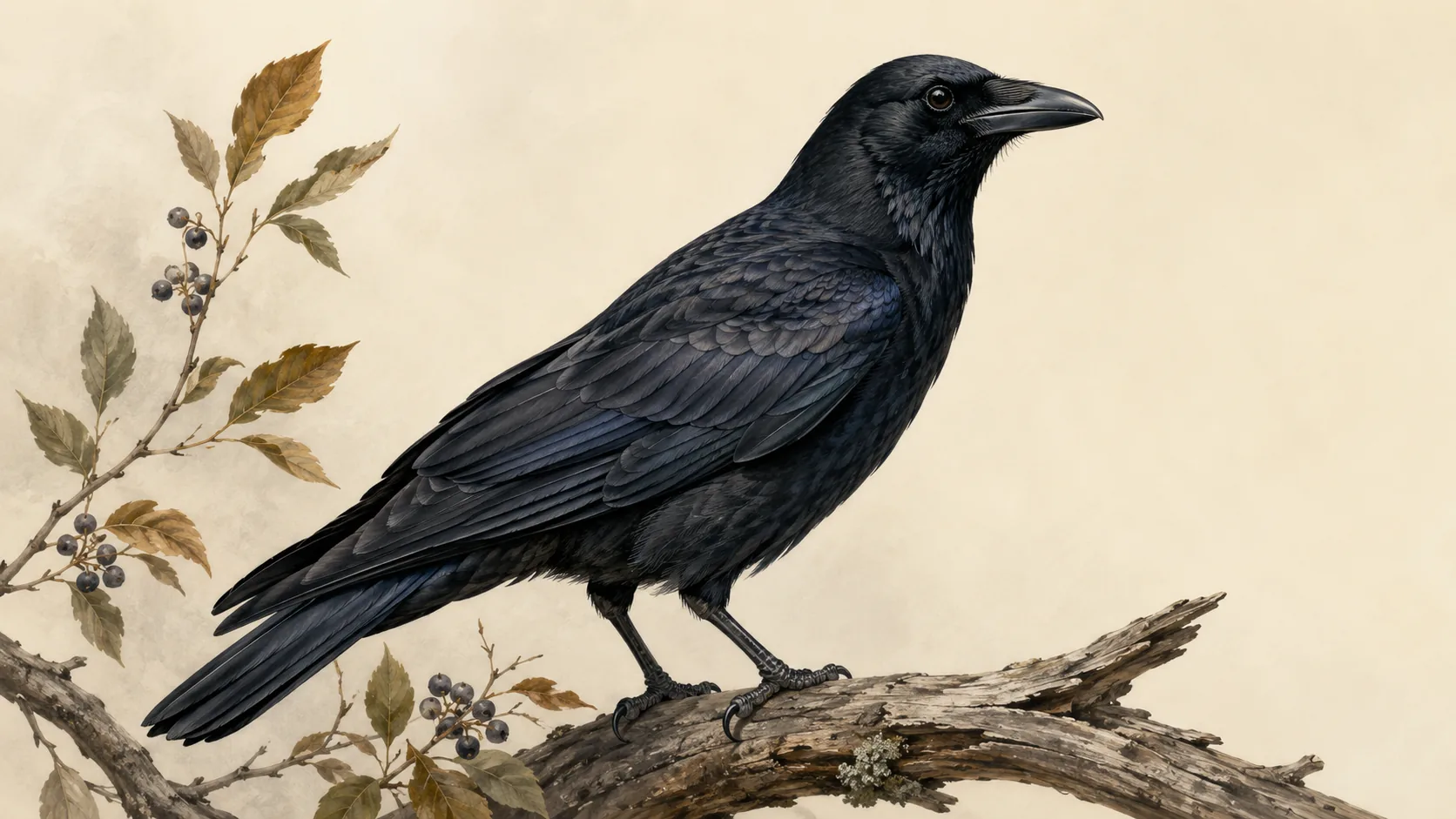
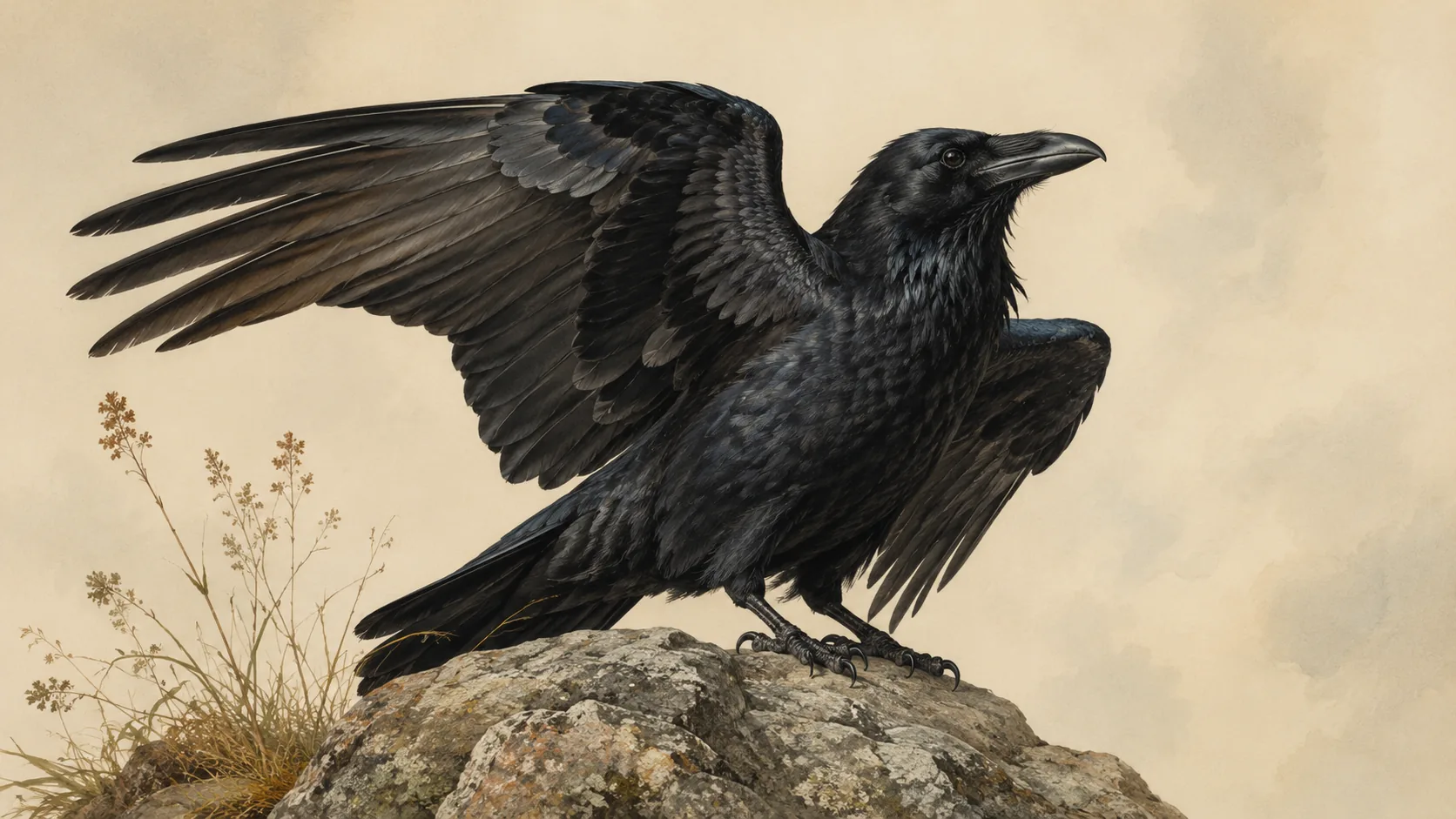
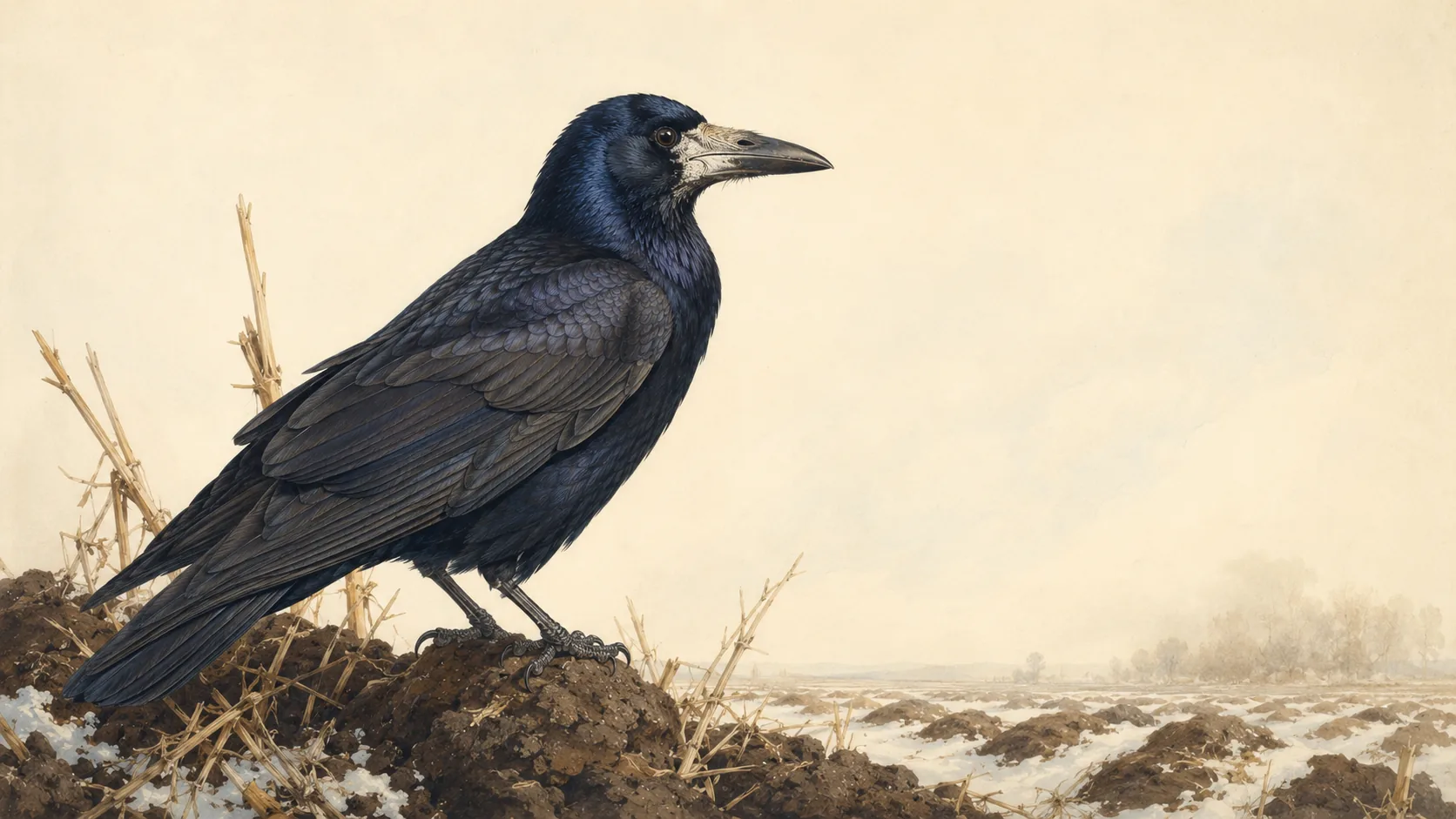
At 41 to 49 centimetres and 370 to 530 grams, the Rook is smaller than a Carrion Crow and larger than a Jackdaw. The plumage is black throughout, but in direct sun it carries a strong purple-blue iridescence that shifts with the angle of light - a sheen that distinguishes it from the flatter black of a crow at close range.
The field mark that settles most identifications is the bare skin. Adult Rooks have a patch of grey-white, featherless skin at the base of the bill, extending around the nostrils and across the lores. This bare patch is absent in Carrion Crows, absent in Ravens, and absent in young Rooks - which is why first-winter birds are consistently misidentified. Juveniles have fully feathered faces and are best separated from crows by bill shape: the Rook’s bill is long, pointed, and slightly down-curved, built for deep probing rather than for pulling at carcasses.
The legs carry a loose ruff of feathers that gives the bird a distinctly ragged, baggy look at the thigh - what field guides have called ‘pantaloons’. In flight, the tail reads as wedge-shaped where a crow’s is square, and the wings are narrower at the base.
Voice
The Rook’s call is a harsh, flat ‘kaah’ - lower and more nasal than the Carrion Crow’s ‘caw’, lacking the Raven’s resonant depth. Within a rookery the soundscape is a continuous overlapping clamour of calls, counter-calls, and rattling social exchanges. The BTO notes that within-colony communication involves a range of softer gurgles and rattles alongside the louder alarm notes. There is no single call that uniquely identifies the Rook, but the collective noise of a colony in full argument - arriving and departing birds, pairs disputing over a stick - is one of the more recognisable sounds in the British countryside.
Range and habitat
The Rook breeds widely across the UK and across a Palearctic range that runs from western Europe and Scandinavia through Russia to eastern Siberia. The IUCN lists it as Least Concern globally, with a total population estimated in the tens of millions. Within Britain, the BTO Atlas records breeding in approximately 77 per cent of 10-km squares, with a slight skew toward lowland farming country in England, Scotland, and Ireland.
The habitat preference is open farmland with mature hedgerow trees or woodlands for nesting. Rooks are largely absent from upland moorland, dense forest, and the centres of large cities. They need two things together: bare or short-grazed earth where the bill can probe for invertebrates, and tall trees within commuting distance for the colony. This is almost exactly the landscape of traditional mixed-farm Britain, which is why the species has tracked that landscape’s fortunes closely. The BTO records a 25 per cent decline in UK breeding numbers between 1995 and 2023 - a drop attributed primarily to changes in arable farming, including reduced winter stubble, and the use of seed dressings that reduce invertebrate prey.
In winter, some northern European populations drift south and west. British birds are largely resident but often form large communal roosts outside the breeding season, sometimes in the tens of thousands.
Diet
The Rook is an invertebrate specialist by inclination and an opportunist by necessity. In spring and summer, earthworms and soil-dwelling beetle larvae form the bulk of the diet, extracted by probing damp earth with that long, pointed bill. The Woodland Trust notes that rooks also take grain, fruit, acorns, and occasionally carrion or the eggs of ground-nesting birds - not because they are aggressive hunters, but because a corvid’s foraging calculus is pragmatic rather than principled.
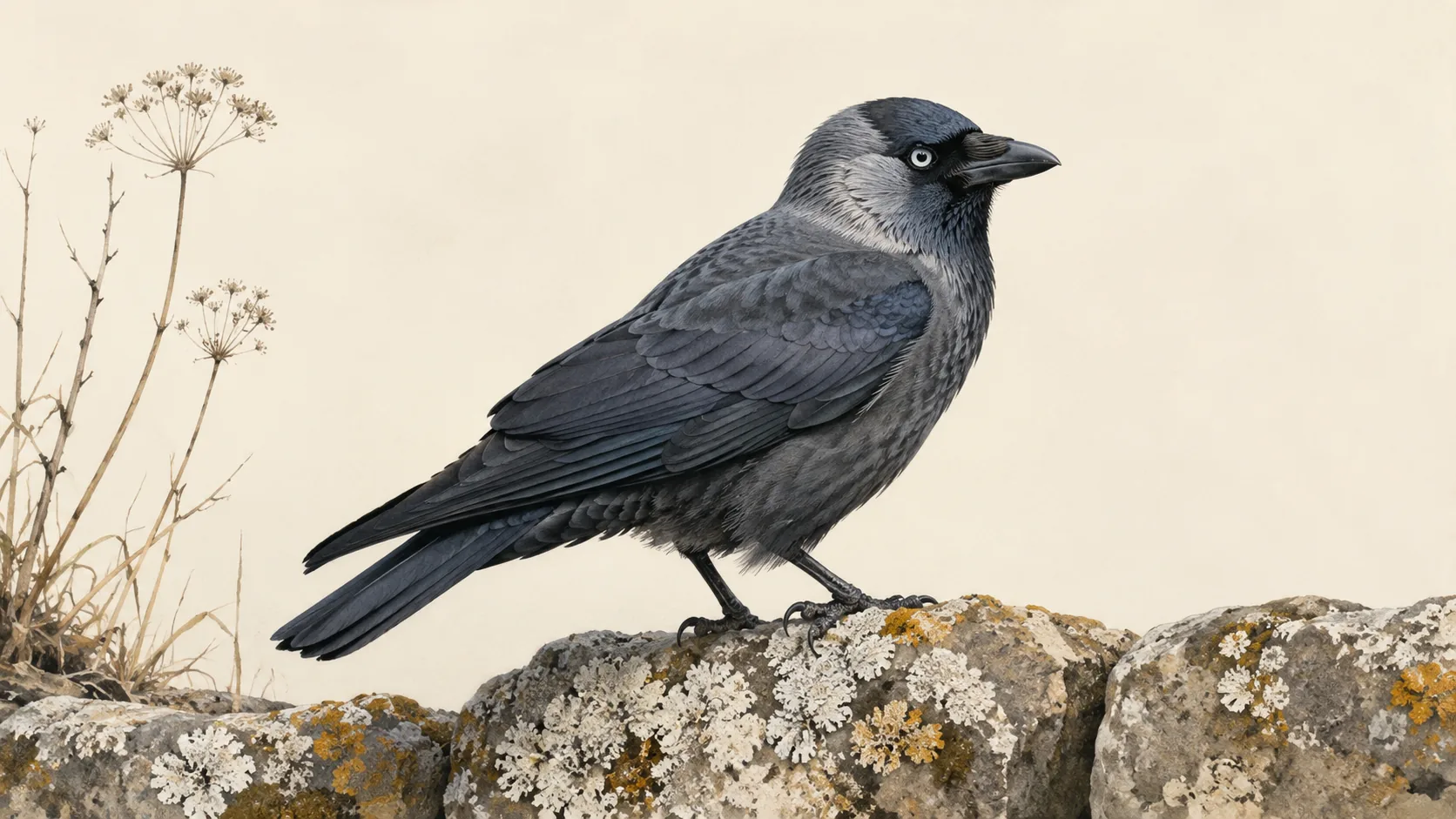
Feeding is done in flocks, often mixed with Jackdaws. The two species are nearly constant companions in lowland farm settings, and the social information that passes through a mixed feeding group - where one bird looks, whether another flushes, how quickly the flock settles back after a disturbance - is itself a resource.
Breeding and nesting
The rookery is the structural fact of the Rook’s year. Pairs begin returning to colony sites in January and February, and nest construction or repair is well underway by March. The nests are large cups of sticks, lined with grass, leaves, and hair, built high in the outer canopy - elms historically, now often sycamores, beeches, or tall ornamental limes in the absence of elm. A colony of any size involves dozens to hundreds of pairs, nesting within a metre or two of their neighbours, which makes stick theft both inevitable and constant.
The BTO records clutch sizes of three to four eggs, incubated by the female alone for 15 to 16 days, with fledging around 32 to 34 days after hatching. Only one brood per year. The male feeds the incubating female throughout the sitting period - a pattern that reinforces pair bonds and also means that a colony in late March has a visible split between fed, settled females and harried, foraging males. Rookeries can persist on the same site for over 100 years, which means some colonies in British landscape have been in continuous occupation since the mid-Victorian era.
The tool-use finding
The most counter-intuitive fact about the Rook is what happened in a Cambridge laboratory in 2009. Christopher Bird and Nathan Emery, working with four captive Rooks at the University of Cambridge, presented the birds with a series of physical tasks requiring tool use - stone-dropping into vertical tubes, sequential tool use, tool modification by removing branches from sticks, and bending wire into hooks to retrieve a bucket of food.
Rooks do not use tools in the wild. There is no record of a Rook in the field picking up a stone to drop into a crevice or fashioning a hook from a wire. What Bird and Emery found was that the birds solved these problems rapidly, often on the first trial, and without prior training in tool use. One bird, named Fry, bent a piece of wire into a hook to lift a small bucket from a tube. It was a behaviour previously documented in only one New Caledonian crow, a species for which tool use is a defining field characteristic. Bird and Emery concluded that the ability to represent tools may be a general cognitive capacity rather than an adaptation unique to habitual tool-using lineages. Convergent evolution, in other words: a Rook and a crow reaching the same solution from different evolutionary directions.
This finding reframes how the rookery looks. Those birds disputing sticks in the high elms in February are not simply following instinct. They are individuals capable of physical reasoning that most non-human primates have never demonstrated in controlled conditions. The noise is social. But behind the noise is a mind that can bend wire.