Field Guide
Gray-crowned Rosy-Finch
Stand at the edge of a July snowbank at 3,500 metres in the alpine zone of Montana and you will likely see them before you hear them: small brown shapes running along the slush line, stopping, picking, running on. The snow around them is littered with windblown midges and frozen crane flies, delivered from the lowlands on thermals and then stranded. Leucosticte tephrocotis - the Gray-crowned Rosy-Finch - has organised its entire summer life around this unlikely harvest.
Few birds have committed so completely to a single, extreme habitat. This is a bird that breeds where most birds refuse to go, forages on snow, and carries food to its chicks in anatomical pouches that no other North American finch possesses. It is not, in the standard sense, a celebrated species. It occupies no famous mythology. But for anyone who has watched a flock work a melting snowfield in the thin air above treeline, it earns a kind of awe that rarer birds seldom provoke.
What it looks like
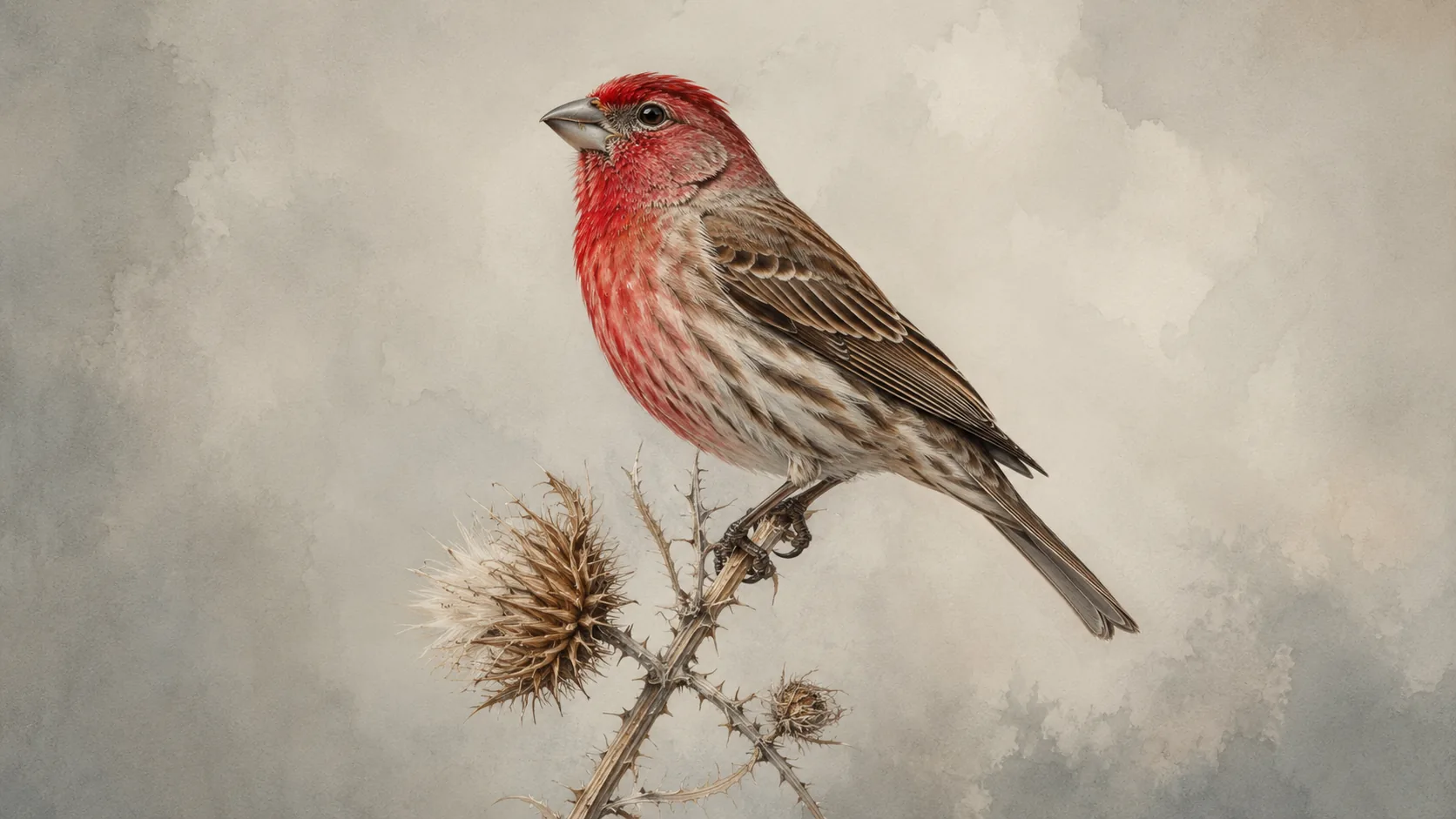
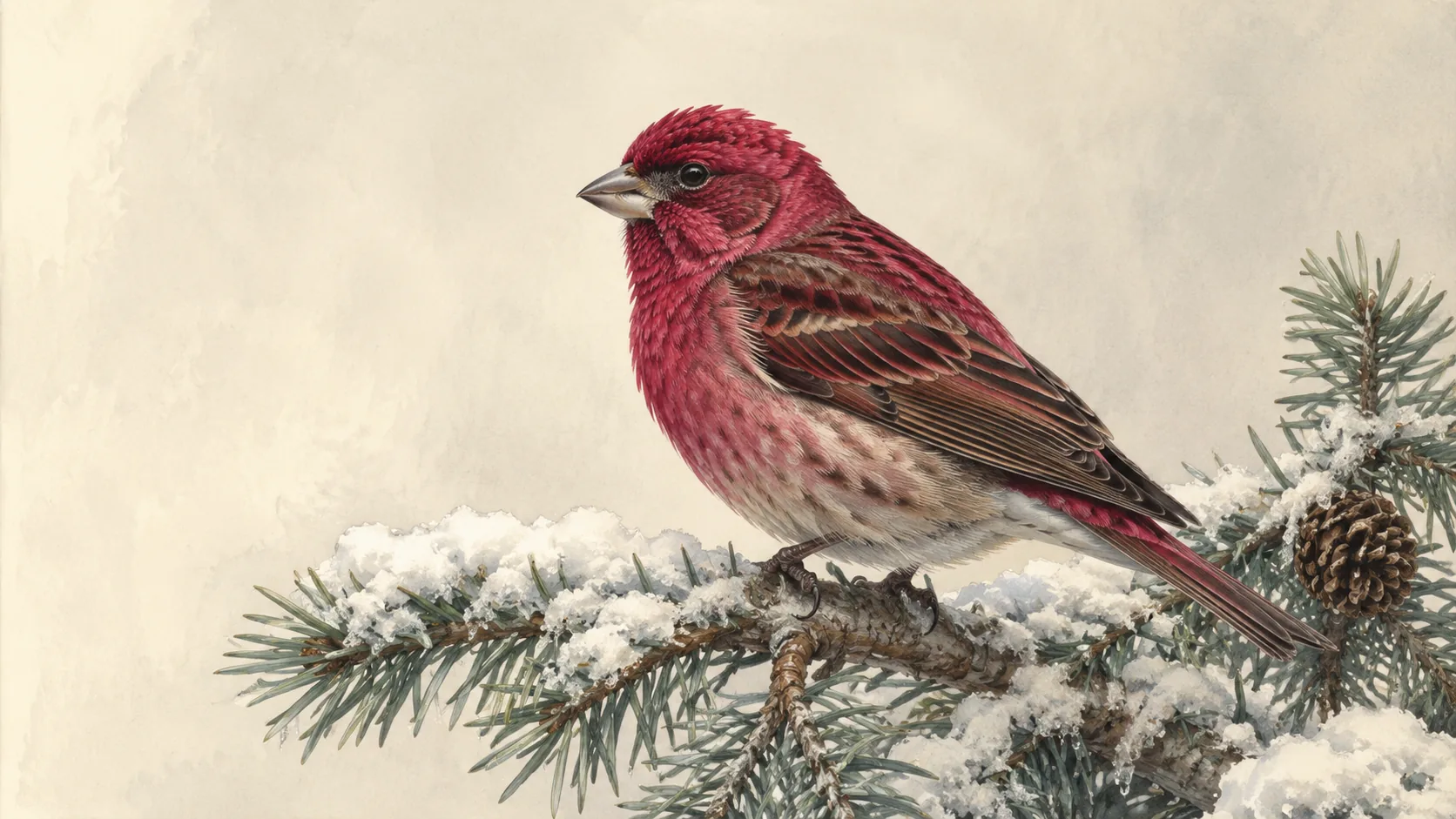
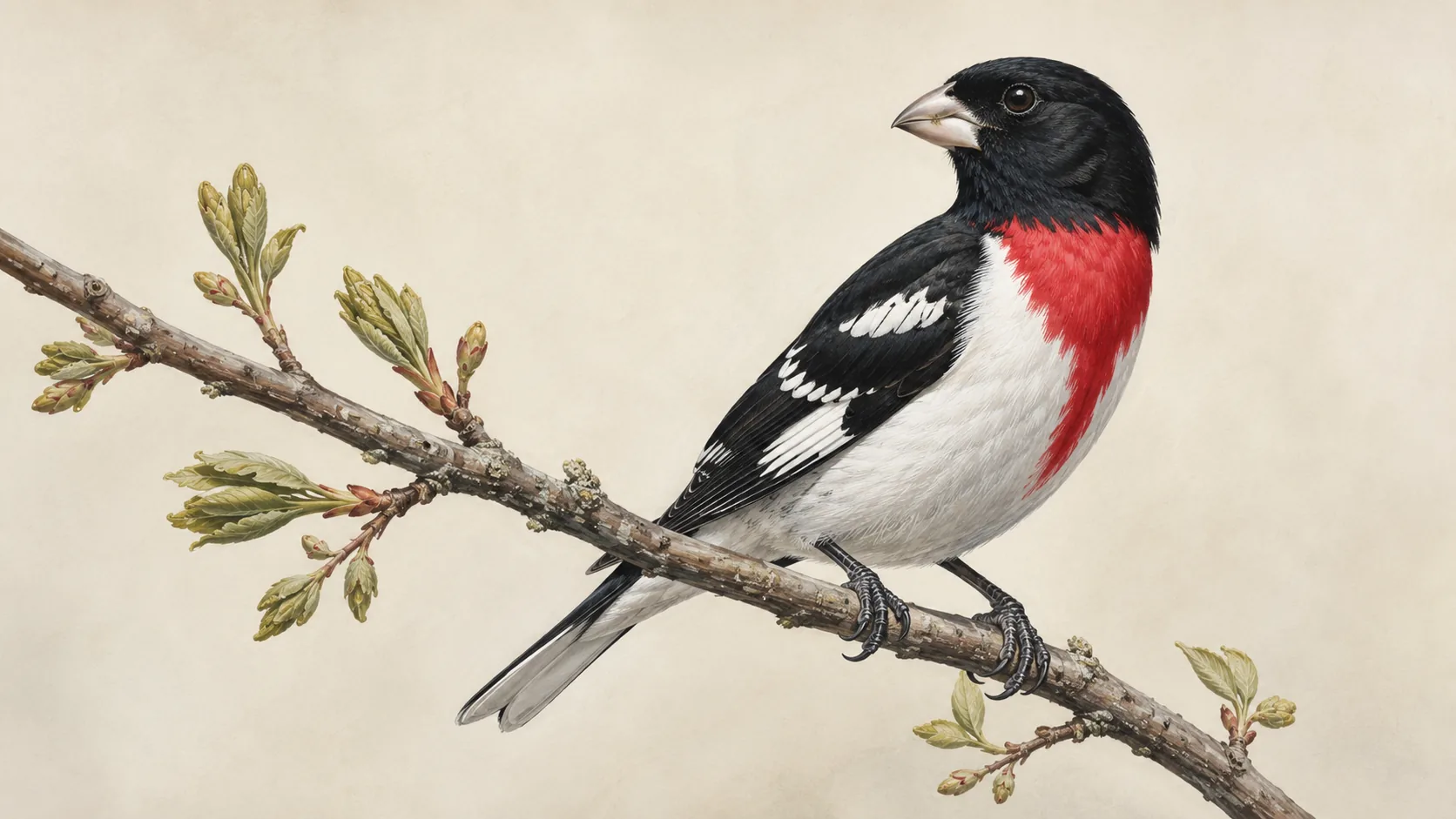
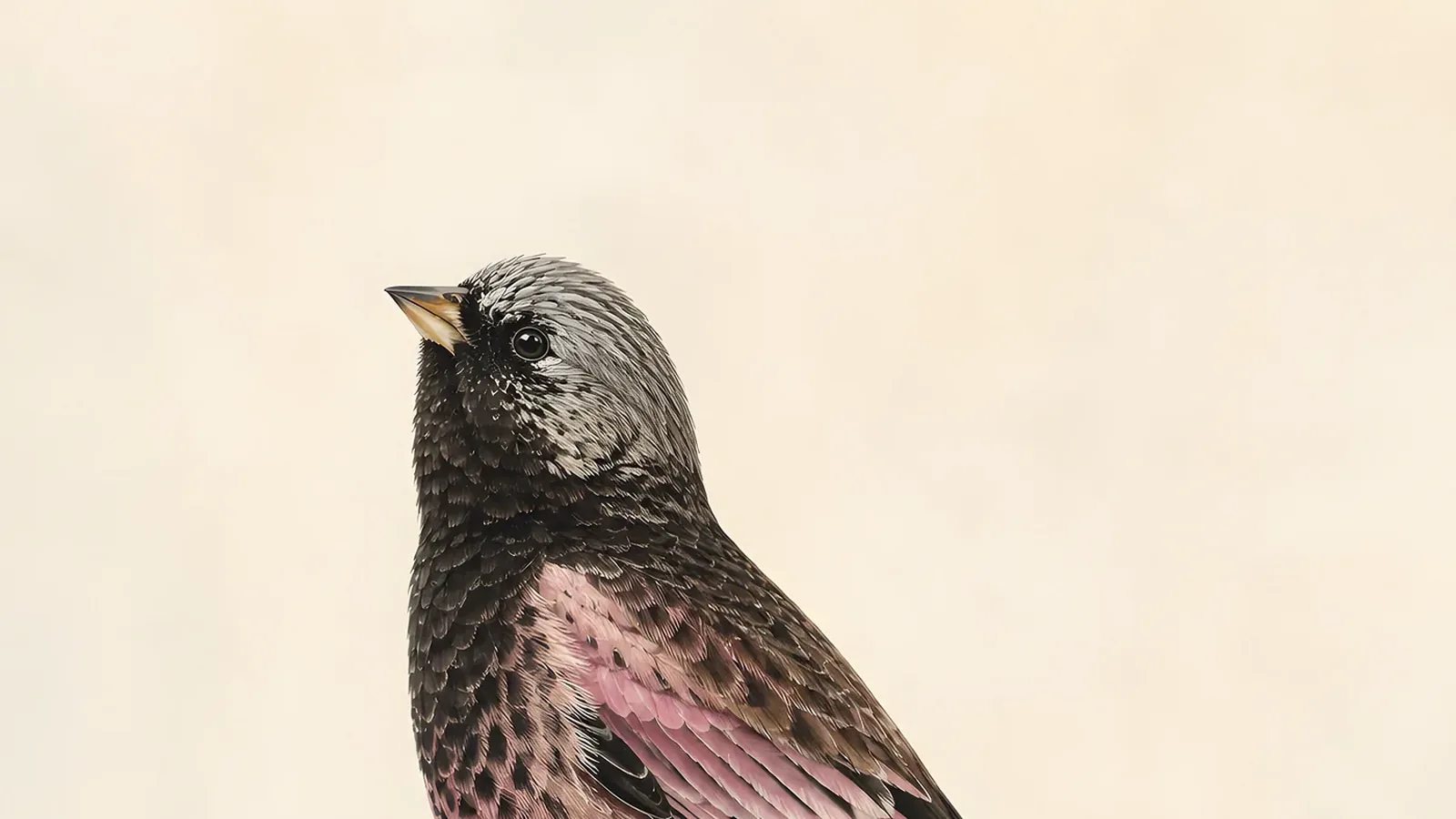
The adult male is brown through the back and breast - a warm cinnamon-brown that becomes darker and almost blackish on the forehead and face. The crown is clean grey, and it is this grey that names the bird. The rump, belly, and wing coverts carry a rose-pink wash: not gaudy, but visible, the colour of old brickwork caught in raking light. In flight, the pink flashes. On the ground, against grey talus, it subdues.
The female follows the same palette at reduced intensity. Her grey crown is narrower, her pink wash paler, her overall impression softer. First-year birds of both sexes are more uniform, with buffy wingbars and little or no pink below.
| Measurement | Range |
|---|---|
| Length | 15-18 cm |
| Weight | 28-40 g |
| Wingspan | 33-36 cm |
| Oldest recorded | 6 years, 7 months (Cornell Lab of Ornithology banding records) |
The subspecies situation repays attention. The Finch Research Network recognises two groupings within the species: the brown-cheeked interior group (which includes the nominate tephrocotis, nesting across the Rocky Mountain chain) and the grey-cheeked coastal group. The coastal form - Leucosticte tephrocotis littoralis, commonly called the Hepburn’s Rosy-Finch after the naturalist who first described it - is the one most likely to confuse a careful observer. In Hepburn’s, the grey of the crown extends well below the eye, wrapping the cheek and auriculars in grey rather than brown, giving the bird a hooded rather than capped appearance. Hepburn’s breeds from coastal Alaska south through British Columbia and winters in the interior west, where it can appear alongside the interior form at the same feeding site.
The Pribilof and Aleutian island subspecies are substantially larger - up to 42-60 grams and 170-210 mm in length - making them feel like a different bird when encountered.
The highest nest
The Audubon Society’s field guide describes Gray-crowned Rosy-Finches nesting on slopes of Denali, and the Finch Research Network characterises them as “likely the highest elevation breeding birds in North America.” Robertson and colleagues (2026, Ecology and Evolution) placed Sierra Nevada breeding populations at 2,750 to 4,000 metres, with one study site in the White Mountains at 4,285 to 4,344 metres - a range few songbirds ever approach.
Nest sites are uniformly severe. The female builds in rock crevices, cliff faces, and steep talus, placing the nest deep enough in the rock that it is shielded from direct weather. She constructs an open cup of grass, moss, and plant stems, lined with hair or feathers. The site must be close to permanent or persistent snow: Robertson et al. (2026) found that abundance was highest near persistent snow patches, which supply foraging habitat, and near cliffs, which supply nesting substrate. Remove either element and the bird disappears.
Clutch size runs from three to six eggs, typically four or five. The female incubates for approximately 14 days. Both parents feed nestlings. Mountain-breeding pairs typically raise one brood each season, though Alaskan island populations sometimes attempt two.
The most unusual anatomical feature of the breeding bird is the gular pouch. Both sexes develop a pair of pouches opening from the floor of the mouth during the breeding season - a structure documented by Audubon’s field guide as unique among North American finches. The pouches allow a parent returning from a foraging run across the snowfield to carry substantially more food than the bill alone would allow, delivering a packed load of seeds and insects to nestlings in a single trip. When you watch an adult work the slush line and then turn upslope toward a cliff, the gular pouch is what makes the distance economical.
What it sounds like
The primary call is a buzzy, descending “chew” - loud enough to carry over wind, with a quality the Finch Research Network describes as ascending briefly before dropping. Flocks in flight give a repeated “cheep cheep” noted by Audubon’s field guide as the characteristic sound of a passing group. There is a “seeer” or “zzeer” variant as well, used in close contact. The song is modest: a few churring notes that blend into the sound of running snowmelt. This is not a bird with elaborate song display. It lives above the treeline, far from the acoustic complexity of forest, and has kept its voice simple.
Diet at the snow’s edge
The snow’s edge is not a barren place. Wind carries insects, seeds, and organic debris upward on the same currents that carry pollen and dust. When those materials hit the cold air above the snowfields, they fall and become trapped. Mann, Edwards, and Gara (Arctic and Alpine Research, 1980) documented the arthropods concentrated on snowfields at Mount Rainier: Collembola, carabid beetles, a staphylinid, and a grylloblattid among them - a surprisingly rich, if frozen, invertebrate community. The Gray-crowned Rosy-Finch has learned to work this resource systematically, hopping along the margin where bare ground meets ice, picking off immobilised insects with quick precise jabs.
Seeds of grasses and weeds make up a large proportion of the diet year-round, and the Audubon field guide notes the species will also consume new buds and leaves when available. Nestlings receive mostly insects. In winter, at lower elevations, seeds dominate again - and the bird adapts readily to feeders.
Range and the winter descent
The breeding range runs from the Aleutian and Pribilof islands of Alaska south through the Coast Ranges, Cascades, and Rockies into California, Nevada, Utah, Wyoming, and Montana. The Finch Research Network describes the species as “most northern of the three rosy-finch species” and notes it occupies the Brooks Range in Alaska, a range extending further north than the other two rosy-finches manage.
In autumn, mountain-breeding birds descend altitudinally. They gather into flocks - sometimes dozens strong, occasionally larger - and move to valley floors, open plains, and towns. The American Bird Conservancy notes these flocks as “surprisingly tame,” a quality that reflects the near-absence of human contact during the breeding season. A bird that has spent the summer above treeline where few people walk has had little reason to learn fear of large bipeds.
Winter flocks often mix rosy-finch species at the same feeding stations, particularly at well-watched sites in New Mexico and Colorado where all three North American rosy-finches can sometimes be seen together. The purple finch, a woodland species wintering at lower elevations, occupies the opposite end of the finch habitat spectrum from this bird.
The National Audubon Society’s 2019 climate assessment found that a two-degree Celsius rise in global temperature would eliminate 48% of the Gray-crowned Rosy-Finch’s suitable habitat. The bird’s dependence on persistent snowfields - which Robertson et al. (2026) confirmed are the primary driver of local abundance - makes it directly vulnerable to the shrinkage of alpine snowpack. The IUCN lists the species as Least Concern, which reflects current population size rather than trajectory.
Breeding
“Abundance was highest near persistent snow patches that provide foraging habitat and near cliffs that provide nesting substrate.” - Robertson et al., Ecology and Evolution, 2026
Breeding is compressed into the short alpine summer. Nest construction begins in late May or June, when the first patches of ground emerge from snow cover. The Audubon field guide describes the nesting season opening on the “first snow-free patches” - a phrase that captures the bird’s precise dependence on the melt schedule of a particular slope, a particular cliff face, a particular year’s snowpack.
The clutch is laid in late June. By late July or August the young have fledged and family groups are already working the snowfields together, the adults showing juveniles the trick of the slush line before the whole assembly descends for winter.
This is a bird that has taken the most demanding possible terms for a life in North America and made them work. The snowfield is not incidental to its existence. The snowfield is the point. Everything about the species - the gular pouch, the early nest, the tolerance for cold, the pink wash that camouflages against iron-stained talus, the tameness born of altitude - has been shaped by the decision, made over evolutionary time, to live where summer lasts six weeks and the nearest food supply is frozen solid.
When the snowfields shrink, so does the bird’s world. That is the idea worth sitting with.