Field Guide
Hepatic Tanager
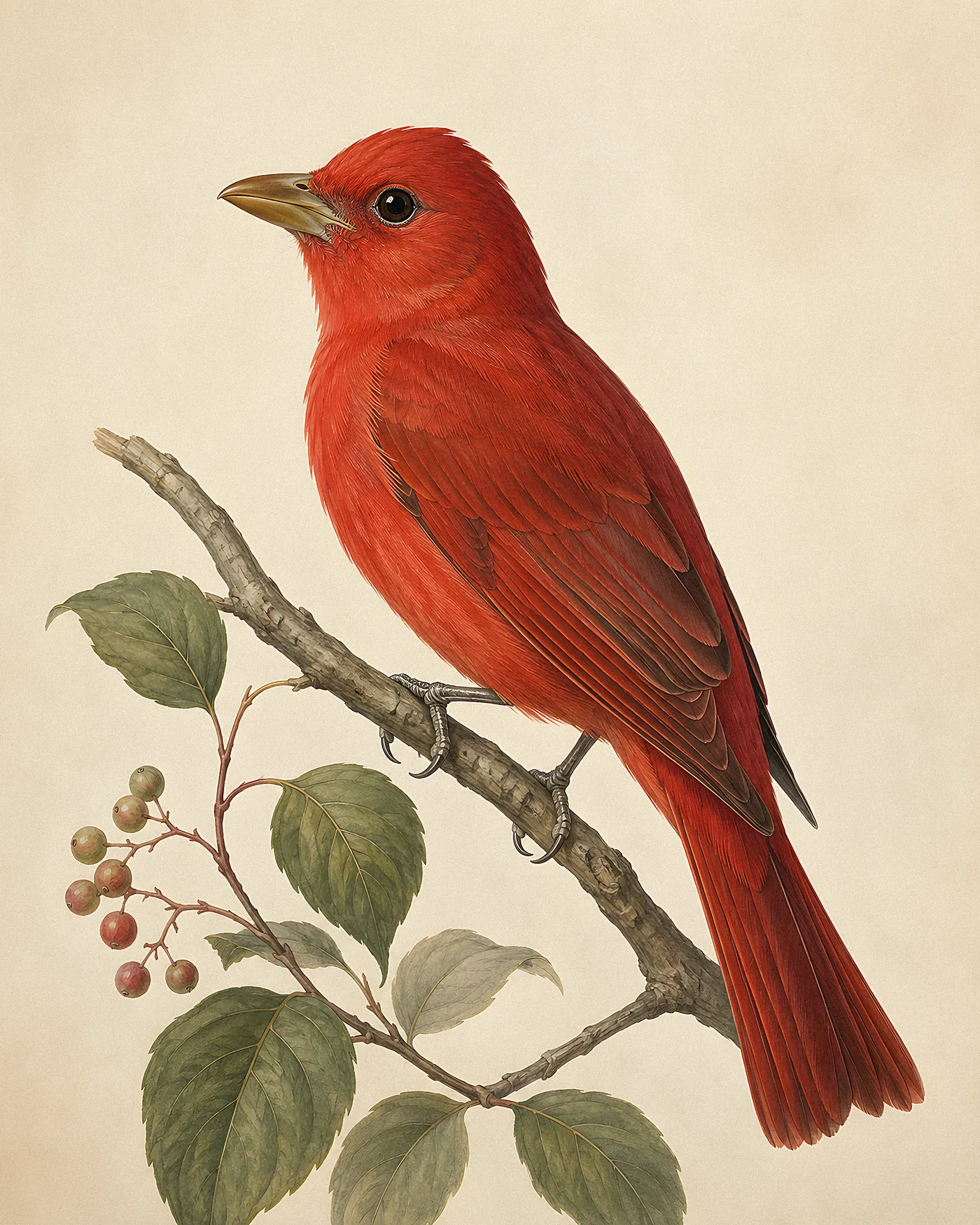
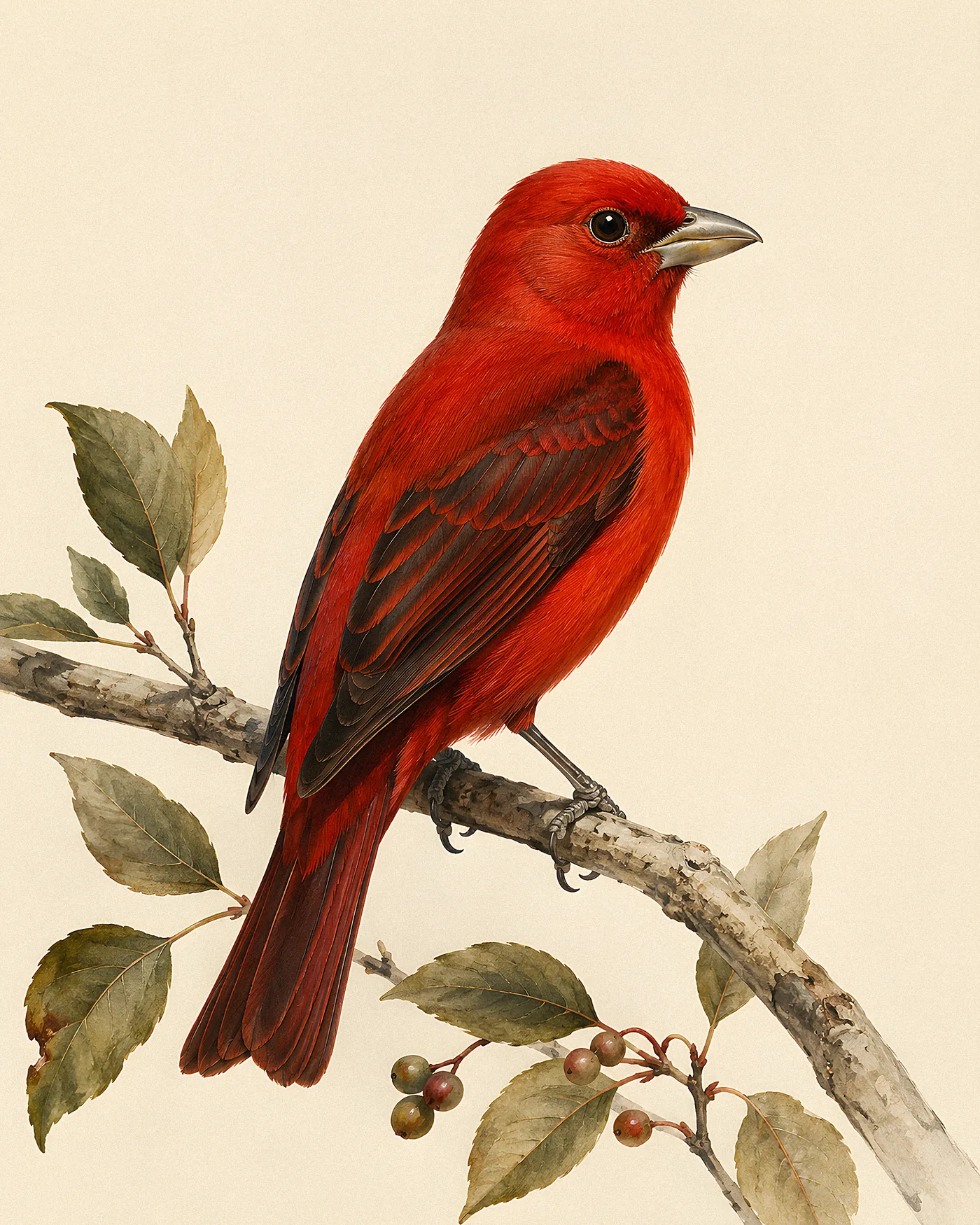
High in a pine-oak forest in the mountains of southeastern Arizona, at six thousand feet where the air is thin and the pines are widely spaced, there is a red bird moving slowly through the canopy. He is not the clean rose-red of a Summer Tanager. His red is darker, dustier, a brick or liver colour, which is exactly what the name records: hepatic means of the liver. Across his cheek runs a smudge of grey, and his bill is dark, not pale. A male Hepatic Tanager is working the pines, and to see him at all you have probably climbed for it.
This is the least-known of the United States tanagers, and the paradox is striking. Piranga flava is the most widely distributed tanager of its group in the entire Western Hemisphere, ranging from the American Southwest all the way to northern Argentina. Yet in the country where most field guides are written, it occupies only a thin strip of high southwestern mountain forest, where Cornell Lab notes it is common but very little studied.
What he looks like
The breeding male is brick-red, a darker and greyer red than either the Summer or the Scarlet Tanager, washed greyish on the back and flanks. The two features that clinch him are the grey ear patch behind the eye and the dark bill. Where the Summer Tanager wears a pale, almost ivory bill, the Hepatic Tanager’s is dusky, and that single mark separates the two even when the light flattens the colour. Cornell Lab puts the species at roughly 16 to 18 centimetres long, weighing 31 to 48 grams, with a wingspan around 27 to 30 centimetres, a solidly built tanager with a heavy bill, longish tail and strong feet.
The female is olive-yellow above and yellow below, greyer on the back than a female Summer Tanager, and she keeps the same diagnostic pair of marks: a dusky ear patch and a dark bill. She is the duller, quieter bird, well suited to a nest set high in a pine. As with the other tanagers, the young male passes through a mottled phase before settling into the adult brick-red.
What it sounds like
The song is a slow, melodious series of short phrases, most of them double or triple-noted, carrying a pause between them. It is often compared to an American Robin’s song but slower and more wistful, more melancholy in its spacing than the hurried delivery of its red cousins. Sung from high in an open pine, it has a deliberate, unhurried quality that fits the bird’s careful movements.
The call is the surest separator from the Summer Tanager. The Hepatic Tanager gives a single dry, low chuck, sometimes likened to the note of a Hermit Thrush, quite different from the Summer Tanager’s rattling pit-ti-tuck. In a southwestern pine wood, the chuck and the dark bill together name the bird.
Range and habitat
Piranga flava is the great traveller of its genus, breeding from the southwestern United States south through Mexico and Central America and on into South America as far as northern Argentina, the most widely distributed of all its relatives. In the United States, Cornell Lab records it in open pine and pine-oak forest at moderately high altitude in the mountains of Arizona, New Mexico and west Texas, favouring a partly open canopy with an open understory rather than dense vegetation.
US and northern birds move to lower elevations or south in winter, while much of the species across Central and South America is resident. Cornell Lab notes that the bird has gradually expanded its range northward since the 1960s. The IUCN lists the Hepatic Tanager as Least Concern, with a population estimated at around 7.6 million across its vast range, a reassuring figure for a bird that, in the United States at least, few birders ever go looking for.
Diet
The Hepatic Tanager forages slowly and deliberately, moving through trees and large shrubs and gleaning prey from leaves, bark and flowers with its heavy bill rather than chasing it through the air. The diet is mostly insects and spiders: Cornell Lab lists caterpillars, moths and butterflies, bees, ants and grasshoppers, along with spiders.
It rounds the menu out with small fruits, taking wild cherry and grape among others, and it will also take small seeds, flowers and nectar. It is not the aerial wasp-hunter the Summer Tanager is; its style is patient and methodical, a slow search through the high pines rather than a sally out into the open air.
Breeding and nesting
The pair is seasonally socially monogamous, holding a nesting territory through the breeding season. The female builds the nest, a shallow open cup woven from grasses and weed stems, set fairly high, frequently 15 to 50 feet up, in the fork of a pine or oak. Both parents feed the young.
Cornell Lab records a clutch of three to five bluish-green eggs marked with brown speckling. Because the bird is so little studied in the United States, finer detail on incubation and the nestling period is thinner than for its better-watched relatives, which is itself part of the Hepatic Tanager’s story: a common bird that has slipped through the gaps in attention precisely because it lives where few people climb.
The common bird nobody watches
The Hepatic Tanager is a lesson in how range and attention pull apart. By distribution it is the most successful tanager of its kind in the Americas, spread across two continents and counted in the millions. By study it is, in the United States, close to a blank: a bird Cornell Lab calls common but very little known, hidden in high mountain pine forest that takes effort to reach.
That gap is the bird’s quiet character. The brick-red male with the grey cheek and the dark bill is not rare and not threatened. He is simply out of the way, singing his slow, robin-like phrases from the top of a widely spaced pine at six thousand feet, dropping his low chuck, going about a life that almost nobody has bothered to write down in detail.
The most widespread tanager of its group in the Americas is, in the United States, one of the least studied birds in the field guide.
So the climb is the point. To meet a Hepatic Tanager you have to go up into the southwestern mountains and into the open pines, and the reward is a bird that is abundant somewhere and scarce in our knowledge, brick-red and unhurried, waiting in plain sight for someone to pay attention.