Field Guide
Common Redpoll
A flock of Common Redpolls drops into a stand of birch in February, dozens of small brown finches working the catkins upside down, twittering without pause, and every one of them carries a spot of crimson on the forehead like a drop of paint. They are creatures of the cold. While most songbirds spend the deep north’s winter somewhere warmer, the redpoll stays, feeds in temperatures that would still a larger bird, and at nightfall does something almost no other finch does: it digs into the snow to sleep.
This is the bird of the irruption years. Some winters the birch and alder crop fails across the boreal forest, and redpolls pour south in waves, suddenly filling feeders across the northern states where they had been absent for years. Then the seed returns, and they vanish north again. You do not so much find the Common Redpoll as wait for it to find you.
What it looks like
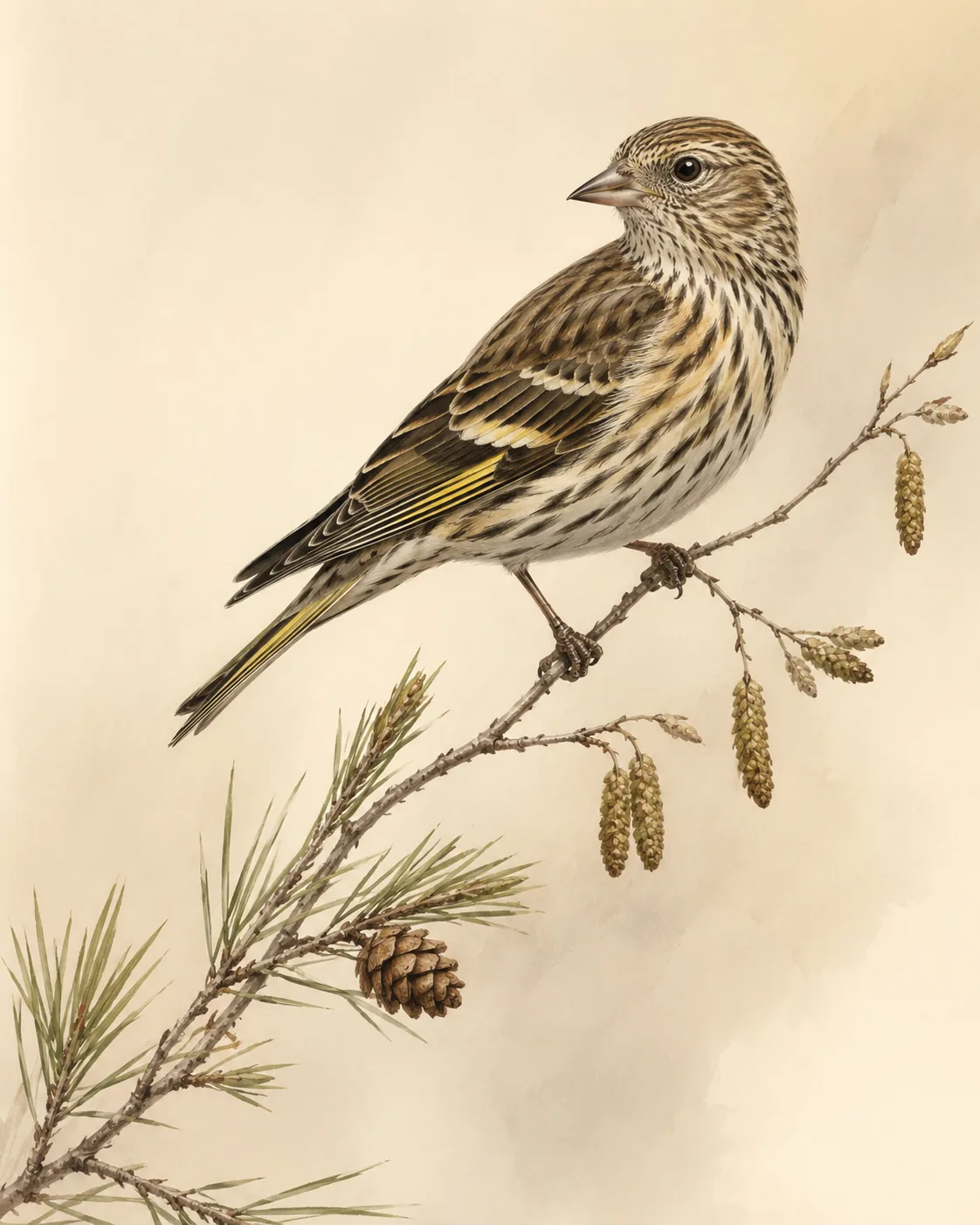
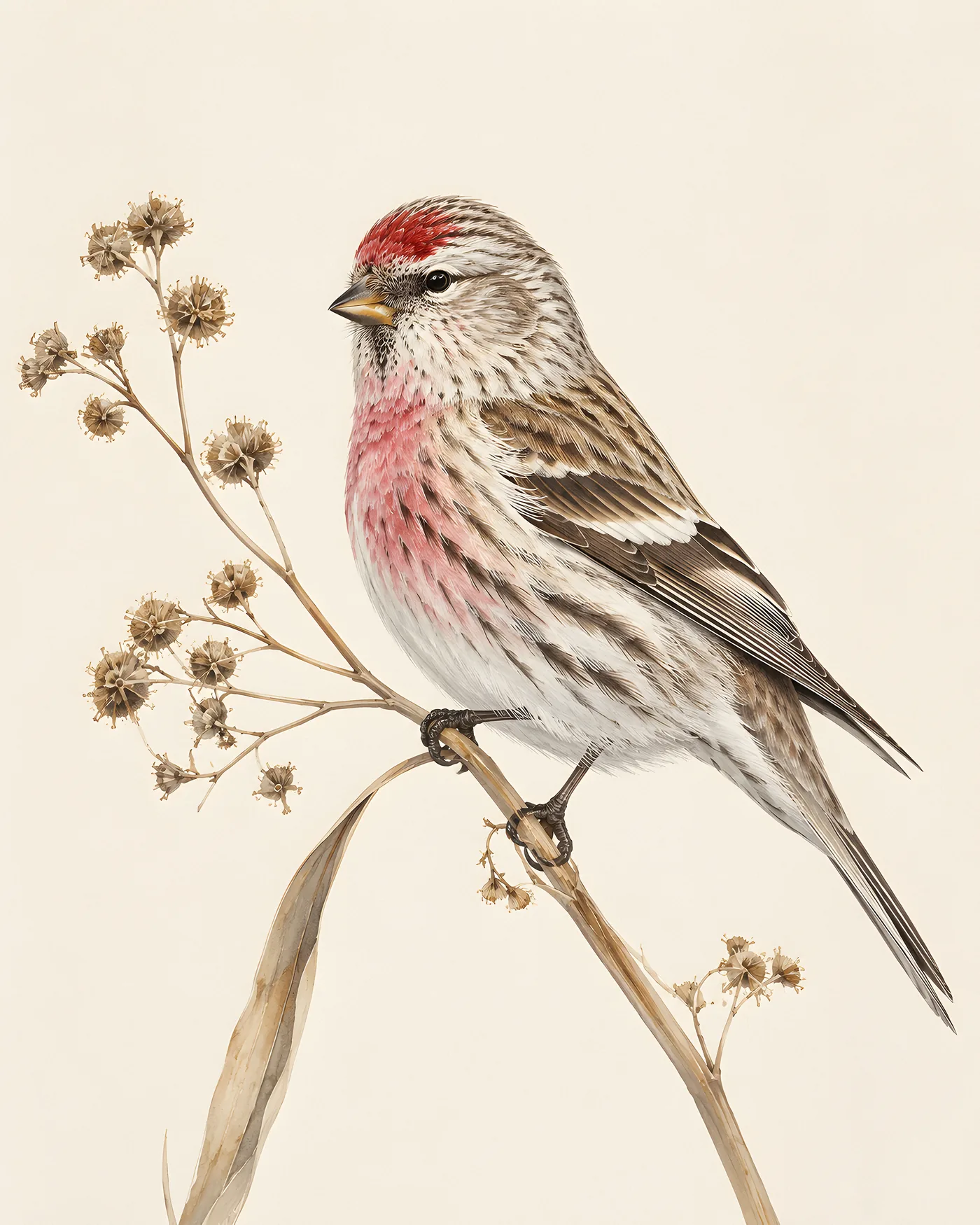
The redpoll is a tiny, streaky finch, smaller than a House Finch, with a stubby yellow bill, a small black chin, two pale wingbars, and the field mark it is named for: a bright red cap, the poll, set squarely on the forehead. The upperparts are brown and heavily streaked, the underparts whitish with streaking along the flanks.
The male carries the colour further. Cornell Lab describes a rosy-pink wash across the breast and rump in adult males, brightest in the breeding season, laid over the same streaked body. The female wears the red cap and black chin but lacks the pink breast, reading as a buffier, browner bird overall. Some individuals, in both sexes, are notably pale and frosty, with whiter, less heavily marked plumage. The sexes are otherwise alike in size, and a winter flock at a feeder is a moving puzzle of caps, streaks and the occasional flush of pink.
What it sounds like
The redpoll is a constant talker. A feeding flock keeps up a running chatter of dry, buzzy chit-chit-chit call notes and rising trills, so a stand of birch full of redpolls hums before you see a single bird. The flight call is a hard, rattling series given as the flock lifts and wheels.
The song, heard mostly as the flocks loosen toward spring, threads those same buzzy notes and trills into a longer, energetic rambling phrase. Cornell Lab notes the song is most active just before the winter flocks break up, a sound tied to the first lengthening days rather than to deep winter.
Range and habitat
Acanthis flammea is a circumpolar bird of the far north, breeding right around the top of the world. Its nesting range runs through the boreal forest and Arctic tundra edge of Alaska, northern Canada, Scandinavia and Siberia, in open birch and alder woodland, scrub, and the dwarf willows at the tree limit. Few songbirds breed so far north.
In winter it stays within the boreal zone where it can, but in irruption years it moves south into the northern United States and southern Canada in unpredictable numbers, drawn to birches, alders and feeders. Cornell Lab ties these movements to the seed crop rather than the calendar: the birds irrupt south when the northern birch and alder seeds fail, then withdraw when the crop recovers. The IUCN lists the Common Redpoll as Least Concern, with the enormous circumpolar range that classification reflects.
Diet
The redpoll lives on very small seeds. Cornell Lab puts birch and alder catkin seeds at the centre of the diet, with the seeds of willow, spruce, grasses and many weeds taken as well, and some insects added in the breeding season. The bird’s whole feeding life is shaped around prising these tiny seeds from catkins, often while hanging upside down at the tip of a swaying twig.
It has one piece of equipment that suits the cold. The Common Redpoll has a throat pouch, an expandable pocket in the oesophagus, in which it can store seeds. On a short, bitter winter day it crams the pouch, then retreats to shelter and digests the hoard slowly, a way of taking on fuel fast while the food and the daylight last.
Breeding and nesting
The redpoll nests late and far north, in the brief Arctic and boreal summer. The female builds the nest, often low in a stunted spruce, willow or birch, and Cornell Lab describes a well-insulated cup: an outer layer of fine twigs, a middle of root fibres, juniper bark and lichen, and a deep inner lining of plant down, feathers, wool and hair, built for warmth in a cold place.
She lays three to seven pale, speckled eggs and incubates them herself for roughly eleven days, fed by the male while she sits. Both adults feed the young, which leave the nest about a week and a half after hatching. The dense, downy lining is not decoration. It is the difference between a clutch that survives an Arctic night and one that does not.
A finch that should not be able to winter in the boreal north survives it by carrying seed in its throat and sleeping inside the snow.
The redpoll is easy to overlook and easy to miss for years at a stretch, a small streaked bird that comes and goes with the seed crop. But it rewards the wait. The next time a chattering flock pours into your birches in a hard winter, look for the red foreheads and the rosy-breasted males among them, and remember where they have just come from, and where, when the cold deepens tonight, they may go to sleep.